
BuddhistCatholicContemplativeEvangelicalGeneral ChristianHinduJewishLatter-day SaintMuslimNew VisionsProgressive Christian
Beliefs
- Buddhist
- Catholic
- Contemplative
- Evangelical
- General Christian
- Hindu
- Jewish
- Latter-day Saint
- More Voices
- Muslim
- New Visions
- Pagan
- Progressive Christian
Topics
- Religion News
- Food and Religion
- Sports and Religion
- Religious Art
- Religious Music and Entertainment
- Religious Events
- History and Religion
- Style and Religion
- Politics and Religion
- Women in Religion
- Recreation Outdoors and Religion
- Business Finance and Religion
- Careers Workplace and Religion
- Education and Religion
- Family Parenting and Religion
- Health Fitness and Religion
- Home and Religion
- Relationships and Religion
- Technology and Religion
- Travel and Religion
Columnists
- Buddhist Columnists
- Business Finance and Religion Columnists
- Careers Workplace and Religion Columnists
- Catholic Columnists
- Contemplative Columnists
- Education and Religion Columnists
- Evangelists Columnists
- Family Parenting and Religion Columnists
- General Christian Columnists
- Health Fitness and Religion Columnists
- Hindu Columnists
- History and Religion Columnists
- Home and Religion Columnists
- Jewish Columnists
- More Voices Columnists
- Latter Day Columnists
- Muslim Columnists
- New Visions Columnists
- Nonreligious Columnists
- Pagan Columnists
- Politics and Religion Columnists
- Progressive Columnists
- Recreation Outdoors and Religion Columnists
- Relationships and Religion Columnists
- Religion News Columnists
- Religious Art Columnists
- Religious Events Columnists
- Religious Music and Entertainment Columnists
- Sports and Religion Columnists
- Style and Religion Columnists
- Technology and Religion Columnists
- Travel and Religion Columnists
- Women in Religion Columnists
Resource Library
- 2026 Calendar
- Library of World Religions
- The 100 Most Holy Places on Earth
- Patheos Answers
- Podcasts
- Videos
- Faith Leaders Database
- Anglican Episcopalian
- Bahai
- Baptist
- Buddhism
- Christianity
- Confucianism
- Eastern Orthodoxy
- Hinduism
- Holiness and Pentecostal
- ISKCON
- Islam
- Judaism
- Lutheran
- Methodist
- The Church of Jesus Christ of Latter-day Saints
- New Age
- Paganism
- Presbytarian and Reformed
- Protestantism
- Religion Behind the Scenes
- Roman Catholic
- Scientology
- Shia Islam
- Sikhism
- Sufism
- Sunni Islam
- Taoism
- Zen
- See all religions
Research Tools
 Ad-Free & Subscriber Log-In Subscription Support
Follow Patheos 

- Trending:
- Advent
- |
- Forgiveness
- |
- Thanksgiving
- |
- Election
- |
- Seasonal Holidays
- |
- Marriage
 Catholic Authenticity
-
Categories
- Home
- Catholic
- Stoics Have More Fun!
Stoics Have More Fun!
Last updated on: October 30, 2015 at 5:30 pm by Melinda Selmys
Stoics Have More Fun! 2015-10-30T17:30:59-04:00 Melinda Selmys
Patheos Explore the world's faith through different perspectives on religion and spirituality! Patheos has the views of the prevalent religions and spiritualities of the world.
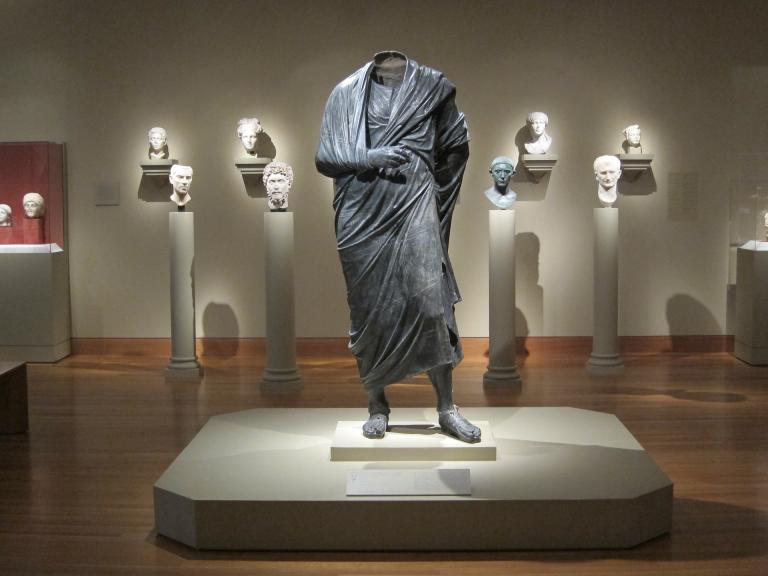
I just did my most fun interview ever. For once someone wanted to know about something other than what it’s like to be Catholic and gay.
– Would you call yourself an ‘ex-Stoic’? What were the best and worst aspects of living a dedicated Stoic life?
I generally use the term “recovering Stoic,” mostly because it amuses me — but also because I’ve always had a fairly deep-seated inclination towards Stoicism, even when I didn’t have a lot of knowledge of Stoic philosophy per se.
Far and away the best aspect of living Stoicism is the detachment. There’s a very real high that comes from being able to just deal with whatever happens, with knowing that you’re basically impervious to the slings and arrows of outrageous fortune, with being able to look down on your emotions from a vantage point of cultivated objectivity and kind of maneuver them around to get the effects that you want. I have a t-shirt that I made which reads “Stoics Have More Fun.” The logic of it being that if you’re a Stoic you can have fun with all kinds of experiences that people usually think of as unpleasant. Being massively stressed out as a Stoic is kind of neat. Giving birth as a Stoic is a serious trip. Because all of your emotions and sensations are externals — they’re not a part of you and they’re basically value-neutral — there’s an incredible kind of freedom that comes with that.
And probably the worst thing about Stoicism is the detachment. The longer that you practice it, the easier it is to just not give a damn. I don’t mean that you behave immorally — being exactingly moral is an important part of the deal. I mean that you’re kind of skimming along over the top of human experience, interacting with it largely in the abstract. It makes it harder to relate to other people because their problems don’t make sense. You can be scrupulously kind and considerate, forgiving, patient, attentive — but real compassion becomes harder and harder because feelings are just problems that you can fix. So when other people are experiencing emotional pain it kind of feels like they’re voluntarily torturing themselves and you want to show them how to stop doing that rather than entering into their suffering and sharing it with them. And then also, you can end up absorbing a lot of damage to yourself because you can just take it, and it doesn’t matter. Until one day it does matter, and you crash.
– Stoicism is criticised as dry, rational and self-centred. But Stoics protest that it’s about managing emotions rather than shunning them, and that their tradition has a lot to say about friendship and one’s connection with the rest of humanity. Does that show that, really, there are lots of Stoicisms?
Well, there’s the pop meaning of stoic, which is basically “unfeeling” — you know, the silent tough-guy who takes it all on the chin. But that doesn’t really have all that much to do with Stoicism as a philosophy. Stoicism isn’t repression, and it’s not being emotionless. It’s a set of very powerful techniques for shaping your interior life by pulling up a lot of the stuff that usually remains in the subconscious into the conscious realm where you can manipulate it using your reason and your will.
Friendship, especially, is really highly valued in Stoicism because it’s the least embodied form of love. It allows you to have close, reliable relationships without having to deal with intense emotional entanglements. Basically, you can have intimacy but it’s fairly low-risk. Stoicism sees friendship as the best form of human love because it’s the least passionate: it’s based on more intellectual values like common interest, mutual accord, a shared pursuit of virtue. It works better for men, of course, because women’s friendships tend to be more emotional – if you’re a woman trying to be a Stoic you basically end up making friends with guys.
As for connection to the rest of humanity, yes, definitely. One of the really beautiful things about Stoicism is the sense that you’re a part of something much larger than yourself. Part of the way in which your problems don’t matter is that they’re recontextualized within a broader human scheme: you’re just a small part of a much larger entity. A social entity, at the lowest level, a cosmic one above that. So care for the community, a sense of obligation and duty, a desire to contribute to human flourishing on a grander scale, those are all definitely a huge part of the Stoic lifestyle. If you took that away you would have a very inhuman and narcissistic philosophy – which is what a lot of people who don’t know much about it imagine Stoicism to be.
– Stoicism was the inspiration for CBT, which is not uncontroversial but seems to get good results, even help people get over serious crises. Is that empirical proof that Stoicism works?
Well of course it works. It’s hugely powerful. And if you look at a lot of early Christian writing, you can see the Church fathers taking the techniques of Stoicism and integrating them into a Christian worldview, in much the same way that a lot of churches today incorporate psychotherapeutic approaches into pastoral care. Cognitive Behavioural Therapy basically takes Stoic technique, divorces it from Stoic philosophy, and then applies it — often with very dramatic results. And really, I think there’s a lot to be gained by having Stoic practice as a part of your interior tool-kit, because there are situations where various Stoic disciplines are definitely both effective and appropriate. Where you get into problems with Stoicism — and I think this is the case with every philosophy — is when it becomes the entire tool-kit. You know, you can think of it as being in the same category as something like Marxist analysis, social constructionism, Aristotelian categories — all of those tools are amazingly effective if you apply them to the right kind of problems, but when you allow any particular philosophical method to become a worldview unto itself that’s when you end up generating problematic nonsense.
– Some Christian thinkers have regarded Stoicism as a kind of delusion; others –Simone Weil, for instance – see it as expressing a deep piety which makes it the closest of all philosophies to Christianity. Who’s right?
It depends on which aspects of Stoicism you’re concentrating on. There’s definitely a very profound piety in traditional Stoicism, and to a large degree Stoicism and Christianity are very sympatico. Both seek to situate the human person within a larger, divinely ordained context. Both promote the cultivation of virtue — and identify a lot of the same behaviours as virtuous or vicious. Both seek to free the person from enslavement to appetites and passions. And there does seem to have been a certain amount of mutual respect between Christians and Stoics, at least for a while. Epictetus, for example, speaks with great admiration for the “Galilean” martyrs, and uses them as an example of how it’s possible to have interior freedom even in the face of death. And of course the notion of apatheia was very important in a lot of the writings of the Church Fathers, especially in the East.
But then, there were significant persecutions of Christians under the Stoic emperor Marcus Aurelius — basically because Stoicism sees the social order in this world as the higher good towards which individual human life is ordered, whereas Christianity looks towards the eschatological transformation of society in the Communion of Saints. Also, God in Stoicism is imminent, whereas God in Christianity is a transcendent Being who becomes immanent through the Incarnation. And Stoicism posits human perfection through moral effort and self-discipline, whereas Christianity promises salvation through grace. So there are these very fundamental differences as well.
Image credit:
Previous Post

October 30, 2015
Identities are Forged by Violence
Next Post

November 7, 2015 Is Being Open to Life Easier if You're Rich?
Browse Our Archives
Select a Category Abuse Beauty Charity Chastity Current Events Faith Family Feminism Fiction Humility Humour Identity Justice Perseverence Philosophy Poverty Sexuality trauma Uncategorized Virtues Wombats
Select a Month February 2020 November 2019 October 2019 August 2019 July 2019 June 2019 May 2019 April 2019 March 2019 February 2019 October 2018 September 2018 August 2018 July 2018 June 2018 May 2018 April 2018 March 2018 February 2018 January 2018 December 2017 November 2017 October 2017 September 2017 August 2017 July 2017 June 2017 May 2017 April 2017 March 2017 February 2017 January 2017 December 2016 November 2016 October 2016 September 2016 August 2016 July 2016 June 2016 May 2016 April 2016 March 2016 February 2016 January 2016 December 2015 November 2015 October 2015 September 2015 August 2015 July 2015 June 2015
Follow Us!
TAKE THE
Religious Wisdom Quiz
Who saw the "writing on the wall"?
Select your answer to see how you score.
Amos Nebuchadnezzar Darius Belshazzar
Books by This Author Books by Melinda Selmys
Support this
Column


Related posts from Catholic Authenticity

The Power of Negative Thinking: On Trauma and...

The Seductive Illusion of Objectivity

Is It A Sin to be Scandalized by...

TRENDING AT PATHEOS Catholic

How Discretion Guides Us Away From Extremes
Prudence is an important virtue for all of us. While we should...

Bad Survey Questions Distort Eucharistic Theology
It seems to be the newest thing: someone conducts a bad survey...

If Baptism Washes Away Sin, Why Do Catholics...
The seven sacraments stand as the foundation of Catholic ecclesial life. The...

The Power of Setting a Good Example
Remember last August when the Chicago White Sox hosted a "Pope Hat...

A Catholic Critique of Biblical Unitarianism
If the statistics are to be believed, Unitarianism is rising worldwide. Although...

How Grandma Tourism Helps Grandparents Live Their Vocation
Grandma, The New Travel Influencer What started as a nostalgia-inspired social media...
view all Catholic blogs
Ad-Free & Subscriber Log-In Subscription Support
- About Us
- 2026 Calendar
- Videos
- Podcasts
- Library of World Religions
- Faith In Media Tracker
- Advertise With Us
- Write for Us
- Privacy Policy
- Terms of Service
- Do Not Sell My Data
- Contact Us
- Radiant Digital
- Manage Newsletter Subscriptions
- Unsubscribe From Notifications
- Sitemap
Copyright 2008-2026, Patheos, part of the Radiant Digital network of media brands. All rights reserved.
Subscription Support Ad-Free & Subscriber Log-In
Follow Patheos