
BuddhistCatholicContemplativeEvangelicalGeneral ChristianHinduJewishLatter-day SaintMuslimNew VisionsProgressive Christian
Beliefs
- Buddhist
- Catholic
- Contemplative
- Evangelical
- General Christian
- Hindu
- Jewish
- Latter-day Saint
- More Voices
- Muslim
- New Visions
- Pagan
- Progressive Christian
Topics
- Religion News
- Food and Religion
- Sports and Religion
- Religious Art
- Religious Music and Entertainment
- Religious Events
- History and Religion
- Style and Religion
- Politics and Religion
- Women in Religion
- Recreation Outdoors and Religion
- Business Finance and Religion
- Careers Workplace and Religion
- Education and Religion
- Family Parenting and Religion
- Health Fitness and Religion
- Home and Religion
- Relationships and Religion
- Technology and Religion
- Travel and Religion
Columnists
- Buddhist Columnists
- Business Finance and Religion Columnists
- Careers Workplace and Religion Columnists
- Catholic Columnists
- Contemplative Columnists
- Education and Religion Columnists
- Evangelists Columnists
- Family Parenting and Religion Columnists
- General Christian Columnists
- Health Fitness and Religion Columnists
- Hindu Columnists
- History and Religion Columnists
- Home and Religion Columnists
- Jewish Columnists
- More Voices Columnists
- Latter Day Columnists
- Muslim Columnists
- New Visions Columnists
- Nonreligious Columnists
- Pagan Columnists
- Politics and Religion Columnists
- Progressive Columnists
- Recreation Outdoors and Religion Columnists
- Relationships and Religion Columnists
- Religion News Columnists
- Religious Art Columnists
- Religious Events Columnists
- Religious Music and Entertainment Columnists
- Sports and Religion Columnists
- Style and Religion Columnists
- Technology and Religion Columnists
- Travel and Religion Columnists
- Women in Religion Columnists
Resource Library
- 2026 Calendar
- Library of World Religions
- The 100 Most Holy Places on Earth
- Patheos Answers
- Podcasts
- Videos
- Faith Leaders Database
- Anglican Episcopalian
- Bahai
- Baptist
- Buddhism
- Christianity
- Confucianism
- Eastern Orthodoxy
- Hinduism
- Holiness and Pentecostal
- ISKCON
- Islam
- Judaism
- Lutheran
- Methodist
- The Church of Jesus Christ of Latter-day Saints
- New Age
- Paganism
- Presbytarian and Reformed
- Protestantism
- Religion Behind the Scenes
- Roman Catholic
- Scientology
- Shia Islam
- Sikhism
- Sufism
- Sunni Islam
- Taoism
- Zen
- See all religions
Research Tools
 Ad-Free & Subscriber Log-In Subscription Support
Ad-Free & Subscriber Log-In Subscription Support
Follow Patheos 

- Trending:
- Forgiveness
- |
- Marriage
- |
- Consciousness
- |
- Death Penalty
- |
- Election
- |
- Halloween
 Catholic Authenticity
-
Categories
- Home
- Catholic
- Oriented Towards Beauty
Oriented Towards Beauty
Last updated on: October 26, 2015 at 3:13 pm by Melinda Selmys
Oriented Towards Beauty 2015-10-26T15:13:12-04:00 Melinda Selmys
Patheos Explore the world's faith through different perspectives on religion and spirituality! Patheos has the views of the prevalent religions and spiritualities of the world.
All right, so I’m tired, brain-dead and my uterus is sucking away all of the oxygen that would normally be diverted to my frontal lobe. As a result, I’ve decided that it’s a good time to talk about truth, orthodoxy, faith and the authority of the Church. As like, probably part of an intricate five to ten part series. Because, ummm… probably I’m deranged?
Or perhaps more importantly because I kind of want to deal with it in a way that’s honest and personal, because that’s how truth is for me. It’s not a series of abstractions, an intellectual construct, a brilliant pile of syllogisms or a set of authoritative texts. I’ve only ever been able to really relate to truth on the level of lived experience, which is probably why I’m so attracted to a religious system in which Truth is conceptualized not as a series of abstract Forms, an impersonal Ideal, or an indifferent Nature, but as a Person.
The ultimate goal here is to set out a kind of road-map for something that might be called Catholic Scepticism, Postmodern Catholicism, or – as my blog is titled – Catholic Authenticity. I just want to note here that by this title I do not mean “Authentic Catholicism.” I do not imagine that my Catholicism sets some kind of benchmark for authentic expression of the faith. Rather, what I’m attempting is to live out a Catholic identity within an existentialist framework of authenticity. Perhaps this is a doomed enterprise, but as my philosophical experiments have gone it’s been by far the most successful.
Alright, so a little bit of background is in order. I want to start by talking about methodology: that is, how do I personally go about the business of trying to discover truth, and why?
To begin with, I believe that all human hearts are fundamentally ordered towards their Divine origin, but I don’t think that this innate orientation always manifests itself in the same way. There’s a theory, which I find basically convincing, that different people respond to different degrees to the three Platonic transcendentals: Truth, Goodness and Beauty. Everyone is ultimately drawn towards all three, but generally most people will have one that is primary and they will approach the other two through it.
So, for some people truth is primary. They just have a deeply felt conviction that truth is really important in and of itself. I’m assuming that these are the folks who get something out of analytic philosophy. To such a person, calling truth into question, or debating the value of reason, is basically nonsensical. Truth is true. What else could it be? For a person who thinks this way, the value of goodness is often vouchsafed through moral philosophy, and beauty is often justified through the study of aesthetics.
For another person, goodness may be the most fundamental value. For this type of person, immediate moral activity forms the basis of their approach to God. Generally, these are practical individuals who don’t have a lot of patience with abstract truth – or, for that matter, a lot of interest in abstract art. For them, truth is understood in terms of concrete goods that they can observe in the lives of those they serve and care for. Beauty is valued insofar as it warms the heart and illuminates the triumph of human goodness.
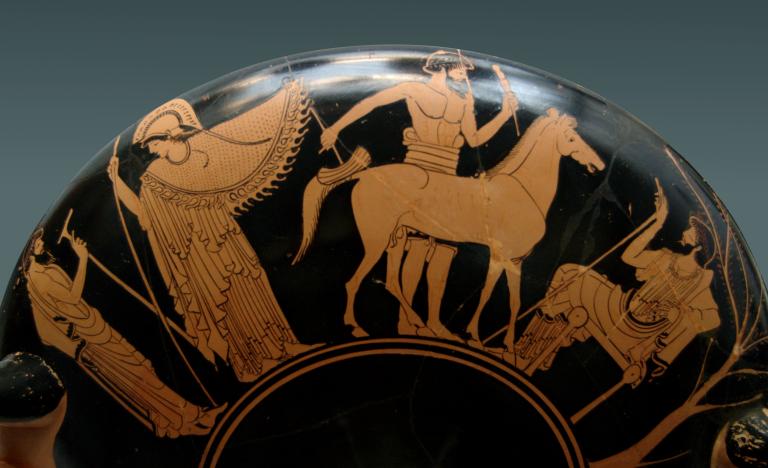
Finally, there are people like me. Why am I interested in philosophy? Simply, because at the tender age of 15 I read Ode to A Grecian Urn. Keats describes this fantastic piece of pottery (probably actually an amalgam of various Greek pots), in which certain timeless values are preserved and elevated – translated out of their mere earthly context through the remarkable alchemy of art. In the final stanza, this urn – which is really a stand-in for art as such – speaks a message to mankind:
“Beauty is Truth, Truth Beauty, that is all ye know on earth and all ye need to know.”
This single line of poetry is, arguably, the basis of my entire belief system. But I don’t believe it because it has been rigorously subjected to rational analysis, nor do I believe it because I have seen all of the good fruit that it bears in the formation of human character. Rather, I believe it because it sent a certain thrill running through my soul, as though a chord had been struck at the foundation of my being and a part of me had been tuned to some deep celestial hymn.
The simple beauty of the statement, and of the poem that couched it, was evidence enough. For me the evidentiary power of beauty is sufficient that I’m not actually capable of doubting its testimony except as a rather silly thought experiment. Keats’ dictum is true? Why? Because it is self-verifying. And I honestly don’t care if that involves circular reasoning – because Beauty comes first. I only accept the validity of reasoning in the first place because reason corresponds to truth and truth to beauty.
To those with naturally analytic temperaments this may sound distressingly backwards. My sole defence is that it seems also to have been the fundamental methodology of the founder of philosophy himself: Socrates, in both the Phaedras and the Symposium, describes a movement from the contemplation of particular beautiful objects to the contemplation of the beauty of principles and truths to the contemplation of ultimate Beauty. This intense, Socrates would even say erotic, desire for the beautiful, forms the basis of philosophical aspiration in the Socratic account. So even if I’m crazy, I’m in good company.
This dedication to beauty as the basis for philosophical questioning produces an approach to philosophy that is deeply incarnational: that is, it is rooted in the experience of the person, rather than in the pure evaluations of the intellect. In my next post, I want to explore the ramifications of this in terms of philosophical method, and in particular to describe my experience of philosophy as an experimental art.
Image Credit: “Athena workshop sculptor Staatliche Antikensammlungen 2650” by Foundry Painter – User:Bibi Saint-Pol, own work, 2007-02-10. Licensed under Public Domain via Commons – https://commons.wikimedia.org/wiki/File:Athena_workshop_sculptor_Staatliche_Antikensammlungen_2650.jpg#/media/File:Athena_workshop_sculptor_Staatliche_Antikensammlungen_2650.jpg
Previous Post

October 26, 2015
World Table: New Commenting System Coming to Catholic Authenticity
Next Post

October 26, 2015 Gender Heresy
Browse Our Archives
Select a Category Abuse Beauty Charity Chastity Current Events Faith Family Feminism Fiction Humility Humour Identity Justice Perseverence Philosophy Poverty Sexuality trauma Uncategorized Virtues Wombats
Select a Month February 2020 November 2019 October 2019 August 2019 July 2019 June 2019 May 2019 April 2019 March 2019 February 2019 October 2018 September 2018 August 2018 July 2018 June 2018 May 2018 April 2018 March 2018 February 2018 January 2018 December 2017 November 2017 October 2017 September 2017 August 2017 July 2017 June 2017 May 2017 April 2017 March 2017 February 2017 January 2017 December 2016 November 2016 October 2016 September 2016 August 2016 July 2016 June 2016 May 2016 April 2016 March 2016 February 2016 January 2016 December 2015 November 2015 October 2015 September 2015 August 2015 July 2015 June 2015
Follow Us!
TAKE THE
Religious Wisdom Quiz
I am twelve men sent to explore the Promised Land, but only two gave a good report. Who are we?
Select your answer to see how you score.
Explorers The twelve spies Leaders of Israel Messengers
Books by This Author Books by Melinda Selmys
Support this
Column


Related posts from Catholic Authenticity

Sex Positive: How I Learned To Stop Worrying...

The Power of Negative Thinking: On Trauma and...

The Seductive Illusion of Objectivity

A Monstrous Monstrance, or Why Does Religion Suck?
TRENDING AT PATHEOS Catholic

Rejecting Doom: Christian Hope And Human Action
Christianity is a religion of hope. We are to have hope and...

It’s What Comes From Within Which Matters
One of the most difficult things for us to understand is why...

Why I Choose the Eucharist Over the Sermon
Choose the Eucharist, Not the Sermon What are we supposed to get...

5 Design Elements Found in Spiritually Rooted Homes
Putting Spirituality Into Home Decor Our homes are more than our living...

Credo: A Story of God Told with the...
About 10 years ago, I began to imagine a personal "Credo" that...

The Anatomy of Divine Revelation in Catholic Thought
The claim that God has made Himself known to human beings is...
view all Catholic blogs
Ad-Free & Subscriber Log-In Subscription Support
- About Us
- 2026 Calendar
- Videos
- Podcasts
- Library of World Religions
- Faith In Media Tracker
- Advertise With Us
- Write for Us
- Privacy Policy
- Terms of Service
- Do Not Sell My Data
- Contact Us
- Radiant Digital
- Manage Newsletter Subscriptions
- Unsubscribe From Notifications
- Sitemap
Copyright 2008-2026, Patheos. All rights reserved.
Subscription Support Ad-Free & Subscriber Log-In
Follow Patheos