
BuddhistCatholicContemplativeEvangelicalGeneral ChristianHinduJewishLatter-day SaintMuslimNew VisionsProgressive Christian
Beliefs
- Buddhist
- Catholic
- Contemplative
- Evangelical
- General Christian
- Hindu
- Jewish
- Latter-day Saint
- More Voices
- Muslim
- New Visions
- Pagan
- Progressive Christian
Topics
- Religion News
- Food and Religion
- Sports and Religion
- Religious Art
- Religious Music and Entertainment
- Religious Events
- History and Religion
- Style and Religion
- Politics and Religion
- Women in Religion
- Recreation Outdoors and Religion
- Business Finance and Religion
- Careers Workplace and Religion
- Education and Religion
- Family Parenting and Religion
- Health Fitness and Religion
- Home and Religion
- Relationships and Religion
- Technology and Religion
- Travel and Religion
Columnists
- Buddhist Columnists
- Business Finance and Religion Columnists
- Careers Workplace and Religion Columnists
- Catholic Columnists
- Contemplative Columnists
- Education and Religion Columnists
- Evangelists Columnists
- Family Parenting and Religion Columnists
- General Christian Columnists
- Health Fitness and Religion Columnists
- Hindu Columnists
- History and Religion Columnists
- Home and Religion Columnists
- Jewish Columnists
- More Voices Columnists
- Latter Day Columnists
- Muslim Columnists
- New Visions Columnists
- Nonreligious Columnists
- Pagan Columnists
- Politics and Religion Columnists
- Progressive Columnists
- Recreation Outdoors and Religion Columnists
- Relationships and Religion Columnists
- Religion News Columnists
- Religious Art Columnists
- Religious Events Columnists
- Religious Music and Entertainment Columnists
- Sports and Religion Columnists
- Style and Religion Columnists
- Technology and Religion Columnists
- Travel and Religion Columnists
- Women in Religion Columnists
Resource Library
- 2026 Calendar
- Library of World Religions
- The 100 Most Holy Places on Earth
- Patheos Answers
- Podcasts
- Videos
- Faith Leaders Database
- Anglican Episcopalian
- Bahai
- Baptist
- Buddhism
- Christianity
- Confucianism
- Eastern Orthodoxy
- Hinduism
- Holiness and Pentecostal
- ISKCON
- Islam
- Judaism
- Lutheran
- Methodist
- The Church of Jesus Christ of Latter-day Saints
- New Age
- Paganism
- Presbytarian and Reformed
- Protestantism
- Religion Behind the Scenes
- Roman Catholic
- Scientology
- Shia Islam
- Sikhism
- Sufism
- Sunni Islam
- Taoism
- Zen
- See all religions
Research Tools
 Ad-Free & Subscriber Log-In Subscription Support
Ad-Free & Subscriber Log-In Subscription Support
Follow Patheos 

- Trending:
- Forgiveness
- |
- Marriage
- |
- Consciousness
- |
- Death Penalty
- |
- Election
- |
- Halloween
 Catholic Authenticity
-
Categories
- Home
- Catholic
- Sex and Simulacrum
Sex and Simulacrum
Last updated on: September 28, 2015 at 4:13 pm by Melinda Selmys
Sex and Simulacrum 2015-09-28T16:13:05-04:00 Melinda Selmys
Patheos Explore the world's faith through different perspectives on religion and spirituality! Patheos has the views of the prevalent religions and spiritualities of the world.
I want to talk about the relationship between gender and “essential” masculinity/femininity, but before I get to that I need to lay a little groundwork in the form of a brief introduction to one of my favourite postmodern thinkers: Jean Baudrillard.
Baudrillard is mostly known as a social critic, and one of his most interesting analyses involves the idea of simulation and simulacrum. The basic concept is that when you represent a thing there’s a kind of declension away from reality that takes place. Baudrillard describes a four step process that goes like this:
1. The thing itself – reality.
2. Representation – the thing is represented in a way that draws attention to its reality.
3. Simulation – the thing is represented in a way that is draws attention away from the reality.
4. Simulacrum – the representation completely replaces the reality, producing a kind of hyperreality that becomes (subjectively) more real than the real.
To give an example, we might consider the process by which myth becomes idolatry. You start out with a mystical experience of God, which becomes represented in a myth. At this point, the myth draws attention towards the reality, and there is a recognition that the myth is incomplete, that it’s representational as opposed to real.
The next step is to represent the myth through ritual action, to simulate the myth. At this point the reality of mystical encounter starts to be obscured, now it is the representation that is being represented. This is also the point at which style starts to become an important consideration – what matters is not that myth be transparent to the divinity, but rather that it create a stylized sense of divine action.
Finally, a perfect simulacrum is achieved when the simulation completely replaces the divine encounter, when the representation becomes a god in its own right. Traditional idolatry, where a representation in stone is literally worshipped as a divine being, is a great illustration of this principle.
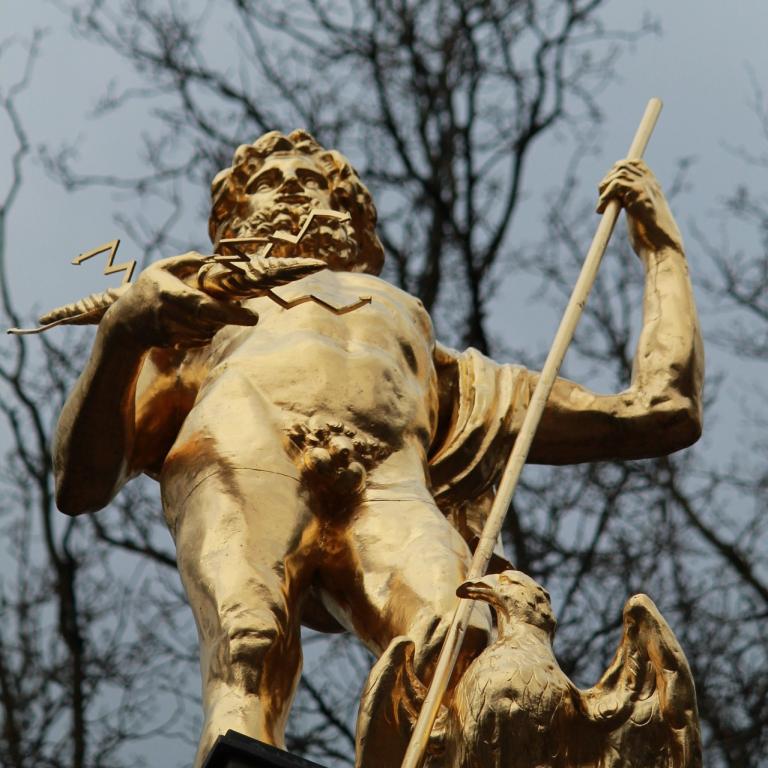
We might at this point consider that in the case of Jove (etymologically, “Jupiter” is derived from the words for god + father), there actually came to be a historic moment when worshippers of God the Father were literally put to death for failing to offer the correct rites before the statue. The simulacrum literally tends towards the annihilation of any acknowledgement of the reality.
So what does this have to do with sex and gender? Well, I’m going to argue that within many areas of contemporary Western society (including, among others, the “Biblical masculinity” and “Biblical femininity” movements), what has occurred is basically a devolution from the reality of sex to a simulacrum of sex. I would chart that movement something like this:
1. Reality: male and female as reproductive and biological categories which are essential for the perpetuation of the human species.
2. Representation: gender, man and woman, expresses sexual difference in the social sphere. At the first stage, gender is a positive thing because it provides artistic ways of expressing sexual difference and illuminates human sexuality with a series of meanings and significations (yin and yang, polarity, complementarity, fecundity, etc.)
3. Simulation: gender roles become increasingly stylized and solidified. They no longer have a direct association with the biological realities of sex but are rather a means of reifying the representations and signifiers associated with gender.
4. Simulacrum: Gender replaces sex as the new reality of human sexuality. Conformity, or non-conformity, with gender roles becomes significant in and of itself without any reference to sexual biology. Among hard traditionalists, this manifests in an insistence on socially constructed gender roles, as though the roles themselves really are essential masculinity and femininity. Among queer theorists, it manifests in a celebration of gender divorced from any consideration of sex. Among gender theorists, it results in a complete rejection of sexual difference under the belief that sex can be collapsed into gender – and that gender ought to be abolished.
Note that a number of apparently contradictory ideologies vie against one another within the systematic logic of the simulacrum. This is important. In order for the simulacrum to maintain itself, it’s necessary that it manifest as a system of multiplicity and complexity. Disagreement, conflict and critique must be able to take place within the system without compromising its fundamental assertion of its own reality.
Indeed, the hyperreal discourse has to be more complicated than the relatively simple reality that it replaces because it must sustain itself solely through a system of significations – since the signs no longer point to anything in reality, it’s necessary to produce a continual string of significations and counter-significations to conceal the fundamental lack of real referents within the system. The discussion must reduce towards absurdity, because its bases are absolutely undiscoverable.
Does this mean that we should abolish gender entirely? No. Every demands that I’ve ever seen for the abolition of gender comes either out of radical feminist gender theory (a system in which gender is constructed as the overarching bogey-man of “patriarchy”), or out of a hard sexual essentialist system that seeks to essentialize traditional gender roles. Clearly neither of these approaches is actually able to break out of the system that is being critiqued.
A simulacrum cannot be simply dismantled by an abrupt return to reality, because we are incapable of accessing reality itself. Our engagement with the real demands representation (for the sceptical Catholic reader, Aquinas’ formulation of this principle involves a discussion of the relationship between material things, the senses, the phantasms and the intellect. “The Philosopher says (De Anima iii, 4) that “things are intelligible in proportion as they are separate from matter.” Therefore material things must needs be understood according as they are abstracted from matter and from material images, namely, phantasms.” (Summa, 1st part, Q 85, A 1) Phantasms, in Aquinas, are basically mental representations derived from sense-data.)
Rather, the problem of gender can only be adequately addressed by returning to an acknowledgement that the practices associated with gender are in fact cultural practices, that they are a mode of representation and not the thing in itself. This involves a willingness to approach sex, maleness and femaleness, as a mystery, as something which can be preserved in its reality only if we accept that that reality must always ultimately transcend our representations, expectations, roles and ideals.
Image credit: pixabay
Previous Post

September 25, 2015
Is the Pope Catholic?
Next Post

October 3, 2015 True Love & Lying Books
Browse Our Archives
Select a Category Abuse Beauty Charity Chastity Current Events Faith Family Feminism Fiction Humility Humour Identity Justice Perseverence Philosophy Poverty Sexuality trauma Uncategorized Virtues Wombats
Select a Month February 2020 November 2019 October 2019 August 2019 July 2019 June 2019 May 2019 April 2019 March 2019 February 2019 October 2018 September 2018 August 2018 July 2018 June 2018 May 2018 April 2018 March 2018 February 2018 January 2018 December 2017 November 2017 October 2017 September 2017 August 2017 July 2017 June 2017 May 2017 April 2017 March 2017 February 2017 January 2017 December 2016 November 2016 October 2016 September 2016 August 2016 July 2016 June 2016 May 2016 April 2016 March 2016 February 2016 January 2016 December 2015 November 2015 October 2015 September 2015 August 2015 July 2015 June 2015
Follow Us!
TAKE THE
Religious Wisdom Quiz
Who was Samuel's mother, who prayed for a child at Shiloh?
Select your answer to see how you score.
Hannah Leah Peninnah Rebekah
Books by This Author Books by Melinda Selmys
Support this
Column


Related posts from Catholic Authenticity

Sex Positive: How I Learned To Stop Worrying...


A Biblical Account of Toxic Femininity

TRENDING AT PATHEOS Catholic

Rejecting Doom: Christian Hope And Human Action
Christianity is a religion of hope. We are to have hope and...

It’s What Comes From Within Which Matters
One of the most difficult things for us to understand is why...

Why I Choose the Eucharist Over the Sermon
Choose the Eucharist, Not the Sermon What are we supposed to get...

5 Design Elements Found in Spiritually Rooted Homes
Putting Spirituality Into Home Decor Our homes are more than our living...

Credo: A Story of God Told with the...
About 10 years ago, I began to imagine a personal "Credo" that...

The Anatomy of Divine Revelation in Catholic Thought
The claim that God has made Himself known to human beings is...
view all Catholic blogs
Ad-Free & Subscriber Log-In Subscription Support
- About Us
- 2026 Calendar
- Videos
- Podcasts
- Library of World Religions
- Faith In Media Tracker
- Advertise With Us
- Write for Us
- Privacy Policy
- Terms of Service
- Do Not Sell My Data
- Contact Us
- Radiant Digital
- Manage Newsletter Subscriptions
- Unsubscribe From Notifications
- Sitemap
Copyright 2008-2026, Patheos. All rights reserved.
Subscription Support Ad-Free & Subscriber Log-In
Follow Patheos