
BuddhistCatholicContemplativeEvangelicalGeneral ChristianHinduJewishLatter-day SaintMuslimNew VisionsProgressive Christian
Beliefs
- Buddhist
- Catholic
- Contemplative
- Evangelical
- General Christian
- Hindu
- Jewish
- Latter-day Saint
- More Voices
- Muslim
- New Visions
- Pagan
- Progressive Christian
Topics
- Religion News
- Food and Religion
- Sports and Religion
- Religious Art
- Religious Music and Entertainment
- Religious Events
- History and Religion
- Style and Religion
- Politics and Religion
- Women in Religion
- Recreation Outdoors and Religion
- Business Finance and Religion
- Careers Workplace and Religion
- Education and Religion
- Family Parenting and Religion
- Health Fitness and Religion
- Home and Religion
- Relationships and Religion
- Technology and Religion
- Travel and Religion
Columnists
- Buddhist Columnists
- Business Finance and Religion Columnists
- Careers Workplace and Religion Columnists
- Catholic Columnists
- Contemplative Columnists
- Education and Religion Columnists
- Evangelists Columnists
- Family Parenting and Religion Columnists
- General Christian Columnists
- Health Fitness and Religion Columnists
- Hindu Columnists
- History and Religion Columnists
- Home and Religion Columnists
- Jewish Columnists
- More Voices Columnists
- Latter Day Columnists
- Muslim Columnists
- New Visions Columnists
- Nonreligious Columnists
- Pagan Columnists
- Politics and Religion Columnists
- Progressive Columnists
- Recreation Outdoors and Religion Columnists
- Relationships and Religion Columnists
- Religion News Columnists
- Religious Art Columnists
- Religious Events Columnists
- Religious Music and Entertainment Columnists
- Sports and Religion Columnists
- Style and Religion Columnists
- Technology and Religion Columnists
- Travel and Religion Columnists
- Women in Religion Columnists
Resource Library
- 2026 Calendar
- Library of World Religions
- The 100 Most Holy Places on Earth
- Patheos Answers
- Podcasts
- Videos
- Faith Leaders Database
- Anglican Episcopalian
- Bahai
- Baptist
- Buddhism
- Christianity
- Confucianism
- Eastern Orthodoxy
- Hinduism
- Holiness and Pentecostal
- ISKCON
- Islam
- Judaism
- Lutheran
- Methodist
- The Church of Jesus Christ of Latter-day Saints
- New Age
- Paganism
- Presbytarian and Reformed
- Protestantism
- Religion Behind the Scenes
- Roman Catholic
- Scientology
- Shia Islam
- Sikhism
- Sufism
- Sunni Islam
- Taoism
- Zen
- See all religions
Research Tools
 Ad-Free & Subscriber Log-In Subscription Support
Ad-Free & Subscriber Log-In Subscription Support
Follow Patheos 

- Trending:
- Forgiveness
- |
- Marriage
- |
- Consciousness
- |
- Death Penalty
- |
- Election
- |
- Halloween
 Catholic Authenticity
-
Categories
- Home
- Catholic
- Getting from Theism to Catholicsm (Part II)
Getting from Theism to Catholicsm (Part II)
Last updated on: September 18, 2015 at 2:33 pm by Melinda Selmys
Getting from Theism to Catholicsm (Part II) 2015-09-18T14:33:52-04:00 Melinda Selmys
Patheos Explore the world's faith through different perspectives on religion and spirituality! Patheos has the views of the prevalent religions and spiritualities of the world.
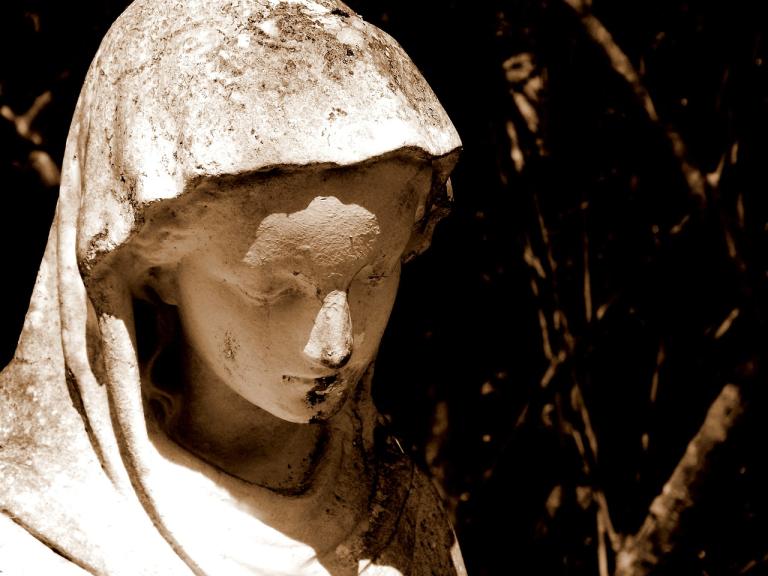
Several months before I decided to take God seriously I was in an argument with a Christian who suggested that there was no point in combing the Old Testament for contradictions in order to prove that Christianity was foolish: the Old Testament was full of apparent contradictions because it could only truly be understood or interpreted in the light of the New Testament. So naturally I set out to find the contradictions in the New Testament.
I made it about halfway through the book of Matthew before I started to feel a little sick with myself. There was a kind of integrity about the figure of Jesus that made me feel like a cad, even an intellectual fraud, for approaching the texts about Him with the kind of disdainful remove that my experiment demanded. Besides, I’d been raised as a good Anglican. I knew what was coming. The idea of reading the Gethsemane sequence with the same kind of superciliousness I used when combing Leviticus turned my stomach.
The actual effect of reading the gospels was to remind me that Christ Himself is an incredibly compelling figure. The image of Him kneeling on the Mount of Olives, sweating blood while the friends that He was about to die for slept in the bushes nearby was one that struck me with particular depth, but I was also able to recognize the radical profundity of the teaching. He did not sound like a bible-thumping preacher or a Sunday school teacher or a platitudinous guru. He spoke with the same kind of heart-stopping conviction as Socrates, and He too put His body on the line: only instead of enjoying a nice cup of hemlock tea among friends, Jesus was tortured to death in front of His mother.
This was not a man who could be trivialized.
I was, however, firmly convinced that He was only a man, so I set out to write a novel about Him in which I would strip away all of the unnecessary legendizing that had been done by His followers after the fact. I would reveal the human Jesus. No dubious miracle stories or religious moralizing: just the man.
This project was, of course, abandoned. I read Bulgakov’s The Master and Margerita and realized that my idea already been done about a hundred thousand times better than I could hope to do it. In a text that mercilessly satirized the kind of demythologization that I had intended to undertake.
So I was left with the mystery of Christ. I couldn’t cut Him down to size without doing violence to the figure that the gospels presented, and I was increasingly unsatisfied with arguments that tried to dismiss the accounts of Him as the religious delusions of an ignorant rabble. The depth of Christ’s philosophy deserved a more honest interpretation.
When I actually decided to test the God hypothesis through prayer I did not, however, approach Christ. I loved Him as a literary and historical figure. I was kind of scared of Him as a God. His gaze was a little too incisive, and I wasn’t ready to have it scrutinizing my soul.
I suppose that God realized this, because when I began to pray I was not greeted by images of Jesus, His arms outstretched in suffering love for humankind. My first point of contact with the otherworld came in the form of a very feminine presence, a mother archetype whose love fell on my soul soft as moonlight, powerful as thunder. I was briefly pleased. I had found the Goddess that I had been hoping for. The only problem was that this lovely, winsome ideal of feminine grace and strength soon started to suggest that I needed to look beyond her, to her son.
This kind of startled me. I had never thought all that much about Mary. She always seemed like a mostly marginal character in the gospels. She had a few good lines in Luke, but other than that she was usually on the sidelines. My feminist background had taught me to see her as the epitome of feminine weakness: submissive, simpering and self-effacing. The personality that I encountered in prayer was none of these things. “Fair as the moon, bright as the sun, terrible as an army set in battle array” would be a more apt description.
So I went out, even before I thought I was seriously considering Catholicism, and I learned the “Hail Mary.” It was a beautiful prayer, nothing like anything that I had encountered before in the Christian tradition. Here, woman was described as “blessed” “full of grace” “Holy” “Mother of God.” There was a valorization of woman here that differed radically from the stereotype I had built up in my head of a misogynistic faith.
It was these two personalities then: Christ, as I discovered Him in the written tradition of the Christian faith, and Mary, as I discovered her in prayer, that ultimately led me to the doors of the Church. I’d encountered a lot of beautiful ideas, rituals, traditions, and myths in the other religions, but I hadn’t encountered any personalities that resonated with my soul the way that Jesus and His Mother did. I think probably the central fact of my conversion was a realization that I wasn’t looking for a new abstract philosophy to replace my atheistic rationalism: I was looking for a different kind of Truth. A Truth capable of reciprocating the love and devotion that I felt when I approached the Good, the Beautiful and the True.
From there, Catholicism was kind of a fait accomplis. No other religions had Christ, and no other denominations had Mary. I loved both. Everything else seemed secondary. That image: the God who had become man, taking on the weakness of a child or of a corpse, clasped in the arms of the woman who had become the Mother of God – that to me expressed perfectly the relationship of profound communion and reciprocity that I experienced in prayer. A relationship, not of domination, but of divinization in which I was not merely called to submit and serve, but to become obedient through an intimate encounter of spirit and flesh.
Photo credit: Pixabay
Previous Post

July 2, 2015
What is Art? (or What Pontius Pilate Asked John Keats)
Next Post

July 3, 2015 NFP Wurkt Fur Mee!
Browse Our Archives
Select a Category Abuse Beauty Charity Chastity Current Events Faith Family Feminism Fiction Humility Humour Identity Justice Perseverence Philosophy Poverty Sexuality trauma Uncategorized Virtues Wombats
Select a Month February 2020 November 2019 October 2019 August 2019 July 2019 June 2019 May 2019 April 2019 March 2019 February 2019 October 2018 September 2018 August 2018 July 2018 June 2018 May 2018 April 2018 March 2018 February 2018 January 2018 December 2017 November 2017 October 2017 September 2017 August 2017 July 2017 June 2017 May 2017 April 2017 March 2017 February 2017 January 2017 December 2016 November 2016 October 2016 September 2016 August 2016 July 2016 June 2016 May 2016 April 2016 March 2016 February 2016 January 2016 December 2015 November 2015 October 2015 September 2015 August 2015 July 2015 June 2015
Follow Us!
TAKE THE
Religious Wisdom Quiz
Which mountain did Jesus ascend from at His ascension?
Select your answer to see how you score.
Mount Zion Mount of Olives Mount Sinai Mount Carmel
Books by This Author Books by Melinda Selmys
Support this
Column


Related posts from Catholic Authenticity

The Lord Has Worked Marvels For Me: Open...

The Central Spiritual Struggle of Women: Open Letter,...

An Open Letter to the Young Rad-Trad Women

Maybe It's Okay That Man Should Be Alone
TRENDING AT PATHEOS Catholic

Rejecting Doom: Christian Hope And Human Action
Christianity is a religion of hope. We are to have hope and...

It’s What Comes From Within Which Matters
One of the most difficult things for us to understand is why...

Why I Choose the Eucharist Over the Sermon
Choose the Eucharist, Not the Sermon What are we supposed to get...

5 Design Elements Found in Spiritually Rooted Homes
Putting Spirituality Into Home Decor Our homes are more than our living...

Credo: A Story of God Told with the...
About 10 years ago, I began to imagine a personal "Credo" that...

The Anatomy of Divine Revelation in Catholic Thought
The claim that God has made Himself known to human beings is...
view all Catholic blogs
Ad-Free & Subscriber Log-In Subscription Support
- About Us
- 2026 Calendar
- Videos
- Podcasts
- Library of World Religions
- Faith In Media Tracker
- Advertise With Us
- Write for Us
- Privacy Policy
- Terms of Service
- Do Not Sell My Data
- Contact Us
- Radiant Digital
- Manage Newsletter Subscriptions
- Unsubscribe From Notifications
- Sitemap
Copyright 2008-2026, Patheos. All rights reserved.
Subscription Support Ad-Free & Subscriber Log-In
Follow Patheos