
BuddhistCatholicContemplativeEvangelicalGeneral ChristianHinduJewishLatter-day SaintMuslimNew VisionsProgressive Christian
Beliefs
- Buddhist
- Catholic
- Contemplative
- Evangelical
- General Christian
- Hindu
- Jewish
- Latter-day Saint
- More Voices
- Muslim
- New Visions
- Pagan
- Progressive Christian
Topics
- Religion News
- Food and Religion
- Sports and Religion
- Religious Art
- Religious Music and Entertainment
- Religious Events
- History and Religion
- Style and Religion
- Politics and Religion
- Women in Religion
- Recreation Outdoors and Religion
- Business Finance and Religion
- Careers Workplace and Religion
- Education and Religion
- Family Parenting and Religion
- Health Fitness and Religion
- Home and Religion
- Relationships and Religion
- Technology and Religion
- Travel and Religion
Columnists
- Buddhist Columnists
- Business Finance and Religion Columnists
- Careers Workplace and Religion Columnists
- Catholic Columnists
- Contemplative Columnists
- Education and Religion Columnists
- Evangelists Columnists
- Family Parenting and Religion Columnists
- General Christian Columnists
- Health Fitness and Religion Columnists
- Hindu Columnists
- History and Religion Columnists
- Home and Religion Columnists
- Jewish Columnists
- More Voices Columnists
- Latter Day Columnists
- Muslim Columnists
- New Visions Columnists
- Nonreligious Columnists
- Pagan Columnists
- Politics and Religion Columnists
- Progressive Columnists
- Recreation Outdoors and Religion Columnists
- Relationships and Religion Columnists
- Religion News Columnists
- Religious Art Columnists
- Religious Events Columnists
- Religious Music and Entertainment Columnists
- Sports and Religion Columnists
- Style and Religion Columnists
- Technology and Religion Columnists
- Travel and Religion Columnists
- Women in Religion Columnists
Resource Library
- 2026 Calendar
- Library of World Religions
- The 100 Most Holy Places on Earth
- Patheos Answers
- Podcasts
- Videos
- Faith Leaders Database
- Anglican Episcopalian
- Bahai
- Baptist
- Buddhism
- Christianity
- Confucianism
- Eastern Orthodoxy
- Hinduism
- Holiness and Pentecostal
- ISKCON
- Islam
- Judaism
- Lutheran
- Methodist
- The Church of Jesus Christ of Latter-day Saints
- New Age
- Paganism
- Presbytarian and Reformed
- Protestantism
- Religion Behind the Scenes
- Roman Catholic
- Scientology
- Shia Islam
- Sikhism
- Sufism
- Sunni Islam
- Taoism
- Zen
- See all religions
Research Tools
 Ad-Free & Subscriber Log-In Subscription Support
Ad-Free & Subscriber Log-In Subscription Support
Follow Patheos 

- Trending:
- Forgiveness
- |
- Marriage
- |
- Consciousness
- |
- Death Penalty
- |
- Election
- |
- Halloween
 Caryn Riswold
- Home
- Progressive Christian
- Getting Theological: The Bible
Getting Theological: The Bible
Last updated on: October 4, 2012 at 6:00 am by Caryn Riswold
Getting Theological: The Bible 2012-10-02T12:45:34-06:00 Caryn Riswold
Patheos Explore the world's faith through different perspectives on religion and spirituality! Patheos has the views of the prevalent religions and spiritualities of the world.
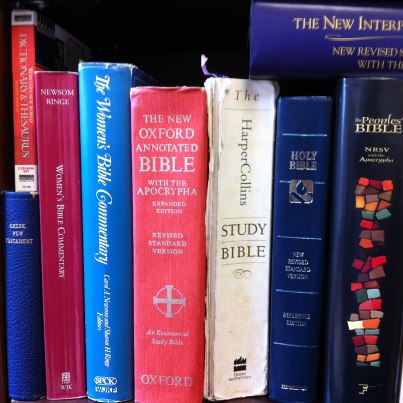 If you’ve been reading the series of posts in which I “get theological,” then you might have noticed that I use and reference the bible sparingly. A commenter on my very first post, on God, noted this immediately, saying that there “isn’t a whole of of scripture or Christ in your brief analysis.” True enough. In part this is because I think that there is plenty to say about God that is beyond the bible. (Cue righteous indignation from certain Christians now.)
It will come as no surprise, then, that my understanding of the bible does not include the concept of inerrancy or infallibility. That does not preclude me from having a sense of the bible as the word of God … it just means that I understand it’s authority differently.
First, the bible is a human book. Written by humans, compiled by humans, shaped, ordered, and disputed by humans. So everything I wrote about what it means to be human has an influence on what I believe about the bible. Graced and broken. Gifted and flawed. Sainted and sinning.
Second, God works only and always through human beings, despite their flaws and limitations. So when it comes to communicating truth, how else would it happen? And how great it is, that this is how it happens.
Third, this means that our reading and interpretation of biblical texts, canonical, apocryphal, non-canonical, and those yet undiscovered, is part of an ongoing process of revelation. God didn’t say everything that there was to say to human beings a few thousand years ago, and then stop. As the UCC motto says, “God is still speaking.” Thank goodness.
Because the world today is radically different as well as shockingly similar to the ancient world in which the canonical bible came to be. It is different in that we confront social, political, and scientific realities that ancient authors couldn’t have imagined. It is similar in that human beings have always been able to create amazing and inspirational communities, and always been captive to their own worst instincts and limits.
Do I think the bible is true? I think it communicates some truths, yes.
Do I think that everything we need to know about God and the world is in the bible? Of course not.
And yet it remains a powerful witness to truth, God, the world, and our human community throughout time. It has authority in the same way that tradition has authority. Until it doesn’t.
I have a lot of bibles in my possession, each signifying something about this book of books. In my office you’ll find The HarperCollins Study Bible that is the standard for use in my classroom and scholarly work; the Greek New Testament that I can’t read but picked up once I realized the bible had been written in ancient languages; the RSV, NIV, NRSV, and other translations I’ve gathered over the years for comparative and teaching purposes.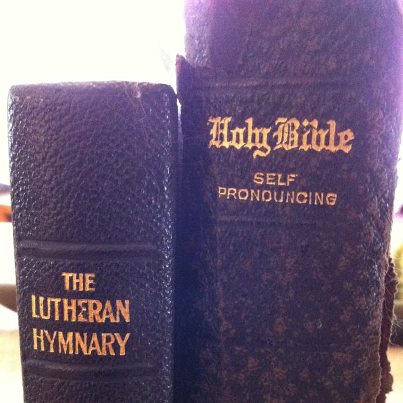
Then at home there is another HCSB for good measure, a Good News Bible that was presented to me by the women of the church as part of our third grade Sunday School rite of passage (now there’s a “translation” not to be missed), and several other sacred texts that have found their way to me after the deaths of grandparents.
Two of those texts, worn from age and use, say something else entirely about the bible. As we first flipped through one small old bible, two small black and white photographs fell out. One is of eight cows and a grove of trees in the distance, with handwriting on the back: Cattle sold April 1952. The other is of a man on a tractor, snow-covered barn, barren trees, and chilly prairie landscape surrounding him, with handwriting on the back: Winter 1952.
The other text is The Lutheran Hymnary with my grandmother’s name embossed on the cover, inscribed to her from her in-laws on her birthday in 1946. Tucked inside it as a page marker perhaps, page 18 from a seed catalog listing soybean varieties and characteristics.
I tell these stories because whatever else I say or know or don’t know about the bible, I know that it has a unique role in many people’s lives. It is personal, beyond just a book. These artifacts of the daily lives of my grandparents, seeds, snow, cows, and tractors, were part of their lives and part of their faith and part of the tradition that I inherited.
So is the bible.
Christian communities have found in it source and sustenance for millennia. It has also been the root of controversy and a weapon of choice. It has cultural and political influence in this country whether you personally accept its truth or not. And like tradition, the bible is something that each member of the Christian community has to reckon and wrestle with. To see how it is graced and how it is flawed. To take better care with how and when and why it is used.
To see it for what it is. And what it isn’t.
Previous Post
October 3, 2012
Debate Bingo With AAUW, Amnesty USA, & RCRC
Next Post

October 8, 2012 Another Week in Pro-Choice Prayer
Browse Our Archives
Select a Category Abortion At the Intersections Atheism Christianity Contraception Education Feminism Gender Getting Theological Honorable Mention Islam LGBT News Our Voices Race Uncategorized
Select a Month July 2017 June 2017 May 2017 March 2017 February 2017 January 2017 August 2016 July 2016 June 2016 May 2016 April 2016 March 2016 February 2016 January 2016 December 2015 November 2015 October 2015 September 2015 August 2015 July 2015 June 2015 May 2015 April 2015 March 2015 February 2015 January 2015 December 2014 November 2014 October 2014 September 2014 August 2014 July 2014 June 2014 May 2014 April 2014 March 2014 February 2014 January 2014 December 2013 November 2013 October 2013 September 2013 August 2013 July 2013 June 2013 May 2013 April 2013 March 2013 February 2013 January 2013 December 2012 November 2012 October 2012 September 2012 August 2012 July 2012
Follow Us!
TAKE THE
Religious Wisdom Quiz
Who taught, "Love your enemies and pray for those who persecute you"?
Select your answer to see how you score.
James Jesus John Paul
Related posts from Caryn Riswold

What I Won’t Write About Mary Daly for...

We Need To Dance at Each Other’s Weddings

Freedom & the Racialized Body: Resonances with Luther...

Active in Love: The ELCA on Faith, Sexism,...
TRENDING AT PATHEOS Progressive Christian

Why Christians Have a Sacred Duty to Vote:...
The Bible offers strong support for the sacred duty to vote. Here...

What Being a Modern-Day Apostle Means to Me
In my last column, I discussed the ins and outs of modern-day...

Did Ancient China Once Worship the God of...
Across human history, a common thread weaves through the origins of the...

Love Your Neighbor – Including Earth-Kin: Lev. 19,...
God’s command to love your neighbor means acting in an ethical and...

Lead a Church Study of “Jesus and Lao...
Guest writer Jack Thomas (The Irreverent Reverend) reflects on leading his church...

Principles for Understanding the Apostolic Ministry Today
Whenever people discover that my formal ministry title is "apostle," as in...
view all Progressive Christian blogs
Ad-Free & Subscriber Log-In Subscription Support
- About Us
- 2026 Calendar
- Videos
- Podcasts
- Library of World Religions
- Faith In Media Tracker
- Advertise With Us
- Write for Us
- Privacy Policy
- Terms of Service
- Do Not Sell My Data
- Contact Us
- Radiant Digital
- Manage Newsletter Subscriptions
- Unsubscribe From Notifications
- Sitemap
Copyright 2008-2026, Patheos. All rights reserved.
Subscription Support Ad-Free & Subscriber Log-In
Follow Patheos