
BuddhistCatholicContemplativeEvangelicalGeneral ChristianHinduJewishLatter-day SaintMuslimNew VisionsProgressive Christian
Beliefs
- Buddhist
- Catholic
- Contemplative
- Evangelical
- General Christian
- Hindu
- Jewish
- Latter-day Saint
- More Voices
- Muslim
- New Visions
- Pagan
- Progressive Christian
Topics
- Religion News
- Food and Religion
- Sports and Religion
- Religious Art
- Religious Music and Entertainment
- Religious Events
- History and Religion
- Style and Religion
- Politics and Religion
- Women in Religion
- Recreation Outdoors and Religion
- Business Finance and Religion
- Careers Workplace and Religion
- Education and Religion
- Family Parenting and Religion
- Health Fitness and Religion
- Home and Religion
- Relationships and Religion
- Technology and Religion
- Travel and Religion
Columnists
- Buddhist Columnists
- Business Finance and Religion Columnists
- Careers Workplace and Religion Columnists
- Catholic Columnists
- Contemplative Columnists
- Education and Religion Columnists
- Evangelists Columnists
- Family Parenting and Religion Columnists
- General Christian Columnists
- Health Fitness and Religion Columnists
- Hindu Columnists
- History and Religion Columnists
- Home and Religion Columnists
- Jewish Columnists
- More Voices Columnists
- Latter Day Columnists
- Muslim Columnists
- New Visions Columnists
- Nonreligious Columnists
- Pagan Columnists
- Politics and Religion Columnists
- Progressive Columnists
- Recreation Outdoors and Religion Columnists
- Relationships and Religion Columnists
- Religion News Columnists
- Religious Art Columnists
- Religious Events Columnists
- Religious Music and Entertainment Columnists
- Sports and Religion Columnists
- Style and Religion Columnists
- Technology and Religion Columnists
- Travel and Religion Columnists
- Women in Religion Columnists
Resource Library
- 2026 Calendar
- Library of World Religions
- The 100 Most Holy Places on Earth
- Patheos Answers
- Podcasts
- Videos
- Faith Leaders Database
- Anglican Episcopalian
- Bahai
- Baptist
- Buddhism
- Christianity
- Confucianism
- Eastern Orthodoxy
- Hinduism
- Holiness and Pentecostal
- ISKCON
- Islam
- Judaism
- Lutheran
- Methodist
- The Church of Jesus Christ of Latter-day Saints
- New Age
- Paganism
- Presbytarian and Reformed
- Protestantism
- Religion Behind the Scenes
- Roman Catholic
- Scientology
- Shia Islam
- Sikhism
- Sufism
- Sunni Islam
- Taoism
- Zen
- See all religions
Research Tools
 Ad-Free & Subscriber Log-In Subscription Support
Ad-Free & Subscriber Log-In Subscription Support
Follow Patheos 

- Trending:
- Forgiveness
- |
- Marriage
- |
- Consciousness
- |
- Death Penalty
- |
- Election
- |
- Halloween
 Caryn Riswold
- Home
- Progressive Christian
- The Grace of Being Freed From Judging My Neighbor
The Grace of Being Freed From Judging My Neighbor
Last updated on: July 28, 2016 at 12:51 pm by Caryn Riswold
The Grace of Being Freed From Judging My Neighbor 2016-07-28T12:51:36-06:00 Caryn Riswold
Patheos Explore the world's faith through different perspectives on religion and spirituality! Patheos has the views of the prevalent religions and spiritualities of the world.
 Earlier this week, I had an op-ed about religious freedom published in the local newspaper, responding to to legislative efforts in many states (VP nominee Mike Pence’s Indiana among them) to enable business owners to use religious freedom as a license to deny services and discriminate.
Here’s an excerpt (click to read the full piece):
As Lutherans prepare to commemorate the 500th anniversary of the advent of the Reformation in 2017, a pivotal voice from the past suggests another more compelling view of Christian freedom from which legislators and people of faith might learn.
In his 1520 essay “On the Freedom of a Christian,” Martin Luther makes an argument using twin claims: “A Christian is the most free lord of all, and subject to none; a Christian is the most dutiful servant of all, and subject to everyone.” Both a free person and a dutiful servant, the Christian is a paradox.
How is this possible? For Luther, it was based on his concept that a person has two natures: an inner, spiritual nature and an outer, bodily nature. With regard to the spirit, Luther argued for absolute freedom from having to earn salvation; nothing that a Christian could do, say, buy or become could earn a ticket to heaven. This is because, for him, Christians are already saved by the power of God’s grace.
Freed for what? This is where Luther’s explanation of the outer, bodily nature of the person came into play. As a “servant of all,” the Christian is freed to serve his or her neighbor. Freed from having to be concerned with his or her own salvation, he or she could therefore focus on self-control “that he may be able to serve others more sincerely and more freely.” This is the part of person who interacts with others in the world through work, community and politics. As Luther said, the Christian “must needs speak, act, and converse among” other people. As must we all.
This is something Luther understood that Christians would undertake joyfully. Serving one’s neighbor is how one lives as a faithful servant of God in the world. This entails all the things that we do as members of a community, including paying taxes that support public schools, safe roads and clean drinking water. It means running our businesses fairly by following laws regarding hiring, pay, and public access. It includes states providing social services for the most vulnerable among us. It also means enforcing laws that protect us from the harmful actions of others, like discrimination on the basis of race, gender, religion and sexual orientation.
Knowing that there are more Missouri-Synod Lutherans in my town than there are ELCA Lutherans (click here if you’re not familiar with why that difference matters), and knowing how conservative generally the readers of this paper are, I expected criticism. I didn’t have to wait long … two days later a letter to the editor was published suggesting that I made “a gigantic, fallacious leap” by suggesting that Luther’s ideas about freedom are “relevant to our culture’s accepting sexual orientation.” 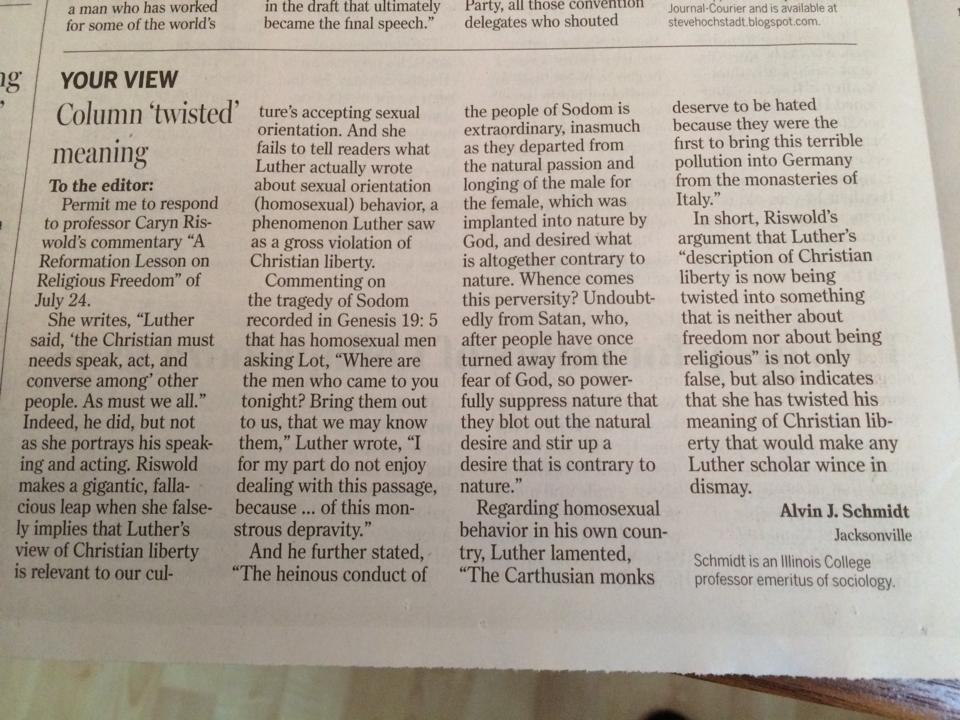 The author is a local retired LCMS clergy and former faculty member at the institution where I teach known for his writing against pluralism, multiculturalism, and Islam among other things. He goes on to quote at length the things that Luther said about Sodom in his Genesis commentary, as well as Luther’s call to hate the Carthusian monks “because they were the first to bring this terrible pollution into Germany.” (Of course, “terrible pollution” = same sex activity.)
He concludes by stating that my argument “would make any Luther scholar wince in dismay.” The implication there is that I am not a Luther scholar. Never mind my sixteen-year-old Ph.D. from the Lutheran School of Theology at Chicago, the two books I have written on Martin Luther, the many articles and chapters I have published that work with elements of the Reformer’s theology, as well as the three forthcoming entries I will have in the Encyclopedia of Martin Luther and the Reformation. His immediate disregard for any authority that I might have on the topics on which I write are based on more than disagreement; they are the product of a significant generational and gender gap.
Of course my op-ed wasn’t making an argument about homosexuality per se, thus Luther’s writings on the subject (with which I am familiar) weren’t relevant. (Nor were particular things he said about women, like “it’s more fitting for them to lisp and stammer” than to be authoritative, though my interlocutor may agree there too.) I made an argument that the nuance in the Reformer’s understanding of what it means to be Christian in the world, freed to serve, is a helpful corrective to those bound up today in a theology that compels them to discriminate and deny services to their neighbors.
In fact, Luther might recognize that way of thinking as a type of works-righteousness, something he vehemently argued against. The freedom of a Christian was a byproduct of grace: the unmerited gift of God in fact frees the Christian from having to earn her salvation by doing, thinking, saying the right thing. With such freedom she can then undertake service to the neighbor joyfully and humbly.
What a relief to not have to worry about judging my neighbor and instead look for ways to make his life better.
If only the so-called “religious freedom” zealots could enjoy such relief.
Luther rose image via wikimedia commons. Letter image mine.

Previous Post

July 11, 2016
Writing About #BlackLivesMatter While White
Next Post

August 1, 2016 All About Hijab: Gender, Race, Religion & Ghazala Khan
Browse Our Archives
Select a Category Abortion At the Intersections Atheism Christianity Contraception Education Feminism Gender Getting Theological Honorable Mention Islam LGBT News Our Voices Race Uncategorized
Select a Month July 2017 June 2017 May 2017 March 2017 February 2017 January 2017 August 2016 July 2016 June 2016 May 2016 April 2016 March 2016 February 2016 January 2016 December 2015 November 2015 October 2015 September 2015 August 2015 July 2015 June 2015 May 2015 April 2015 March 2015 February 2015 January 2015 December 2014 November 2014 October 2014 September 2014 August 2014 July 2014 June 2014 May 2014 April 2014 March 2014 February 2014 January 2014 December 2013 November 2013 October 2013 September 2013 August 2013 July 2013 June 2013 May 2013 April 2013 March 2013 February 2013 January 2013 December 2012 November 2012 October 2012 September 2012 August 2012 July 2012
Follow Us!
TAKE THE
Religious Wisdom Quiz
What miraculous catch did Peter witness after obeying Jesus?
Select your answer to see how you score.
A net full of fish A boat sinking A gold coin A sea turning red
Related posts from Caryn Riswold

What I Won’t Write About Mary Daly for...

We Need To Dance at Each Other’s Weddings

Freedom & the Racialized Body: Resonances with Luther...

Active in Love: The ELCA on Faith, Sexism,...
TRENDING AT PATHEOS Progressive Christian

What Being a Modern-Day Apostle Means to Me
In my last column, I discussed the ins and outs of modern-day...

Did Ancient China Once Worship the God of...
Across human history, a common thread weaves through the origins of the...

Love Your Neighbor – Including Earth-Kin: Lev. 19,...
God’s command to love your neighbor means acting in an ethical and...

Lead a Church Study of “Jesus and Lao...
Guest writer Jack Thomas (The Irreverent Reverend) reflects on leading his church...

Pastoral Wisdom for Responding to Sermon Pushback
Getting sermon pushback on your social justice sermon? Learn practical, Proverbs-based strategies...

Principles for Understanding the Apostolic Ministry Today
Whenever people discover that my formal ministry title is "apostle," as in...
view all Progressive Christian blogs
Ad-Free & Subscriber Log-In Subscription Support
- About Us
- 2026 Calendar
- Videos
- Podcasts
- Library of World Religions
- Faith In Media Tracker
- Advertise With Us
- Write for Us
- Privacy Policy
- Terms of Service
- Do Not Sell My Data
- Contact Us
- Radiant Digital
- Manage Newsletter Subscriptions
- Unsubscribe From Notifications
- Sitemap
Copyright 2008-2026, Patheos. All rights reserved.
Subscription Support Ad-Free & Subscriber Log-In
Follow Patheos