
BuddhistCatholicContemplativeEvangelicalGeneral ChristianHinduJewishLatter-day SaintMuslimNew VisionsProgressive Christian
Beliefs
- Buddhist
- Catholic
- Contemplative
- Evangelical
- General Christian
- Hindu
- Jewish
- Latter-day Saint
- More Voices
- Muslim
- New Visions
- Pagan
- Progressive Christian
Topics
- Religion News
- Food and Religion
- Sports and Religion
- Religious Art
- Religious Music and Entertainment
- Religious Events
- History and Religion
- Style and Religion
- Politics and Religion
- Women in Religion
- Recreation Outdoors and Religion
- Business Finance and Religion
- Careers Workplace and Religion
- Education and Religion
- Family Parenting and Religion
- Health Fitness and Religion
- Home and Religion
- Relationships and Religion
- Technology and Religion
- Travel and Religion
Columnists
- Buddhist Columnists
- Business Finance and Religion Columnists
- Careers Workplace and Religion Columnists
- Catholic Columnists
- Contemplative Columnists
- Education and Religion Columnists
- Evangelists Columnists
- Family Parenting and Religion Columnists
- General Christian Columnists
- Health Fitness and Religion Columnists
- Hindu Columnists
- History and Religion Columnists
- Home and Religion Columnists
- Jewish Columnists
- More Voices Columnists
- Latter Day Columnists
- Muslim Columnists
- New Visions Columnists
- Nonreligious Columnists
- Pagan Columnists
- Politics and Religion Columnists
- Progressive Columnists
- Recreation Outdoors and Religion Columnists
- Relationships and Religion Columnists
- Religion News Columnists
- Religious Art Columnists
- Religious Events Columnists
- Religious Music and Entertainment Columnists
- Sports and Religion Columnists
- Style and Religion Columnists
- Technology and Religion Columnists
- Travel and Religion Columnists
- Women in Religion Columnists
Resource Library
- 2026 Calendar
- Library of World Religions
- The 100 Most Holy Places on Earth
- Patheos Answers
- Podcasts
- Videos
- Faith Leaders Database
- Anglican Episcopalian
- Bahai
- Baptist
- Buddhism
- Christianity
- Confucianism
- Eastern Orthodoxy
- Hinduism
- Holiness and Pentecostal
- ISKCON
- Islam
- Judaism
- Lutheran
- Methodist
- The Church of Jesus Christ of Latter-day Saints
- New Age
- Paganism
- Presbytarian and Reformed
- Protestantism
- Religion Behind the Scenes
- Roman Catholic
- Scientology
- Shia Islam
- Sikhism
- Sufism
- Sunni Islam
- Taoism
- Zen
- See all religions
Research Tools
 Ad-Free & Subscriber Log-In Subscription Support
Ad-Free & Subscriber Log-In Subscription Support
Follow Patheos 

- Trending:
- Forgiveness
- |
- Marriage
- |
- Consciousness
- |
- Death Penalty
- |
- Election
- |
- Halloween
 Caryn Riswold
- Home
- Progressive Christian
- 16 Questions About Feminism & Christianity Answered
16 Questions About Feminism & Christianity Answered
Last updated on: May 17, 2016 at 1:00 pm by Caryn Riswold
16 Questions About Feminism & Christianity Answered 2016-05-17T13:00:49-06:00 Caryn Riswold
Patheos Explore the world's faith through different perspectives on religion and spirituality! Patheos has the views of the prevalent religions and spiritualities of the world.
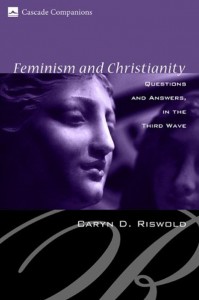
 Though I wrote the book about eight years ago, I find myself still and once again answering basic questions that Christians have about feminism, and that feminists have about Christianity.
This time, it is in preparation for an interview with another website. I’ll share more from that piece once it is published, but thought I’d go ahead and share here the basic questions and summary answers that shaped my third book, Feminism and Christianity: Questions and Answers in the Third Wave, published in 2009, and eventually led to this blog. I’m happy to be able to draw on and share this work anew, as I have through excerpts published in the widely used introductory women’s studies textbook published by McGraw Hill, Women’s Voices, Feminist Visions, edited by Susan Shaw and Janet Lee.
(The following is adapted from pages 119-122 of Feminism and Christianity.)
- Why should feminists care about Christianity?
Feminism should reform Christianity to establish and maintain women’s equal humanity while confronting patriarchy – a status-quo ideology that maintains male power over women.
- Why should Christians care about feminism?
Christians should care about feminism because it brings the religion back to the root ideals of egalitarian human life glimpsed in its early years, and because feminism has contributed to revitalizing the religion by advocating the leadership and scholarly contributions of women.
- How has Christianity been a problem for women?
Christianity is guilty of misunderstanding women, holding them back, and legitimating their abuse, so feminists must subject it to scrutiny and hold it accountable for failure or for renewal.
- Why don’t feminists accept that the Bible teaches that men and women have different roles in creation, and that wives should submit to their husbands?
Feminists and Christians learn through closer historical, theological, and sociological examination that biblical texts and religious teachings against the full equality of men and women are limited by their contexts in their ability to communicate truth.
- Has Christianity been oppressive only on the basis of gender?
The shameful Christian legacy of violence against and exploitation of other religious people and the earth is being overcome by faithful activism in which feminists can and should participate.
- Isn’t feminism just a lot of whining, privileged, white women?
Feminism in the third wave is a global justice movement acting on behalf of women’s full equality at the intersection of race, class, gender, and other aspects of identity – making it even more relevant for a global Christianity in the twenty-first century.
- How has Christianity affected women’s lives in a positive way?
Christianity has been good for women because of its theological vision of equality under a compassionate God and because of its historical and present practice of radical community organizing and transformation led by women.
- Do feminists just want to turn patriarchy into a matriarchy?
Feminism’s focus on women names the problem of sexism and the reality of inequality in society and the church, challenging a system that values and grants power to some people over others on the basis of unearned privileges.
- How are feminists changing the fact that Christianity has been anti-feminist, if not anti-woman?
Feminists are changing the fact that Christianity has been anti-feminist and anti-woman through activism, scholarly engagement, and faithful participation that have resulted in denominations and biblical shifts toward inclusion.
- How can a person be both Christian and feminist?
A person can be both Christian and feminist because the two identities share core commitments to human dignity and equality, justice among people, and sustainable relations with the earth.
- If Jesus was a feminist, and Paul was a misogynist, what’s the real Christianity?
While it is anachronistic to claim that Jesus was a feminist, and too limiting to name Paul a misogynist, deeper knowledge about each of the historical figures is simply part of the larger story of the real Christianity.
- Are all feminists really lesbians? Doesn’t feminism at least promote the sin of homosexuality?
Debunking assumptions about feminism as well as Christianity when it comes to homosexuality leads to a realistic challenge to the religious tradition that some denominations are meeting and others are battling.
- How do different Christian sects or denominations deal with women?
Different Christian denominations deal with women in a variety of ways from complete exclusion to complete inclusion in leadership roles; a corresponding diversity of ideas about women’s equality and humanity reveals that despite a bento toward justice in Christianity, the religion continues to have loud and powerful leaders insistent on preserving patriarchal power.
- Does feminism include goddess worship? If so, isn’t it anti-Christian?
Feminism challenges Christianity to understand its history of suppressing concepts of a female deity as well as to open itself up to a rich storehouse of images and names for God that more fully represents human experience.
- Is Christianity better or worse for women than other religions?
Christianity is incredibly similar to other religions when it comes to women: A wide range of views and ways of treating women have always been connected to an intricate set of historical and political factors that can completely affirm as well as completely subordinate and mistreat women.
- Why do women think they can be pastors?
Women think they can be pastors on the basis of their own internal sense of being called by the Spirit of God along with a faithful interpretation of biblical texts that has reformed the Christian tradition in the direction of inclusion.
For more detailed discussion of any one or more of these, along with introductory discussions and definitions of both feminism and Christianity, you can get Feminism and Christianity: Questions and Answers in the Third Wave via your local independent bookstore or online.
Images mine.
Previous Post

May 2, 2016
#BlackLivesMatter in Barbershop’s Love Letter to Chicago
Next Post

June 9, 2016 Hello, Christians Who Still Don’t Get Feminism
Browse Our Archives
Select a Category Abortion At the Intersections Atheism Christianity Contraception Education Feminism Gender Getting Theological Honorable Mention Islam LGBT News Our Voices Race Uncategorized
Select a Month July 2017 June 2017 May 2017 March 2017 February 2017 January 2017 August 2016 July 2016 June 2016 May 2016 April 2016 March 2016 February 2016 January 2016 December 2015 November 2015 October 2015 September 2015 August 2015 July 2015 June 2015 May 2015 April 2015 March 2015 February 2015 January 2015 December 2014 November 2014 October 2014 September 2014 August 2014 July 2014 June 2014 May 2014 April 2014 March 2014 February 2014 January 2014 December 2013 November 2013 October 2013 September 2013 August 2013 July 2013 June 2013 May 2013 April 2013 March 2013 February 2013 January 2013 December 2012 November 2012 October 2012 September 2012 August 2012 July 2012
Follow Us!
TAKE THE
Religious Wisdom Quiz
What does "Genesis" mean?
Select your answer to see how you score.
Wisdom Law Origin or beginning History
Related posts from Caryn Riswold

What I Won’t Write About Mary Daly for...

We Need To Dance at Each Other’s Weddings

Freedom & the Racialized Body: Resonances with Luther...

Active in Love: The ELCA on Faith, Sexism,...
TRENDING AT PATHEOS Progressive Christian

Why Christians Have a Sacred Duty to Vote:...
The Bible offers strong support for the sacred duty to vote. Here...

What Being a Modern-Day Apostle Means to Me
In my last column, I discussed the ins and outs of modern-day...

Did Ancient China Once Worship the God of...
Across human history, a common thread weaves through the origins of the...

Love Your Neighbor – Including Earth-Kin: Lev. 19,...
God’s command to love your neighbor means acting in an ethical and...

Lead a Church Study of “Jesus and Lao...
Guest writer Jack Thomas (The Irreverent Reverend) reflects on leading his church...

Principles for Understanding the Apostolic Ministry Today
Whenever people discover that my formal ministry title is "apostle," as in...
view all Progressive Christian blogs
Ad-Free & Subscriber Log-In Subscription Support
- About Us
- 2026 Calendar
- Videos
- Podcasts
- Library of World Religions
- Faith In Media Tracker
- Advertise With Us
- Write for Us
- Privacy Policy
- Terms of Service
- Do Not Sell My Data
- Contact Us
- Radiant Digital
- Manage Newsletter Subscriptions
- Unsubscribe From Notifications
- Sitemap
Copyright 2008-2026, Patheos. All rights reserved.
Subscription Support Ad-Free & Subscriber Log-In
Follow Patheos