
BuddhistCatholicContemplativeEvangelicalGeneral ChristianHinduJewishLatter-day SaintMuslimNew VisionsProgressive Christian
Beliefs
- Buddhist
- Catholic
- Contemplative
- Evangelical
- General Christian
- Hindu
- Jewish
- Latter-day Saint
- More Voices
- Muslim
- New Visions
- Pagan
- Progressive Christian
Topics
- Religion News
- Food and Religion
- Sports and Religion
- Religious Art
- Religious Music and Entertainment
- Religious Events
- History and Religion
- Style and Religion
- Politics and Religion
- Women in Religion
- Recreation Outdoors and Religion
- Business Finance and Religion
- Careers Workplace and Religion
- Education and Religion
- Family Parenting and Religion
- Health Fitness and Religion
- Home and Religion
- Relationships and Religion
- Technology and Religion
- Travel and Religion
Columnists
- Buddhist Columnists
- Business Finance and Religion Columnists
- Careers Workplace and Religion Columnists
- Catholic Columnists
- Contemplative Columnists
- Education and Religion Columnists
- Evangelists Columnists
- Family Parenting and Religion Columnists
- General Christian Columnists
- Health Fitness and Religion Columnists
- Hindu Columnists
- History and Religion Columnists
- Home and Religion Columnists
- Jewish Columnists
- More Voices Columnists
- Latter Day Columnists
- Muslim Columnists
- New Visions Columnists
- Nonreligious Columnists
- Pagan Columnists
- Politics and Religion Columnists
- Progressive Columnists
- Recreation Outdoors and Religion Columnists
- Relationships and Religion Columnists
- Religion News Columnists
- Religious Art Columnists
- Religious Events Columnists
- Religious Music and Entertainment Columnists
- Sports and Religion Columnists
- Style and Religion Columnists
- Technology and Religion Columnists
- Travel and Religion Columnists
- Women in Religion Columnists
Resource Library
- 2026 Calendar
- Library of World Religions
- The 100 Most Holy Places on Earth
- Patheos Answers
- Podcasts
- Videos
- Faith Leaders Database
- Anglican Episcopalian
- Bahai
- Baptist
- Buddhism
- Christianity
- Confucianism
- Eastern Orthodoxy
- Hinduism
- Holiness and Pentecostal
- ISKCON
- Islam
- Judaism
- Lutheran
- Methodist
- The Church of Jesus Christ of Latter-day Saints
- New Age
- Paganism
- Presbytarian and Reformed
- Protestantism
- Religion Behind the Scenes
- Roman Catholic
- Scientology
- Shia Islam
- Sikhism
- Sufism
- Sunni Islam
- Taoism
- Zen
- See all religions
Research Tools
 Ad-Free & Subscriber Log-In Subscription Support
Ad-Free & Subscriber Log-In Subscription Support
Follow Patheos 

- Trending:
- Forgiveness
- |
- Marriage
- |
- Consciousness
- |
- Death Penalty
- |
- Election
- |
- Halloween
 Caryn Riswold
- Home
- Progressive Christian
- My Review of “Mormon Feminism”
My Review of “Mormon Feminism”
Last updated on: October 1, 2015 at 11:11 am by Caryn Riswold
My Review of “Mormon Feminism” 2015-10-01T11:11:45-06:00 Caryn Riswold
Patheos Explore the world's faith through different perspectives on religion and spirituality! Patheos has the views of the prevalent religions and spiritualities of the world.
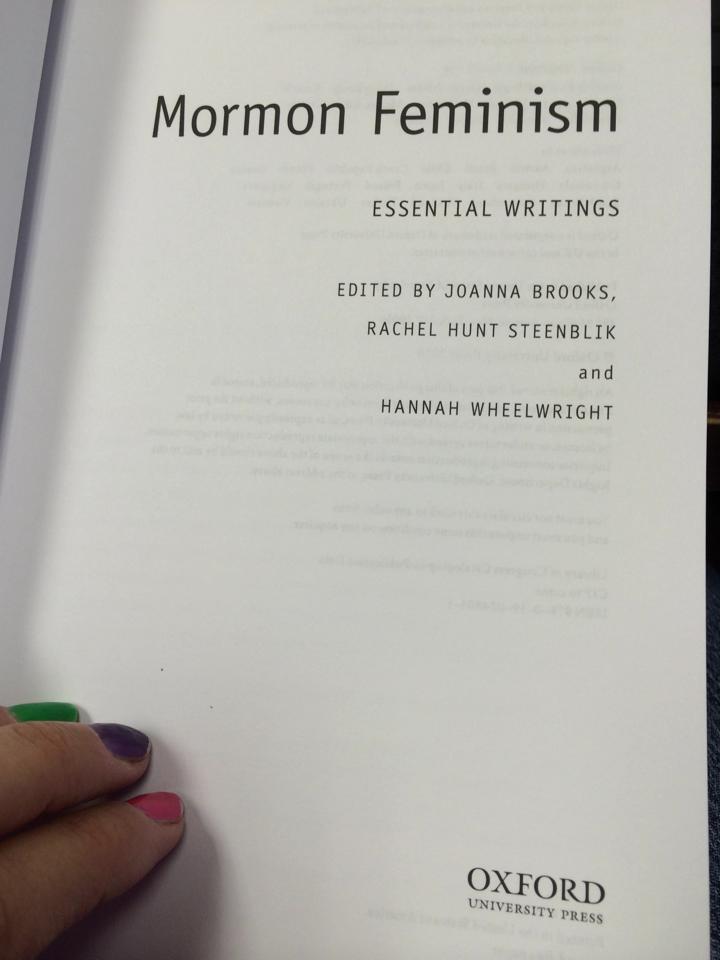 The new book, Mormon Feminism: Essential Writings, edited by Joanna Brooks, Rachel Hunt Steenblik, and Hannah Wheelwright is being released by Oxford University Press this month, and I consider it a must-read for anyone interested in constructive engagement at the intersection of feminism and religion. Here is an excerpt of my review of the book, which appeared first over at Feminism and Religion:
Mormon feminists experience what most feminists of faith have heard at some point. Utter dismissal of the possibility of their existence.
We know several variations:
You can’t be Christian and feminist.
There’s no such thing as a Catholic feminist.
You can’t seriously be Jewish and feminist.
You can’t possibly be Muslim and feminist.
To be Mormon and feminist? Preposterous.
In response, scholars, activists, and writers within each tradition have had to document their history, make their theological case, and engage their scriptures as robustly as any conservative traditionalist would. In order to achieve meaningful institutional change, unimpeachable work and confident testimony is required.
The new volume, Mormon Feminism: Essential Writings, edited by Joanna Brooks, Rachel Hunt Steenblik, and Hannah Wheelwright is destined to be a new core text on the subject of whether and how one can (and should) be a Mormon feminist. It combines history, theology, memoir, poetry, collective statements, and personal essays from generations of women who refuse to let the tradition that gives them life be defined by those who would exclude them from its most venerated spaces. The authors claim voice, define space, and deconstruct arguments with the boldness required to be part of this distinctly American pioneer religious tradition.
Joanna Brooks’ introduction alone makes a clear case for Mormon feminism, while naming key aspects of doctrine and practice that “offer mixed or contradictory messages about gender, equality, and power.” And, rather than being merely a defensive argument or an apologetic case, Brooks constructively connects Mormonism and feminism on matters of substance and vision:
“Many of us identify as feminists because the feminist’s movement’s hunger for justice and positive change aligns with our own religious feelings as Mormons that the purpose of life is to work for the betterment of humankind, the creation of a Zion community of equals. … Both Mormonism and feminism value struggle or work as necessary to growth.”
This point is echoed in a later essay by Valerie Hudson Cassler, who says in a 2010 piece “I didn’t join the Church because I was a feminist, but I stay in the Church because I am a feminist.” Cassler goes on to review key points of doctrine that she says “make this a revolutionary religion from a feminine perspective.” […]
The final section of the book reveals a religious feminism come-of-age, one reckoning with the intersection of race and class with its particular brand of patriarchy. As womanist writer Gina Colvin puts it:
“Mormonism is without doubt a patriarchy. But simply naming it a patriarchy ignores its additional features – because it’s not just a patriarchy. It’s a colonial patriarchy. It’s a white patriarchy. It’s a class-based patriarchy. It’s an Americentric conservative patriarchy bound to a particular economic and political order that is nearing its ‘use by’ date.”
To read the rest of the review, click here.
For more of my blog posts on Mormon feminism, click here.
Image mine.
Previous Post
September 24, 2015
Gender Equality & the #GlobalGoals as a #PrayerforEveryone
Next Post

October 6, 2015 Guns, Masculinity, a Culture of Life, & Educators on the Front Line
Browse Our Archives
Select a Category Abortion At the Intersections Atheism Christianity Contraception Education Feminism Gender Getting Theological Honorable Mention Islam LGBT News Our Voices Race Uncategorized
Select a Month July 2017 June 2017 May 2017 March 2017 February 2017 January 2017 August 2016 July 2016 June 2016 May 2016 April 2016 March 2016 February 2016 January 2016 December 2015 November 2015 October 2015 September 2015 August 2015 July 2015 June 2015 May 2015 April 2015 March 2015 February 2015 January 2015 December 2014 November 2014 October 2014 September 2014 August 2014 July 2014 June 2014 May 2014 April 2014 March 2014 February 2014 January 2014 December 2013 November 2013 October 2013 September 2013 August 2013 July 2013 June 2013 May 2013 April 2013 March 2013 February 2013 January 2013 December 2012 November 2012 October 2012 September 2012 August 2012 July 2012
Follow Us!
TAKE THE
Religious Wisdom Quiz
What does "Abraham" mean?
Select your answer to see how you score.
Father of Many Man of Wisdom King of Peace Chosen One
Related posts from Caryn Riswold

What I Won’t Write About Mary Daly for...

We Need To Dance at Each Other’s Weddings

Freedom & the Racialized Body: Resonances with Luther...

Active in Love: The ELCA on Faith, Sexism,...
TRENDING AT PATHEOS Progressive Christian

Why Christians Have a Sacred Duty to Vote:...
The Bible offers strong support for the sacred duty to vote. Here...

What Being a Modern-Day Apostle Means to Me
In my last column, I discussed the ins and outs of modern-day...

Did Ancient China Once Worship the God of...
Across human history, a common thread weaves through the origins of the...

Love Your Neighbor – Including Earth-Kin: Lev. 19,...
God’s command to love your neighbor means acting in an ethical and...

Lead a Church Study of “Jesus and Lao...
Guest writer Jack Thomas (The Irreverent Reverend) reflects on leading his church...

Principles for Understanding the Apostolic Ministry Today
Whenever people discover that my formal ministry title is "apostle," as in...
view all Progressive Christian blogs
Ad-Free & Subscriber Log-In Subscription Support
- About Us
- 2026 Calendar
- Videos
- Podcasts
- Library of World Religions
- Faith In Media Tracker
- Advertise With Us
- Write for Us
- Privacy Policy
- Terms of Service
- Do Not Sell My Data
- Contact Us
- Radiant Digital
- Manage Newsletter Subscriptions
- Unsubscribe From Notifications
- Sitemap
Copyright 2008-2026, Patheos. All rights reserved.
Subscription Support Ad-Free & Subscriber Log-In
Follow Patheos