
BuddhistCatholicContemplativeEvangelicalGeneral ChristianHinduJewishLatter-day SaintMuslimNew VisionsProgressive Christian
Beliefs
- Buddhist
- Catholic
- Contemplative
- Evangelical
- General Christian
- Hindu
- Jewish
- Latter-day Saint
- More Voices
- Muslim
- New Visions
- Pagan
- Progressive Christian
Topics
- Religion News
- Food and Religion
- Sports and Religion
- Religious Art
- Religious Music and Entertainment
- Religious Events
- History and Religion
- Style and Religion
- Politics and Religion
- Women in Religion
- Recreation Outdoors and Religion
- Business Finance and Religion
- Careers Workplace and Religion
- Education and Religion
- Family Parenting and Religion
- Health Fitness and Religion
- Home and Religion
- Relationships and Religion
- Technology and Religion
- Travel and Religion
Columnists
- Buddhist Columnists
- Business Finance and Religion Columnists
- Careers Workplace and Religion Columnists
- Catholic Columnists
- Contemplative Columnists
- Education and Religion Columnists
- Evangelists Columnists
- Family Parenting and Religion Columnists
- General Christian Columnists
- Health Fitness and Religion Columnists
- Hindu Columnists
- History and Religion Columnists
- Home and Religion Columnists
- Jewish Columnists
- More Voices Columnists
- Latter Day Columnists
- Muslim Columnists
- New Visions Columnists
- Nonreligious Columnists
- Pagan Columnists
- Politics and Religion Columnists
- Progressive Columnists
- Recreation Outdoors and Religion Columnists
- Relationships and Religion Columnists
- Religion News Columnists
- Religious Art Columnists
- Religious Events Columnists
- Religious Music and Entertainment Columnists
- Sports and Religion Columnists
- Style and Religion Columnists
- Technology and Religion Columnists
- Travel and Religion Columnists
- Women in Religion Columnists
Resource Library
- 2026 Calendar
- Library of World Religions
- The 100 Most Holy Places on Earth
- Patheos Answers
- Podcasts
- Videos
- Faith Leaders Database
- Anglican Episcopalian
- Bahai
- Baptist
- Buddhism
- Christianity
- Confucianism
- Eastern Orthodoxy
- Hinduism
- Holiness and Pentecostal
- ISKCON
- Islam
- Judaism
- Lutheran
- Methodist
- The Church of Jesus Christ of Latter-day Saints
- New Age
- Paganism
- Presbytarian and Reformed
- Protestantism
- Religion Behind the Scenes
- Roman Catholic
- Scientology
- Shia Islam
- Sikhism
- Sufism
- Sunni Islam
- Taoism
- Zen
- See all religions
Research Tools
 Ad-Free & Subscriber Log-In Subscription Support
Ad-Free & Subscriber Log-In Subscription Support
Follow Patheos 

- Trending:
- Forgiveness
- |
- Marriage
- |
- Consciousness
- |
- Death Penalty
- |
- Election
- |
- Halloween
 Caryn Riswold
- Home
- Progressive Christian
- Rites of Passage: Sabbatical as Sabbath
Rites of Passage: Sabbatical as Sabbath
Last updated on: April 21, 2015 at 10:40 am by Caryn Riswold
Rites of Passage: Sabbatical as Sabbath 2015-04-21T10:40:27-06:00 Caryn Riswold
Patheos Explore the world's faith through different perspectives on religion and spirituality! Patheos has the views of the prevalent religions and spiritualities of the world.
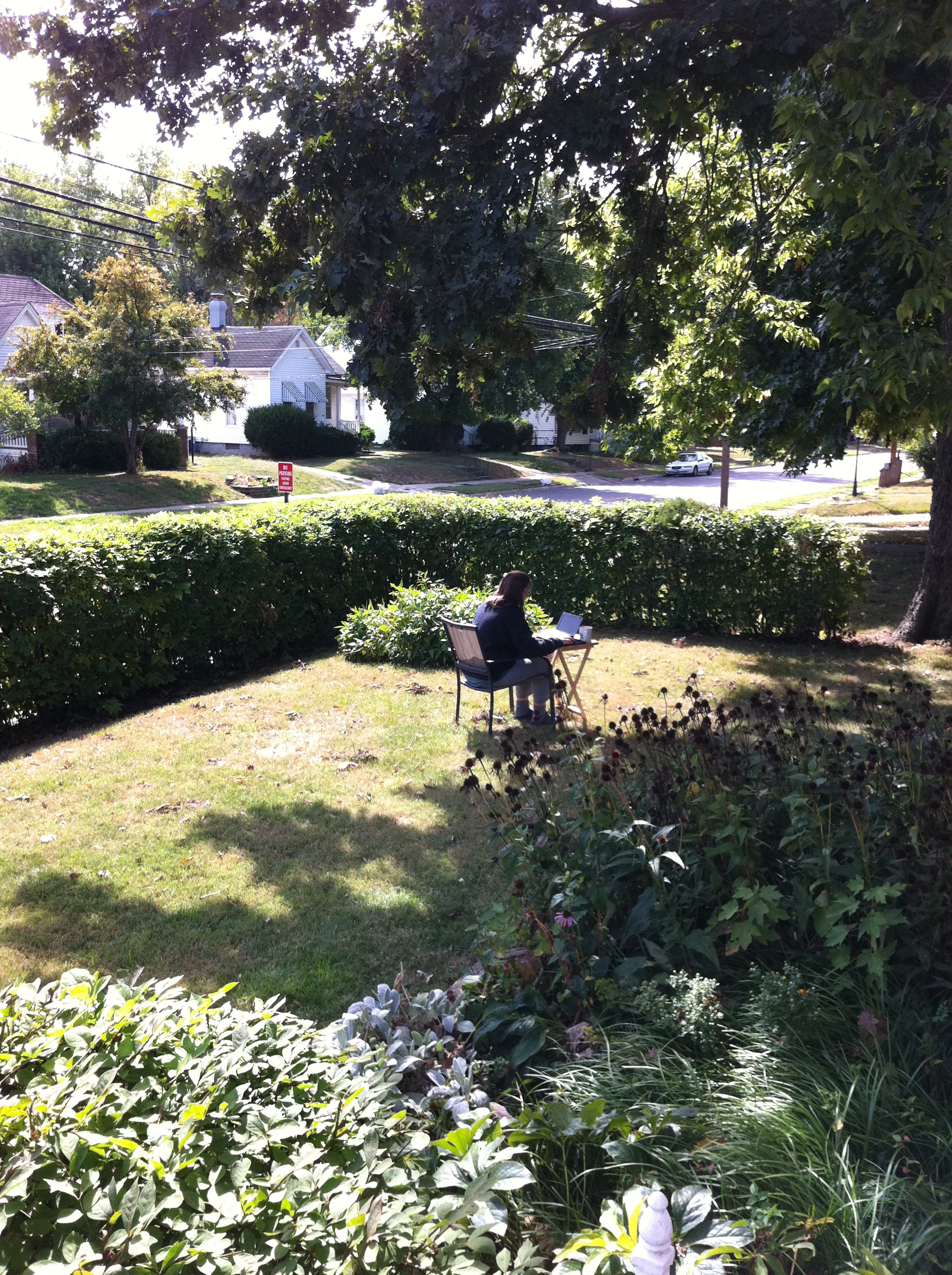 The first spring I spent in Chicago after two years of living in southern California was magical. Do you know how brilliant the first green grass is after a long snowy winter? Having grown up in South Dakota I was and am intimately familiar with dramatic season changes. But something about having been out of that rhythm for the two years of graduate school in sunny Claremont let me forget what a marvel spring can be. After we moved to central Illinois and bought our 150+ year old house, our first spring here was a delight of discovering where tulips would pop up next, and how randomly some previous owners had planted hyacinth bulbs and daffodils all around the yard.
This spring, in addition to enjoying the flowering redbud trees all around, I’m anticipating a seasonal change that’s rooted firmly in religious tradition and now entrenched in the culture of higher education: sabbatical. I’ve never lived a life outside of the academic calendar, actually, having started kindergarten at age 4, and plowed on through high school right to college and directly to three graduate degrees thereafter , Ph.D. in hand by 28, a teaching postdoctoral fellowship for two years leading into a tenure-track job where I’ve been toiling away for thirteen years now.
I first wrote about sabbatical and the Sabbath a couple of years ago after my first sabbatical.
It’s one of the privileges of a job as a tenured professor. Every seven years we can apply for a semester or a year away from the classroom, with full or partial pay. The purpose is manifold: scholarly productivity, pedagogical innovation, research and travel, and oh yes, rest. I found it alternately ironic and painful that my [first] sabbatical was in the spring semester of 2009, which you may recall as the peak/valley of the great recession. All around me, family and friends losing jobs, struggling to keep their homes, and having to relocate. On the news every day a wildly bouncing stock market and social volatility that made everyone jumpy.
And I’m on sabbatical? Reading, writing, travelling, speaking … keeping busy but in ways that only I truly controlled. And enjoyed. And reckoned with the social privilege that my life reflected in so many ways. This time set apart from anxiety and rollercoaster-existence.
Now, the next seven year cycle is complete and I’m preparing for a full year sabbatical. Well, preparing is too gentle a word for the frantic countdown that’s been occupying my mindset for the last year and a half. There’s an app for that, you know … and I frequently snap a picture of the countdown and share it with friends, thinking that knowing it officially starts in three weeks and five days, twelve hours, twenty-nine minutes …. that this somehow makes it more real or helps us get through another crazy academic year. 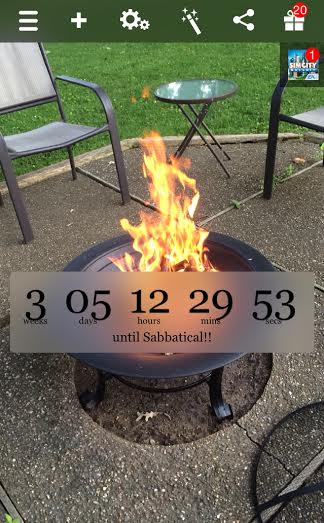
As I described it in my earlier post, Sabbath is rooted in sacred time, and that’s something I’m trying to re-member as it gets closer:
The Jewish and Christian traditions of sabbath offer this. Sacred time, time set apart, to not do what we are daily consumed with. Biblically, it is connected to the first creation story in Genesis. When “God blessed the seventh day and hallowed it, because on it God rested from all the work that he had done in creation.” (Gen. 2:3). Judaism and Christianity have scheduled this differently, as Friday/Saturday between sunsets for the former, and Sunday for the latter. Historically, the practice of sabbath has shifted. For some times and traditions, it has meant not working at all, and conducting no business that would require others to work.
When people ask me what I’ll be doing on sabbatical, I usually respond by saying, “whatever I want!” Because it’s true. Also, because I’m going to do a lot of things, it’s just that teaching classes isn’t one of them. I want to remember, though, that the gift of sabbatical is in fact the privilege of controlling where I direct my energy and how I spend my time. For too many of us, this is what’s missing in daily weekly ordinary life.
But you don’t get awarded a sabbatical from teaching to “do whatever you want!” so in a few days I’ll share in another post some of the specific things I will be working on during this rite of passage.
In the meantime, I’ll pass on a version of question I heard in a webinar from Dan Blank last week that is guiding my thoughts as this sabbath draws near: What would you do with an extra three hours a week (or three days, or three weeks, or fifteen months) for your own creative work?
Previous Post

April 14, 2015
Christian Privilege & the Religion Professor

Browse Our Archives
Select a Category Abortion At the Intersections Atheism Christianity Contraception Education Feminism Gender Getting Theological Honorable Mention Islam LGBT News Our Voices Race Uncategorized
Select a Month July 2017 June 2017 May 2017 March 2017 February 2017 January 2017 August 2016 July 2016 June 2016 May 2016 April 2016 March 2016 February 2016 January 2016 December 2015 November 2015 October 2015 September 2015 August 2015 July 2015 June 2015 May 2015 April 2015 March 2015 February 2015 January 2015 December 2014 November 2014 October 2014 September 2014 August 2014 July 2014 June 2014 May 2014 April 2014 March 2014 February 2014 January 2014 December 2013 November 2013 October 2013 September 2013 August 2013 July 2013 June 2013 May 2013 April 2013 March 2013 February 2013 January 2013 December 2012 November 2012 October 2012 September 2012 August 2012 July 2012
Follow Us!
TAKE THE
Religious Wisdom Quiz
I danced before the ark with all my might, wearing only a linen ephod. Who am I?
Select your answer to see how you score.
Solomon Jonathan David Saul
Related posts from Caryn Riswold

What I Won’t Write About Mary Daly for...

We Need To Dance at Each Other’s Weddings

Freedom & the Racialized Body: Resonances with Luther...

Active in Love: The ELCA on Faith, Sexism,...
TRENDING AT PATHEOS Progressive Christian

Why Christians Have a Sacred Duty to Vote:...
The Bible offers strong support for the sacred duty to vote. Here...

What Being a Modern-Day Apostle Means to Me
In my last column, I discussed the ins and outs of modern-day...

Did Ancient China Once Worship the God of...
Across human history, a common thread weaves through the origins of the...

Love Your Neighbor – Including Earth-Kin: Lev. 19,...
God’s command to love your neighbor means acting in an ethical and...

Lead a Church Study of “Jesus and Lao...
Guest writer Jack Thomas (The Irreverent Reverend) reflects on leading his church...

Principles for Understanding the Apostolic Ministry Today
Whenever people discover that my formal ministry title is "apostle," as in...
view all Progressive Christian blogs
Ad-Free & Subscriber Log-In Subscription Support
- About Us
- 2026 Calendar
- Videos
- Podcasts
- Library of World Religions
- Faith In Media Tracker
- Advertise With Us
- Write for Us
- Privacy Policy
- Terms of Service
- Do Not Sell My Data
- Contact Us
- Radiant Digital
- Manage Newsletter Subscriptions
- Unsubscribe From Notifications
- Sitemap
Copyright 2008-2026, Patheos. All rights reserved.
Subscription Support Ad-Free & Subscriber Log-In
Follow Patheos