
BuddhistCatholicContemplativeEvangelicalGeneral ChristianHinduJewishLatter-day SaintMuslimNew VisionsProgressive Christian
Beliefs
- Buddhist
- Catholic
- Contemplative
- Evangelical
- General Christian
- Hindu
- Jewish
- Latter-day Saint
- More Voices
- Muslim
- New Visions
- Pagan
- Progressive Christian
Topics
- Religion News
- Food and Religion
- Sports and Religion
- Religious Art
- Religious Music and Entertainment
- Religious Events
- History and Religion
- Style and Religion
- Politics and Religion
- Women in Religion
- Recreation Outdoors and Religion
- Business Finance and Religion
- Careers Workplace and Religion
- Education and Religion
- Family Parenting and Religion
- Health Fitness and Religion
- Home and Religion
- Relationships and Religion
- Technology and Religion
- Travel and Religion
Columnists
- Buddhist Columnists
- Business Finance and Religion Columnists
- Careers Workplace and Religion Columnists
- Catholic Columnists
- Contemplative Columnists
- Education and Religion Columnists
- Evangelists Columnists
- Family Parenting and Religion Columnists
- General Christian Columnists
- Health Fitness and Religion Columnists
- Hindu Columnists
- History and Religion Columnists
- Home and Religion Columnists
- Jewish Columnists
- More Voices Columnists
- Latter Day Columnists
- Muslim Columnists
- New Visions Columnists
- Nonreligious Columnists
- Pagan Columnists
- Politics and Religion Columnists
- Progressive Columnists
- Recreation Outdoors and Religion Columnists
- Relationships and Religion Columnists
- Religion News Columnists
- Religious Art Columnists
- Religious Events Columnists
- Religious Music and Entertainment Columnists
- Sports and Religion Columnists
- Style and Religion Columnists
- Technology and Religion Columnists
- Travel and Religion Columnists
- Women in Religion Columnists
Resource Library
- 2026 Calendar
- Library of World Religions
- The 100 Most Holy Places on Earth
- Patheos Answers
- Podcasts
- Videos
- Faith Leaders Database
- Anglican Episcopalian
- Bahai
- Baptist
- Buddhism
- Christianity
- Confucianism
- Eastern Orthodoxy
- Hinduism
- Holiness and Pentecostal
- ISKCON
- Islam
- Judaism
- Lutheran
- Methodist
- The Church of Jesus Christ of Latter-day Saints
- New Age
- Paganism
- Presbytarian and Reformed
- Protestantism
- Religion Behind the Scenes
- Roman Catholic
- Scientology
- Shia Islam
- Sikhism
- Sufism
- Sunni Islam
- Taoism
- Zen
- See all religions
Research Tools
 Ad-Free & Subscriber Log-In Subscription Support
Ad-Free & Subscriber Log-In Subscription Support
Follow Patheos 

- Trending:
- Forgiveness
- |
- Marriage
- |
- Consciousness
- |
- Death Penalty
- |
- Election
- |
- Halloween
 Caryn Riswold
- Home
- Progressive Christian
- At the Intersections: The Sacred Feminine, Medieval Style
At the Intersections: The Sacred Feminine, Medieval Style
Last updated on: April 28, 2015 at 9:58 am by Caryn Riswold
At the Intersections: The Sacred Feminine, Medieval Style 2015-04-28T09:58:31-06:00 Caryn Riswold
Patheos Explore the world's faith through different perspectives on religion and spirituality! Patheos has the views of the prevalent religions and spiritualities of the world.
Many good people live and work at the intersections, and I occasionally invite someone to tell a story from where they stand. Today’s piece comes from Lisa Deam, scholar of art and the history of the middle ages. I met Lisa when we were both postdoctoral fellows in the Lilly Fellows Program in Humanities and the Arts, engaged in regular and vibrant conversation about vocation, scholarship, teaching, and learning. These days, Lisa works to make medieval spirituality relevant to life in the twenty-first century through her writing and speaking to church groups, women’s organizations, and communities interested in how to make sense of the intersections in their own lives.
Lisa’s new book, A World Transformed: Exploring the Spirituality of Medieval Maps, is available now, and I asked her to share a bit from it with us here.
When Dan Brown’s novel, The Da Vinci Code, took the world by storm in 2003, I chuckled. It seemed so risqué to imagine Mary Magdalene mothering Jesus’ child. The book amused me not because Brown went too far but because, in his pursuit of the “sacred feminine,” he didn’t go far enough. He didn’t look at the Middle Ages. According to medieval thinkers (and the Bible itself), Jesus didn’t need a spouse to further his bloodline. He himself was seen as a birthing mother.
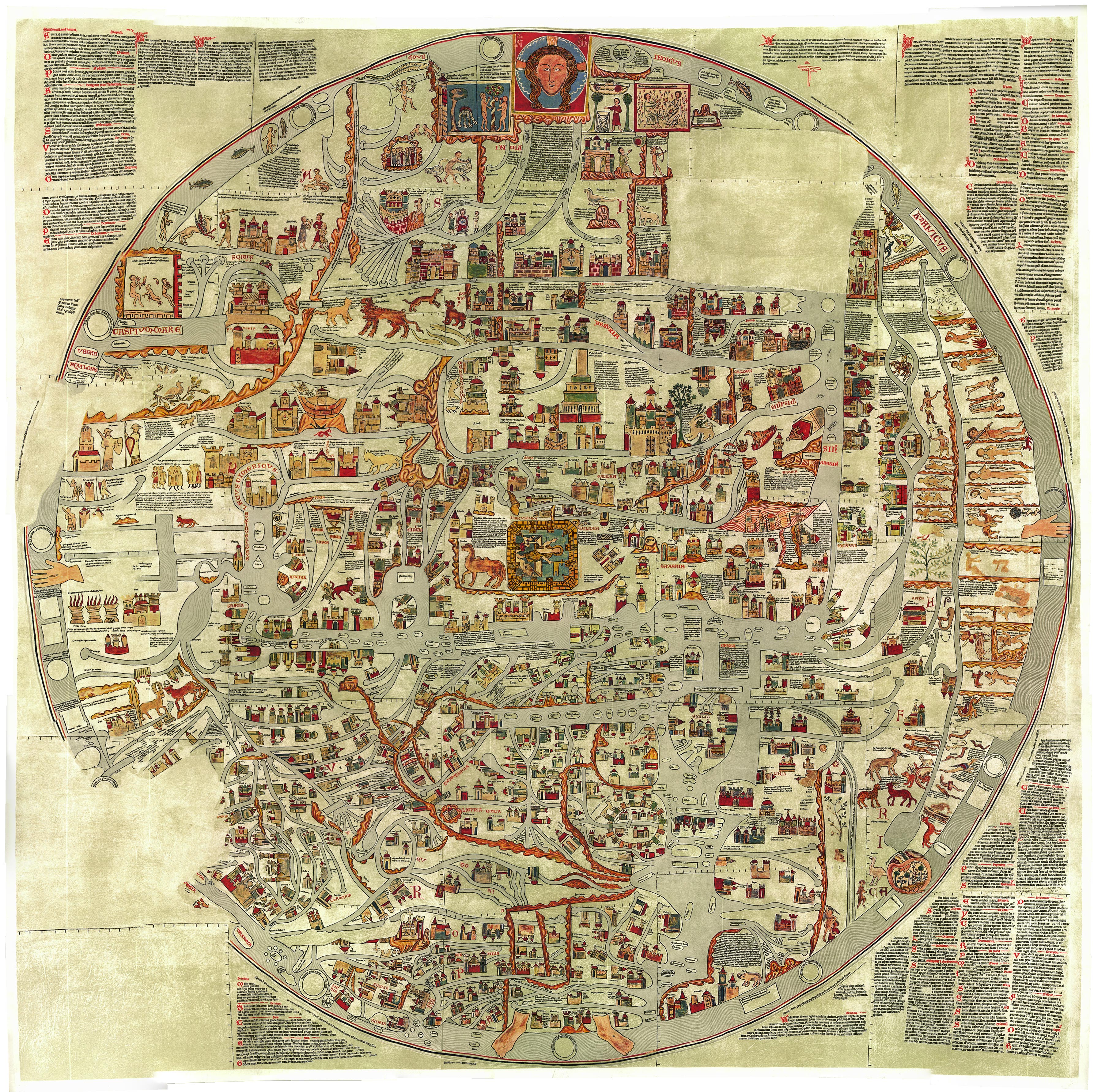 In this excerpt from my recent book, A World Transformed: Exploring the Spirituality of Medieval Maps, I explore the medieval tradition of Jesus as mother via the Ebstorf Map, a world map made ca. 1300.
“Look closely at the map, especially the edge, where Jesus’ head, hands, and feet appear. Jesus does not just hold the world; he embodies it. Round and full, the earth becomes his torso, from which his extremities (somewhat awkwardly) protrude. The map is actually a full-length portrait of our Lord.
The Ebstorf Map gives us a way to understand divine creativity. Jesus’ body contains the world but also swells with the world. To my mind—and I believe this was the intention of its makers—the Ebstorf Map pictures a pregnant body. It is round and swollen. It completely subsumes the normal proportions of the human form. And at the center of this pregnant body lies Jerusalem, which, in Jewish and Christian traditions, was often called the navel of the world.
Of all the names and concepts for Jerusalem that we’ve examined in this book—geographical center, pilgrimage destination, heavenly city—I find “navel” the most evocative. In many geographical texts, “navel” simply means “center.” But of course, it also carries connotations of gestation and birth. It describes wonderfully the place of Christ’s death and resurrection. In Jerusalem, Jesus gave life to the world, much as the umbilical cord carries sustenance to a new human being through the site of the navel. The city of Jerusalem signifies that our earth is forever linked, as if by an unbroken cord, to the one who carried it and brought it forth.
Together with Jesus’ swollen torso, the navel gives us a new and perhaps a challenging image of our Lord. We think of God as our father and Jesus himself as our friend and brother. By picturing Jesus with a pregnant body, one that delivers nourishment through the earth’s navel, the Ebstorf Map presents Jesus as mother—a mother to the world. The map may have been made by the nuns in the Benedictine convent in which it was displayed. Yet its theology does not spring from a “female mind.” In the Middle Ages, men of the church also thought of Jesus as a mother. This arresting tradition, so foreign to the way we address Jesus today, was quite widespread at the time the Ebstorf Map was made.
Male religious leaders frequently sought to imitate the savior’s feminine side. Authority figures such as abbots and prelates saw in Jesus the nurturing and protective qualities they needed in their role as caretakers. As he lay dying, the twelfth-century Cistercian abbot Aelred of Rievaulx told his monks that, “as earnestly as a mother after her sons, I long after you all in the bowels of Jesus Christ.” [1] Yet Jesus’ motherhood consisted of more than a set of admirable qualities; it was also physical. Abbots and monks thought about Jesus’ body and the maternal nourishment it could provide. In his Rule of Life for a Recluse, Aelred of Rievaulx wrote:
On your altar let it be enough for you to have a representation of our Savior hanging on the cross; that will bring before your mind his Passion for you to imitate, his outspread arms will invite you to embrace him, his naked breasts will feed you with the milk of sweetness to console you. [2]
The followers of Christ were to nurse from these breasts and so receive spiritual food.
The Ebstorf Map represents the culmination of the medieval conception of Jesus as mother. In Aelred’s passage above, Jesus lactates. On the map, he does something even more maternal: he gives birth. It is a powerful, if, to modern eyes, sometimes uncomfortable way of thinking about the far-reaching compassion of Jesus. Our savior nurtures us with a body that is neither male nor female; it is both. He gives us every part of himself, including parts we didn’t even know he had!”
Read the rest of this story, including the biblical basis for Jesus as mother, in A World Transformed: Exploring the Spirituality of Medieval Maps (Cascade 2015).
[1] Walter Daniel, The Life of Ailred of Rievaulx, trans. F. M. Powicke (New York: Thomas Nelson and Sons, 1950), 58.
[2] The Works of Aelred of Rievaulx, vol. 1: Treatises, The Pastoral Prayer (Spencer, MA: Cistercian Publications, 1971), 73.
Ebstorf Map image by User: Kolossos (own work, related to the stiching) [Public domain], via Wikimedia Commons



Next Post
May 7, 2015 Writing the Sabbath: Plans and Invitations
Browse Our Archives
Select a Category Abortion At the Intersections Atheism Christianity Contraception Education Feminism Gender Getting Theological Honorable Mention Islam LGBT News Our Voices Race Uncategorized
Select a Month July 2017 June 2017 May 2017 March 2017 February 2017 January 2017 August 2016 July 2016 June 2016 May 2016 April 2016 March 2016 February 2016 January 2016 December 2015 November 2015 October 2015 September 2015 August 2015 July 2015 June 2015 May 2015 April 2015 March 2015 February 2015 January 2015 December 2014 November 2014 October 2014 September 2014 August 2014 July 2014 June 2014 May 2014 April 2014 March 2014 February 2014 January 2014 December 2013 November 2013 October 2013 September 2013 August 2013 July 2013 June 2013 May 2013 April 2013 March 2013 February 2013 January 2013 December 2012 November 2012 October 2012 September 2012 August 2012 July 2012
Follow Us!
TAKE THE
Religious Wisdom Quiz
What was the primary economic system in Biblical times?
Select your answer to see how you score.
Taxation Barter Gold standard Silver coins
Related posts from Caryn Riswold

What I Won’t Write About Mary Daly for...

We Need To Dance at Each Other’s Weddings

Freedom & the Racialized Body: Resonances with Luther...

Active in Love: The ELCA on Faith, Sexism,...
TRENDING AT PATHEOS Progressive Christian

Why Christians Have a Sacred Duty to Vote:...
The Bible offers strong support for the sacred duty to vote. Here...

What Being a Modern-Day Apostle Means to Me
In my last column, I discussed the ins and outs of modern-day...

Did Ancient China Once Worship the God of...
Across human history, a common thread weaves through the origins of the...

Love Your Neighbor – Including Earth-Kin: Lev. 19,...
God’s command to love your neighbor means acting in an ethical and...

Lead a Church Study of “Jesus and Lao...
Guest writer Jack Thomas (The Irreverent Reverend) reflects on leading his church...

Principles for Understanding the Apostolic Ministry Today
Whenever people discover that my formal ministry title is "apostle," as in...
view all Progressive Christian blogs
Ad-Free & Subscriber Log-In Subscription Support
- About Us
- 2026 Calendar
- Videos
- Podcasts
- Library of World Religions
- Faith In Media Tracker
- Advertise With Us
- Write for Us
- Privacy Policy
- Terms of Service
- Do Not Sell My Data
- Contact Us
- Radiant Digital
- Manage Newsletter Subscriptions
- Unsubscribe From Notifications
- Sitemap
Copyright 2008-2026, Patheos. All rights reserved.
Subscription Support Ad-Free & Subscriber Log-In
Follow Patheos