
BuddhistCatholicContemplativeEvangelicalGeneral ChristianHinduJewishLatter-day SaintMuslimNew VisionsProgressive Christian
Beliefs
- Buddhist
- Catholic
- Contemplative
- Evangelical
- General Christian
- Hindu
- Jewish
- Latter-day Saint
- More Voices
- Muslim
- New Visions
- Pagan
- Progressive Christian
Topics
- Religion News
- Food and Religion
- Sports and Religion
- Religious Art
- Religious Music and Entertainment
- Religious Events
- History and Religion
- Style and Religion
- Politics and Religion
- Women in Religion
- Recreation Outdoors and Religion
- Business Finance and Religion
- Careers Workplace and Religion
- Education and Religion
- Family Parenting and Religion
- Health Fitness and Religion
- Home and Religion
- Relationships and Religion
- Technology and Religion
- Travel and Religion
Columnists
- Buddhist Columnists
- Business Finance and Religion Columnists
- Careers Workplace and Religion Columnists
- Catholic Columnists
- Contemplative Columnists
- Education and Religion Columnists
- Evangelists Columnists
- Family Parenting and Religion Columnists
- General Christian Columnists
- Health Fitness and Religion Columnists
- Hindu Columnists
- History and Religion Columnists
- Home and Religion Columnists
- Jewish Columnists
- More Voices Columnists
- Latter Day Columnists
- Muslim Columnists
- New Visions Columnists
- Nonreligious Columnists
- Pagan Columnists
- Politics and Religion Columnists
- Progressive Columnists
- Recreation Outdoors and Religion Columnists
- Relationships and Religion Columnists
- Religion News Columnists
- Religious Art Columnists
- Religious Events Columnists
- Religious Music and Entertainment Columnists
- Sports and Religion Columnists
- Style and Religion Columnists
- Technology and Religion Columnists
- Travel and Religion Columnists
- Women in Religion Columnists
Resource Library
- 2026 Calendar
- Library of World Religions
- The 100 Most Holy Places on Earth
- Patheos Answers
- Podcasts
- Videos
- Faith Leaders Database
- Anglican Episcopalian
- Bahai
- Baptist
- Buddhism
- Christianity
- Confucianism
- Eastern Orthodoxy
- Hinduism
- Holiness and Pentecostal
- ISKCON
- Islam
- Judaism
- Lutheran
- Methodist
- The Church of Jesus Christ of Latter-day Saints
- New Age
- Paganism
- Presbytarian and Reformed
- Protestantism
- Religion Behind the Scenes
- Roman Catholic
- Scientology
- Shia Islam
- Sikhism
- Sufism
- Sunni Islam
- Taoism
- Zen
- See all religions
Research Tools
 Ad-Free & Subscriber Log-In Subscription Support
Ad-Free & Subscriber Log-In Subscription Support
Follow Patheos 

- Trending:
- Forgiveness
- |
- Marriage
- |
- Consciousness
- |
- Death Penalty
- |
- Election
- |
- Halloween
 Caryn Riswold
- Home
- Progressive Christian
- Disciplining the Spirit With Jack Levison
Disciplining the Spirit With Jack Levison
Last updated on: February 8, 2015 at 1:48 pm by Caryn Riswold
Disciplining the Spirit With Jack Levison 2015-02-08T13:48:24-07:00 Caryn Riswold
Patheos Explore the world's faith through different perspectives on religion and spirituality! Patheos has the views of the prevalent religions and spiritualities of the world.
 One of the richest, most complicated, and ineffable topics in theology is the Spirit. Some Christians call it the Holy Ghost, though I much prefer the Hebrew term ruach. Breath. Wind. Air. When I have the opportunity to do a little Hebrew vocabulary with my students, I have them hold one hand in front of their mouth, and say the word out loud, drawing out the uuuu and the ccchhh sounds.
Try it. You can feel it … your breath. It’s warm, moist, maybe even a little stinky depending on what you had for lunch.
We talk about how one of the most basic differences between a dead body and a live body is breath. How people in the ancient world would have understandably attached the concept of breath, which is life itself, to their creator god. We also talk about how it’s a strange thing to explain, the spirit. I love this image, from artist Lucy Synk, of ruach.
I tell a story about one of my nephews asking (when he was about 5) at a funeral home visitation, upon seeing the open casket with my grandmother, his great-grandmother, in it, “so, when is she going to heaven?” I said, “well, we think that maybe she’s already there.” He said, pointing toward the casket, “no, she’s right there.”
Right. She was. And she wasn’t.
I tried to explain to him the difference between body and spirit … I’m not sure how good it was, but it satisfied him for the evening.
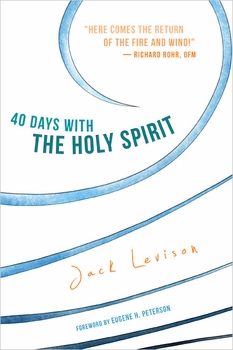 It’s a tough thing to capture and explain, the spirit. And it’s not that Jack Levison claims to have captured and organized the Holy Spirit herself for readers of his new book, 40 Days With the Holy Spirit, it’s that he’s trying to make the ineffable accessible. He does this through his writing, short pieces that are both personal and theological, making decades of complex biblical scholarship available in focused bits. The forty essays, meant to be read one-a-day-for-forty-days, are framed each by a few relevant verses of scripture, blank space for writing and reflecting, and a prayer to conclude.
It’s a highly ordered and practically oriented book. Which is awesomely inappropriate for its topic … the chaotic and transcendent spirit of God. And this isn’t actually a criticism. It’s a recognition of the necessary disjuncture between what we as humans do, the prosaic and mundane and controlling things we do, and what a mysterious God of creation and redemption and providential care does.
It’s hard to explain, and yet we try. It’s hard to understand, and yet we glimpse. It’s hard to see, and yet we do. This happens in every religion, as a matter of fact, which is why I often find the topic of the spirit as one of the most beneficial when thinking about and engaging in interfaith cooperation. The spirit is, if nothing else, evidence that none of us human beings control and define all that there is of God.
When I think of trying to find, as Levison suggests, “a comfy space” or a “sacred spot” to spend time meditating on texts and ideas and the spirit itself, I think of my yoga mat. I’ve been casually studying and practicing yoga for over a decade now, and I always come back to the radical challenge of focusing on breath. Only breath. Calming the mind, especially the mind that lives in my overly active brain. Yoga, insofar as the word means “to yoke” or “unite” the physical, mental, and spiritual parts of the self, is for me a series of physical activities that are meant to call attention to the present. What your foot is doing now, here, on this mat. Where your shoulders are. How your knee feels. Whether you can continue standing for three more breaths. And the breath is a tool to help you do that. Because it’s hard to think about Tuesday’s meeting and last night’s worries and tomorrow’s to-do list when you’re trying valiantly to straighten out your Warrior III pose.
So Jack Levison’s book is a tool to help Christians focus on the present. It places just enough order and discipline onto the chaotic and ungovernable so as to make it visible. To help call attention to the fact that in many ways, we already have what we need. Words from the past, a call to the future, time to focus.
Here. Now. With this book. For a little while, and just breathe.
On a Related Note: I was part of a seminar on Gender & Christianity that Jack and his wife Priscilla Pope-Levison directed in 2010, which produced, in addition to several lasting friendships, a great book on Sex, Gender, and Christianity.
Previous Post
February 3, 2015
For Damaged Girls
Next Post

February 12, 2015 A Feminist Religion Professor’s Valentine’s Weekend
Browse Our Archives
Select a Category Abortion At the Intersections Atheism Christianity Contraception Education Feminism Gender Getting Theological Honorable Mention Islam LGBT News Our Voices Race Uncategorized
Select a Month July 2017 June 2017 May 2017 March 2017 February 2017 January 2017 August 2016 July 2016 June 2016 May 2016 April 2016 March 2016 February 2016 January 2016 December 2015 November 2015 October 2015 September 2015 August 2015 July 2015 June 2015 May 2015 April 2015 March 2015 February 2015 January 2015 December 2014 November 2014 October 2014 September 2014 August 2014 July 2014 June 2014 May 2014 April 2014 March 2014 February 2014 January 2014 December 2013 November 2013 October 2013 September 2013 August 2013 July 2013 June 2013 May 2013 April 2013 March 2013 February 2013 January 2013 December 2012 November 2012 October 2012 September 2012 August 2012 July 2012
Follow Us!
TAKE THE
Religious Wisdom Quiz
In what city was Jesus born?
Select your answer to see how you score.
Bethlehem Nazareth Jerusalem Jericho
Related posts from Caryn Riswold

What I Won’t Write About Mary Daly for...

We Need To Dance at Each Other’s Weddings

Freedom & the Racialized Body: Resonances with Luther...

Active in Love: The ELCA on Faith, Sexism,...
TRENDING AT PATHEOS Progressive Christian

Why Christians Have a Sacred Duty to Vote:...
The Bible offers strong support for the sacred duty to vote. Here...

What Being a Modern-Day Apostle Means to Me
In my last column, I discussed the ins and outs of modern-day...

Did Ancient China Once Worship the God of...
Across human history, a common thread weaves through the origins of the...

Love Your Neighbor – Including Earth-Kin: Lev. 19,...
God’s command to love your neighbor means acting in an ethical and...

Lead a Church Study of “Jesus and Lao...
Guest writer Jack Thomas (The Irreverent Reverend) reflects on leading his church...

Principles for Understanding the Apostolic Ministry Today
Whenever people discover that my formal ministry title is "apostle," as in...
view all Progressive Christian blogs
Ad-Free & Subscriber Log-In Subscription Support
- About Us
- 2026 Calendar
- Videos
- Podcasts
- Library of World Religions
- Faith In Media Tracker
- Advertise With Us
- Write for Us
- Privacy Policy
- Terms of Service
- Do Not Sell My Data
- Contact Us
- Radiant Digital
- Manage Newsletter Subscriptions
- Unsubscribe From Notifications
- Sitemap
Copyright 2008-2026, Patheos. All rights reserved.
Subscription Support Ad-Free & Subscriber Log-In
Follow Patheos