
BuddhistCatholicContemplativeEvangelicalGeneral ChristianHinduJewishLatter-day SaintMuslimNew VisionsProgressive Christian
Beliefs
- Buddhist
- Catholic
- Contemplative
- Evangelical
- General Christian
- Hindu
- Jewish
- Latter-day Saint
- More Voices
- Muslim
- New Visions
- Pagan
- Progressive Christian
Topics
- Religion News
- Food and Religion
- Sports and Religion
- Religious Art
- Religious Music and Entertainment
- Religious Events
- History and Religion
- Style and Religion
- Politics and Religion
- Women in Religion
- Recreation Outdoors and Religion
- Business Finance and Religion
- Careers Workplace and Religion
- Education and Religion
- Family Parenting and Religion
- Health Fitness and Religion
- Home and Religion
- Relationships and Religion
- Technology and Religion
- Travel and Religion
Columnists
- Buddhist Columnists
- Business Finance and Religion Columnists
- Careers Workplace and Religion Columnists
- Catholic Columnists
- Contemplative Columnists
- Education and Religion Columnists
- Evangelists Columnists
- Family Parenting and Religion Columnists
- General Christian Columnists
- Health Fitness and Religion Columnists
- Hindu Columnists
- History and Religion Columnists
- Home and Religion Columnists
- Jewish Columnists
- More Voices Columnists
- Latter Day Columnists
- Muslim Columnists
- New Visions Columnists
- Nonreligious Columnists
- Pagan Columnists
- Politics and Religion Columnists
- Progressive Columnists
- Recreation Outdoors and Religion Columnists
- Relationships and Religion Columnists
- Religion News Columnists
- Religious Art Columnists
- Religious Events Columnists
- Religious Music and Entertainment Columnists
- Sports and Religion Columnists
- Style and Religion Columnists
- Technology and Religion Columnists
- Travel and Religion Columnists
- Women in Religion Columnists
Resource Library
- 2026 Calendar
- Library of World Religions
- The 100 Most Holy Places on Earth
- Patheos Answers
- Podcasts
- Videos
- Faith Leaders Database
- Anglican Episcopalian
- Bahai
- Baptist
- Buddhism
- Christianity
- Confucianism
- Eastern Orthodoxy
- Hinduism
- Holiness and Pentecostal
- ISKCON
- Islam
- Judaism
- Lutheran
- Methodist
- The Church of Jesus Christ of Latter-day Saints
- New Age
- Paganism
- Presbytarian and Reformed
- Protestantism
- Religion Behind the Scenes
- Roman Catholic
- Scientology
- Shia Islam
- Sikhism
- Sufism
- Sunni Islam
- Taoism
- Zen
- See all religions
Research Tools
 Ad-Free & Subscriber Log-In Subscription Support
Ad-Free & Subscriber Log-In Subscription Support
Follow Patheos 

- Trending:
- Forgiveness
- |
- Marriage
- |
- Consciousness
- |
- Death Penalty
- |
- Election
- |
- Halloween
 Caryn Riswold
- Home
- Progressive Christian
- Books, Vocation, & Education
Books, Vocation, & Education
Last updated on: November 6, 2014 at 1:29 pm by Caryn Riswold
Books, Vocation, & Education 2014-11-06T13:29:55-07:00 Caryn Riswold
Patheos Explore the world's faith through different perspectives on religion and spirituality! Patheos has the views of the prevalent religions and spiritualities of the world.
 It happens regularly … a student comes into my office, stops and looks around, says: “So many books!” I usually smile, and say, “of course … it’s my job.” That’s only partially true, of course, since as a college professor, the students are my job. Actually, introducing the students to the books is most precisely my job. If I can make that a long-lasting relationship, I count it a job well done.
So I read a lot. I write a fair amount. Recently I’ve been reading and writing a lot related to higher education and religion, things I’ve talked about here before. A few new(ish) books have risen to the top in the past year, and are ones that have informed my work on everything from vocation and higher education to teaching nonreligious students to integrating civic engagement into religion and women’s studies classes.
Sacred Ground: Pluralism, Prejudice, and the Promise of America is Eboo Patel’s latest book, and while the first half is about the history and politics of interreligious cooperation and conflict in the United States, the second half is about the central role played by colleges, universities, and seminaries in making interfaith cooperation a social norm. There are both resources and challenges in our collective history, and twenty-first century higher education is summoned to make religious diversity as central a part of its curricular and co-curricular efforts as it has done with gender, race, global and other diversity and inclusion issues. To that end, most recently, the Interfaith Youth Core founded by Patel has identified nine leadership practices of vanguard interfaith campuses. These are what those of us in higher education would call “high impact practices,” things that characterize a campus committed to and successful at educating students to live, work, and lead in a religiously diverse world.
Dorothy Bass and Mark Schwehn have produced a lovely edited volume called Leading Lives That Matter: What We Should Do and Who We Should Be. This book is currently being used colleagues on my campus committed to a yearlong initiative on student advising, talking about ways to better engage students in reflection and activity that helps them discern how to … lead a live that matters … or in the words of our mission statement, lead a fulfilling life of leadership and service. This volume brings together religious and nonreligious texts, classical and contemporary voices, essays, articles, screenplays, autobiographical sketches, obituaries, and many other pieces focused on questions about work, life, meaning, and purpose. It stands out as an edited volume because of the introductory and transitional pieces by Schwehn and Bass that weave such disparate sources and personalities into one compelling whole.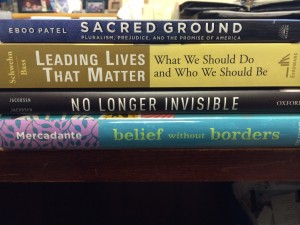
More recently, I picked up No Longer Invisible: Religion in University Education by Douglas Jacobsen and Rhonda Hustedt Jacobsen. Long recognized as leading voices in church-related higher education, the Jacobsens here begin to talk about the ways that the presence and purpose of religion in college and university life and education has and continues to shift in the twenty-first century. As the description states, “Religion in contemporary American life is now incredibly complex, with religious pluralism on the rise and the categories of ‘religious’ and ‘secular’ often blending together in a dizzying array of lifestyles and beliefs.” The shift in demographics in U.S. society inevitably affect colleges and universities themselves, and this book invites us to consider what difference it makes.
And just as I was finishing writing a forthcoming article on teaching millennial students, who are more likely than any other age cohort to not identify with a religious tradition, I got my hands on and have begun reading through Belief Without Borders: Inside the Minds of the Spiritual But Not Religious, by Linda Mercadante. This is part of the new “array” of lifestyles and beliefs that the Jacobsens talk about in their book, especially for those of us who work with 18-25 year olds on a daily basis, and Mercandante devotes her entire volume to discussing the reasons, patterns, and consequences of the rise of those who call themselves “spiritual but not religious.” I admit to being a person who doesn’t care for that category, so I look forward to spending even more time with Mercadante’s work to better understand what’s at work and what’s at stake.
It’s a good life, this reading of books. I’m challenged every day by the young people in my classroom and my office to find ways to make religion compelling, to engage them in reading books and reading the world around them, to equip them to critically respond to issues that are personal and political, local and global. Lucky for me, there are plenty of thoughtful companions in the work, and these four books are a just a few.
What else is out there that we should be reading?
The Lilly Fellows Program in Humanities and the Arts regularly presents a Book Award that “honors an original and imaginative work from any academic discipline that [focuses on] faith and learning in the Christian intellectual tradition, the vocation of teaching and scholarship, and the history, theory or practice of the university as the site of religious inquiry and culture.” It’s a fascinating field of study and scholarship. Nominations are now open, and if you’re interested in learning more about the process, nominating a book, or seeing other work on these topics, click here.
Previous Post

October 23, 2014
Be Afraid
Next Post

November 11, 2014 “When Two People Love Each Other, What Right Do I Have...?”
Browse Our Archives
Select a Category Abortion At the Intersections Atheism Christianity Contraception Education Feminism Gender Getting Theological Honorable Mention Islam LGBT News Our Voices Race Uncategorized
Select a Month July 2017 June 2017 May 2017 March 2017 February 2017 January 2017 August 2016 July 2016 June 2016 May 2016 April 2016 March 2016 February 2016 January 2016 December 2015 November 2015 October 2015 September 2015 August 2015 July 2015 June 2015 May 2015 April 2015 March 2015 February 2015 January 2015 December 2014 November 2014 October 2014 September 2014 August 2014 July 2014 June 2014 May 2014 April 2014 March 2014 February 2014 January 2014 December 2013 November 2013 October 2013 September 2013 August 2013 July 2013 June 2013 May 2013 April 2013 March 2013 February 2013 January 2013 December 2012 November 2012 October 2012 September 2012 August 2012 July 2012
Follow Us!
TAKE THE
Religious Wisdom Quiz
Who was Jonathan's son, crippled as a child, whom David showed kindness?
Select your answer to see how you score.
Abinadab Siba Mephibosheth Jedidiah
Related posts from Caryn Riswold

We Need To Dance at Each Other’s Weddings
Hearing God on Hacksaw Ridge & in Airport...

An Interfaith Leader’s Twelve-Step Response to the Pulse...
TRENDING AT PATHEOS Progressive Christian

What Being a Modern-Day Apostle Means to Me
In my last column, I discussed the ins and outs of modern-day...

Did Ancient China Once Worship the God of...
Across human history, a common thread weaves through the origins of the...

Love Your Neighbor – Including Earth-Kin: Lev. 19,...
God’s command to love your neighbor means acting in an ethical and...

Lead a Church Study of “Jesus and Lao...
Guest writer Jack Thomas (The Irreverent Reverend) reflects on leading his church...

Pastoral Wisdom for Responding to Sermon Pushback
Getting sermon pushback on your social justice sermon? Learn practical, Proverbs-based strategies...

Principles for Understanding the Apostolic Ministry Today
Whenever people discover that my formal ministry title is "apostle," as in...
view all Progressive Christian blogs
Ad-Free & Subscriber Log-In Subscription Support
- About Us
- 2026 Calendar
- Videos
- Podcasts
- Library of World Religions
- Faith In Media Tracker
- Advertise With Us
- Write for Us
- Privacy Policy
- Terms of Service
- Do Not Sell My Data
- Contact Us
- Radiant Digital
- Manage Newsletter Subscriptions
- Unsubscribe From Notifications
- Sitemap
Copyright 2008-2026, Patheos. All rights reserved.
Subscription Support Ad-Free & Subscriber Log-In
Follow Patheos