
BuddhistCatholicContemplativeEvangelicalGeneral ChristianHinduJewishLatter-day SaintMuslimNew VisionsProgressive Christian
Beliefs
- Buddhist
- Catholic
- Contemplative
- Evangelical
- General Christian
- Hindu
- Jewish
- Latter-day Saint
- More Voices
- Muslim
- New Visions
- Pagan
- Progressive Christian
Topics
- Religion News
- Food and Religion
- Sports and Religion
- Religious Art
- Religious Music and Entertainment
- Religious Events
- History and Religion
- Style and Religion
- Politics and Religion
- Women in Religion
- Recreation Outdoors and Religion
- Business Finance and Religion
- Careers Workplace and Religion
- Education and Religion
- Family Parenting and Religion
- Health Fitness and Religion
- Home and Religion
- Relationships and Religion
- Technology and Religion
- Travel and Religion
Columnists
- Buddhist Columnists
- Business Finance and Religion Columnists
- Careers Workplace and Religion Columnists
- Catholic Columnists
- Contemplative Columnists
- Education and Religion Columnists
- Evangelists Columnists
- Family Parenting and Religion Columnists
- General Christian Columnists
- Health Fitness and Religion Columnists
- Hindu Columnists
- History and Religion Columnists
- Home and Religion Columnists
- Jewish Columnists
- More Voices Columnists
- Latter Day Columnists
- Muslim Columnists
- New Visions Columnists
- Nonreligious Columnists
- Pagan Columnists
- Politics and Religion Columnists
- Progressive Columnists
- Recreation Outdoors and Religion Columnists
- Relationships and Religion Columnists
- Religion News Columnists
- Religious Art Columnists
- Religious Events Columnists
- Religious Music and Entertainment Columnists
- Sports and Religion Columnists
- Style and Religion Columnists
- Technology and Religion Columnists
- Travel and Religion Columnists
- Women in Religion Columnists
Resource Library
- 2026 Calendar
- Library of World Religions
- The 100 Most Holy Places on Earth
- Patheos Answers
- Podcasts
- Videos
- Faith Leaders Database
- Anglican Episcopalian
- Bahai
- Baptist
- Buddhism
- Christianity
- Confucianism
- Eastern Orthodoxy
- Hinduism
- Holiness and Pentecostal
- ISKCON
- Islam
- Judaism
- Lutheran
- Methodist
- The Church of Jesus Christ of Latter-day Saints
- New Age
- Paganism
- Presbytarian and Reformed
- Protestantism
- Religion Behind the Scenes
- Roman Catholic
- Scientology
- Shia Islam
- Sikhism
- Sufism
- Sunni Islam
- Taoism
- Zen
- See all religions
Research Tools
 Ad-Free & Subscriber Log-In Subscription Support
Ad-Free & Subscriber Log-In Subscription Support
Follow Patheos 

- Trending:
- Forgiveness
- |
- Marriage
- |
- Consciousness
- |
- Death Penalty
- |
- Election
- |
- Halloween
 Caryn Riswold
- Home
- Progressive Christian
- postChristian & the Sin of postFeminism
postChristian & the Sin of postFeminism
Last updated on: September 2, 2014 at 10:26 am by Caryn Riswold
postChristian & the Sin of postFeminism 2014-09-02T10:26:35-06:00 Caryn Riswold
Patheos Explore the world's faith through different perspectives on religion and spirituality! Patheos has the views of the prevalent religions and spiritualities of the world.
 In his newest book, postChristian, fellow Patheos blogger Christian Piatt takes up some important questions about Christianity in the 21st century: Because Christianity “is not what it should be, what it claims to be,” Piatt asks: What’s left? Can we fix it? Do we care? He frames his reflections on these subtitle questions using seven vices (deadly sins, if you will) and seven virtues associated with the tradition, suggesting in part that for each vice and scandal that humans living in and through the church confront, there is a corresponding virtue and message of good news and grace.
It’s honest, accessible, and compelling. It opens up conversation about the meaning and purpose of church and Christian life in a way that invites believers as well as the disaffected into dialogue. But I’m stuck on something. The vice and scandal of postChristian is its complete lack of attention to gender and sexism. How can we possibly hope to fix whatever is left of the Christian tradition and its churches without addressing sexism? Without women’s voices meaningfully present in the pages of a book hoping to do so?
I counted. Eight women (other than a few biblical women) are named in the book’s 206 pages. One is Piatt’s wife Amy (actually, I might want to read a book that she’d write) and another is his aunt Sandra. Sherry Turkle, Anne Lamott, Brene Brown, Hanna Rosin, Kate Bowler, and Heloise (she the beloved of Peter Abelard). That’s it. In a book where names practically fall off the page, from the classical to the contemporary. Constantine to Louie C.K. John Calvin to John Piper.
One chapter that might have actually substantively addressed sexism and gender, the one on lust, is about abstinence, sex addiction, and pornography. Men’s stories. Fine stories, instructive and relevant to the points that Piatt is making, but only a small part of a much bigger, richer, and more complex picture.
Christian theological discussion of sin as pride that doesn’t take account of the classic feminist critique of that model as reflective of men’s experiences alone is simply incomplete. Piatt’s chapter on pride makes that mistake through its sin of omission. He calls for Christians and the church to “lay ourselves bare” and “look at the path of service, humility, and radical openness to which Jesus leads us.” For people who have fully and over-developed senses of self, yes. Indeed. Humble yourself and serve your neighbor. For those whom our culture repeatedly humbles without their consent and expects to serve a master, no. No.
And when it comes to contemporary discussions about women’s experiences with sexism in the church, especially those seeking to lead through various Christian denominations ordination practices, I refer you to Sarah Sentilles’ 2012 book A Church of Her Own.
As Piatt models, however, for each vice and scandal there is grace and virtue sitting nearby. His sin of omission can be partially corrected by some of the virtue in his work. He says “I care more about the lives we’re choosing to live, as individuals, as members of society, as churchgoers, skeptics, seekers, doubters,” than about beliefs or dogma or labels. And as he relates through many personal stories, it seems that Piatt lives a life seeking justice for gay and lesbian people who have been harmed by this church, embracing doubt and questions and human failings, recasting millennia-old traditions so that they might have relevance and meaning today.
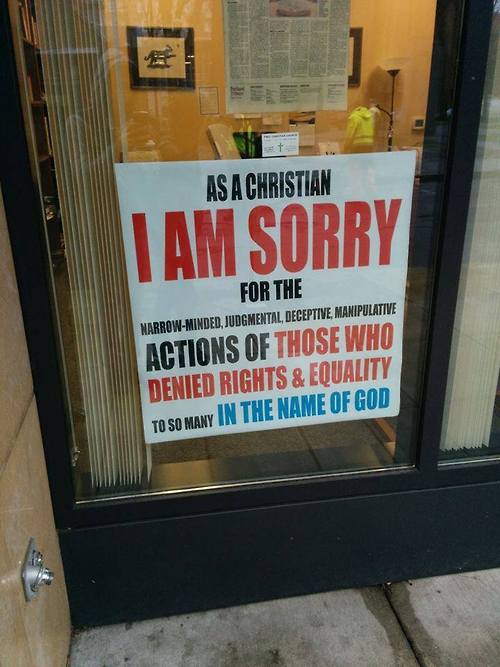 Additionally, I have a colleague who says you can tell a lot about a man by the woman he chooses to marry. In this way, Piatt’s stories about his wife Amy’s ministry, including her public apology-for-narrow-minded-judgemental-deceptive-manipulative-actions-of-so-many-in-the-church sandwich board (based on this postProp 8 billboard) worn around the Portland Gay Pride Fest make me respect his work more.
So in a good many ways, Christian Piatt gets gender justice and lives into it. Yet if you aren’t naming it, you’re making the sin of omission possible for too many others. If you who ‘get it’ aren’t weaving women scholars and pop culture figures as sources into your book, how can we expect those who don’t ‘get it’ to see that there’s still a problem? The concept of postfeminist seems to linger in the background here, the erroneous belief that at some point in the recent past, we fixed sexism and don’t really need to talk about it anymore. In many churches, this takes the form of believing that if we ordain women, we’re good on gender.
Maybe not. I invite Christian Piatt to apply his own typology of “four responses” to injustice and inequality to gender justice in the church, to sexism and women’s inequality in society, and to interrogate his own work individually.
-
Freely giving time and material wealth toward a cause (here, the cause is women’s equality).
-
Working for systemic change to rectify imbalance in existing systems (here, the imbalance is seen in women’s inequality).
-
Identifying and confessing the complicity we have in being a part of corrupt systems (here, complicity with androcentrism and patriarchy).
-
Actively seeking to subvert the system entirely, acknowledging that it is inherently built on a set of values that perpetuate injustice. (p.119-120)
The key, as Piatt notes in his analysis of churches responding to injustices like poverty, is that 1 & 2 are not enough. He shows that for churches themselves, doing the first is relatively easy. The same can be true for individuals. The second is also possible if one is civically minded and engaged in institutions like the church as well as politics. I can see how Piatt himself is probably good at the first two when it comes to gender justice. I’d like to see more evidence of the latter two in any book that proposes to advocate for a future of any sort of church.
This ultimately matters because it bolsters some of the proposals in postChristian. Because if any part of the answer to “can we fix it?” is yes, then gender justice will need to be part of the solution.
Image via.
Previous Post

August 25, 2014
Because Religion?
Next Post

September 11, 2014 Reproductive (in)Justice in Jacksonville
Browse Our Archives
Select a Category Abortion At the Intersections Atheism Christianity Contraception Education Feminism Gender Getting Theological Honorable Mention Islam LGBT News Our Voices Race Uncategorized
Select a Month July 2017 June 2017 May 2017 March 2017 February 2017 January 2017 August 2016 July 2016 June 2016 May 2016 April 2016 March 2016 February 2016 January 2016 December 2015 November 2015 October 2015 September 2015 August 2015 July 2015 June 2015 May 2015 April 2015 March 2015 February 2015 January 2015 December 2014 November 2014 October 2014 September 2014 August 2014 July 2014 June 2014 May 2014 April 2014 March 2014 February 2014 January 2014 December 2013 November 2013 October 2013 September 2013 August 2013 July 2013 June 2013 May 2013 April 2013 March 2013 February 2013 January 2013 December 2012 November 2012 October 2012 September 2012 August 2012 July 2012
Follow Us!
TAKE THE
Religious Wisdom Quiz
Where did David spare Saul's life when he found him in a cave?
Select your answer to see how you score.
Gilgal Bethlehem Hebron En Gedi
Related posts from Caryn Riswold

What I Won’t Write About Mary Daly for...

We Need To Dance at Each Other’s Weddings

Freedom & the Racialized Body: Resonances with Luther...

Active in Love: The ELCA on Faith, Sexism,...
TRENDING AT PATHEOS Progressive Christian

What Being a Modern-Day Apostle Means to Me
In my last column, I discussed the ins and outs of modern-day...

Did Ancient China Once Worship the God of...
Across human history, a common thread weaves through the origins of the...

Love Your Neighbor – Including Earth-Kin: Lev. 19,...
God’s command to love your neighbor means acting in an ethical and...

Lead a Church Study of “Jesus and Lao...
Guest writer Jack Thomas (The Irreverent Reverend) reflects on leading his church...

Pastoral Wisdom for Responding to Sermon Pushback
Getting sermon pushback on your social justice sermon? Learn practical, Proverbs-based strategies...

Principles for Understanding the Apostolic Ministry Today
Whenever people discover that my formal ministry title is "apostle," as in...
view all Progressive Christian blogs
Ad-Free & Subscriber Log-In Subscription Support
- About Us
- 2026 Calendar
- Videos
- Podcasts
- Library of World Religions
- Faith In Media Tracker
- Advertise With Us
- Write for Us
- Privacy Policy
- Terms of Service
- Do Not Sell My Data
- Contact Us
- Radiant Digital
- Manage Newsletter Subscriptions
- Unsubscribe From Notifications
- Sitemap
Copyright 2008-2026, Patheos. All rights reserved.
Subscription Support Ad-Free & Subscriber Log-In
Follow Patheos