
BuddhistCatholicContemplativeEvangelicalGeneral ChristianHinduJewishLatter-day SaintMuslimNew VisionsProgressive Christian
Beliefs
- Buddhist
- Catholic
- Contemplative
- Evangelical
- General Christian
- Hindu
- Jewish
- Latter-day Saint
- More Voices
- Muslim
- New Visions
- Pagan
- Progressive Christian
Topics
- Religion News
- Food and Religion
- Sports and Religion
- Religious Art
- Religious Music and Entertainment
- Religious Events
- History and Religion
- Style and Religion
- Politics and Religion
- Women in Religion
- Recreation Outdoors and Religion
- Business Finance and Religion
- Careers Workplace and Religion
- Education and Religion
- Family Parenting and Religion
- Health Fitness and Religion
- Home and Religion
- Relationships and Religion
- Technology and Religion
- Travel and Religion
Columnists
- Buddhist Columnists
- Business Finance and Religion Columnists
- Careers Workplace and Religion Columnists
- Catholic Columnists
- Contemplative Columnists
- Education and Religion Columnists
- Evangelists Columnists
- Family Parenting and Religion Columnists
- General Christian Columnists
- Health Fitness and Religion Columnists
- Hindu Columnists
- History and Religion Columnists
- Home and Religion Columnists
- Jewish Columnists
- More Voices Columnists
- Latter Day Columnists
- Muslim Columnists
- New Visions Columnists
- Nonreligious Columnists
- Pagan Columnists
- Politics and Religion Columnists
- Progressive Columnists
- Recreation Outdoors and Religion Columnists
- Relationships and Religion Columnists
- Religion News Columnists
- Religious Art Columnists
- Religious Events Columnists
- Religious Music and Entertainment Columnists
- Sports and Religion Columnists
- Style and Religion Columnists
- Technology and Religion Columnists
- Travel and Religion Columnists
- Women in Religion Columnists
Resource Library
- 2026 Calendar
- Library of World Religions
- The 100 Most Holy Places on Earth
- Patheos Answers
- Podcasts
- Videos
- Faith Leaders Database
- Anglican Episcopalian
- Bahai
- Baptist
- Buddhism
- Christianity
- Confucianism
- Eastern Orthodoxy
- Hinduism
- Holiness and Pentecostal
- ISKCON
- Islam
- Judaism
- Lutheran
- Methodist
- The Church of Jesus Christ of Latter-day Saints
- New Age
- Paganism
- Presbytarian and Reformed
- Protestantism
- Religion Behind the Scenes
- Roman Catholic
- Scientology
- Shia Islam
- Sikhism
- Sufism
- Sunni Islam
- Taoism
- Zen
- See all religions
Research Tools
 Ad-Free & Subscriber Log-In Subscription Support
Ad-Free & Subscriber Log-In Subscription Support
Follow Patheos 

- Trending:
- Forgiveness
- |
- Marriage
- |
- Consciousness
- |
- Death Penalty
- |
- Election
- |
- Halloween
 Caryn Riswold
- Home
- Progressive Christian
- On (Re)Watching Sex & the City (all of it)
On (Re)Watching Sex & the City (all of it)
Last updated on: August 11, 2014 at 12:35 pm by Caryn Riswold
On (Re)Watching Sex & the City (all of it) 2014-08-11T12:35:53-06:00 Caryn Riswold
Patheos Explore the world's faith through different perspectives on religion and spirituality! Patheos has the views of the prevalent religions and spiritualities of the world.
 Over the span of six weeks this summer, mostly for fun, I re-watched every episode of the six seasons of Sex & the City (except the one where Miranda is fascinated with the guy in the hot dog suit because my DVD inexplicably won’t play that one!), followed by both movies. Here are some observations, a reflection in listicle form that even notes how and when religion shows up:
- It still works. It’s fundamentally about women’s friendships and the eternal quest for love and self, and that still works. Some things are a bit dated, like the technology, but the things that matter are not. It has a timeless quality that still moves and entertains (and occasionally annoys, see below) and tells a lot of truth about women’s lives.
- The criticisms are still valid. Gays as props, whitewashing New York City, conspicuous consumption, implausible lifestyles, crippling shoes … it’s all still a problem.
- It still works.
- Some scenes can still bring the tears: “We’re having a baby…” said in a context that reveals all that is important about SATC. And the laughs: “We have a teabag situation …” a statement between two friends, having two completely different meanings. And the realization of how far we can come … I refer you to the crushing scenes around Miranda washing her mother-in-law’s back in the bathtub.
- Some of the big questions still matter. I’ve always loved the episode “A Woman’s Right to Shoes” for the way it captures a fundamental tension between single people and their married & reproducing friends. Judgment about how we each spend our time and money is always just around the corner.
- The two movies work, in different ways and to varying success. I know that not everyone agrees with me on this, so hear me out.
- In movie one, the wedding meltdown in the street is still heartbreaking; Carrie’s Mexicoma a picture of devastation. The wedding in the courthouse after the proposal in the closet … perfection.
- In movie two, some things work: the cocktail conversation between Miranda and Charlotte is long overdue. Carrie and Big trying to understand and live into marriage as an adult affair sans children; this is something not talked about in enough movies and television shows. And some things absolutely do not work: Stanford & Anthony’s wedding is a dozen steps too far, even for the fantasyland of SATC. Speaking of fantasy, Abu Dhabi … so not necessary. All the breakthroughs and connections that the women have there (being a mother is hard, I still want my job, marriage isn’t what I thought it would be), could and should have happened in NYC. Tokenizing Muslim women as voiceless and Muslim men as personal servants wasn’t needed to service these important story lines. And it’s a lovely story, but Louise is little more than the “magical negro” in this tale.
- Religion shows up in interesting, minor, family-connected ways: Big goes to church every Sunday with his mother, Charlotte converts to Judaism to honor Harry’s family commitments, Miranda agrees to Brady’s baptism to placate Steve’s Ma, Carrie steps in to walk Miranda down the church aisle behind her mother’s casket.
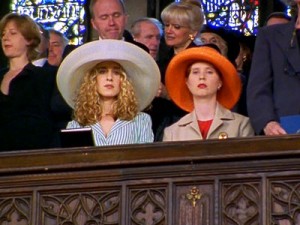 That’s about it. And yet each of those things are, to be fair, important moments in the series. Perhaps exemplary of the “spiritual but not religious” lifestyle, Carrie and her friends constantly wrestle with big questions, with living lives that matter. And they don’t really rely on religion to do it. The only possible exception is when Charlotte and Harry briefly separate and her friends assume that she’ll drop her Judaism. She doesn’t. And in fact, it is how they find each other again at the synagogue’s singles night.
So what? It was just a summer fling, my project of re-watching. It might not mean much, but I know that there aren’t enough good depictions of women’s friendships on television right now. This series didn’t do everything perfectly, but it did a whole lot right. It’s on regular rotation in syndication on any number of cable and satellite channels these days, which I hope means that a new generation gets to discover these women and their lives.
Previous Post

July 31, 2014
"Christians Get In Jacked-Up Situations, Too"
Next Post

August 18, 2014 Voices on Ferguson
Browse Our Archives
Select a Category Abortion At the Intersections Atheism Christianity Contraception Education Feminism Gender Getting Theological Honorable Mention Islam LGBT News Our Voices Race Uncategorized
Select a Month July 2017 June 2017 May 2017 March 2017 February 2017 January 2017 August 2016 July 2016 June 2016 May 2016 April 2016 March 2016 February 2016 January 2016 December 2015 November 2015 October 2015 September 2015 August 2015 July 2015 June 2015 May 2015 April 2015 March 2015 February 2015 January 2015 December 2014 November 2014 October 2014 September 2014 August 2014 July 2014 June 2014 May 2014 April 2014 March 2014 February 2014 January 2014 December 2013 November 2013 October 2013 September 2013 August 2013 July 2013 June 2013 May 2013 April 2013 March 2013 February 2013 January 2013 December 2012 November 2012 October 2012 September 2012 August 2012 July 2012
Follow Us!
TAKE THE
Religious Wisdom Quiz
What does "Abraham" mean?
Select your answer to see how you score.
Father of Many Man of Wisdom King of Peace Chosen One
Related posts from Caryn Riswold

What I Won’t Write About Mary Daly for...

Freedom & the Racialized Body: Resonances with Luther...

Active in Love: The ELCA on Faith, Sexism,...

Feminist, Interfaith, Public: My Luther Year
TRENDING AT PATHEOS Progressive Christian

Why Christians Have a Sacred Duty to Vote:...
The Bible offers strong support for the sacred duty to vote. Here...

What Being a Modern-Day Apostle Means to Me
In my last column, I discussed the ins and outs of modern-day...

Did Ancient China Once Worship the God of...
Across human history, a common thread weaves through the origins of the...

Love Your Neighbor – Including Earth-Kin: Lev. 19,...
God’s command to love your neighbor means acting in an ethical and...

Lead a Church Study of “Jesus and Lao...
Guest writer Jack Thomas (The Irreverent Reverend) reflects on leading his church...

Principles for Understanding the Apostolic Ministry Today
Whenever people discover that my formal ministry title is "apostle," as in...
view all Progressive Christian blogs
Ad-Free & Subscriber Log-In Subscription Support
- About Us
- 2026 Calendar
- Videos
- Podcasts
- Library of World Religions
- Faith In Media Tracker
- Advertise With Us
- Write for Us
- Privacy Policy
- Terms of Service
- Do Not Sell My Data
- Contact Us
- Radiant Digital
- Manage Newsletter Subscriptions
- Unsubscribe From Notifications
- Sitemap
Copyright 2008-2026, Patheos. All rights reserved.
Subscription Support Ad-Free & Subscriber Log-In
Follow Patheos