
BuddhistCatholicContemplativeEvangelicalGeneral ChristianHinduJewishLatter-day SaintMuslimNew VisionsProgressive Christian
Beliefs
- Buddhist
- Catholic
- Contemplative
- Evangelical
- General Christian
- Hindu
- Jewish
- Latter-day Saint
- More Voices
- Muslim
- New Visions
- Pagan
- Progressive Christian
Topics
- Religion News
- Food and Religion
- Sports and Religion
- Religious Art
- Religious Music and Entertainment
- Religious Events
- History and Religion
- Style and Religion
- Politics and Religion
- Women in Religion
- Recreation Outdoors and Religion
- Business Finance and Religion
- Careers Workplace and Religion
- Education and Religion
- Family Parenting and Religion
- Health Fitness and Religion
- Home and Religion
- Relationships and Religion
- Technology and Religion
- Travel and Religion
Columnists
- Buddhist Columnists
- Business Finance and Religion Columnists
- Careers Workplace and Religion Columnists
- Catholic Columnists
- Contemplative Columnists
- Education and Religion Columnists
- Evangelists Columnists
- Family Parenting and Religion Columnists
- General Christian Columnists
- Health Fitness and Religion Columnists
- Hindu Columnists
- History and Religion Columnists
- Home and Religion Columnists
- Jewish Columnists
- More Voices Columnists
- Latter Day Columnists
- Muslim Columnists
- New Visions Columnists
- Nonreligious Columnists
- Pagan Columnists
- Politics and Religion Columnists
- Progressive Columnists
- Recreation Outdoors and Religion Columnists
- Relationships and Religion Columnists
- Religion News Columnists
- Religious Art Columnists
- Religious Events Columnists
- Religious Music and Entertainment Columnists
- Sports and Religion Columnists
- Style and Religion Columnists
- Technology and Religion Columnists
- Travel and Religion Columnists
- Women in Religion Columnists
Resource Library
- 2026 Calendar
- Library of World Religions
- The 100 Most Holy Places on Earth
- Patheos Answers
- Podcasts
- Videos
- Faith Leaders Database
- Anglican Episcopalian
- Bahai
- Baptist
- Buddhism
- Christianity
- Confucianism
- Eastern Orthodoxy
- Hinduism
- Holiness and Pentecostal
- ISKCON
- Islam
- Judaism
- Lutheran
- Methodist
- The Church of Jesus Christ of Latter-day Saints
- New Age
- Paganism
- Presbytarian and Reformed
- Protestantism
- Religion Behind the Scenes
- Roman Catholic
- Scientology
- Shia Islam
- Sikhism
- Sufism
- Sunni Islam
- Taoism
- Zen
- See all religions
Research Tools
 Ad-Free & Subscriber Log-In Subscription Support
Ad-Free & Subscriber Log-In Subscription Support
Follow Patheos 

- Trending:
- Forgiveness
- |
- Marriage
- |
- Consciousness
- |
- Death Penalty
- |
- Election
- |
- Halloween
 Caryn Riswold
- Home
- Progressive Christian
- Food & Faith, Diversity & Service: All in A Semester’s Work
Food & Faith, Diversity & Service: All in A Semester’s Work
Last updated on: November 14, 2013 at 1:01 pm by Caryn Riswold
Food & Faith, Diversity & Service: All in A Semester’s Work 2013-11-14T13:01:46-07:00 Caryn Riswold
Patheos Explore the world's faith through different perspectives on religion and spirituality! Patheos has the views of the prevalent religions and spiritualities of the world.
Last week I attended the Association for Interdisciplinary Studies and presented with a colleague about some of our work teaching a first year learning community as part of our institution’s general education program. Here are excerpts from my part, focusing on food and faith, diversity and service:
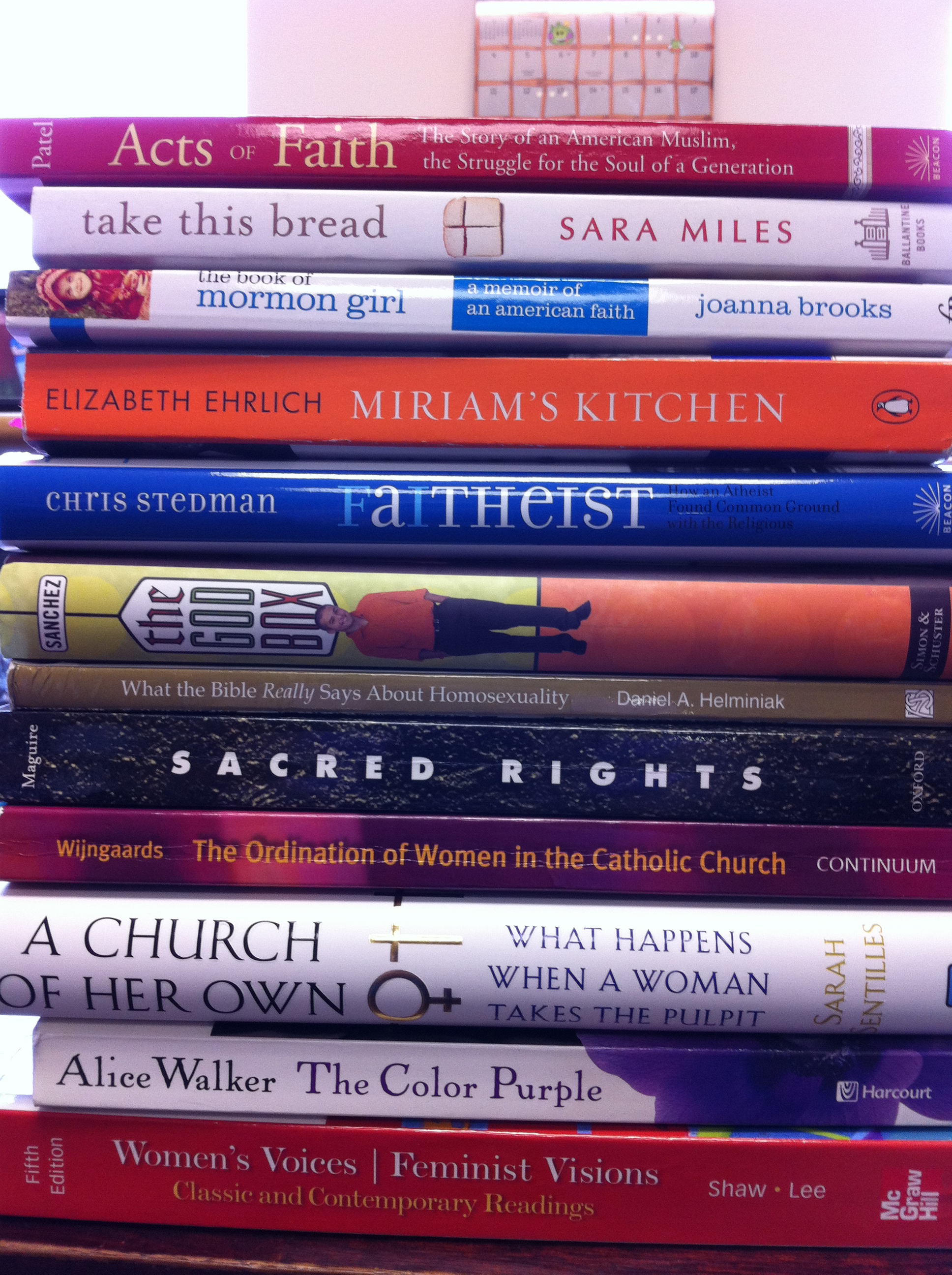 While teaching a religion & literature course last fall, I realized how many of the six memoirs we were reading mentioned or even centered around food as identity marker.
This isn’t an accident: In most major religions, food is a central marker of identity, from dietary restrictions to sacred ritual itself. It is where and when the world is ingested into the body, demanding respect and care in the case of Jewish kosher or Muslim halal butchering, or the prohibition of animal products altogether in the case of Buddhist vegetarianism, or where the substance of the food is transformed and the divine itself becomes a part of the believer, in the case of the Christian eucharist. Beliefs and practices related to food are indicators of theological and ethical commitments of a religion and of an individual believer.
At the same time, I have a colleague who has taught an English course on the rhetoric of the edible in several variations. She also collaborated to lead an international study experience on food and culture in central Europe this past summer. Our partnership, linking her composition course with my religion course, seemed inevitable.
I titled the First Year Seminar I’m teaching now “Food, Faith, and Justice in Autobiographies.” It’s a religion course and the texts are: Acts of Faith, by Muslim Eboo Patel, Take this Bread by Episcopalian Sara Miles, Miriam’s Kitchen by Jewish Elizabeth Ehrlich, The Book of Mormon Girl by Joanna Brooks, and Faitheist, by Chris Stedman, Assistant Humanist Chaplain at Harvard. With each text, I include a session of basic instruction on the religion itself: key moments in the history of each religion, key terminology, significant figures, central beliefs. One goal is that by the end of this course, students will be familiar in a basic way with five distinct traditions.
This is crucial in part because rates of religious illiteracy are amazingly low in a country which is one of the most religious in the world. In 2007, USAToday proclaimed that “Americans Get an F in Religion.” There are several statistics that illustrate the problem: of 1,000 high schoolers surveyed, only 36% know that Ramadan is the Islamic holy month, and 17% think it is the Jewish day of atonement. 60% of Americans can’t name five of the ten commandments, and half of high school seniors think that Sodom and Gomorrah were married.
 One required element of Illinois College’s BLUEprint general education program is U.S. diversity and global awareness, and while all first year students are introduced to basic diversity issues in every seminar, I chose to make religious diversity a focus in my seminar by bringing in texts from five different traditions.
Seeing that there are shared values and journeys between Muslims, Jews, atheists, Episcopalians, and Mormons is foundational. Not only are my students being introduced to information about religions, through personal stories they are invited to see how human identity takes shape. In the first year, the first semester of college, the questions of who am I?, where do I come from?, where am I going?, and, why? … are central questions. These texts give students multiple viewpoints, five diverse and thoughtful companions for the discernment process in which they are enmeshed. It’s not about who is right and wrong. It’s about the process of learning and discerning.
On service:
Because the ability to understand and address social problems is essential for a 21st century college graduate, every Illinois College student in every first year seminar is required to participate in a one-day service blitz, read Adam Davis’ article on “What We Don’t Talk About When We Don’t Talk About Service,” and engage in reflection on the experience. I amplified this focus on service in my seminar, in part based on Sara Miles’ story. Because the eucharist is central to her experience of becoming Christian, she started a food pantry at her church, and eventually expanded her work to start and sustain more than a dozen pantries in the San Francisco bay area. For her this is a religious activity, following the instruction from Jesus to “feed my sheep.”
Students in my seminar each served in one of three local nonprofit agencies’ food programs: The Food Center (a local food bank), New Directions (a homeless shelter that serves an evening meal), and the Jacksonville Congregational Church’s weekend sack lunch program, serving all those in need. 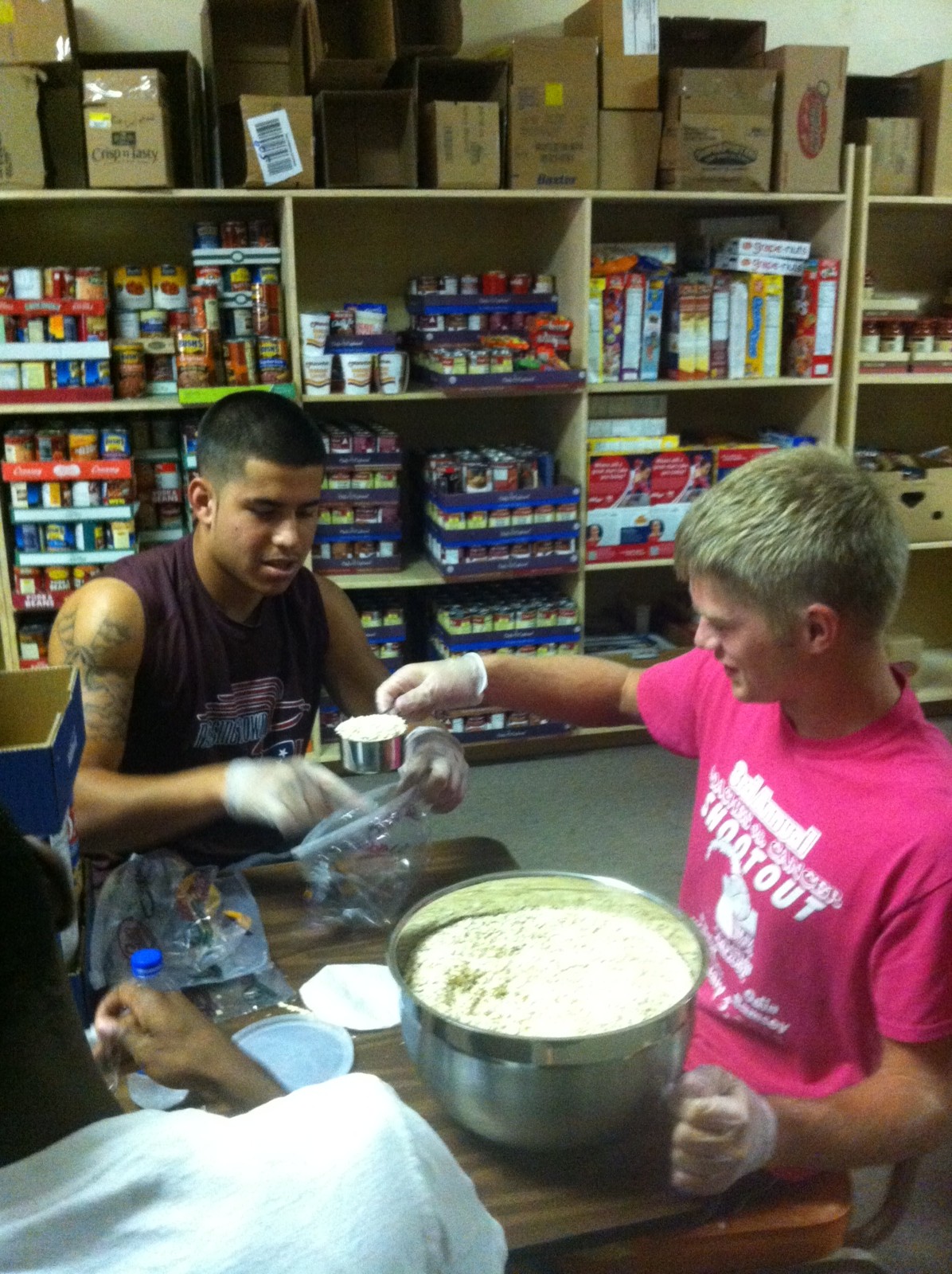 Students went with a partner or small group at least three times to their assigned location, did basic research on the agency and the issue on which it focuses (children , the elderly, homeless, etc.), and then wrote a reflection paper and did a group presentation on their experiences.
This assignment and project integrated the arts and sciences by using spiritual memoir as opportunity to talk about sociological realities. It integrated the college experience with the local community by making three hours of off-campus service required for a course grade. It encouraged students to consider their role in the world, and put into practice something we read about for class discussion. It puts students in the middle of a basic social problem: poverty and food access. And it embodied multiple components of the BLUEprint, civic engagement, U.S. diversity, social and spiritual issues, and requiring that the students use and develop skills like critical thinking, writing, collaboration, and speaking.
More importantly, students were transformed. In attitude, from thinking that the people at the church were judgmental to appreciating what they do to help hungry people, and in action by sustaining the commitment to show up and volunteer even after the required hours were over.
We did a lot of cool stuff with our learning community this fall. To read about our HairRaising service experience, click here.
Association for Interdisciplinary Studies
Previous Post

November 7, 2013
Learning (and Teaching) in Community
Next Post

November 18, 2013 Speaking Her Story
Browse Our Archives
Select a Category Abortion At the Intersections Atheism Christianity Contraception Education Feminism Gender Getting Theological Honorable Mention Islam LGBT News Our Voices Race Uncategorized
Select a Month July 2017 June 2017 May 2017 March 2017 February 2017 January 2017 August 2016 July 2016 June 2016 May 2016 April 2016 March 2016 February 2016 January 2016 December 2015 November 2015 October 2015 September 2015 August 2015 July 2015 June 2015 May 2015 April 2015 March 2015 February 2015 January 2015 December 2014 November 2014 October 2014 September 2014 August 2014 July 2014 June 2014 May 2014 April 2014 March 2014 February 2014 January 2014 December 2013 November 2013 October 2013 September 2013 August 2013 July 2013 June 2013 May 2013 April 2013 March 2013 February 2013 January 2013 December 2012 November 2012 October 2012 September 2012 August 2012 July 2012
Follow Us!
TAKE THE
Religious Wisdom Quiz
Who was the first Nazarite?
Select your answer to see how you score.
David Samuel Samson Eli
Related posts from Caryn Riswold

What I Won’t Write About Mary Daly for...

We Need To Dance at Each Other’s Weddings

Freedom & the Racialized Body: Resonances with Luther...

Active in Love: The ELCA on Faith, Sexism,...
TRENDING AT PATHEOS Progressive Christian

Why Christians Have a Sacred Duty to Vote:...
The Bible offers strong support for the sacred duty to vote. Here...

What Being a Modern-Day Apostle Means to Me
In my last column, I discussed the ins and outs of modern-day...

Did Ancient China Once Worship the God of...
Across human history, a common thread weaves through the origins of the...

Love Your Neighbor – Including Earth-Kin: Lev. 19,...
God’s command to love your neighbor means acting in an ethical and...

Lead a Church Study of “Jesus and Lao...
Guest writer Jack Thomas (The Irreverent Reverend) reflects on leading his church...

Principles for Understanding the Apostolic Ministry Today
Whenever people discover that my formal ministry title is "apostle," as in...
view all Progressive Christian blogs
Ad-Free & Subscriber Log-In Subscription Support
- About Us
- 2026 Calendar
- Videos
- Podcasts
- Library of World Religions
- Faith In Media Tracker
- Advertise With Us
- Write for Us
- Privacy Policy
- Terms of Service
- Do Not Sell My Data
- Contact Us
- Radiant Digital
- Manage Newsletter Subscriptions
- Unsubscribe From Notifications
- Sitemap
Copyright 2008-2026, Patheos. All rights reserved.
Subscription Support Ad-Free & Subscriber Log-In
Follow Patheos