
BuddhistCatholicContemplativeEvangelicalGeneral ChristianHinduJewishLatter-day SaintMuslimNew VisionsProgressive Christian
Beliefs
- Buddhist
- Catholic
- Contemplative
- Evangelical
- General Christian
- Hindu
- Jewish
- Latter-day Saint
- More Voices
- Muslim
- New Visions
- Pagan
- Progressive Christian
Topics
- Religion News
- Food and Religion
- Sports and Religion
- Religious Art
- Religious Music and Entertainment
- Religious Events
- History and Religion
- Style and Religion
- Politics and Religion
- Women in Religion
- Recreation Outdoors and Religion
- Business Finance and Religion
- Careers Workplace and Religion
- Education and Religion
- Family Parenting and Religion
- Health Fitness and Religion
- Home and Religion
- Relationships and Religion
- Technology and Religion
- Travel and Religion
Columnists
- Buddhist Columnists
- Business Finance and Religion Columnists
- Careers Workplace and Religion Columnists
- Catholic Columnists
- Contemplative Columnists
- Education and Religion Columnists
- Evangelists Columnists
- Family Parenting and Religion Columnists
- General Christian Columnists
- Health Fitness and Religion Columnists
- Hindu Columnists
- History and Religion Columnists
- Home and Religion Columnists
- Jewish Columnists
- More Voices Columnists
- Latter Day Columnists
- Muslim Columnists
- New Visions Columnists
- Nonreligious Columnists
- Pagan Columnists
- Politics and Religion Columnists
- Progressive Columnists
- Recreation Outdoors and Religion Columnists
- Relationships and Religion Columnists
- Religion News Columnists
- Religious Art Columnists
- Religious Events Columnists
- Religious Music and Entertainment Columnists
- Sports and Religion Columnists
- Style and Religion Columnists
- Technology and Religion Columnists
- Travel and Religion Columnists
- Women in Religion Columnists
Resource Library
- 2026 Calendar
- Library of World Religions
- The 100 Most Holy Places on Earth
- Patheos Answers
- Podcasts
- Videos
- Faith Leaders Database
- Anglican Episcopalian
- Bahai
- Baptist
- Buddhism
- Christianity
- Confucianism
- Eastern Orthodoxy
- Hinduism
- Holiness and Pentecostal
- ISKCON
- Islam
- Judaism
- Lutheran
- Methodist
- The Church of Jesus Christ of Latter-day Saints
- New Age
- Paganism
- Presbytarian and Reformed
- Protestantism
- Religion Behind the Scenes
- Roman Catholic
- Scientology
- Shia Islam
- Sikhism
- Sufism
- Sunni Islam
- Taoism
- Zen
- See all religions
Research Tools
 Ad-Free & Subscriber Log-In Subscription Support
Ad-Free & Subscriber Log-In Subscription Support
Follow Patheos 

- Trending:
- Forgiveness
- |
- Marriage
- |
- Consciousness
- |
- Death Penalty
- |
- Election
- |
- Halloween
 Caryn Riswold
- Home
- Progressive Christian
- Race, Class, & J.K. Rowling
Race, Class, & J.K. Rowling
Last updated on: September 23, 2013 at 7:57 pm by Caryn Riswold
Race, Class, & J.K. Rowling 2013-09-23T19:57:09-06:00 Caryn Riswold
Patheos Explore the world's faith through different perspectives on religion and spirituality! Patheos has the views of the prevalent religions and spiritualities of the world.
 I finally got a chance to read The Casual Vacancy, J.K. Rowling’s first published non-Harry Potter book, and I’m trying to remember why it got lackluster reviews. But I don’t want to go back and read any of them because I found it captivating.
Maybe it was too soon on the heels of Hogwarts, or maybe it was too edgy for the fans of her young adult fiction. But I thought it shared so much that was compelling about the Harry Potter series if you paid enough attention. From the craft of her writing to the social commentary embedded in each, Rowling is emerging in my mind as a contemporary novelist to be studied.
I’m not an expert in the craft of writing, but I write enough and read enough about writing to recognize good stuff when I see it. Rowling’s style clearly opts for symbolic names, and we see this in The Casual Vacancy from the heroic dead man named Fairbrother, to the ethereal teen beauty named Gaia, to the corrupt money scamming Simon Price. Remember the moony and sweet Luna Lovegood in Harry Potter? Or the geeky Weasley brothers? And of course Voldemort himself, who takes us all on a flight to death (vol de mort). Rowling writes in short focused chapters and uses vivid descriptions of bodies and physical manifestation of characters’ emotional and mental issues. She manages a large cast of characters in each, and in The Casual Vacancy figured out how to use shifting point of view quickly, deftly, and effectively.
But it’s the social commentary embedded in each world that pushes her work to another more interesting level. The Casual Vacancy is a tightly wound dramatic tale of a community fractured along lines of social class. The death of Barry Fairbrother creates a vacancy on the Pagford Town Council, effectively shifting an upcoming vote on whether or not to continue to incorporate and thus support The Fields. This is the impoverished neighborhood sitting between the idyllic Pagford and the midsize town of Yarvil, home to families in need of public aid, no shortage of small time criminals, and an addiction recovery clinic. It’s the kind of world that most of the smug self-assured controlled Pagford residents would like to remain invisible. In this way, the novel captures ugly conversations common to many state and local debates around public aid, economic inequality, crime, and substance abuse.
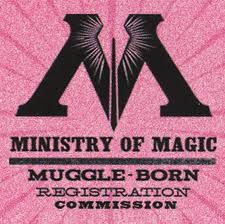 If The Casual Vacancy is all about class, the world of Harry Potter is at least in part about race. Anyone not a witch or wizard is a “muggle” or more negatively (and revealingly) a “mudblood.” Much of the dramatic conflict centered around the fact that Voldemort himself is the son of a muggle and a witch, thus making him a mudblood. The desire of some elements of the wizarding world to register, segregate, and eventually eliminate muggles and only acknowledge purebloods reflects many of the more horrific chapters of human history around blood and race purity.
In the Harry Potter books as well as in The Casual Vacancy, Rowling shows keen insight into how a younger generation inherits the consequences of their parents conflicts. In fact, it is the youth in both worlds who take imperfect action, confront troubling truths head-on, and bring about the final dramatic conflict that not all survive. It wasn’t perfectly tied up, and there was at least one story that I wish had been fleshed out more … because if you’re going to include an intersex character in a book, don’t let the opportunity for humanizing vanish.
Rowling also doesn’t shy away from death. In these worlds as in ours, conflict is real and it has consequences. Lives are lost, and the deaths are not trite or gratuitous. They are tragic and readers mourn. At least this one did. I found myself wishing desperately at the end of The Casual Vacancy that one of the mothers could summon up Mrs. Weasley’s wand and shout, “Not My Daughter, You Bitch!” so that her teen might not have to pay the price for others’ tragic flaws and mistakes.
But magic doesn’t intervene in Pagford or in our daily lives. We confront our own consequences and live with complex social problems that we often ignore and perpetuate. Identities take shape in a world where race and class matter, and J.K. Rowling has found a way to write stories that ring true whether set in magical worlds or a familiar small town.
Because they’re fundamentally about us.
Previous Post

September 20, 2013
Sexism & Churches: A Twitterview with Sarah Sentilles
Next Post

September 25, 2013 Subservient or Subversive, The Butler Works in a Man's World
Browse Our Archives
Select a Category Abortion At the Intersections Atheism Christianity Contraception Education Feminism Gender Getting Theological Honorable Mention Islam LGBT News Our Voices Race Uncategorized
Select a Month July 2017 June 2017 May 2017 March 2017 February 2017 January 2017 August 2016 July 2016 June 2016 May 2016 April 2016 March 2016 February 2016 January 2016 December 2015 November 2015 October 2015 September 2015 August 2015 July 2015 June 2015 May 2015 April 2015 March 2015 February 2015 January 2015 December 2014 November 2014 October 2014 September 2014 August 2014 July 2014 June 2014 May 2014 April 2014 March 2014 February 2014 January 2014 December 2013 November 2013 October 2013 September 2013 August 2013 July 2013 June 2013 May 2013 April 2013 March 2013 February 2013 January 2013 December 2012 November 2012 October 2012 September 2012 August 2012 July 2012
Follow Us!
TAKE THE
Religious Wisdom Quiz
What river did John baptize Jesus in?
Select your answer to see how you score.
Nile River Tigris River Jordan River Red Sea
Related posts from Caryn Riswold

What I Won’t Write About Mary Daly for...

Freedom & the Racialized Body: Resonances with Luther...

Active in Love: The ELCA on Faith, Sexism,...

Feminist, Interfaith, Public: My Luther Year
TRENDING AT PATHEOS Progressive Christian

What Being a Modern-Day Apostle Means to Me
In my last column, I discussed the ins and outs of modern-day...

Did Ancient China Once Worship the God of...
Across human history, a common thread weaves through the origins of the...

Love Your Neighbor – Including Earth-Kin: Lev. 19,...
God’s command to love your neighbor means acting in an ethical and...

Lead a Church Study of “Jesus and Lao...
Guest writer Jack Thomas (The Irreverent Reverend) reflects on leading his church...

Pastoral Wisdom for Responding to Sermon Pushback
Getting sermon pushback on your social justice sermon? Learn practical, Proverbs-based strategies...

Principles for Understanding the Apostolic Ministry Today
Whenever people discover that my formal ministry title is "apostle," as in...
view all Progressive Christian blogs
Ad-Free & Subscriber Log-In Subscription Support
- About Us
- 2026 Calendar
- Videos
- Podcasts
- Library of World Religions
- Faith In Media Tracker
- Advertise With Us
- Write for Us
- Privacy Policy
- Terms of Service
- Do Not Sell My Data
- Contact Us
- Radiant Digital
- Manage Newsletter Subscriptions
- Unsubscribe From Notifications
- Sitemap
Copyright 2008-2026, Patheos. All rights reserved.
Subscription Support Ad-Free & Subscriber Log-In
Follow Patheos