
BuddhistCatholicContemplativeEvangelicalGeneral ChristianHinduJewishLatter-day SaintMuslimNew VisionsProgressive Christian
Beliefs
- Buddhist
- Catholic
- Contemplative
- Evangelical
- General Christian
- Hindu
- Jewish
- Latter-day Saint
- More Voices
- Muslim
- New Visions
- Pagan
- Progressive Christian
Topics
- Religion News
- Food and Religion
- Sports and Religion
- Religious Art
- Religious Music and Entertainment
- Religious Events
- History and Religion
- Style and Religion
- Politics and Religion
- Women in Religion
- Recreation Outdoors and Religion
- Business Finance and Religion
- Careers Workplace and Religion
- Education and Religion
- Family Parenting and Religion
- Health Fitness and Religion
- Home and Religion
- Relationships and Religion
- Technology and Religion
- Travel and Religion
Columnists
- Buddhist Columnists
- Business Finance and Religion Columnists
- Careers Workplace and Religion Columnists
- Catholic Columnists
- Contemplative Columnists
- Education and Religion Columnists
- Evangelists Columnists
- Family Parenting and Religion Columnists
- General Christian Columnists
- Health Fitness and Religion Columnists
- Hindu Columnists
- History and Religion Columnists
- Home and Religion Columnists
- Jewish Columnists
- More Voices Columnists
- Latter Day Columnists
- Muslim Columnists
- New Visions Columnists
- Nonreligious Columnists
- Pagan Columnists
- Politics and Religion Columnists
- Progressive Columnists
- Recreation Outdoors and Religion Columnists
- Relationships and Religion Columnists
- Religion News Columnists
- Religious Art Columnists
- Religious Events Columnists
- Religious Music and Entertainment Columnists
- Sports and Religion Columnists
- Style and Religion Columnists
- Technology and Religion Columnists
- Travel and Religion Columnists
- Women in Religion Columnists
Resource Library
- 2026 Calendar
- Library of World Religions
- The 100 Most Holy Places on Earth
- Patheos Answers
- Podcasts
- Videos
- Faith Leaders Database
- Anglican Episcopalian
- Bahai
- Baptist
- Buddhism
- Christianity
- Confucianism
- Eastern Orthodoxy
- Hinduism
- Holiness and Pentecostal
- ISKCON
- Islam
- Judaism
- Lutheran
- Methodist
- The Church of Jesus Christ of Latter-day Saints
- New Age
- Paganism
- Presbytarian and Reformed
- Protestantism
- Religion Behind the Scenes
- Roman Catholic
- Scientology
- Shia Islam
- Sikhism
- Sufism
- Sunni Islam
- Taoism
- Zen
- See all religions
Research Tools
 Ad-Free & Subscriber Log-In Subscription Support
Ad-Free & Subscriber Log-In Subscription Support
Follow Patheos 

- Trending:
- Forgiveness
- |
- Marriage
- |
- Consciousness
- |
- Death Penalty
- |
- Election
- |
- Halloween
 Caryn Riswold
- Home
- Progressive Christian
- Justice for Chelsea? Lutheran Theology and Trans*Activism
Justice for Chelsea? Lutheran Theology and Trans*Activism
Last updated on: September 18, 2013 at 8:30 am by Caryn Riswold
Justice for Chelsea? Lutheran Theology and Trans*Activism 2013-09-15T13:12:30-06:00 Caryn Riswold
Patheos Explore the world's faith through different perspectives on religion and spirituality! Patheos has the views of the prevalent religions and spiritualities of the world.
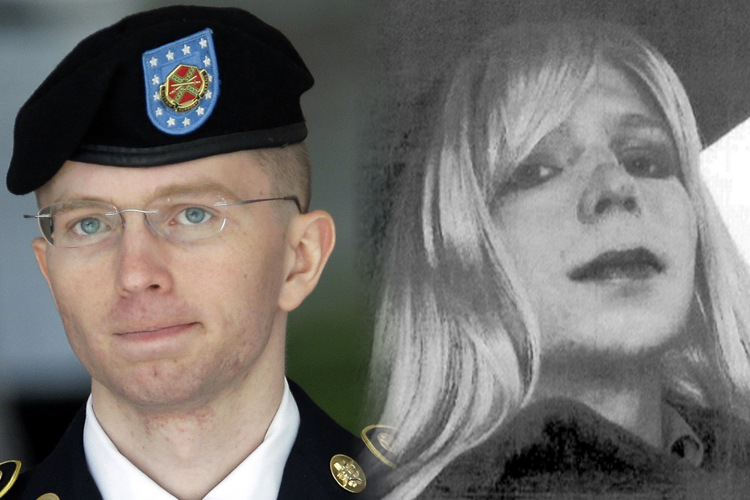 As the trial of Private Manning concluded this August, the convictions on more than 20 counts turned out not to be the big story for many. Through lawyers, she issued a statement about her gender identity along with a request for the media to use her preferred name, Chelsea:
“As I transition into this next phase of my life, I want everyone to know the real me. I am Chelsea Manning. I am a female. Given the way that I feel, and have felt since childhood, I want to begin hormone therapy as soon as possible. I hope that you will support me in this transition. I also request that, starting today, you refer to me by my new name and use the feminine pronoun (except in official mail to the confinement facility).”
This wasn’t news to anyone who had been following alternative media sources for years throughout the case. And now, questions about justice for this convicted criminal, questions about what constitutes humane treatment for a transgender person in a military prison, emerge. Will she have access to hormone therapy? Can she use her self-chosen name? Will she have basic protection from violence and other harm?
 In this month’s issue of the Journal of Lutheran Ethics, I have an article titled “Being Woman, Being Human, Doing Justice” in which I bring trans* issues into conversation with Lutheran theological resources around the question of gender justice.
Can’t believe that’s possible? Here’s a bit:
The basic idea [from Luther] is that as human beings, we exist in relationship. This is not unlike [Judith] Butler’s claim that we don’t do gender alone. [Gerhard] Ebeling uses Luther’s Latin phrasing when he specifies that our relationality extends in four main directions: coram Deo – in relationship with God, coram mundo – in relationship with the material world, coram hominibus– in relationship with other people, and coram meipso – in relationship with one’s self. This gives us tools to reconcile the created-claim with our understanding of the socially-constructed reality. Humans are created (Deo) to be in relationship with other people (hominibus) and the world (mundo). The latter two can be seen as the “sociality” of which Butler speaks, the location of social construction and, we might theologically note, a location of sin.
Perhaps social construction, of gender, of race, of class and other things, can also be seen as part of this world. Like civil government, the family, and other institutions Luther and Augustine ascribed to the kingdom of this world, flawed insofar as they are human-made, they are things through which God works toward justice. The human body itself is a temporal reality through which God works, via the incarnation, to bring about spiritual ends. A gendered body is one of these temporal realities.
As Butler describes it, “Gender is the apparatus by which the production and normalization of masculine and feminine take place along with the interstitial forms of hormonal, chromosomal, psychic, and performative that gender assumes.”
Along with being produced and performed, gender also involves hormonal and chromosomal elements. It is the biological body within the social reality. Similarly, Lutheran theologian Mary Elise Lowe states in a 2009 article that “queer theorists also assert that human identity is unstable and that individual subjects come to be amidst discourses such as law, medicine, economics, and religion.”
In referring to individual subjects, Lowe turns attention to our self-understanding and awareness. This is fundamental in discussions of gender identity, personal identity, and it is what Luther sees as human life coram meipso.
How does our theological and political advocacy advance justice for women when the category of ‘woman’ is complicated by looking at the confluence of, as Butler notes, hormones, chromosomes, psychic, and performative reality? Or, taking into account, as Lowe names, discourses of law, medicine, economics, and religion?
What is a woman? Really?
In the article, I then turn to discussions about queer theory and trans* scholarly activism, using work like Julia Serano’s 2007 book Whipping Girl:
Serano actually challenges strict social constructionism when it comes to understanding gender. Here is how she describes the term trans and the reality it reflects:
“I will use the word trans to refer to people who (to varying degrees) struggle with a subconscious understanding or intuition that there is something ‘wrong’ with the sex they were assigned at birth and/or who feel that they should have been born as or wish they could be the other sex.”
In other words, she says, “their subconscious sex does not match their physical sex.” One of the things this reveals is that gender and sex are not, and trans* people tell us cannot be, completely socially constructed. If it could, in our heteronormative patriarchal culture, there would be no such thing as a trans* person. A profound sense of self, at odds with the body, is the key indicator. This is a powerful example of human life coram meipso.
Serano uses language of “intrinsic inclination” alongside social construction. These inclinations, she says, “are likely to be hardwired into our brains (as they exist on a subconscious level and often remain constant throughout our lives),” though it remains true that “social factors clearly play a strong role in how each individual interprets these inclinations.” She points out that we rarely can tell the difference between the intrinsic and the social, and that “we only ever notice our inclinations when they are exceptional – when they deviate from both biological and social norms.” Many of us don’t notice them because we are “cissexual,” people “who are not transsexual and who have only ever experienced [our] subconscious and physical selves as being aligned.” We, who have experienced our inclinations as more or less matched up with our socially prescribed roles, and our physical bodies, rarely think about them as different or even conflicting things.
Unusual conversation partners, perhaps, Martin Luther, Judith Butler, and Julia Serano. But I think that understanding and dismantling cissexism is going to take a lot of work and as many resources as we can muster. How else can we figure out what justice looks like for a trans* woman like Chelsea Manning, convicted, transitioning, and residing decades in a military prison?
I encourage you to head over to the Journal of Lutheran Ethics for the rest of my article, and to read more articles on gender justice by other creative and compelling scholars.
Previous Post

September 15, 2013
Yes, NALT, but SSA, and WAY?
Next Post

September 20, 2013 Sexism & Churches: A Twitterview with Sarah Sentilles
Browse Our Archives
Select a Category Abortion At the Intersections Atheism Christianity Contraception Education Feminism Gender Getting Theological Honorable Mention Islam LGBT News Our Voices Race Uncategorized
Select a Month July 2017 June 2017 May 2017 March 2017 February 2017 January 2017 August 2016 July 2016 June 2016 May 2016 April 2016 March 2016 February 2016 January 2016 December 2015 November 2015 October 2015 September 2015 August 2015 July 2015 June 2015 May 2015 April 2015 March 2015 February 2015 January 2015 December 2014 November 2014 October 2014 September 2014 August 2014 July 2014 June 2014 May 2014 April 2014 March 2014 February 2014 January 2014 December 2013 November 2013 October 2013 September 2013 August 2013 July 2013 June 2013 May 2013 April 2013 March 2013 February 2013 January 2013 December 2012 November 2012 October 2012 September 2012 August 2012 July 2012
Follow Us!
TAKE THE
Religious Wisdom Quiz
Why did God command the Israelites to eat unleavened bread?
Select your answer to see how you score.
Yeast was considered unclean It was a symbol of humility They had to leave Egypt quickly It was the only bread they knew how to make
Related posts from Caryn Riswold

What I Won’t Write About Mary Daly for...

We Need To Dance at Each Other’s Weddings

Freedom & the Racialized Body: Resonances with Luther...

Active in Love: The ELCA on Faith, Sexism,...
TRENDING AT PATHEOS Progressive Christian

Why Christians Have a Sacred Duty to Vote:...
The Bible offers strong support for the sacred duty to vote. Here...

What Being a Modern-Day Apostle Means to Me
In my last column, I discussed the ins and outs of modern-day...

Did Ancient China Once Worship the God of...
Across human history, a common thread weaves through the origins of the...

Love Your Neighbor – Including Earth-Kin: Lev. 19,...
God’s command to love your neighbor means acting in an ethical and...

Lead a Church Study of “Jesus and Lao...
Guest writer Jack Thomas (The Irreverent Reverend) reflects on leading his church...

Principles for Understanding the Apostolic Ministry Today
Whenever people discover that my formal ministry title is "apostle," as in...
view all Progressive Christian blogs
Ad-Free & Subscriber Log-In Subscription Support
- About Us
- 2026 Calendar
- Videos
- Podcasts
- Library of World Religions
- Faith In Media Tracker
- Advertise With Us
- Write for Us
- Privacy Policy
- Terms of Service
- Do Not Sell My Data
- Contact Us
- Radiant Digital
- Manage Newsletter Subscriptions
- Unsubscribe From Notifications
- Sitemap
Copyright 2008-2026, Patheos. All rights reserved.
Subscription Support Ad-Free & Subscriber Log-In
Follow Patheos