
BuddhistCatholicContemplativeEvangelicalGeneral ChristianHinduJewishLatter-day SaintMuslimNew VisionsProgressive Christian
Beliefs
- Buddhist
- Catholic
- Contemplative
- Evangelical
- General Christian
- Hindu
- Jewish
- Latter-day Saint
- More Voices
- Muslim
- New Visions
- Pagan
- Progressive Christian
Topics
- Religion News
- Food and Religion
- Sports and Religion
- Religious Art
- Religious Music and Entertainment
- Religious Events
- History and Religion
- Style and Religion
- Politics and Religion
- Women in Religion
- Recreation Outdoors and Religion
- Business Finance and Religion
- Careers Workplace and Religion
- Education and Religion
- Family Parenting and Religion
- Health Fitness and Religion
- Home and Religion
- Relationships and Religion
- Technology and Religion
- Travel and Religion
Columnists
- Buddhist Columnists
- Business Finance and Religion Columnists
- Careers Workplace and Religion Columnists
- Catholic Columnists
- Contemplative Columnists
- Education and Religion Columnists
- Evangelists Columnists
- Family Parenting and Religion Columnists
- General Christian Columnists
- Health Fitness and Religion Columnists
- Hindu Columnists
- History and Religion Columnists
- Home and Religion Columnists
- Jewish Columnists
- More Voices Columnists
- Latter Day Columnists
- Muslim Columnists
- New Visions Columnists
- Nonreligious Columnists
- Pagan Columnists
- Politics and Religion Columnists
- Progressive Columnists
- Recreation Outdoors and Religion Columnists
- Relationships and Religion Columnists
- Religion News Columnists
- Religious Art Columnists
- Religious Events Columnists
- Religious Music and Entertainment Columnists
- Sports and Religion Columnists
- Style and Religion Columnists
- Technology and Religion Columnists
- Travel and Religion Columnists
- Women in Religion Columnists
Resource Library
- 2026 Calendar
- Library of World Religions
- The 100 Most Holy Places on Earth
- Patheos Answers
- Podcasts
- Videos
- Faith Leaders Database
- Anglican Episcopalian
- Bahai
- Baptist
- Buddhism
- Christianity
- Confucianism
- Eastern Orthodoxy
- Hinduism
- Holiness and Pentecostal
- ISKCON
- Islam
- Judaism
- Lutheran
- Methodist
- The Church of Jesus Christ of Latter-day Saints
- New Age
- Paganism
- Presbytarian and Reformed
- Protestantism
- Religion Behind the Scenes
- Roman Catholic
- Scientology
- Shia Islam
- Sikhism
- Sufism
- Sunni Islam
- Taoism
- Zen
- See all religions
Research Tools
 Ad-Free & Subscriber Log-In Subscription Support
Ad-Free & Subscriber Log-In Subscription Support
Follow Patheos 

- Trending:
- Forgiveness
- |
- Marriage
- |
- Consciousness
- |
- Death Penalty
- |
- Election
- |
- Halloween
 Caryn Riswold
- Home
- Progressive Christian
- At the Intersections: Response to Need
At the Intersections: Response to Need
Last updated on: August 12, 2013 at 8:30 am by Caryn Riswold
At the Intersections: Response to Need 2013-08-09T10:54:33-06:00 Caryn Riswold
Patheos Explore the world's faith through different perspectives on religion and spirituality! Patheos has the views of the prevalent religions and spiritualities of the world.
Many good people live and work at the intersections … of feminism and Christianity, of ministry and justice, of religion and politics, of gender and society, of race and inequality, of everything and then some. I’ve invited a few people to tell a story from their intersections, and will be sharing their stories from time to time here.
Today’s piece comes from Mary Beth Fraser Connolly, Assistant Director of the Lilly Fellows Program in Humanities and the Arts and instructor at Valparaiso University. She is also the author of the forthcoming book, Women of Faith, which she talks about here:
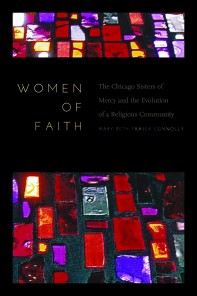 In 2006, I was hired to research and write the Chicago Sisters of Mercy’s history. The result of the project, Women of Faith: The Chicago Sisters of Mercy and the Evolution of a Religious Community, will come out in February 2014 from Fordham University Press. In the early days of the project, the Mercy editorial committee and I kicked around some titles until we landed upon one that ultimately was rejected by Fordham. We had everything from The Fourth Vow (the Sisters of Mercy unofficially have a fourth vow to service to women and children), to Response to Need, and to Led by Mercy. One should not underestimate the importance of a good title and Women of Faith works. Oddly enough the rejected titles may not work for bookselling or library cataloging, but they are not off the mark – thematically. Response to Need was particularly meaningful to me as I dove into the archives and attempted to pull together a thread or narrative of the Chicago Sisters of Mercy history from 1846 to 2008.
When I talk about the Chicago Sisters of Mercy, I mean the women of this regional community comprised of eight separate foundations, spanning from Chicago to Iowa City to Milwaukee and points in between. They had hospitals, academy schools for girls, parish schools for boys and girls, and a women’s college. Mercy Hospital Chicago and Iowa City, Saint Xavier University, and Mother McAuley High School in Chicago are still in operation, though not owned directly by the community. The Chicago Mercys’ history is long and finding that thread – that narrative – to make Women of Faith a manageable text was at times challenging. Response to Need kept coming to my mind. The Mercys were responding to a need, in 1846 and through 2008. They are still doing it today.
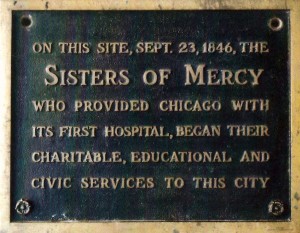
The sisters both past and present were with me, floating about my brain as I thought about how to be respectful and honest about their history. I must confess I am sympathetic to the history of women religious like the Chicago Mercys. I like them. I could give you a list a mile long as to why I do, but I recognize that there are many who have hard feelings about their time in Catholic parochial schools and can share a story or two about the demon nun who terrorized her students. It’s a complex history. Sometimes, however, the stories are straightforward examples of women who buoyed by their faith in God and the support of their sisters in community responded to a need regardless of the consequences.
One example I keep coming back to is that of Mother Agatha O’Brien, the first Reverend Mother of the Chicago South foundation. She entered the Sisters of Mercy in Ireland at sixteen as a lay sister, because she had a rudimentary education and no dowry. Lay sisters tended to be responsible for domestic duties and did not have the same status and voting rights as choir sisters, who brought dowries and had better educations. When the first Sisters of Mercy came to the United States to Pittsburgh, Pennsylvania in 1843, O’Brien went too as novice. O’Brien made her full profession as a choir sister right before a second foundation in Chicago was made. Her talents had elevated her in the eyes of her superiors and she was chosen to lead the new foundation, which consisted of four other sisters. O’Brien was only twenty-four. Under her leadership, the community opened a female academy, a handful of parish schools for poor immigrant children, and took over the only hospital in Chicago by 1852.
In these years, Chicago faced deadly cholera epidemics, usually hitting in the summer. In the summer of 1854, a cholera epidemic claimed the life of Mother Agatha O’Brien. She walked into a cholera ward in early July and the next day she died. Cholera was and is a terrible sickness. In the 1850s in Chicago, it was very deadly and the sister-nurses who operated Mercy Hospital knew this.
That month, the Mercys lost three other sisters and a parish priest to cholera. Why would anyone walk into a cholera ward, knowing they could contract the disease and die? Why did Mother Agatha? We could say she was a fool, or maybe she thought she was immune – it wasn’t the first cholera epidemic after all. Was she determined to help her fellow countrymen, the immigrant Irish, as she was also an ardent champion of a free Ireland? Maybe she was swept up in a romantic notion of religious life and dying in the course of her duty would be glorious? Maybe her faith in God carried her into that ward? Or was it her dedication to the charism of the Sisters of Mercy, her community’s foundress Catherine McAuley, and the vows she professed “to serve the poor, sick, and ignorant?” (The Mercys use “uneducated” these days.) There was a need, and Mother Agatha and her sisters in religion filled it.
This is a dramatic example and it is very easy to accept as an example of a good religious sister. Heck, she died while serving the poor and sick! There are other stories like this one – maybe not so deadly, but dramatic nonetheless. Other types of stories abound of sisters negotiating episcopal authority to achieve what they wanted. Reverend Bishop said no, the sisters found a way around him. The Mercys saw a need, they filled it. It is easy to admire these women for their strength, their championing of the poor, of women and children, in the face of patriarchal authority.
 We all like a good story and in the light of recent news of Nuns on the Bus, Network, and LCWR, seeing mature women of faith standing up to male authority – both ecclesial and state – it is very, well, satisfying. Look there; see how the good sisters are leading the way? Yes, we like that. Over the course of my research and writing, while compelled by the drama, I also marveled at the consistent presence of the Sisters of Mercy and how they keep faith with their founding charism. The sisters, who fed their students, gave them clothes, visited neighborhoods, nursed, taught, and spent time with those needing an ear, or a shoulder, did so without cameras and newspaper reporters. They don’t do it now for the press or accolades, but they are smart, savvy women who know how best to reach people and to respond to need where they see it. These are human women, not perfect, but human faithful women, dedicated to God, their church, their neighbors, and each other.
Yes, I like these Sisters of Mercy, these women of faith.
Previous Post

August 9, 2013
Honorable Mention: Southern Comfort
Next Post
August 14, 2013 A Church Assembles
Browse Our Archives
Select a Category Abortion At the Intersections Atheism Christianity Contraception Education Feminism Gender Getting Theological Honorable Mention Islam LGBT News Our Voices Race Uncategorized
Select a Month July 2017 June 2017 May 2017 March 2017 February 2017 January 2017 August 2016 July 2016 June 2016 May 2016 April 2016 March 2016 February 2016 January 2016 December 2015 November 2015 October 2015 September 2015 August 2015 July 2015 June 2015 May 2015 April 2015 March 2015 February 2015 January 2015 December 2014 November 2014 October 2014 September 2014 August 2014 July 2014 June 2014 May 2014 April 2014 March 2014 February 2014 January 2014 December 2013 November 2013 October 2013 September 2013 August 2013 July 2013 June 2013 May 2013 April 2013 March 2013 February 2013 January 2013 December 2012 November 2012 October 2012 September 2012 August 2012 July 2012
Follow Us!
TAKE THE
Religious Wisdom Quiz
What city was the capital of Israel before Jerusalem?
Select your answer to see how you score.
Shechem Jericho Hebron Bethel
Related posts from Caryn Riswold

What I Won’t Write About Mary Daly for...

We Need To Dance at Each Other’s Weddings

Freedom & the Racialized Body: Resonances with Luther...

Active in Love: The ELCA on Faith, Sexism,...
TRENDING AT PATHEOS Progressive Christian

Why Christians Have a Sacred Duty to Vote:...
The Bible offers strong support for the sacred duty to vote. Here...

What Being a Modern-Day Apostle Means to Me
In my last column, I discussed the ins and outs of modern-day...

Did Ancient China Once Worship the God of...
Across human history, a common thread weaves through the origins of the...

Love Your Neighbor – Including Earth-Kin: Lev. 19,...
God’s command to love your neighbor means acting in an ethical and...

Lead a Church Study of “Jesus and Lao...
Guest writer Jack Thomas (The Irreverent Reverend) reflects on leading his church...

Principles for Understanding the Apostolic Ministry Today
Whenever people discover that my formal ministry title is "apostle," as in...
view all Progressive Christian blogs
Ad-Free & Subscriber Log-In Subscription Support
- About Us
- 2026 Calendar
- Videos
- Podcasts
- Library of World Religions
- Faith In Media Tracker
- Advertise With Us
- Write for Us
- Privacy Policy
- Terms of Service
- Do Not Sell My Data
- Contact Us
- Radiant Digital
- Manage Newsletter Subscriptions
- Unsubscribe From Notifications
- Sitemap
Copyright 2008-2026, Patheos. All rights reserved.
Subscription Support Ad-Free & Subscriber Log-In
Follow Patheos