
BuddhistCatholicContemplativeEvangelicalGeneral ChristianHinduJewishLatter-day SaintMuslimNew VisionsProgressive Christian
Beliefs
- Buddhist
- Catholic
- Contemplative
- Evangelical
- General Christian
- Hindu
- Jewish
- Latter-day Saint
- More Voices
- Muslim
- New Visions
- Pagan
- Progressive Christian
Topics
- Religion News
- Food and Religion
- Sports and Religion
- Religious Art
- Religious Music and Entertainment
- Religious Events
- History and Religion
- Style and Religion
- Politics and Religion
- Women in Religion
- Recreation Outdoors and Religion
- Business Finance and Religion
- Careers Workplace and Religion
- Education and Religion
- Family Parenting and Religion
- Health Fitness and Religion
- Home and Religion
- Relationships and Religion
- Technology and Religion
- Travel and Religion
Columnists
- Buddhist Columnists
- Business Finance and Religion Columnists
- Careers Workplace and Religion Columnists
- Catholic Columnists
- Contemplative Columnists
- Education and Religion Columnists
- Evangelists Columnists
- Family Parenting and Religion Columnists
- General Christian Columnists
- Health Fitness and Religion Columnists
- Hindu Columnists
- History and Religion Columnists
- Home and Religion Columnists
- Jewish Columnists
- More Voices Columnists
- Latter Day Columnists
- Muslim Columnists
- New Visions Columnists
- Nonreligious Columnists
- Pagan Columnists
- Politics and Religion Columnists
- Progressive Columnists
- Recreation Outdoors and Religion Columnists
- Relationships and Religion Columnists
- Religion News Columnists
- Religious Art Columnists
- Religious Events Columnists
- Religious Music and Entertainment Columnists
- Sports and Religion Columnists
- Style and Religion Columnists
- Technology and Religion Columnists
- Travel and Religion Columnists
- Women in Religion Columnists
Resource Library
- 2026 Calendar
- Library of World Religions
- The 100 Most Holy Places on Earth
- Patheos Answers
- Podcasts
- Videos
- Faith Leaders Database
- Anglican Episcopalian
- Bahai
- Baptist
- Buddhism
- Christianity
- Confucianism
- Eastern Orthodoxy
- Hinduism
- Holiness and Pentecostal
- ISKCON
- Islam
- Judaism
- Lutheran
- Methodist
- The Church of Jesus Christ of Latter-day Saints
- New Age
- Paganism
- Presbytarian and Reformed
- Protestantism
- Religion Behind the Scenes
- Roman Catholic
- Scientology
- Shia Islam
- Sikhism
- Sufism
- Sunni Islam
- Taoism
- Zen
- See all religions
Research Tools
 Ad-Free & Subscriber Log-In Subscription Support
Ad-Free & Subscriber Log-In Subscription Support
Follow Patheos 

- Trending:
- Forgiveness
- |
- Marriage
- |
- Consciousness
- |
- Death Penalty
- |
- Election
- |
- Halloween
 Caryn Riswold
- Home
- Progressive Christian
- Not Separate, Not Unequal: Notes on Two SCOTUS Rulings
Not Separate, Not Unequal: Notes on Two SCOTUS Rulings
Last updated on: June 26, 2013 at 11:43 am by Caryn Riswold
Not Separate, Not Unequal: Notes on Two SCOTUS Rulings 2013-06-26T11:43:37-06:00 Caryn Riswold
Patheos Explore the world's faith through different perspectives on religion and spirituality! Patheos has the views of the prevalent religions and spiritualities of the world.
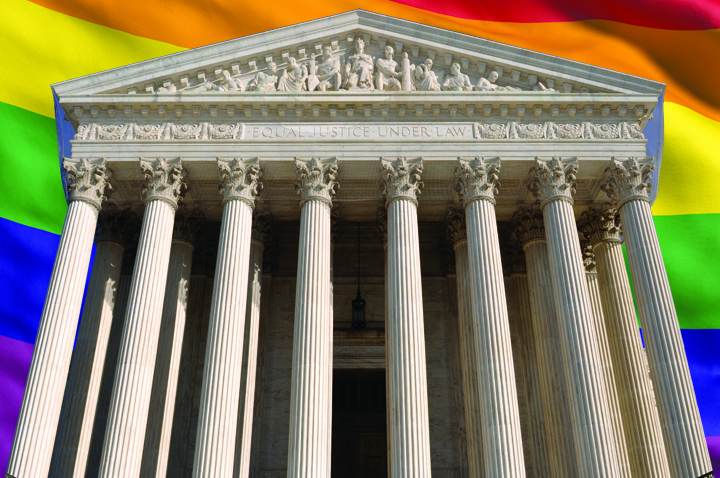 I don’t spend a lot of time reading decisions rendered by the Supreme Court of the United States, but I did today and excerpted a few things with my comment here. There will be more to say and there is already a whole lot of commentary out there, but I thought it would be a good idea to at least start by reading the words of the Court itself. Page numbers cited are to the linked decisions themselves.
In striking down the Defense of Marriage Act Justice Kennedy wrote for the majority in United States v. Windsor:
“Private, consensual sexual intimacy between two adult persons of the same sex may not be punished by the State, and it can form “but one element in a personal bond that is more enduring.” Lawrence v. Texas, 539 U. S. 558, 567 (2003).” (p.19)
The citation of Lawrence v. Texas, the landmark case that struck down anti-sodomy laws, here and elsewhere in the decision (decided ten years prior to the very day!) is a significant mark of how much has happened in a decade’s time. It also makes me wonder what we will be deciding ten years from now.
“For same-sex couples who wished to be married, the State acted to give their lawful conduct a lawful status. This status is a far-reaching legal acknowledgment of the intimate relationship between two people, a relationship deemed by the State worthy of dignity in the community equal with all other marriages. It reflects both the community’s considered perspective on the historical roots of the institution of marriage and its evolving understanding of the meaning of equality.” (p.20)
This is a fine reminder that this country has (thankfully) always had an evolving understanding of the meaning of equality. Some choose to see the Constitution in such a way that it can expand, be amended, live and breathe such to let such evolution occur. See also: Thirteenth Amendment, Nineteenth Amendment. Ahem.
“[DOMA] places same-sex couples in an unstable position of being in a second-tier marriage. The differentiation demeans the couple, whose moral and sexual choices the Constitution protects, see Lawrence, 539 U. S. 558, and whose relationship the State has sought to dignify. And it humiliates tens of thousands of children now being raised by same-sex couples. The law in question makes it even more difficult for the children to understand the integrity and closeness of their own family and its concord with other families in their community and in their daily lives.” (p.23)
Segregation and second-class citizenship are not permissible under the Constitution. Citing Lawrence again, because the law protects private, consensual, sexual intimacy between adult persons, laws whose identifiable purpose is to demean certain families on the basis of other people’s dissenting moral views about sex, are impermissible. There is a social and moral good in recognizing integrity in families when in fact they have it.
“The power the Constitution grants it also restrains. And though Congress has great authority to design laws to fit its own conception of sound national policy, it cannot deny the liberty protected by the Due Process Clause of the Fifth Amendment. What has been explained to this point should more than suffice to establish that the principal purpose and the necessary effect of this law are to demean those persons who are in a lawful same-sex marriage. This requires the Court to hold, as it now does, that DOMA is unconstitutional as a deprivation of the liberty of the person protected by the Fifth Amendment of the Constitution.” (p.25)
 Enough said.
The Hollingsworth v. Perry decision related to Proposition 8 in California is fundamentally about “standing” and who has the right to appeal a decision. This is frankly a technical legal issue about which I am ill-suited to comment, but a few things stand out in this decision.
Justice Roberts wrote for the majority in Hollingsworth v. Perry:
“The Ninth Circuit concluded that “taking away the official designation” of “marriage” from same-sex couples, while continuing to afford those couples all the rights and obligations of marriage, did not further any legitimate interest of the State. Proposition 8, in the court’s view, violated the Equal Protection Clause because it served no purpose “but to impose on gays and lesbians, through the public law, a majority’s private disapproval of them and their relationships.” (p.5)
To me, this section echoes some of the above in that laws whose sole purpose is to establish second-class citizenship are not permissible under the Equal Protection Clause. That was the only purpose of Proposition 8, which is why the lower court had struck it down.
“Article III standing “is not to be placed in the hands of ‘concerned bystanders,’ who will use it simply as a ‘vehicle for the vindication of value interests.’” No matter how deeply committed petitioners may be to upholding Proposition 8 or how “zealous [their] advocacy” … (p.9)
If I don’t like a law because of my values interests, that does not necessarily give me legal standing to challenge it. Even if I really really really don’t like it and the Bible tells me so!
“We have never before upheld the standing of a private party to defend the constitutionality of a state statute when state officials have chosen not to. We decline to do so for the first time here.” (p.17)
Flawed as they are, we elect local, state, and federal officials. Like it or not, they have power.
There will be so much more to say, and there is already a lot of commentary out there. For now, it’s a good exercise in civic engagement to actually read court documents as part of rendering our own opinions.

Previous Post

June 25, 2013
We've Come A Long Way, Baby?
Next Post

July 1, 2013 "You Call Us, Christ-Sophia"
Browse Our Archives
Select a Category Abortion At the Intersections Atheism Christianity Contraception Education Feminism Gender Getting Theological Honorable Mention Islam LGBT News Our Voices Race Uncategorized
Select a Month July 2017 June 2017 May 2017 March 2017 February 2017 January 2017 August 2016 July 2016 June 2016 May 2016 April 2016 March 2016 February 2016 January 2016 December 2015 November 2015 October 2015 September 2015 August 2015 July 2015 June 2015 May 2015 April 2015 March 2015 February 2015 January 2015 December 2014 November 2014 October 2014 September 2014 August 2014 July 2014 June 2014 May 2014 April 2014 March 2014 February 2014 January 2014 December 2013 November 2013 October 2013 September 2013 August 2013 July 2013 June 2013 May 2013 April 2013 March 2013 February 2013 January 2013 December 2012 November 2012 October 2012 September 2012 August 2012 July 2012
Follow Us!
TAKE THE
Religious Wisdom Quiz
What does the name "Abraham" mean?
Select your answer to see how you score.
Strong leader Shelter Blessed man Father of many
Related posts from Caryn Riswold

What I Won’t Write About Mary Daly for...

Freedom & the Racialized Body: Resonances with Luther...

Active in Love: The ELCA on Faith, Sexism,...

Feminist, Interfaith, Public: My Luther Year
TRENDING AT PATHEOS Progressive Christian

What Being a Modern-Day Apostle Means to Me
In my last column, I discussed the ins and outs of modern-day...

Did Ancient China Once Worship the God of...
Across human history, a common thread weaves through the origins of the...

Love Your Neighbor – Including Earth-Kin: Lev. 19,...
God’s command to love your neighbor means acting in an ethical and...

Lead a Church Study of “Jesus and Lao...
Guest writer Jack Thomas (The Irreverent Reverend) reflects on leading his church...

Pastoral Wisdom for Responding to Sermon Pushback
Getting sermon pushback on your social justice sermon? Learn practical, Proverbs-based strategies...

Principles for Understanding the Apostolic Ministry Today
Whenever people discover that my formal ministry title is "apostle," as in...
view all Progressive Christian blogs
Ad-Free & Subscriber Log-In Subscription Support
- About Us
- 2026 Calendar
- Videos
- Podcasts
- Library of World Religions
- Faith In Media Tracker
- Advertise With Us
- Write for Us
- Privacy Policy
- Terms of Service
- Do Not Sell My Data
- Contact Us
- Radiant Digital
- Manage Newsletter Subscriptions
- Unsubscribe From Notifications
- Sitemap
Copyright 2008-2026, Patheos. All rights reserved.
Subscription Support Ad-Free & Subscriber Log-In
Follow Patheos