
BuddhistCatholicContemplativeEvangelicalGeneral ChristianHinduJewishLatter-day SaintMuslimNew VisionsProgressive Christian
Beliefs
- Buddhist
- Catholic
- Contemplative
- Evangelical
- General Christian
- Hindu
- Jewish
- Latter-day Saint
- More Voices
- Muslim
- New Visions
- Pagan
- Progressive Christian
Topics
- Religion News
- Food and Religion
- Sports and Religion
- Religious Art
- Religious Music and Entertainment
- Religious Events
- History and Religion
- Style and Religion
- Politics and Religion
- Women in Religion
- Recreation Outdoors and Religion
- Business Finance and Religion
- Careers Workplace and Religion
- Education and Religion
- Family Parenting and Religion
- Health Fitness and Religion
- Home and Religion
- Relationships and Religion
- Technology and Religion
- Travel and Religion
Columnists
- Buddhist Columnists
- Business Finance and Religion Columnists
- Careers Workplace and Religion Columnists
- Catholic Columnists
- Contemplative Columnists
- Education and Religion Columnists
- Evangelists Columnists
- Family Parenting and Religion Columnists
- General Christian Columnists
- Health Fitness and Religion Columnists
- Hindu Columnists
- History and Religion Columnists
- Home and Religion Columnists
- Jewish Columnists
- More Voices Columnists
- Latter Day Columnists
- Muslim Columnists
- New Visions Columnists
- Nonreligious Columnists
- Pagan Columnists
- Politics and Religion Columnists
- Progressive Columnists
- Recreation Outdoors and Religion Columnists
- Relationships and Religion Columnists
- Religion News Columnists
- Religious Art Columnists
- Religious Events Columnists
- Religious Music and Entertainment Columnists
- Sports and Religion Columnists
- Style and Religion Columnists
- Technology and Religion Columnists
- Travel and Religion Columnists
- Women in Religion Columnists
Resource Library
- 2026 Calendar
- Library of World Religions
- The 100 Most Holy Places on Earth
- Patheos Answers
- Podcasts
- Videos
- Faith Leaders Database
- Anglican Episcopalian
- Bahai
- Baptist
- Buddhism
- Christianity
- Confucianism
- Eastern Orthodoxy
- Hinduism
- Holiness and Pentecostal
- ISKCON
- Islam
- Judaism
- Lutheran
- Methodist
- The Church of Jesus Christ of Latter-day Saints
- New Age
- Paganism
- Presbytarian and Reformed
- Protestantism
- Religion Behind the Scenes
- Roman Catholic
- Scientology
- Shia Islam
- Sikhism
- Sufism
- Sunni Islam
- Taoism
- Zen
- See all religions
Research Tools
 Ad-Free & Subscriber Log-In Subscription Support
Ad-Free & Subscriber Log-In Subscription Support
Follow Patheos 

- Trending:
- Forgiveness
- |
- Marriage
- |
- Consciousness
- |
- Death Penalty
- |
- Election
- |
- Halloween
 Caryn Riswold
- Home
- Progressive Christian
- At the Intersections: Renewing Life
At the Intersections: Renewing Life
Last updated on: March 31, 2013 at 1:10 pm by Caryn Riswold
At the Intersections: Renewing Life 2013-03-31T13:07:31-06:00 Caryn Riswold
Patheos Explore the world's faith through different perspectives on religion and spirituality! Patheos has the views of the prevalent religions and spiritualities of the world.
Many good people live and work at the intersections … of feminism and Christianity, of ministry and justice, of religion and politics, of gender and society, of race and inequality, of everything and then some. I’ve invited a few people to tell a story from their intersections, and will be sharing their stories from time to time here.
Today’s story comes from my friend Krista E. Hughes. Krista is Assistant Professor of Theological Studies at Hanover College (Hanover, Indiana), where she invites her students into critical and imaginative theological reflection on religious pluralism, economic justice, gender and feminism, postmodern models of God, and the many other questions they bring into the classroom. She holds a Ph.D. from Drew University, an M.Div. from Vanderbilt University Divinity School, and a B.A. from Wofford College. Here, she tells her story for our Easter Sunday, a moment at the intersection of constructing a renewed life.
 Today is Easter. And I am not going to church. This year, this once, it seems like I can more fully celebrate the resurrection and the hope it is said to herald by staying home.
Even though I do not attend church as often as I probably should in light of my vocation as a teacher and writer of constructive Christian theology, this is surprising even for me. I cannot remember the last time I did not attend Easter services, whether a simple sunrise service, where we all shiver in the cold and imagine being at the empty tomb in the dawn twilight, or a grander worship event with a brass quartet, a sanctuary filled with lilies and their aroma, and little girls in bright spring dresses. Easter is a decidedly communal affair in the Christian tradition.
Moreover, I live alone. Why would I celebrate the resurrection apart from community? Why would I want to? What even makes me think I can? It sounds a lot like I am merely embracing the (ostensible) “all-about-me” ethos of that nebulous and diverse group of Millennials who self-identify as “spiritual but not religious.”[1]
Perhaps. Yet I am celebrating Easter and resurrection hope in much the same way that Amy Laura Hall has commended eating chocolate for Lent. And I don’t think Jesus would mind. I even got started on Maundy Thursday (yet another decidedly communal liturgy). On Thursday, I took a long walk, and I also got on my yoga mat. On Good Friday, a traditional day of solemnity, I got a professional massage, I took an even longer walk in the woods, and I had a glass of wine with my supper. Holy Saturday was dedicated to a long neglected writing project and to taking two walks, one alone and one with a friend. And today, Easter, when I am not going to church, I will walk some more and write some more, and I will return to my yoga mat, and I will eat some rich food. I also plan to breathe slowly and deeply and often.
This all sounds exceptionally self-indulgent. Indeed, it sounds like it’s all about me.
But what would it mean for Christianity—that does have a rich contemplative tradition after all—to take a cue from Buddhism? Buddhism is not monolithic. Yet one consistent Buddhist message, as I hear it, is that it is only in solitude, in the frightening quiet of our mind, following the rhythms of our own breath, that we can realize how thoroughly connected we are—to All that is. It is precisely from this disposition of inwardness that compassion toward and connection to others are said to emerge.
The fact is I am coming out of a season of my life when I have felt disconnected from my “community,” unable either to contribute to or learn from it in ways that are normally life-giving—to me and to my community. Late last summer through early this winter was a time of immense, chronic stress. The details are not important, but suffice it to say that when my circumstances finally shifted, the stress gave way to depletion and a mild case of depression. Fatigue and lack of motivation and focus marked day after day after day (not helped in the least by the gray skies and unseasonably cold temperatures of a winter that has extended nearly into April). I experience my “religious community” primarily through my vocation as a teacher and a writer of theology. In neither role recently—first due to stress, then to depletion—have I been able to offer the full extent of my gifts and talents.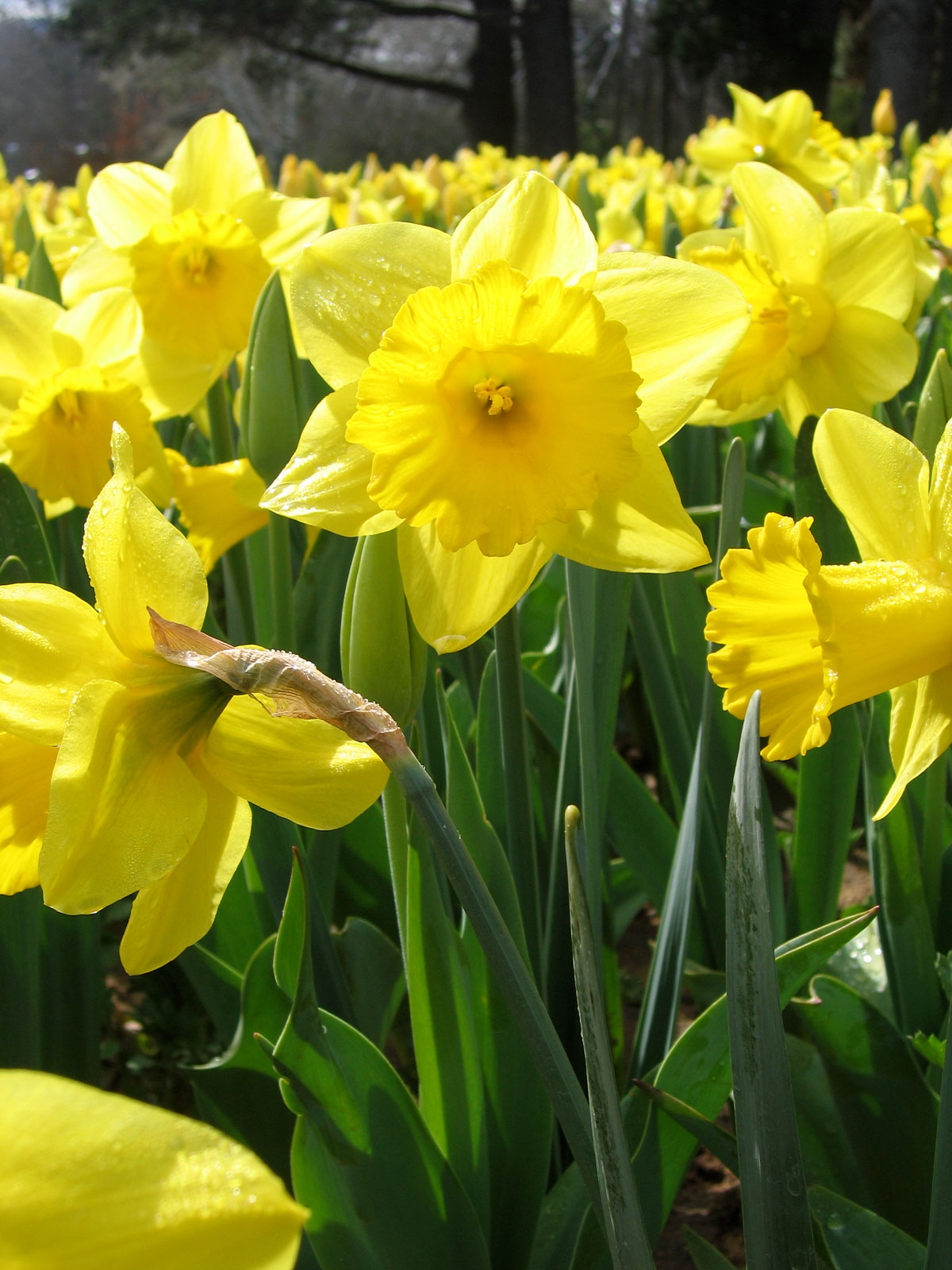
But the last few days, as the sun has come out and the daffodils have bloomed, I too have started to come back to life in body, mind, and soul. This has not simply felt good. Almost overnight, I have found myself more attentive to and connected with my students, and I have been inspired to write, excited to contribute my thoughts to a wider theological conversation. It is not lost on me that these blossomings have coincided with the celebration of these Christian holy days.
Yes, in many ways my solitary and self-indulgent activities have been all about me. I have not participated in the worship services of Passion/Palm Sunday and Good Friday, where I would have had to confess my own complicity in the violence we humans do to one another. I have not lovingly washed a sister-stranger’s feet at a Maundy Thursday ritual. And I will not join my Alleluias with others this morning, contributing my voice to a joyous chorus that surely the Holy deserves. But there are years past I have done these things, and there will be years to come when I will do them again.
This year I will celebrate Easter at dawn, in solitude, giving thanks for the grace of resurrection in my own small life, a resurrection that will allow me to return to my community bearing the fullness of my gifts and seeking to live into, however imperfectly, the mandatum of Holy Thursday that we love one another through offering the best of ourselves in the service of others.
I may “fail Easter” too, Caryn. But God’s resurrection promises shine brightly this day.
For more stories ‘at the intersections’ click here.
[1] For one such critique, see this piece by pastor Lillian Daniel. While I grant that some “spiritual but not religious” may fall prey to “all about me” thinking, many critiques seem to imply that church community is superior to other forms of community. Isn’t it possible that while some folks’ spiritual practices may be solitary, they are contributing in tremendously rich ways to the world around them? Even as my students (I admit, too frequently for my taste) express an “all about me” ethos in their writing and classroom comments, I also see daily on my campus the phenomenal activity of countless student organizations that simply would not be happening if my students are as fully self-concerned as they claim to be.
Previous Post
March 31, 2013
"Christ-Sophia Has Risen"
Next Post

April 2, 2013 Red Logo Resistance: Homonationalism & the HRC
Browse Our Archives
Select a Category Abortion At the Intersections Atheism Christianity Contraception Education Feminism Gender Getting Theological Honorable Mention Islam LGBT News Our Voices Race Uncategorized
Select a Month July 2017 June 2017 May 2017 March 2017 February 2017 January 2017 August 2016 July 2016 June 2016 May 2016 April 2016 March 2016 February 2016 January 2016 December 2015 November 2015 October 2015 September 2015 August 2015 July 2015 June 2015 May 2015 April 2015 March 2015 February 2015 January 2015 December 2014 November 2014 October 2014 September 2014 August 2014 July 2014 June 2014 May 2014 April 2014 March 2014 February 2014 January 2014 December 2013 November 2013 October 2013 September 2013 August 2013 July 2013 June 2013 May 2013 April 2013 March 2013 February 2013 January 2013 December 2012 November 2012 October 2012 September 2012 August 2012 July 2012
Follow Us!
TAKE THE
Religious Wisdom Quiz
Who was the only female judge of Israel?
Select your answer to see how you score.
Esther Ruth Deborah Hannah
Related posts from Caryn Riswold

What I Won’t Write About Mary Daly for...

We Need To Dance at Each Other’s Weddings

Freedom & the Racialized Body: Resonances with Luther...

Active in Love: The ELCA on Faith, Sexism,...
TRENDING AT PATHEOS Progressive Christian

Why Christians Have a Sacred Duty to Vote:...
The Bible offers strong support for the sacred duty to vote. Here...

What Being a Modern-Day Apostle Means to Me
In my last column, I discussed the ins and outs of modern-day...

Did Ancient China Once Worship the God of...
Across human history, a common thread weaves through the origins of the...

Love Your Neighbor – Including Earth-Kin: Lev. 19,...
God’s command to love your neighbor means acting in an ethical and...

Lead a Church Study of “Jesus and Lao...
Guest writer Jack Thomas (The Irreverent Reverend) reflects on leading his church...

Principles for Understanding the Apostolic Ministry Today
Whenever people discover that my formal ministry title is "apostle," as in...
view all Progressive Christian blogs
Ad-Free & Subscriber Log-In Subscription Support
- About Us
- 2026 Calendar
- Videos
- Podcasts
- Library of World Religions
- Faith In Media Tracker
- Advertise With Us
- Write for Us
- Privacy Policy
- Terms of Service
- Do Not Sell My Data
- Contact Us
- Radiant Digital
- Manage Newsletter Subscriptions
- Unsubscribe From Notifications
- Sitemap
Copyright 2008-2026, Patheos. All rights reserved.
Subscription Support Ad-Free & Subscriber Log-In
Follow Patheos