
BuddhistCatholicContemplativeEvangelicalGeneral ChristianHinduJewishLatter-day SaintMuslimNew VisionsProgressive Christian
Beliefs
- Buddhist
- Catholic
- Contemplative
- Evangelical
- General Christian
- Hindu
- Jewish
- Latter-day Saint
- More Voices
- Muslim
- New Visions
- Pagan
- Progressive Christian
Topics
- Religion News
- Food and Religion
- Sports and Religion
- Religious Art
- Religious Music and Entertainment
- Religious Events
- History and Religion
- Style and Religion
- Politics and Religion
- Women in Religion
- Recreation Outdoors and Religion
- Business Finance and Religion
- Careers Workplace and Religion
- Education and Religion
- Family Parenting and Religion
- Health Fitness and Religion
- Home and Religion
- Relationships and Religion
- Technology and Religion
- Travel and Religion
Columnists
- Buddhist Columnists
- Business Finance and Religion Columnists
- Careers Workplace and Religion Columnists
- Catholic Columnists
- Contemplative Columnists
- Education and Religion Columnists
- Evangelists Columnists
- Family Parenting and Religion Columnists
- General Christian Columnists
- Health Fitness and Religion Columnists
- Hindu Columnists
- History and Religion Columnists
- Home and Religion Columnists
- Jewish Columnists
- More Voices Columnists
- Latter Day Columnists
- Muslim Columnists
- New Visions Columnists
- Nonreligious Columnists
- Pagan Columnists
- Politics and Religion Columnists
- Progressive Columnists
- Recreation Outdoors and Religion Columnists
- Relationships and Religion Columnists
- Religion News Columnists
- Religious Art Columnists
- Religious Events Columnists
- Religious Music and Entertainment Columnists
- Sports and Religion Columnists
- Style and Religion Columnists
- Technology and Religion Columnists
- Travel and Religion Columnists
- Women in Religion Columnists
Resource Library
- 2026 Calendar
- Library of World Religions
- The 100 Most Holy Places on Earth
- Patheos Answers
- Podcasts
- Videos
- Faith Leaders Database
- Anglican Episcopalian
- Bahai
- Baptist
- Buddhism
- Christianity
- Confucianism
- Eastern Orthodoxy
- Hinduism
- Holiness and Pentecostal
- ISKCON
- Islam
- Judaism
- Lutheran
- Methodist
- The Church of Jesus Christ of Latter-day Saints
- New Age
- Paganism
- Presbytarian and Reformed
- Protestantism
- Religion Behind the Scenes
- Roman Catholic
- Scientology
- Shia Islam
- Sikhism
- Sufism
- Sunni Islam
- Taoism
- Zen
- See all religions
Research Tools
 Ad-Free & Subscriber Log-In Subscription Support
Ad-Free & Subscriber Log-In Subscription Support
Follow Patheos 

- Trending:
- Forgiveness
- |
- Marriage
- |
- Consciousness
- |
- Death Penalty
- |
- Election
- |
- Halloween
 Caryn Riswold
- Home
- Progressive Christian
- “Our Multiple, Messy, In-Process Selves”
“Our Multiple, Messy, In-Process Selves”
Last updated on: February 27, 2013 at 8:30 am by Caryn Riswold
“Our Multiple, Messy, In-Process Selves” 2013-02-26T10:10:28-07:00 Caryn Riswold
Patheos Explore the world's faith through different perspectives on religion and spirituality! Patheos has the views of the prevalent religions and spiritualities of the world.
I first met Darcy Baxter several years ago at a Faith and Feminism conference at Ebenezer/herchurch Lutheran in San Francisco, and have had the joy of getting to know more about her and her work through our participation in The Faith & Reproductive Justice Leadership Institute at The Center for American Progress in Washington D.C. this past year.
 This month, she wrote an excellent piece for UUWorld, the quarterly magazine for the Unitarian Universalist Association of Congregations. In it, she focuses on the UUA’s recent decision on what it’s social justice issue for the next four years will be:
Every couple of years at the Unitarian Universalist Association’s General Assembly, congregational delegates choose a social justice issue for our congregations to engage with over a period of four years. The UUA provides resources and a study guide for congregations. Each congregation then decides how it will act on that issue.
In June 2012, the General Assembly voted to make reproductive justice our Congregational Study/Action Issue for the next four years. (Learn more at UUA.org/reproductive.)
Darcy goes on in the piece to break down some of the basics, for people who may be unfamiliar with this language to talk about these issues:
The reproductive justice movement was created by a coalition of women of color to promote the right of all women to have children, not to have children, and to raise their children in safe and healthy environments.
 The reproductive justice movement, thus, has some key milestones in its history:
In 1984, the National Black Women’s Health Project was founded with two goals: to more effectively address reproductive health issues in African-American communities, and to advocate within the mainstream (predominantly white) pro-choice movement for a broader agenda that includes the concerns of women of color. Over the next ten years, other women of color created reproductive justice organizations, such as the National Latina Health Organization, the Native American Women’s Health Education Resource Center, and Asians and Pacific Islanders for Reproductive Health. Following the 1994 International Conference on Population and Development in Cairo, Egypt, the women involved with these organizations coined the term “reproductive justice” to name their work, ideas, and aspirations. In 1997, the SisterSong Women of Color Reproductive Justice Collective was formed, bringing together sixteen organizations advocating for the reproductive and sexual health of women of color. SisterSong has been instrumental in promoting reproductive justice and in building support for it, as a conceptual framework and movement-building political strategy.
Darcy also effectively explains what is unique and indeed essential in framing these issues as “reproductive justice” :
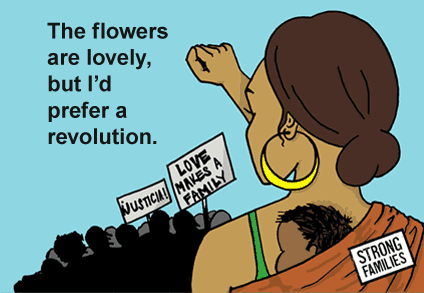
Reproductive justice emphasizes that everything is connected, and therefore insists we refuse to isolate or pit important social issues against each other. Instead, reproductive justice advances these rights across the interdependent web of social justice issues. As the advocacy group Forward Together puts it in their “Strong Families” initiative, reproductive justice calls on us to work towards a world where every person and family has the rights, recognition, and resources to make decisions about their gender, their bodies, and their sexuality; where every person, family, and community has what they need to flourish.
And, what does this all have to do with religion and churches?
All of us are many things at once, even though we often feel a need to hide or highlight one part over another. For me, religious community is about a place of connection and interconnection. It is about building a space where all parts of us can show up, where we do not have to be singular, tidy, and complete. Religious community should be a place where each of us can be our multiple, messy, in-process selves.
I encourage you to head over to UUWorld.org and read the full piece. Darcy’s compassion and commitment to justice shines through in the piece, and I hope that this sparks more conversation and work in all of our communities.
Image from the Forward Together/Strong Families website “Mama’s Day Our Way”
faith and reproductive justice
National Black Women's Health Project
Previous Post

February 25, 2013
Telling the Truth About Privilege
Next Post
February 28, 2013 Black History is Now, part three
Browse Our Archives
Select a Category Abortion At the Intersections Atheism Christianity Contraception Education Feminism Gender Getting Theological Honorable Mention Islam LGBT News Our Voices Race Uncategorized
Select a Month July 2017 June 2017 May 2017 March 2017 February 2017 January 2017 August 2016 July 2016 June 2016 May 2016 April 2016 March 2016 February 2016 January 2016 December 2015 November 2015 October 2015 September 2015 August 2015 July 2015 June 2015 May 2015 April 2015 March 2015 February 2015 January 2015 December 2014 November 2014 October 2014 September 2014 August 2014 July 2014 June 2014 May 2014 April 2014 March 2014 February 2014 January 2014 December 2013 November 2013 October 2013 September 2013 August 2013 July 2013 June 2013 May 2013 April 2013 March 2013 February 2013 January 2013 December 2012 November 2012 October 2012 September 2012 August 2012 July 2012
Follow Us!
TAKE THE
Religious Wisdom Quiz
Who killed his brother: Cain or Abel?
Select your answer to see how you score.
Abel Seth Cain Adam
Related posts from Caryn Riswold

What I Won’t Write About Mary Daly for...

We Need To Dance at Each Other’s Weddings

Freedom & the Racialized Body: Resonances with Luther...

Active in Love: The ELCA on Faith, Sexism,...
TRENDING AT PATHEOS Progressive Christian

What Being a Modern-Day Apostle Means to Me
In my last column, I discussed the ins and outs of modern-day...

Did Ancient China Once Worship the God of...
Across human history, a common thread weaves through the origins of the...

Love Your Neighbor – Including Earth-Kin: Lev. 19,...
God’s command to love your neighbor means acting in an ethical and...

Lead a Church Study of “Jesus and Lao...
Guest writer Jack Thomas (The Irreverent Reverend) reflects on leading his church...

Pastoral Wisdom for Responding to Sermon Pushback
Getting sermon pushback on your social justice sermon? Learn practical, Proverbs-based strategies...

Principles for Understanding the Apostolic Ministry Today
Whenever people discover that my formal ministry title is "apostle," as in...
view all Progressive Christian blogs
Ad-Free & Subscriber Log-In Subscription Support
- About Us
- 2026 Calendar
- Videos
- Podcasts
- Library of World Religions
- Faith In Media Tracker
- Advertise With Us
- Write for Us
- Privacy Policy
- Terms of Service
- Do Not Sell My Data
- Contact Us
- Radiant Digital
- Manage Newsletter Subscriptions
- Unsubscribe From Notifications
- Sitemap
Copyright 2008-2026, Patheos. All rights reserved.
Subscription Support Ad-Free & Subscriber Log-In
Follow Patheos