
BuddhistCatholicContemplativeEvangelicalGeneral ChristianHinduJewishLatter-day SaintMuslimNew VisionsProgressive Christian
Beliefs
- Buddhist
- Catholic
- Contemplative
- Evangelical
- General Christian
- Hindu
- Jewish
- Latter-day Saint
- More Voices
- Muslim
- New Visions
- Pagan
- Progressive Christian
Topics
- Religion News
- Food and Religion
- Sports and Religion
- Religious Art
- Religious Music and Entertainment
- Religious Events
- History and Religion
- Style and Religion
- Politics and Religion
- Women in Religion
- Recreation Outdoors and Religion
- Business Finance and Religion
- Careers Workplace and Religion
- Education and Religion
- Family Parenting and Religion
- Health Fitness and Religion
- Home and Religion
- Relationships and Religion
- Technology and Religion
- Travel and Religion
Columnists
- Buddhist Columnists
- Business Finance and Religion Columnists
- Careers Workplace and Religion Columnists
- Catholic Columnists
- Contemplative Columnists
- Education and Religion Columnists
- Evangelists Columnists
- Family Parenting and Religion Columnists
- General Christian Columnists
- Health Fitness and Religion Columnists
- Hindu Columnists
- History and Religion Columnists
- Home and Religion Columnists
- Jewish Columnists
- More Voices Columnists
- Latter Day Columnists
- Muslim Columnists
- New Visions Columnists
- Nonreligious Columnists
- Pagan Columnists
- Politics and Religion Columnists
- Progressive Columnists
- Recreation Outdoors and Religion Columnists
- Relationships and Religion Columnists
- Religion News Columnists
- Religious Art Columnists
- Religious Events Columnists
- Religious Music and Entertainment Columnists
- Sports and Religion Columnists
- Style and Religion Columnists
- Technology and Religion Columnists
- Travel and Religion Columnists
- Women in Religion Columnists
Resource Library
- 2026 Calendar
- Library of World Religions
- The 100 Most Holy Places on Earth
- Patheos Answers
- Podcasts
- Videos
- Faith Leaders Database
- Anglican Episcopalian
- Bahai
- Baptist
- Buddhism
- Christianity
- Confucianism
- Eastern Orthodoxy
- Hinduism
- Holiness and Pentecostal
- ISKCON
- Islam
- Judaism
- Lutheran
- Methodist
- The Church of Jesus Christ of Latter-day Saints
- New Age
- Paganism
- Presbytarian and Reformed
- Protestantism
- Religion Behind the Scenes
- Roman Catholic
- Scientology
- Shia Islam
- Sikhism
- Sufism
- Sunni Islam
- Taoism
- Zen
- See all religions
Research Tools
 Ad-Free & Subscriber Log-In Subscription Support
Ad-Free & Subscriber Log-In Subscription Support
Follow Patheos 

- Trending:
- Forgiveness
- |
- Marriage
- |
- Consciousness
- |
- Death Penalty
- |
- Election
- |
- Halloween
 Caryn Riswold
- Home
- Progressive Christian
- Getting Theological: Remember Sabbath
Getting Theological: Remember Sabbath
Last updated on: September 14, 2012 at 6:00 am by Caryn Riswold
Getting Theological: Remember Sabbath 2012-09-11T15:28:30-06:00 Caryn Riswold
Patheos Explore the world's faith through different perspectives on religion and spirituality! Patheos has the views of the prevalent religions and spiritualities of the world.
It was right after I’d submitted the final manuscript proofs to the publisher for my third book, Feminism and Christianity, that I admitted to my Facebook friends that I was antsy without a big book project. Wondering what was next. Feeling adrift. 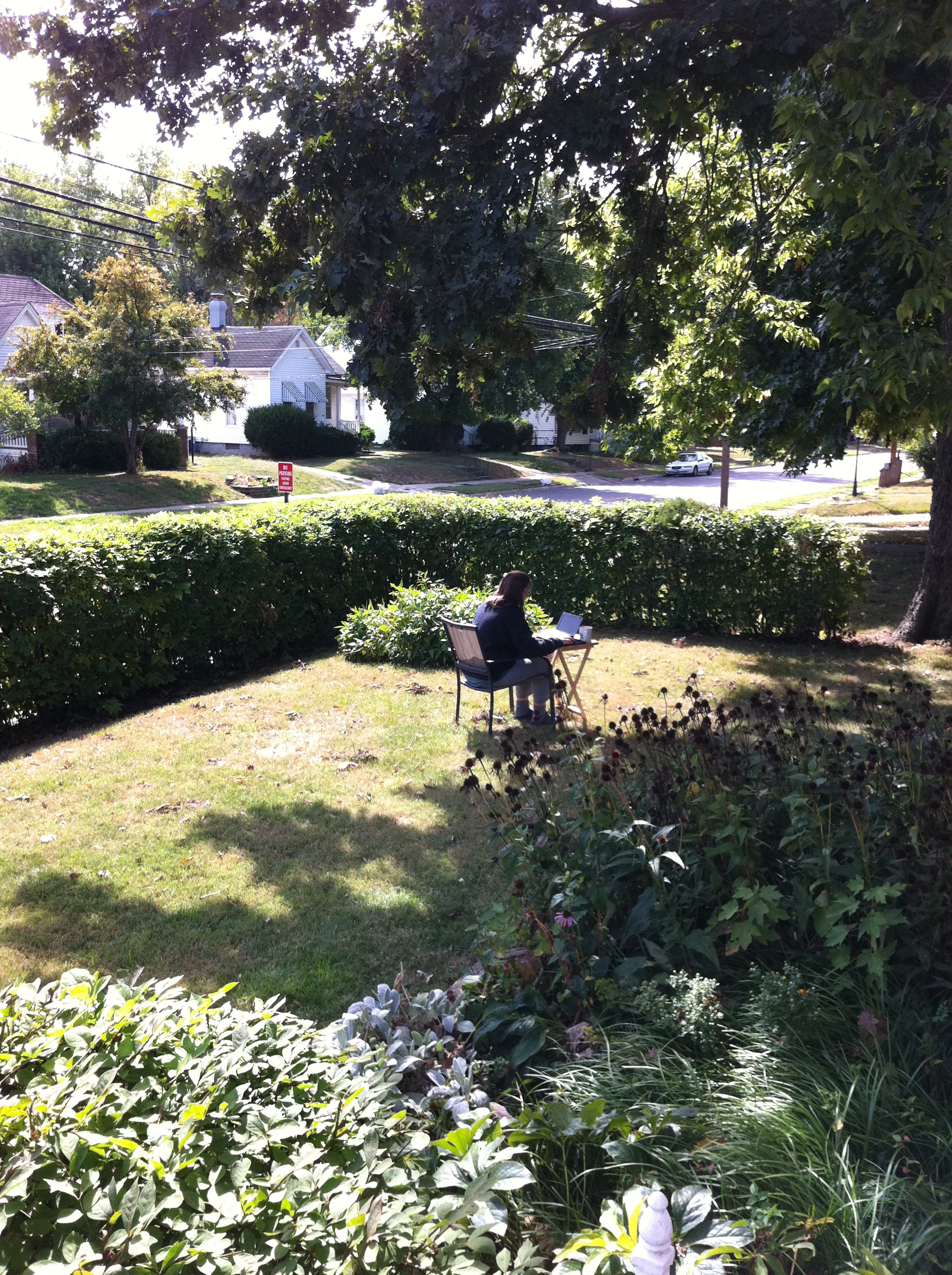
My friend Krista simply commented, “Remember sabbath.”
Oh. Yeah. That sounds familiar.
Sabbath. That religious practice of sacred time. Time set apart from the ordinary, time for worship, reflection, prayer, rest, and gratitude. It’s something found in many religious traditions, including Christianity. As the fourth in my series of posts “Getting Theological,” this one is framed not with the words of other thinkers or the tradition itself, but framed with experience and daily life. {Here’s another blogger writing on sabbath, a former student of mine, Jeff Goins.}
When Krista nudged me to “remember sabbath,” it was during my first sabbatical. It’s one of the privileges of a job as a tenured professor. Every seven years we can apply for a semester or a year away from the classroom, with full or partial pay. The purpose is manifold: scholarly productivity, pedagogical innovation, research and travel, and oh yes, rest. I found it alternately ironic and painful that my sabbatical was in the spring semester of 2009, which you may recall as the peak/valley of the great recession. All around me, family and friends losing jobs, struggling to keep their homes, and having to relocate. On the news every day a wildly bouncing stock market and social volatility that made everyone jumpy.
And I’m on sabbatical? Reading, writing, travelling, speaking … keeping busy but in ways that only I truly controlled. And enjoyed. And reckoned with the social privilege that my life reflected in so many ways. This time set apart from anxiety and rollercoaster-existence.
More recently, on an airplane on the way home from a trip west to visit family, I took this picture. Where the traditional “No Smoking” sign has traditionally glowered at travelers, warning them against disobedience under penalty of federal law, were the words: Turn off electronic devices. I had never seen it before, and haven’t since. But it’s perfect.
It reminded me of this picture, taken at the Science Museum in London during our trip there in 2009 (that sabbatical travel again). 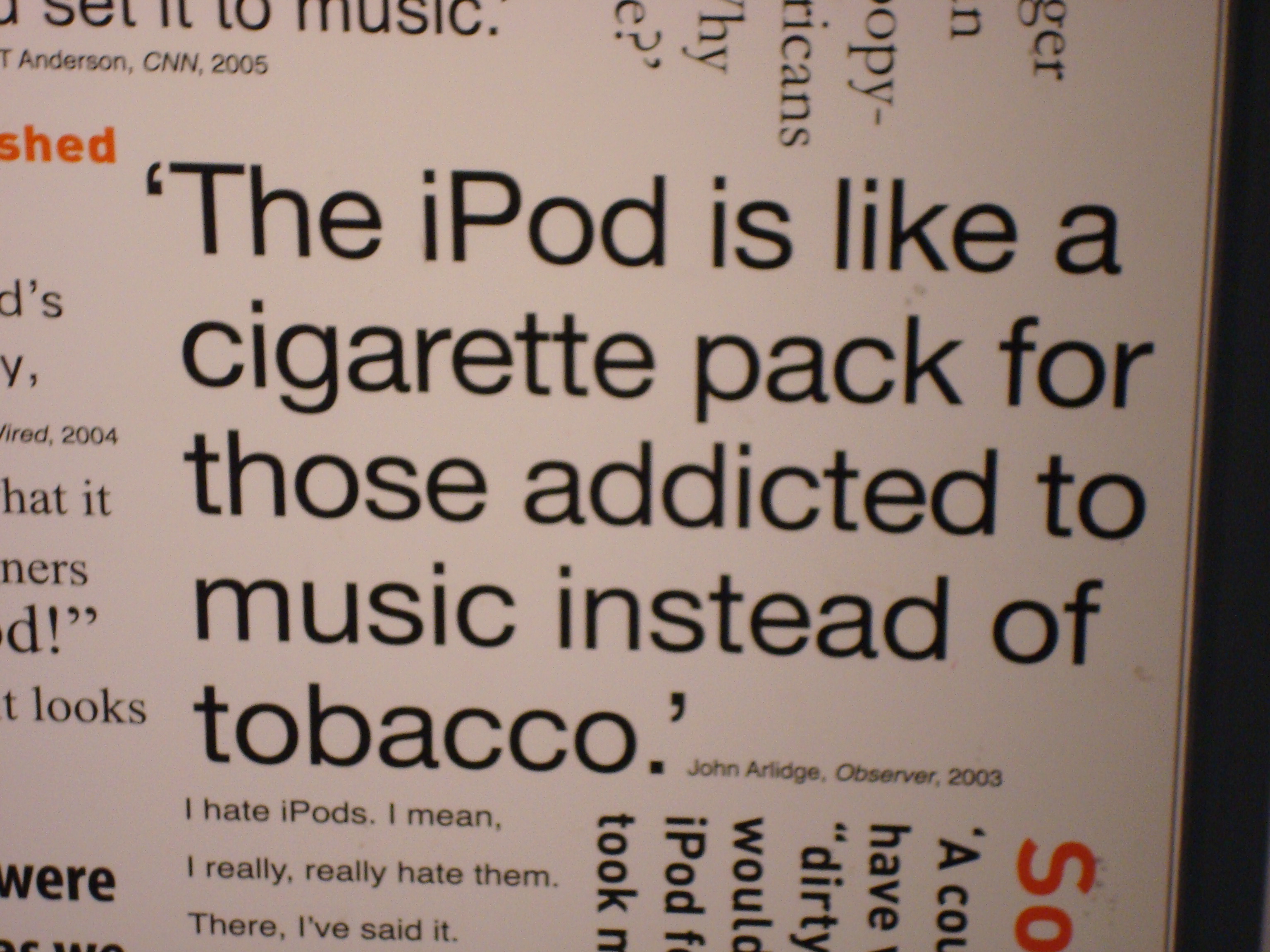 It was part of a large display about the invention of the iPod. Seeing how “No Electronic Devices” has replaced “No Smoking” makes it official: The iPhone is the new cigarette. We’ve replaced one little addictive package with another. A new way to keep ourselves busy, occupied, fixated, addictively connected.
But, what do you do when you are prohibited by federal law from using your cell phone or laptop? I’m usually a paper-book-reader person, so I always have a physical book or magazine to read. (I’m also a don’t-talk-to-me-traveler when solo, and burying my nose in a book is a great way to ignore the person to whose thighs I am inevitably adjacent.)
But when faced with the iPhone-as-cigarette light (which I decided to call it), what do others do? On that flight, some closed their eyes, others talked to the person next to them, a few flipped through the airline magazine. Several looked out the window, while others rummaged through a bag, or ate a snack, or actually watched the flight attendants instruct us on what to do in case of a water landing in the middle of Kansas.
It’s a little sabbath, isn’t it? Taking time to look out the window. Talk to your neighbor. Close your eyes and be quiet. Pray? Read something – on paper. Sleep. Eat something because you’re strapped in with no place to go. Things we don’t normally do because we’re attached to our devices and our busyness.
The Jewish and Christian traditions of sabbath offer this. Sacred time, time set apart, to not do what we are daily consumed with. Biblically, it is connected to the first creation story in Genesis. When “God blessed the seventh day and hallowed it, because on it God rested from all the work that he had done in creation.” (Gen. 2:3). Judaism and Christianity have scheduled this differently, as Friday/Saturday between sunsets for the former, and Sunday for the latter. Historically, the practice of sabbath has shifted. For some times and traditions, it has meant not working at all, and conducting no business that would require others to work.
But today, a very few of us are able to have long stretches of time, even 24 hours between sunsets, with no working and no doing of business, no errands and no chores. Some states still have remnants of ways that this used to be broadly legislated, they were called blue laws. Businesses were not allowed to open on Sunday. Everyone was expected to keep the sabbath. Liquor laws are a most obvious way to see how the impact of this still exists today. In Indiana, you can’t buy any alcohol on Sunday (which we were vexed to learn on one Sunday grocery run early in our years living there), and in my central Illinois town just recently the city council voted to move up the time that you’re allowed to buy booze from noon to 9am on Sunday.
Whatever it is consumes our ordinary time, sabbath offers us a time away from it. In a twenty-first century life, though, I keep returning to the fact that the ability to engage in sabbath is in itself a fruit of privilege.
Must it be so?
Previous Post

September 13, 2012
Nothing Wrong with the Cairo Embassy Statement
Next Post
September 17, 2012 Faith & Reproductive Justice
Browse Our Archives
Select a Category Abortion At the Intersections Atheism Christianity Contraception Education Feminism Gender Getting Theological Honorable Mention Islam LGBT News Our Voices Race Uncategorized
Select a Month July 2017 June 2017 May 2017 March 2017 February 2017 January 2017 August 2016 July 2016 June 2016 May 2016 April 2016 March 2016 February 2016 January 2016 December 2015 November 2015 October 2015 September 2015 August 2015 July 2015 June 2015 May 2015 April 2015 March 2015 February 2015 January 2015 December 2014 November 2014 October 2014 September 2014 August 2014 July 2014 June 2014 May 2014 April 2014 March 2014 February 2014 January 2014 December 2013 November 2013 October 2013 September 2013 August 2013 July 2013 June 2013 May 2013 April 2013 March 2013 February 2013 January 2013 December 2012 November 2012 October 2012 September 2012 August 2012 July 2012
Follow Us!
TAKE THE
Religious Wisdom Quiz
What is the collective name of the stories Jesus told?
Select your answer to see how you score.
Prayers Proverbs Parables Psalms
Related posts from Caryn Riswold

What I Won’t Write About Mary Daly for...

We Need To Dance at Each Other’s Weddings

Freedom & the Racialized Body: Resonances with Luther...

Active in Love: The ELCA on Faith, Sexism,...
TRENDING AT PATHEOS Progressive Christian

What Being a Modern-Day Apostle Means to Me
In my last column, I discussed the ins and outs of modern-day...

Did Ancient China Once Worship the God of...
Across human history, a common thread weaves through the origins of the...

Love Your Neighbor – Including Earth-Kin: Lev. 19,...
God’s command to love your neighbor means acting in an ethical and...

Lead a Church Study of “Jesus and Lao...
Guest writer Jack Thomas (The Irreverent Reverend) reflects on leading his church...

Pastoral Wisdom for Responding to Sermon Pushback
Getting sermon pushback on your social justice sermon? Learn practical, Proverbs-based strategies...

Principles for Understanding the Apostolic Ministry Today
Whenever people discover that my formal ministry title is "apostle," as in...
view all Progressive Christian blogs
Ad-Free & Subscriber Log-In Subscription Support
- About Us
- 2026 Calendar
- Videos
- Podcasts
- Library of World Religions
- Faith In Media Tracker
- Advertise With Us
- Write for Us
- Privacy Policy
- Terms of Service
- Do Not Sell My Data
- Contact Us
- Radiant Digital
- Manage Newsletter Subscriptions
- Unsubscribe From Notifications
- Sitemap
Copyright 2008-2026, Patheos. All rights reserved.
Subscription Support Ad-Free & Subscriber Log-In
Follow Patheos