
BuddhistCatholicContemplativeEvangelicalGeneral ChristianHinduJewishLatter-day SaintMuslimNew VisionsProgressive Christian
Beliefs
- Buddhist
- Catholic
- Contemplative
- Evangelical
- General Christian
- Hindu
- Jewish
- Latter-day Saint
- More Voices
- Muslim
- New Visions
- Pagan
- Progressive Christian
Topics
- Religion News
- Food and Religion
- Sports and Religion
- Religious Art
- Religious Music and Entertainment
- Religious Events
- History and Religion
- Style and Religion
- Politics and Religion
- Women in Religion
- Recreation Outdoors and Religion
- Business Finance and Religion
- Careers Workplace and Religion
- Education and Religion
- Family Parenting and Religion
- Health Fitness and Religion
- Home and Religion
- Relationships and Religion
- Technology and Religion
- Travel and Religion
Columnists
- Buddhist Columnists
- Business Finance and Religion Columnists
- Careers Workplace and Religion Columnists
- Catholic Columnists
- Contemplative Columnists
- Education and Religion Columnists
- Evangelists Columnists
- Family Parenting and Religion Columnists
- General Christian Columnists
- Health Fitness and Religion Columnists
- Hindu Columnists
- History and Religion Columnists
- Home and Religion Columnists
- Jewish Columnists
- More Voices Columnists
- Latter Day Columnists
- Muslim Columnists
- New Visions Columnists
- Nonreligious Columnists
- Pagan Columnists
- Politics and Religion Columnists
- Progressive Columnists
- Recreation Outdoors and Religion Columnists
- Relationships and Religion Columnists
- Religion News Columnists
- Religious Art Columnists
- Religious Events Columnists
- Religious Music and Entertainment Columnists
- Sports and Religion Columnists
- Style and Religion Columnists
- Technology and Religion Columnists
- Travel and Religion Columnists
- Women in Religion Columnists
Resource Library
- 2026 Calendar
- Library of World Religions
- The 100 Most Holy Places on Earth
- Patheos Answers
- Podcasts
- Videos
- Faith Leaders Database
- Anglican Episcopalian
- Bahai
- Baptist
- Buddhism
- Christianity
- Confucianism
- Eastern Orthodoxy
- Hinduism
- Holiness and Pentecostal
- ISKCON
- Islam
- Judaism
- Lutheran
- Methodist
- The Church of Jesus Christ of Latter-day Saints
- New Age
- Paganism
- Presbytarian and Reformed
- Protestantism
- Religion Behind the Scenes
- Roman Catholic
- Scientology
- Shia Islam
- Sikhism
- Sufism
- Sunni Islam
- Taoism
- Zen
- See all religions
Research Tools
 Ad-Free & Subscriber Log-In Subscription Support
Ad-Free & Subscriber Log-In Subscription Support
Follow Patheos 

- Trending:
- Forgiveness
- |
- Marriage
- |
- Consciousness
- |
- Death Penalty
- |
- Election
- |
- Halloween
 Caryn Riswold
- Home
- Progressive Christian
- Getting Theological: Church
Getting Theological: Church
Last updated on: September 27, 2012 at 6:00 am by Caryn Riswold
Getting Theological: Church 2012-09-23T14:22:35-06:00 Caryn Riswold
Patheos Explore the world's faith through different perspectives on religion and spirituality! Patheos has the views of the prevalent religions and spiritualities of the world.
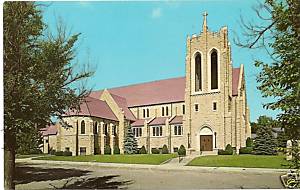 Theologizing about church is, for me, sort of like theorizing about family. Something to be done with hesitance and great care. Nevertheless, in this, the fifth in my series of posts “Getting Theological,” I write about the institution, the idea, the place, and the tradition that is church.
As someone who grew up being taken to church, every Sunday, my first knowledge was that church is something you did with other people, in my case family, and it’s something that you did regularly. It was a practice that marked you as part of a community and as a certain kind of person. I knew people who didn’t do this, in the neighborhood, at school, in my young consciousness of other people, and I didn’t know what that would be like.
My understanding of church is also affected by the fact that my great-grandparents helped build and fund the country church where they are now buried, where my great-aunts and uncles, and other distant relatives are buried and will be laid to rest. 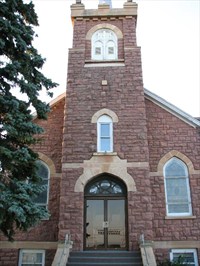 It’s a church with an altar whose gold accent paint was retouched several times by the women in my family. Where I buried an uncle too soon, watched my husband help carry the caskets of my own grandparents while I stood with my nephews, where I have planted flowers and cleaned gravestones on many Memorial Days past, learning the stories of the people I never met, and where my own parents will someday be buried. The rose-quartz Lutheran church building standing sentry on the windswept country hillside surrounded by farms and family is ever-present in my consciousness.
As is the other stone church standing atop a hill in the small city in which I grew up. With the small side chapel featuring the altar from the original church building a few blocks away, where I was baptized and in which my husband and I were married.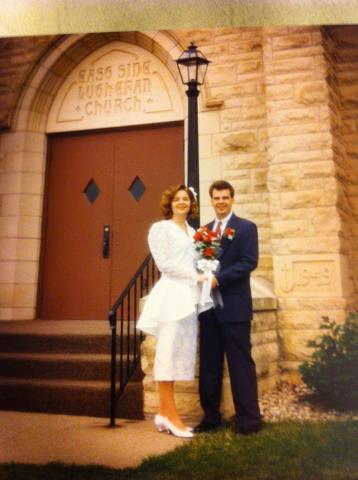 With the grand sanctuary and detailed stained glass windows where my brother and his wife were married, and where I have worshipped alongside my parents for decades. Dozens of candlelight Christmas eves and countless Sunday morning services. Sunday school. Confirmation. Church camp.
See … church and family are inextricable in so many ways.
But there is more to say that isn’t as personal. Or maybe it is, but in another way. In a less positive way. Because church is also a place of pain for people. A dear friend once told me the story of how he was beaten up at church by others in his confirmation class. Because he was gay. With the pastor nearby doing nothing to intervene.
I’ve talked to a parent whose teenage son attempted suicide almost a dozen times because his church didn’t respect his deep understanding that he was, in fact, born that way. I’ve heard stories from a woman whose pastor counseled her to endure abuse from her husband because divorce was not an option and it’s what a good Christian woman should do. And I’ve sat with the woman whose pastor told her that his sexual assault of her was her fault. And he forgave her.
I’ve even had countless conversations with young people trying to figure out the simple question: Can you be Christian if you don’t go to church?
Of course you can. Even though church can be a practice that is life-giving and a place that connects people to each other in empowering ways, it can be a place that oppresses and stifles.
Because whatever else church is, it is a human community. I’ve written elsewhere about how human beings are both graced and broken, and the same must be said about church. Because of this, I appreciate Mary Daly’s radical feminist idea of ‘sisterhood’ as anti-church, “creating a counter-world to the society endorsed by patriarchal religion,” AND sisterhood as church. Both ideas were preached in her famed 1971 sermon at Harvard Memorial Church on “The Women’s Movement: An Exodus Community:”
“Sisterhood is also functioning as church, proclaiming dimensions of truth which religion fails to proclaim. It is a space set apart, in which we can be ourselves, free of the mendacious contortions of mind, will, and feeling demanded of us ‘out there.’ It is a charismatic community, in which we experience prophecy and healing.”
We recently installed a new pastor at the church where I am now a member. The first sermon he delivered, as part of the installation service, was a children’s sermon. The synod bishop preached the “regular” sermon that day. Now, I admit to not being a fan of the idea and practice of children’s sermons. Here’s what I kind of liked about this one: Because the gospel text he had chosen for this service was John 13:1-17, where Jesus washes the feet of the disciples in advance of the Passover meal, this pastor’s first public act and message in worship involved washing the feet of a child.
Washing the feet of a child.
This is the work of church. A model of servant leadership.
It’s an example of not only what a pastor can be, but what a church should do: care for others, attend to the vulnerable, serve the community, challenge preconceived notions of power and humility.
Institution. Idea. Place. Tradition.
Whatever else church is, it will always be about people.
Previous Post

September 26, 2012
Did Jesus Have A Wife? I Hope So
Next Post

September 27, 2012 An Open Letter to Illinois Pharmacists
Browse Our Archives
Select a Category Abortion At the Intersections Atheism Christianity Contraception Education Feminism Gender Getting Theological Honorable Mention Islam LGBT News Our Voices Race Uncategorized
Select a Month July 2017 June 2017 May 2017 March 2017 February 2017 January 2017 August 2016 July 2016 June 2016 May 2016 April 2016 March 2016 February 2016 January 2016 December 2015 November 2015 October 2015 September 2015 August 2015 July 2015 June 2015 May 2015 April 2015 March 2015 February 2015 January 2015 December 2014 November 2014 October 2014 September 2014 August 2014 July 2014 June 2014 May 2014 April 2014 March 2014 February 2014 January 2014 December 2013 November 2013 October 2013 September 2013 August 2013 July 2013 June 2013 May 2013 April 2013 March 2013 February 2013 January 2013 December 2012 November 2012 October 2012 September 2012 August 2012 July 2012
Follow Us!
TAKE THE
Religious Wisdom Quiz
How was the land divided among the tribes of Israel?
Select your answer to see how you score.
By casting lots By family wealth By strength in battle By age
Related posts from Caryn Riswold

What I Won’t Write About Mary Daly for...

We Need To Dance at Each Other’s Weddings

Freedom & the Racialized Body: Resonances with Luther...

Active in Love: The ELCA on Faith, Sexism,...
TRENDING AT PATHEOS Progressive Christian

What Being a Modern-Day Apostle Means to Me
In my last column, I discussed the ins and outs of modern-day...

Did Ancient China Once Worship the God of...
Across human history, a common thread weaves through the origins of the...

Love Your Neighbor – Including Earth-Kin: Lev. 19,...
God’s command to love your neighbor means acting in an ethical and...

Lead a Church Study of “Jesus and Lao...
Guest writer Jack Thomas (The Irreverent Reverend) reflects on leading his church...

Pastoral Wisdom for Responding to Sermon Pushback
Getting sermon pushback on your social justice sermon? Learn practical, Proverbs-based strategies...

Principles for Understanding the Apostolic Ministry Today
Whenever people discover that my formal ministry title is "apostle," as in...
view all Progressive Christian blogs
Ad-Free & Subscriber Log-In Subscription Support
- About Us
- 2026 Calendar
- Videos
- Podcasts
- Library of World Religions
- Faith In Media Tracker
- Advertise With Us
- Write for Us
- Privacy Policy
- Terms of Service
- Do Not Sell My Data
- Contact Us
- Radiant Digital
- Manage Newsletter Subscriptions
- Unsubscribe From Notifications
- Sitemap
Copyright 2008-2026, Patheos. All rights reserved.
Subscription Support Ad-Free & Subscriber Log-In
Follow Patheos