
BuddhistCatholicContemplativeEvangelicalGeneral ChristianHinduJewishLatter-day SaintMuslimNew VisionsProgressive Christian
Beliefs
- Buddhist
- Catholic
- Contemplative
- Evangelical
- General Christian
- Hindu
- Jewish
- Latter-day Saint
- More Voices
- Muslim
- New Visions
- Pagan
- Progressive Christian
Topics
- Religion News
- Food and Religion
- Sports and Religion
- Religious Art
- Religious Music and Entertainment
- Religious Events
- History and Religion
- Style and Religion
- Politics and Religion
- Women in Religion
- Recreation Outdoors and Religion
- Business Finance and Religion
- Careers Workplace and Religion
- Education and Religion
- Family Parenting and Religion
- Health Fitness and Religion
- Home and Religion
- Relationships and Religion
- Technology and Religion
- Travel and Religion
Columnists
- Buddhist Columnists
- Business Finance and Religion Columnists
- Careers Workplace and Religion Columnists
- Catholic Columnists
- Contemplative Columnists
- Education and Religion Columnists
- Evangelists Columnists
- Family Parenting and Religion Columnists
- General Christian Columnists
- Health Fitness and Religion Columnists
- Hindu Columnists
- History and Religion Columnists
- Home and Religion Columnists
- Jewish Columnists
- More Voices Columnists
- Latter Day Columnists
- Muslim Columnists
- New Visions Columnists
- Nonreligious Columnists
- Pagan Columnists
- Politics and Religion Columnists
- Progressive Columnists
- Recreation Outdoors and Religion Columnists
- Relationships and Religion Columnists
- Religion News Columnists
- Religious Art Columnists
- Religious Events Columnists
- Religious Music and Entertainment Columnists
- Sports and Religion Columnists
- Style and Religion Columnists
- Technology and Religion Columnists
- Travel and Religion Columnists
- Women in Religion Columnists
Resource Library
- 2026 Calendar
- Library of World Religions
- The 100 Most Holy Places on Earth
- Patheos Answers
- Podcasts
- Videos
- Faith Leaders Database
- Anglican Episcopalian
- Bahai
- Baptist
- Buddhism
- Christianity
- Confucianism
- Eastern Orthodoxy
- Hinduism
- Holiness and Pentecostal
- ISKCON
- Islam
- Judaism
- Lutheran
- Methodist
- The Church of Jesus Christ of Latter-day Saints
- New Age
- Paganism
- Presbytarian and Reformed
- Protestantism
- Religion Behind the Scenes
- Roman Catholic
- Scientology
- Shia Islam
- Sikhism
- Sufism
- Sunni Islam
- Taoism
- Zen
- See all religions
Research Tools
 Ad-Free & Subscriber Log-In Subscription Support
Ad-Free & Subscriber Log-In Subscription Support
Follow Patheos 

- Trending:
- Forgiveness
- |
- Marriage
- |
- Consciousness
- |
- Death Penalty
- |
- Election
- |
- Halloween
 Caryn Riswold
- Home
- Progressive Christian
- Getting Theological: God
Getting Theological: God
Last updated on: August 22, 2012 at 6:00 am by Caryn Riswold
Getting Theological: God 2012-08-20T11:34:04-06:00 Caryn Riswold
Patheos Explore the world's faith through different perspectives on religion and spirituality! Patheos has the views of the prevalent religions and spiritualities of the world.
So I missed Tony Jones’ deadline. His open invitation to progressive bloggers said in part:
“Progressive/liberal/mainline theology, on the other hand, has a PR problem. We might think that people know what we think about God, but they don’t. It’s clear in the comments on this blog and elsewhere. …
Thus, I have a challenge: I challenge all progressive theo-bloggers to write one post about God between now and August 15.”
OK. I’ll talk about God. I am a theologian, after all. To be clear, this will also be my first in a series of posts that are “getting theological.” Stay tuned for Jesus, being human, the bible, church, sabbath, hope, and whatever other theological whimsy carries me away.
But first, God. And isn’t that exactly the point?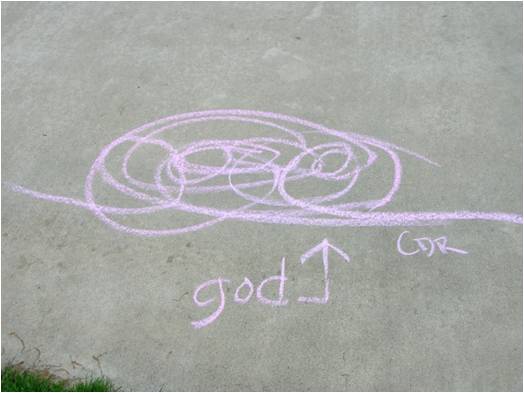
My God-talk is framed with the words of those who’ve helped me figure it out.
Ntozake Shange
i found god in myself
& i loved her / i loved her fiercely (p.63)
God is creator and a sustaining source of life, and therefore present in me. In you. In those whom society shuns, as Shange said so beautifully in for colored girls. This has radical consequences for our understanding of being human, so that post will come later. Consider what this means about God. Fully present in all things, all bodies. A reason that they are. Not sanctioning all that we do (umm, that’ll be sin … again, later), but reminding me that no matter what the world says about my worthiness, it isn’t caught up in skin color or gender or financial stability or physical appearance. It begins and end with God. This is what it means to be source and sustenance. If I’m created in the image of God, so are you. Even and especially when we don’t have the same image. The diversity of the world and all of its life, diversity abounding … this is God’s image because it is God’s creation.
Mary Daly
I have already suggested that if God is male, then the male is god. (p.19)
God isn’t male. But you know, God might be female. Maybe God transcends gender. Actually, we have no idea what that means because human society has thusfar demonstrated itself to be unable to transcend gender. Therefore, images of God rarely escape gendering, produced as they are by human history and community. When society is skewed in the direction of the male, as patriarchy has ensured that it has been for generations, then images of God are similarly skewed. It’s nonsense, really. But the theological is sociological, and vice versa. This is why I’m more interested in affirming female language and images for God than male. It’s strategy, really. And let’s not pretend that theology isn’t strategically employed. Unlike Tony who said in a comment on his own post that “all of our academia has squelched our ability to speak candidly and unapologetically about God,” I think that our academia has bolstered the ability to untangle what’s really going on with so much of traditional God-talk. Once untangled, we can be free to say no, in fact, Father isn’t God’s proper name. Because it’s as important to say what God isn’t as to say what God is.
Elizabeth Johnson
SHE WHO IS: linguistically this is possible; theologically it is legitimate; existentially and religiously it is necessary if speech about God is to shake off the shackles of idolatry and be a blessing for women. (p.243)
YHWH is a much better name for God than Father. Not because it is that which is revealed to Moses in Exodus, but because it is a verb. A verb! Be … to be … I am that I am … I will be that I will be … the Harper Collins Study Bible footnotes properly indicate that we’re unsure of what form of the verb “to be” this Hebrew word is. And how great is that? The name of God is first of all a mystery. Mystery! Remember that all self-assured God-talkers! The name of God is second of all not a fixed static noun, proper or otherwise. It’s dynamic. Alive. Moving. Breathing. Doing. It’s the word we use to name existence itself. Being. Be-ing. Present, future, and whatever else there IS. And given what I said above, I’m with Elizabeth Johnson in that we speak of God as She Who Is.
Alfred North Whitehead
For the kingdom of heaven is with us today. The action of the fourth phase is the love of God for the world. … What is done in the world is transformed into a reality in heaven, and the reality in heaven passes back into the world. By reason of this reciprocal relation, the love in the world passes into the love in heaven, and floods back again into the world. In this sense, God is the great companion – the fellow-sufferer who understands. (p.351)
God has power in a mutual relationship with the world. I have never understood why we’d valorize a concept of power as coercion, dominance, and control in a deity when we abhor it in our fellow human beings. We call that violence. Then again, I don’t understand much of what a patriarchal culture valorizes. Rather than this making God less powerful or less worthy of worship, as critics of what is called process theology usually charge, I think it makes God more worthy of respect and praise. God does what God can do, and we are called to do what we can do. What we do affects God, and what God does affects us. If God weren’t affected by the world, grieved by our pain, angered at our injustices, enthralled by our joys, well then … what’s the point?
Draw God!
In some of my classes, I ask students to draw a picture of God. It’s the kind of task that breaks up a boring lecture, let’s us use crayons in college, and prompts discussion about why so many of us are quick to dismiss our ability to draw the divine, when we are so confident of what we or ancient authors say with words. Pictures with crayons (or sidewalk chalk as in my picture) are as limited and flawed, partial and full of possibility, as anything we can write or say with our words.
And that’s the most important that I have to say about God.
Previous Post

August 21, 2012
Pro-Faith and Pro-Choice: NARAL & RCRC
Next Post
August 24, 2012 Honorable Mention: This is What a Lutheran Bishop Looks Like
Browse Our Archives
Select a Category Abortion At the Intersections Atheism Christianity Contraception Education Feminism Gender Getting Theological Honorable Mention Islam LGBT News Our Voices Race Uncategorized
Select a Month July 2017 June 2017 May 2017 March 2017 February 2017 January 2017 August 2016 July 2016 June 2016 May 2016 April 2016 March 2016 February 2016 January 2016 December 2015 November 2015 October 2015 September 2015 August 2015 July 2015 June 2015 May 2015 April 2015 March 2015 February 2015 January 2015 December 2014 November 2014 October 2014 September 2014 August 2014 July 2014 June 2014 May 2014 April 2014 March 2014 February 2014 January 2014 December 2013 November 2013 October 2013 September 2013 August 2013 July 2013 June 2013 May 2013 April 2013 March 2013 February 2013 January 2013 December 2012 November 2012 October 2012 September 2012 August 2012 July 2012
Follow Us!
TAKE THE
Religious Wisdom Quiz
Who was king when Daniel was thrown into the lions' den?
Select your answer to see how you score.
Nebuchadnezzar Darius Cyrus Belshazzar
Related posts from Caryn Riswold

What I Won’t Write About Mary Daly for...

We Need To Dance at Each Other’s Weddings

Freedom & the Racialized Body: Resonances with Luther...

Active in Love: The ELCA on Faith, Sexism,...
TRENDING AT PATHEOS Progressive Christian

What Being a Modern-Day Apostle Means to Me
In my last column, I discussed the ins and outs of modern-day...

Did Ancient China Once Worship the God of...
Across human history, a common thread weaves through the origins of the...

Love Your Neighbor – Including Earth-Kin: Lev. 19,...
God’s command to love your neighbor means acting in an ethical and...

Lead a Church Study of “Jesus and Lao...
Guest writer Jack Thomas (The Irreverent Reverend) reflects on leading his church...

Pastoral Wisdom for Responding to Sermon Pushback
Getting sermon pushback on your social justice sermon? Learn practical, Proverbs-based strategies...

Principles for Understanding the Apostolic Ministry Today
Whenever people discover that my formal ministry title is "apostle," as in...
view all Progressive Christian blogs
Ad-Free & Subscriber Log-In Subscription Support
- About Us
- 2026 Calendar
- Videos
- Podcasts
- Library of World Religions
- Faith In Media Tracker
- Advertise With Us
- Write for Us
- Privacy Policy
- Terms of Service
- Do Not Sell My Data
- Contact Us
- Radiant Digital
- Manage Newsletter Subscriptions
- Unsubscribe From Notifications
- Sitemap
Copyright 2008-2026, Patheos. All rights reserved.
Subscription Support Ad-Free & Subscriber Log-In
Follow Patheos