
BuddhistCatholicContemplativeEvangelicalGeneral ChristianHinduJewishLatter-day SaintMuslimNew VisionsProgressive Christian
Beliefs
- Buddhist
- Catholic
- Contemplative
- Evangelical
- General Christian
- Hindu
- Jewish
- Latter-day Saint
- More Voices
- Muslim
- New Visions
- Pagan
- Progressive Christian
Topics
- Religion News
- Food and Religion
- Sports and Religion
- Religious Art
- Religious Music and Entertainment
- Religious Events
- History and Religion
- Style and Religion
- Politics and Religion
- Women in Religion
- Recreation Outdoors and Religion
- Business Finance and Religion
- Careers Workplace and Religion
- Education and Religion
- Family Parenting and Religion
- Health Fitness and Religion
- Home and Religion
- Relationships and Religion
- Technology and Religion
- Travel and Religion
Columnists
- Buddhist Columnists
- Business Finance and Religion Columnists
- Careers Workplace and Religion Columnists
- Catholic Columnists
- Contemplative Columnists
- Education and Religion Columnists
- Evangelists Columnists
- Family Parenting and Religion Columnists
- General Christian Columnists
- Health Fitness and Religion Columnists
- Hindu Columnists
- History and Religion Columnists
- Home and Religion Columnists
- Jewish Columnists
- More Voices Columnists
- Latter Day Columnists
- Muslim Columnists
- New Visions Columnists
- Nonreligious Columnists
- Pagan Columnists
- Politics and Religion Columnists
- Progressive Columnists
- Recreation Outdoors and Religion Columnists
- Relationships and Religion Columnists
- Religion News Columnists
- Religious Art Columnists
- Religious Events Columnists
- Religious Music and Entertainment Columnists
- Sports and Religion Columnists
- Style and Religion Columnists
- Technology and Religion Columnists
- Travel and Religion Columnists
- Women in Religion Columnists
Resource Library
- 2026 Calendar
- Library of World Religions
- The 100 Most Holy Places on Earth
- Patheos Answers
- Podcasts
- Videos
- Faith Leaders Database
- Anglican Episcopalian
- Bahai
- Baptist
- Buddhism
- Christianity
- Confucianism
- Eastern Orthodoxy
- Hinduism
- Holiness and Pentecostal
- ISKCON
- Islam
- Judaism
- Lutheran
- Methodist
- The Church of Jesus Christ of Latter-day Saints
- New Age
- Paganism
- Presbytarian and Reformed
- Protestantism
- Religion Behind the Scenes
- Roman Catholic
- Scientology
- Shia Islam
- Sikhism
- Sufism
- Sunni Islam
- Taoism
- Zen
- See all religions
Research Tools
 Ad-Free & Subscriber Log-In Subscription Support
Ad-Free & Subscriber Log-In Subscription Support
Follow Patheos 

- Trending:
- Forgiveness
- |
- Marriage
- |
- Consciousness
- |
- Death Penalty
- |
- Election
- |
- Halloween
 THE CARTOMANCER
- Home
- Pagan
- The art of the question: sins and virtues
The art of the question: sins and virtues
Last updated on: July 10, 2020 at 5:46 pm by Camelia Elias
The art of the question: sins and virtues 2020-07-10T17:46:20+02:00 Camelia Elias
Patheos Explore the world's faith through different perspectives on religion and spirituality! Patheos has the views of the prevalent religions and spiritualities of the world.
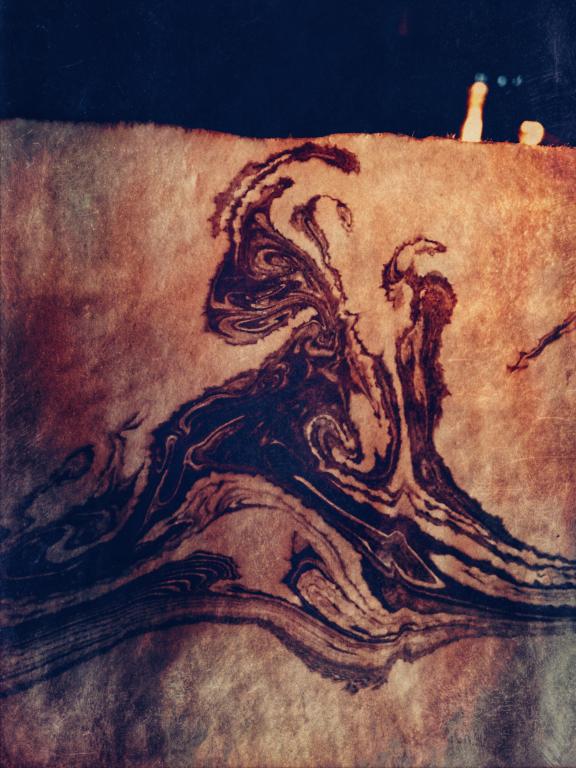
Ink calligraphy by Camelia Elias (Photo: Camelia Elias)
We live in a world of representations. We transact with the notion of a ‘self’ against ‘the other.’ A zen inclined person is able to maintain the fixity of such social constructs, while at the same time know that they are precisely that, social constructs.
Part of what I like about my work as a fortuneteller is seeing how we cope with the perennial question of the self in relation and the point when the idea of taking everything personally breaks down. I’m after that point, because recognizing the flow of events in the proposition that life happens as it happens features absolutely no constructs of separation: I against the other, mother against daughter, friend against enemy, groups marked by identity against governments.
There are many questions to pose when divisions and separations are maintained. There are no questions to pose when the point of break down of social constructs occur. The first thing that goes out with the rubble is precisely representation. It’s a tough one to handle, because we all want recognition. We want recognition for what we do, and we want recognition of our boundaries.
If the neighbor parks their car on my property because it’s convenient for them, and hey, there’s so much space I enjoy over here, you can be sure that I’ll react. The fact that I have more space than the other is besides the point, and none of the other’s business. What I want is not a false correlation about what I own and why – I don’t even owe any explanations for that – but a simple recognition of my jurisdiction. The whole legal system is built around policing the self in relation.
The same applies to work. I read the cards for people who ask about how to deal with the situation when they present an original idea at work, only to see other colleagues run off with it without crediting.
As it happens, cards for divination have been invented to address precisely such situations, when the dividing line between taking liberties and maintaining boundaries is blurred.
In all my divination books and cartomancy courses, I dedicate entire sections and sessions to the art of the question, the gist of it being that it’s a good idea to identify first what is at stake in a question, and then proceed to analysis and judgment. As questions can assume different characters – such as the descriptive, the analytical, the reflective, and the evaluative – they can also change nuance, all according to how the shifting signifiers or the representational enters into play across the board.
The question ‘does he love me’, invites to a description of the situation on the basis of which you can conclude either in the affirmative, the negative, or the maybe mode. ‘How he loves me’ invites to a reflection of modality on the basis on which I can then conclude in the evaluative: ‘he loves me like this, serving me coffee and kissing me when I expect it the least, so he’s worth keeping.’ ‘Why he loves me like he does’ invites to a reading that has an investigative character.
Let’s just say that by merely being aware of just these four types of questions we encounter commonly in our work with the cards, we get to see how entertaining fortunetelling is.
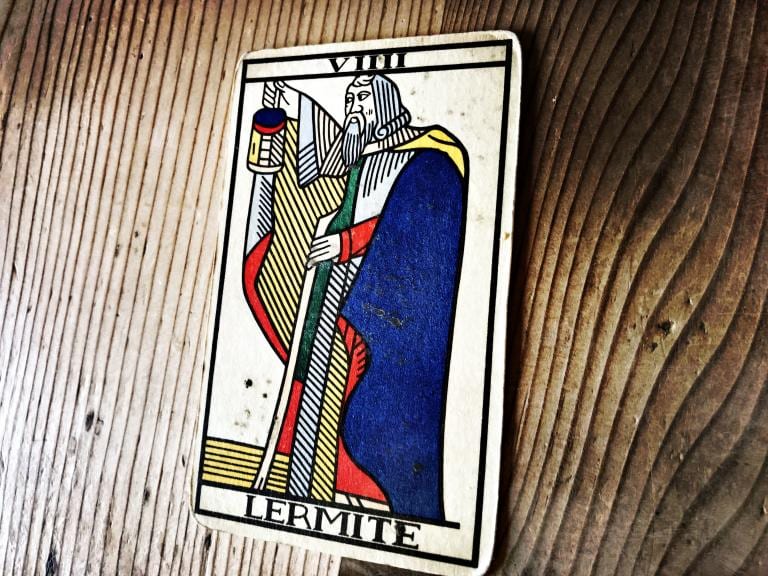
The Hermit by Jean-Claude Flornoy (Photo: Camelia Elias)
Now, what of the time when we don’t have a question to bring to the cards? Since the 60s and up until recently, when people started looking at the cards as markers of something other than a psychological process, reading cards according to their nominal quality was very popular. Knowing how ‘this means that’ settled it for many, and it still does, when we look at the popularity of reading ‘a daily’, that is to say, looking at how one card can stand as a predictive representation of how the events in a day will unfold. You can say, ‘Today I got the Hermit. This means that I’ll be off Facebook’.
In this reading of the Hermit, what I do is look at the function of what we culturally associate with the Hermit, the act of retreating from the world. This is good enough for me, but I see that there are many for whom looking at the function of things is not enough. They want ‘meaning’, as there’s ‘more’ to the cards than just straightforward function. There’s symbolic function and value, there’s story. ‘Give me that,’ the ones invested in delusions ask. So people launch in a discourse that’s purely nominally descriptive on an elastic that stretches from the commonsensical to the utterly ridiculous. Any classic little white book, the short booklet that accompanies a standard set of cards, will introduce you to a list of keywords that you can pick from, for instance these associations: the Hermit equals old age, aloneness, retreat from the world, wisdom, prudence, attention, mistrust, illness, lack of vigor, stupor, amnesia, and so on.
Now, there’s nothing wrong with such a list of words, if there’s a question on the table, but things go rotten when there’s no question. The hermit representing ten different things is a whole lot of things to equalize, so how do you determine which of the ten will turn out to represent your day? You can’t. Not if you want precision. You can only do it in hindsight: ‘Ah yes, it was all about being limited in my body, as my back hurt today, and not at all about sitting and philosophizing.’ There goes that initial insight in your ‘daily’…
I think about questions a lot, and I like to be prompted by some that are not necessarily those of my common conditioning. I’m about to start a new cycle of Tarot prompts on the topic of Seven Deadly Sins. In my cartomantic prompts what I do is turn it all around. I don’t read for the plot, for ‘meaning’, as arbitrary meanings leave me cold and not convinced. I don’t read for the pragmatic function of our cultural competence in recognizing what images represent exactly either. I read for the art of the question, when I look at the cards past conditioning. The only condition I take into account is the framing of the context. In this case now, why look at seven deadly sins? Because I see how the old representation of the thieves of our common sense is very much alive in our modern day. But if I want to address my consumerism – from food to uninformed opinions – what questions might I ask? Of the opposite representation? Of virtues?
As it happens the whole of the Tarot has been built around the representation of classical virtues, with justice, fortitude, temperance, and prudence leading the way. Always depending on context, the nominal factor here acquires significance only if we constrain the question to fit a template, a trifecta, a four-point model, or a 12-step program.
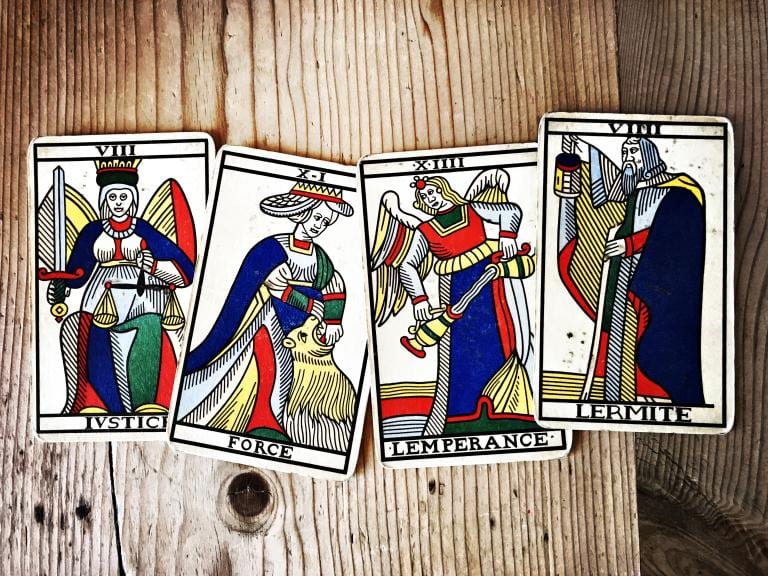
Jean Noblet Marseille Tarot by Jean-Claude Flornoy (Photo: Camelia Elias)
How do we ask questions that bring us to a level where we get to experience something other than a trite model? People love models, and I’m good at crafting and designing them myself for instrumental purpose, but when I want to get past representations, and get a sense of how I can better observe flow not separation, then I must find a way of asking questions that bring me to a place where I don’t operate with opposites: sins vs virtues, ‘me’ against ‘the other’.
The classicists didn’t consider the autobiographical self as part of the seven deadly sins, rather more like elevating it to the status of ultimate virtue – ‘being yourself’ is very much endorsed as a virtue – but upon reflecting on the actual construction of ‘myself,’ what can we say we find there?
I’m greedy for an answer, greed I want to impale right now with a set of cards that can prompt me towards what the question is here.
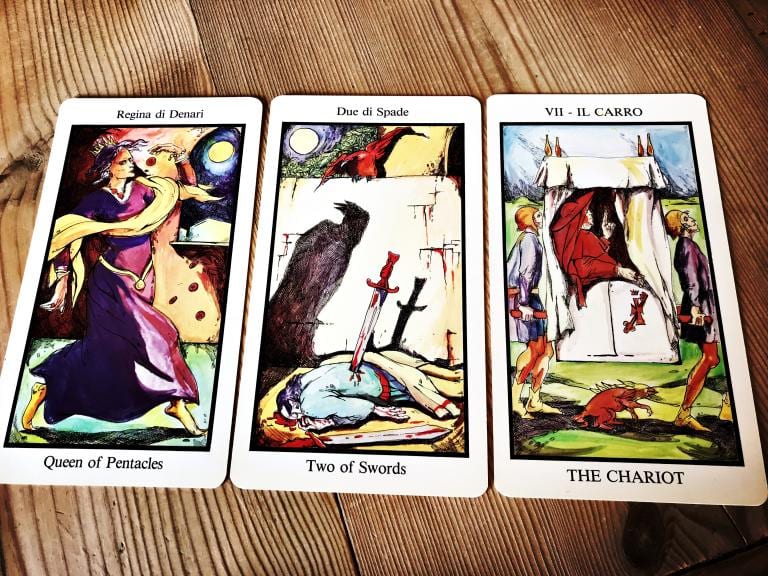
Elisabetta Cassari, Solleone Tarot (Photo: Camelia Elias)
Three cards fell on the table from Elisabetta Cassari’s wonderfully disturbing deck, the Solleone Tarot:
The Queen of Coins (‘pentacles’ is not the correct translation of the Italian denari), Two of Swords, and the Chariot make an appearance for a question to arise:
In the pursuit of money, who does the Queen of Coins stab in the back? To what outcome? We don’t see her riding in the Chariot. Is the reptilian figure below the chariot her? What does this tell us about greed? Greed rides along, sometimes even virtuously, if dedication to it is strong enough. But… and meanwhile, the Pope’s finger.
In my Zen practice I’ve been schooled in the art of ‘pointing out instruction’. When this happens, what is experienced is precisely a move beyond the trite question, beyond meaning and symbolic function. We’re here with sins and virtues as part and parcel of what we’re able to recognize is the case. We read the cards for that. Nothing more, nothing less. If you’re adventurous, you can find that a snappy reading under the signature of reading like the Devil is more dangerous than all the sins and virtues in the world.
♠
Seven Deadly Sins stays open for registration until Sunday. We start Monday. I’ll be happy to welcome you on a cartomantic prompts ride.

About Camelia Elias
Camelia Elias, PhD & Dr.Phil., is a former university professor. After 20 years in academia, she left her career to pursue her interests in teaching and writing on the philosophy and practice of reading cards. She works with contemplative arts, oracular language, and martial arts cartomancy and Zen at her own school, Aradia Academy. You can read more about the author here.
Previous Post
July 2, 2020
Rotten associations
Next Post
July 26, 2020 The dead serious occultist in the age of activism
Browse Our Archives
Select a Category Columns The Cartomancer Uncategorized
Select a Month January 2024 October 2023 August 2023 July 2023 June 2023 November 2022 October 2022 August 2022 May 2022 April 2022 February 2022 January 2022 November 2021 October 2021 September 2021 August 2021 June 2021 April 2021 March 2021 February 2021 January 2021 December 2020 November 2020 October 2020 September 2020 August 2020 July 2020 June 2020 May 2020 April 2020 March 2020 February 2020 January 2020 December 2019 November 2019 October 2019 September 2019 August 2019 July 2019 June 2019 May 2019 April 2019 March 2019 February 2019 January 2019 December 2018 November 2018 October 2018 September 2018 August 2018 July 2018 June 2018 May 2018 April 2018 March 2018 February 2018 January 2018 December 2017 November 2017 October 2017 September 2017 August 2017 July 2017 June 2017 May 2017 April 2017 March 2017 February 2017 January 2017 December 2016 November 2016 October 2016 September 2016 August 2016 July 2016 June 2016 May 2016 April 2016 March 2016 February 2016 January 2016 December 2015 November 2015 October 2015 September 2015 August 2015 July 2015
Follow Us!
TAKE THE
Religious Wisdom Quiz
In 2 Peter, what does Peter say he will soon put aside?
Select your answer to see how you score.
His ministry His life His job His burdens
Related posts from THE CARTOMANCER
TRENDING AT PATHEOS Pagan

When we talk about Greek religion, we often begin with the dodekatheion—the...

I was recently chatting with someone on Instagram. She asked me what...

While there are many people who share their results, the end of...

On July 23, I saw Christopher Nolan's The Odyssey which is Homer’s...

As I write this two big events have just finished up. One...

Restoring the Watershed of Divine Love
Perhaps cooperation is not something we manufacture through legislation, ideology, or moral...
view all Pagan blogs
Ad-Free & Subscriber Log-In Subscription Support
- About Us
- 2026 Calendar
- Videos
- Podcasts
- Library of World Religions
- Faith In Media Tracker
- Advertise With Us
- Write for Us
- Privacy Policy
- Terms of Service
- Do Not Sell My Data
- Contact Us
- Radiant Digital
- Manage Newsletter Subscriptions
- Unsubscribe From Notifications
- Sitemap
Copyright 2008-2026, Patheos. All rights reserved.
Subscription Support Ad-Free & Subscriber Log-In
Follow Patheos