
BuddhistCatholicContemplativeEvangelicalGeneral ChristianHinduJewishLatter-day SaintMuslimNew VisionsProgressive Christian
Beliefs
- Buddhist
- Catholic
- Contemplative
- Evangelical
- General Christian
- Hindu
- Jewish
- Latter-day Saint
- More Voices
- Muslim
- New Visions
- Pagan
- Progressive Christian
Topics
- Religion News
- Food and Religion
- Sports and Religion
- Religious Art
- Religious Music and Entertainment
- Religious Events
- History and Religion
- Style and Religion
- Politics and Religion
- Women in Religion
- Recreation Outdoors and Religion
- Business Finance and Religion
- Careers Workplace and Religion
- Education and Religion
- Family Parenting and Religion
- Health Fitness and Religion
- Home and Religion
- Relationships and Religion
- Technology and Religion
- Travel and Religion
Columnists
- Buddhist Columnists
- Business Finance and Religion Columnists
- Careers Workplace and Religion Columnists
- Catholic Columnists
- Contemplative Columnists
- Education and Religion Columnists
- Evangelists Columnists
- Family Parenting and Religion Columnists
- General Christian Columnists
- Health Fitness and Religion Columnists
- Hindu Columnists
- History and Religion Columnists
- Home and Religion Columnists
- Jewish Columnists
- More Voices Columnists
- Latter Day Columnists
- Muslim Columnists
- New Visions Columnists
- Nonreligious Columnists
- Pagan Columnists
- Politics and Religion Columnists
- Progressive Columnists
- Recreation Outdoors and Religion Columnists
- Relationships and Religion Columnists
- Religion News Columnists
- Religious Art Columnists
- Religious Events Columnists
- Religious Music and Entertainment Columnists
- Sports and Religion Columnists
- Style and Religion Columnists
- Technology and Religion Columnists
- Travel and Religion Columnists
- Women in Religion Columnists
Resource Library
- 2026 Calendar
- Library of World Religions
- The 100 Most Holy Places on Earth
- Patheos Answers
- Podcasts
- Videos
- Faith Leaders Database
- Anglican Episcopalian
- Bahai
- Baptist
- Buddhism
- Christianity
- Confucianism
- Eastern Orthodoxy
- Hinduism
- Holiness and Pentecostal
- ISKCON
- Islam
- Judaism
- Lutheran
- Methodist
- The Church of Jesus Christ of Latter-day Saints
- New Age
- Paganism
- Presbytarian and Reformed
- Protestantism
- Religion Behind the Scenes
- Roman Catholic
- Scientology
- Shia Islam
- Sikhism
- Sufism
- Sunni Islam
- Taoism
- Zen
- See all religions
Research Tools
 Ad-Free & Subscriber Log-In Subscription Support
Ad-Free & Subscriber Log-In Subscription Support
Follow Patheos 

- Trending:
- Forgiveness
- |
- Marriage
- |
- Consciousness
- |
- Death Penalty
- |
- Election
- |
- Halloween
 THE CARTOMANCER
- Home
- Pagan
- Concepts at odds: the intuitive, the spiritual, the plain clear
Concepts at odds: the intuitive, the spiritual, the plain clear
Last updated on: January 22, 2023 at 7:15 pm by Camelia Elias
Concepts at odds: the intuitive, the spiritual, the plain clear 2023-01-22T19:15:38+02:00 Camelia Elias
Patheos Explore the world's faith through different perspectives on religion and spirituality! Patheos has the views of the prevalent religions and spiritualities of the world.
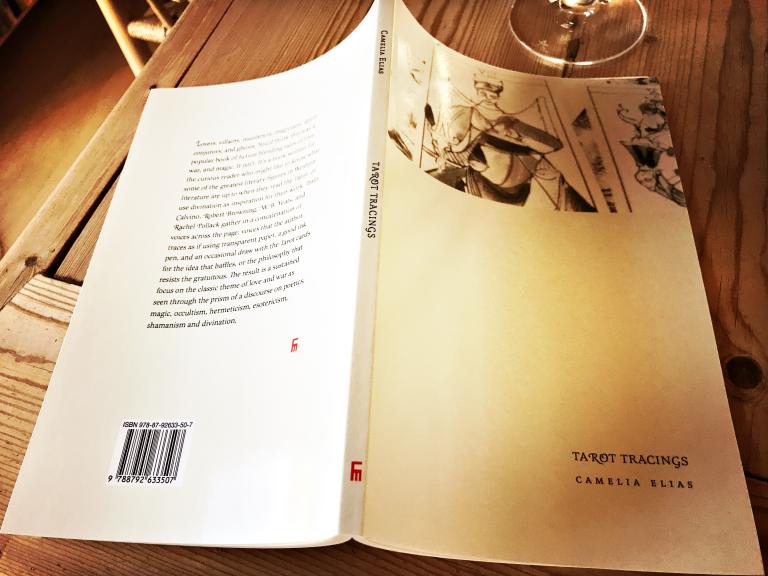
Tarot Tracings (Photo: Camelia Elias)
Sometimes book launch events can create more text right then and there. When my book, Tarot Tracings: Essays on Literature and Divination was flung to the public via a talk, what I hammered on was this point: the fortuneteller is not spiritual, but rather invested in clarity. My talk about the book – which is an exploration of tracing the surface of divination in authors Italo Calvino, Robert Browning, W.B. Yeats, and Rachel Pollack – was a Zen talk about the need to distinguish between what we’re doing and what we think we’re doing when we read the cards.
Because this is an important discussion, I allowed myself to reproduce in writing the ensuing dialogue that took place in the Aradia Academy alumni group between brilliant cartomancer Dorian Broadway and myself, since Dorian’s question and my answer may be of use to others in their own practice. Dorian asked, starting with a reference to the dictionary:
Camelia, you often mention that you are Zen rather than spiritual. Merriam-Webster says this on Zen: 1: a Japanese sect of Mahayana Buddhism that aims at enlightenment by direct intuition through meditation. 2: or Zen : a state of calm attentiveness in which one’s actions are guided by intuition rather than by conscious effort.
On the spiritual, Merriam-Webster says this: 1: of, relating to, consisting of, or affecting the spirit: incorporeal, spiritual needs; 2a: of or relating to sacred matters, spiritual songs; 2b: ecclesiastical rather than lay or temporal, spiritual authority, lords spiritual; 3: concerned with religious values; 4: related or joined in spirit, our spiritual home, his spiritual heir; 5a: of or relating to supernatural beings or phenomena; 5b: of, relating to, or involving spiritualism.
Would you mind elaborating on how you define the two and how you define yourself as Zen and not as spiritual? My curiosity is piqued.
I answered Dorian thus:
Let me ask you this first: what do you suppose ‘direct intuition’ means? Think about it for a second before you move on it. There isn’t the time when we don’t have a direct experience to things. How would the opposite manifest? When I read, is it not me reading, having a direct experience to the act of reading? When I eat or make love is it not me eating or making love who is having a direct experience to these acts? Now that we got this clear, what do you make of the ‘intuition’ related to these acts? Is this intuition not related to these alwyas direct experiences? Methinks it is. It’s this sort of clarity that goes into knowing what you’re doing that we call ‘direct intuition.’ Now, conversely, when we talk about the intangibles that the dictionary also refers to, what exactly are we talking about? Direct intuition or direct experience ? How would this manifest? I tell you this: if you experience a manifestation ‘of the spirit,’ you’re having a direct experience not ‘of spirit,’ but rather, of the language that you use when you think ‘spirit.’
Now let me also ask you this: is your experience of what you conjure into language ‘of the outside,’ or ‘of the inside?’ How? Convince me that such a thing exists, that is, things like ‘inside’ or stuff also known as spirit ‘out there.’ What the hell is all that about? If we have access to ‘spirit’ it’s because we think ‘spirit.’ But since when is what we think reality? Get real here… So, the difference between ‘direct experience’ and ‘spiritual experience’ is one of language and the degree to which we live and see phenomena through language; language that describes what we experience.
Lastly, now I ask you this: since when is language the thing itself? The real? Let’s get real again, amen, and if we are to make an effort, then let that effort be about being clear, or standing clear of all the gross bullshit out there. There’s no ‘inside,’ ‘inner,’ ‘spiritual,’ ‘shadow,’ ‘mystery’ or ‘the unconscious.’ The unconscious is as inaccessible as the real, that’s why it’s called the unconscious. If you think that you can ‘make the unconscious conscious,’ to go with this popular Jungian illusion right now, what you actually do is place more layers of fiction on top of what your regular linguistic fiction is already all about. You think you can make your inner, spiritual, shadow, unconscious life conscious? Good luck with that. The only thing you can have access to is how you name your shit on the surface of life. Know it for what it is, not for what it isn’t, and you’ll be a sage. There’s no ‘spiritual’ dimension to our linguistic strategies and tactics, manipulations and enchantments. It’s just pretty words that we use to comfort or to kill with. And that’s that.
Now for the purpose of this essay, I want to state that when I go like this, Zen, or by whatever other concept, I don’t do it for the purpose of merely being a contrarian. I do it for the purpose of highlighting the difference between being clear and being wishful about a state of nature, a state of things, or a state of human character. Being spiritual is being both wishful and wilful, where wilful designates a state of capriciousness and stubbornness about deciding that things are ‘like this’ in spite of contrary evidence.
To give an example that I also offered in my talk, the corona virus is a virus. It’s not a ‘message from the universe,’ ‘a lesson,’ ‘an opportunity to grow,’ ‘an initiation,’ ‘an alchemical process,’ ‘shedding the old self so that a new self can emerge,’ ‘the Armageddon,’ ‘the end of the world,’ or ‘the end of capitalism.’ It’s a virus. All the other intangibles related to our numerous beliefs about what the pandemic crisis is all about are anchored in fictions, wishful and wilful thinking. Now, obviously, it’s not good business to say that a pandemic is devoid of meaning, financial or spiritual business alike, but when it comes to clarity, the only statement that we can provide in actuality is to simply say it like it is, the corona virus is a virus, nothing more and nothing less.
Now extrapolate from this and apply this clear thinking to the practice of fortunetelling, a practice that’s actually anchored in calculating and triangulating angles based on context, image text, and story text. When I read fortunes I engage with analytical, deductive reasoning. I permute with variables of risk and probability. Game theory 101. In this approach to divination, there is no space for the belief that reading cards is a spiritual practice, or that there’s anything spiritual about the cards themselves. The cards do not possess arcane secrets, anymore than I possess a a spiritual dimension. Thinking of metaphysics is no more a spiritual practice than the practice of eating cornflakes for breakfast.
Unless, it’s cosmic…
Here’s an example: woman meets man. ‘Cosmic connection,’ she tells me. ‘But how long will it last?’ she want to know. I understand two things from this question before I let any cards hit the table: 1) If it’s cosmic, ‘what if you can’t handle it?’ so it’s fair to be anxious about recognizing your human limitations in the face of the big thing. 2) If ‘it feels spiritual,’ then why worry at all? Isn’t belief in the cosmic order of things enough? My assumption here is that the woman can’t trust her own words about the relationship – ‘it’s a cosmic connection’ – because if she did, she would not come to see me. This is the point when I want to laugh at the uselessness of the belief in the cosmic relation, and yet, regardless of my preliminary analysis of the basic human concern here, I still let three cards fall on the table.
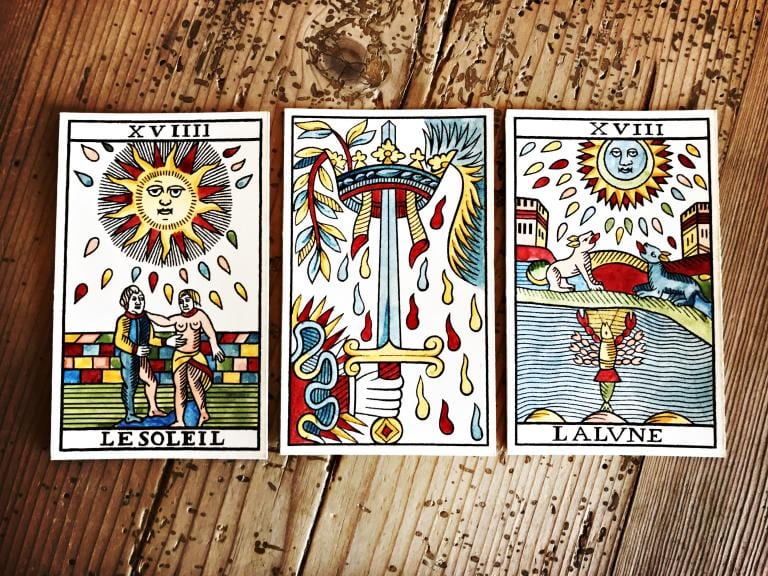
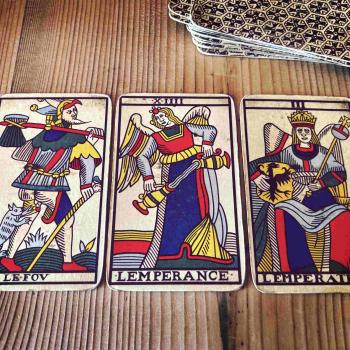
Jean Noblet Marseille Tarot as reconstructed by JC Flornoy, hand painted by Edmund Zebrowsky (Photo: C Elias)
The Sun, Ace of Swords, the Moon.
In response to the woman’s question: ‘but how long will it last?’ I said the following: ‘the cosmic connection will last half a day.’ ‘Heh?’ the woman exclaimed, making ‘goo-goo’ eyes. ‘What do you mean by half a day?’ I explained. ‘We go from daylight to the night. That’s 12 hours. In between we got the sword. We’re with the fast and furious here.’ ‘So, it won’t even last a year?’ the woman wanted to know, disclosing a tone of disappointment.’ ‘Not very bloody likely,’ I said, winking at the dripping blood from the big sword, and then leaving it at that. After this image, no one mention the word cosmic anymore.
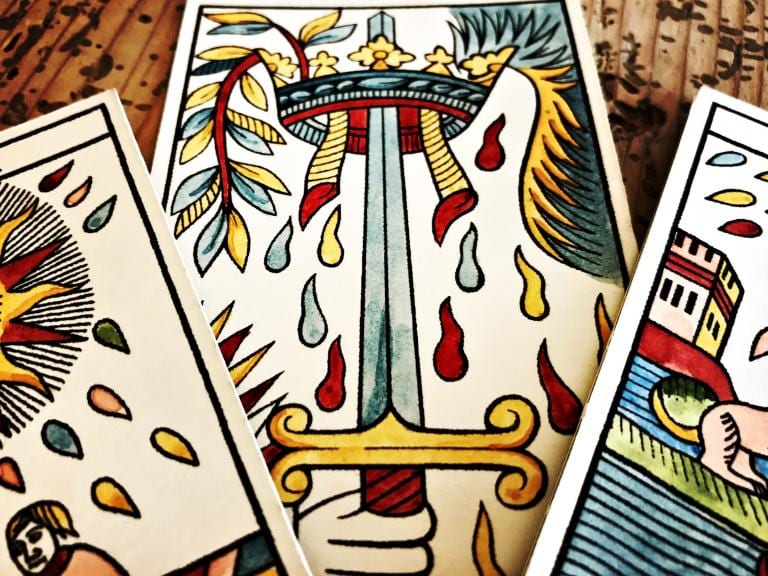
Jean Noblet Marseille Tarot as reconstructed by JC Flornoy, hand painted by Edmund Zebrowsky (Photo: C Elias)
And so it goes. I call this reading a ‘clear reading.’ If it’s ‘spiritual,’ or based on an ‘intuitive channeling’ of a mean fortuneteller that came before me, yet one also full of compassion, I haven’t clue. What I do have a clue of is precisely what I gave my attention to: the cards, the context, and the caliber of my precise shot.
I say to my students: try to be less spiritual in your readings and more clear on what you actually see is happening. Then take it from there.
♠
Stay in the loop for cartomantic courses.

About Camelia Elias
Camelia Elias, PhD & Dr.Phil., is a former university professor. After 20 years in academia, she left her career to pursue her interests in teaching and writing on the philosophy and practice of reading cards. She works with contemplative arts, oracular language, and martial arts cartomancy and Zen at her own school, Aradia Academy. You can read more about the author here.
Previous Post
April 14, 2020
More of this, less of that
Next Post
May 7, 2020 Magicians, marriages, and conmen
Browse Our Archives
Select a Category Columns The Cartomancer Uncategorized
Select a Month January 2024 October 2023 August 2023 July 2023 June 2023 November 2022 October 2022 August 2022 May 2022 April 2022 February 2022 January 2022 November 2021 October 2021 September 2021 August 2021 June 2021 April 2021 March 2021 February 2021 January 2021 December 2020 November 2020 October 2020 September 2020 August 2020 July 2020 June 2020 May 2020 April 2020 March 2020 February 2020 January 2020 December 2019 November 2019 October 2019 September 2019 August 2019 July 2019 June 2019 May 2019 April 2019 March 2019 February 2019 January 2019 December 2018 November 2018 October 2018 September 2018 August 2018 July 2018 June 2018 May 2018 April 2018 March 2018 February 2018 January 2018 December 2017 November 2017 October 2017 September 2017 August 2017 July 2017 June 2017 May 2017 April 2017 March 2017 February 2017 January 2017 December 2016 November 2016 October 2016 September 2016 August 2016 July 2016 June 2016 May 2016 April 2016 March 2016 February 2016 January 2016 December 2015 November 2015 October 2015 September 2015 August 2015 July 2015
Follow Us!
TAKE THE
Religious Wisdom Quiz
What destroyed Pharaoh's army as they pursued the Israelites?
Select your answer to see how you score.
Plague of locusts The sea Earthquake Fire from heaven
Related posts from THE CARTOMANCER
TRENDING AT PATHEOS Pagan

When we talk about Greek religion, we often begin with the dodekatheion—the...

I was recently chatting with someone on Instagram. She asked me what...

While there are many people who share their results, the end of...

On July 23, I saw Christopher Nolan's The Odyssey which is Homer’s...

As I write this two big events have just finished up. One...

Restoring the Watershed of Divine Love
Perhaps cooperation is not something we manufacture through legislation, ideology, or moral...
view all Pagan blogs
Ad-Free & Subscriber Log-In Subscription Support
- About Us
- 2026 Calendar
- Videos
- Podcasts
- Library of World Religions
- Faith In Media Tracker
- Advertise With Us
- Write for Us
- Privacy Policy
- Terms of Service
- Do Not Sell My Data
- Contact Us
- Radiant Digital
- Manage Newsletter Subscriptions
- Unsubscribe From Notifications
- Sitemap
Copyright 2008-2026, Patheos. All rights reserved.
Subscription Support Ad-Free & Subscriber Log-In
Follow Patheos