
BuddhistCatholicContemplativeEvangelicalGeneral ChristianHinduJewishLatter-day SaintMuslimNew VisionsProgressive Christian
Beliefs
- Buddhist
- Catholic
- Contemplative
- Evangelical
- General Christian
- Hindu
- Jewish
- Latter-day Saint
- More Voices
- Muslim
- New Visions
- Pagan
- Progressive Christian
Topics
- Religion News
- Food and Religion
- Sports and Religion
- Religious Art
- Religious Music and Entertainment
- Religious Events
- History and Religion
- Style and Religion
- Politics and Religion
- Women in Religion
- Recreation Outdoors and Religion
- Business Finance and Religion
- Careers Workplace and Religion
- Education and Religion
- Family Parenting and Religion
- Health Fitness and Religion
- Home and Religion
- Relationships and Religion
- Technology and Religion
- Travel and Religion
Columnists
- Buddhist Columnists
- Business Finance and Religion Columnists
- Careers Workplace and Religion Columnists
- Catholic Columnists
- Contemplative Columnists
- Education and Religion Columnists
- Evangelists Columnists
- Family Parenting and Religion Columnists
- General Christian Columnists
- Health Fitness and Religion Columnists
- Hindu Columnists
- History and Religion Columnists
- Home and Religion Columnists
- Jewish Columnists
- More Voices Columnists
- Latter Day Columnists
- Muslim Columnists
- New Visions Columnists
- Nonreligious Columnists
- Pagan Columnists
- Politics and Religion Columnists
- Progressive Columnists
- Recreation Outdoors and Religion Columnists
- Relationships and Religion Columnists
- Religion News Columnists
- Religious Art Columnists
- Religious Events Columnists
- Religious Music and Entertainment Columnists
- Sports and Religion Columnists
- Style and Religion Columnists
- Technology and Religion Columnists
- Travel and Religion Columnists
- Women in Religion Columnists
Resource Library
- 2026 Calendar
- Library of World Religions
- The 100 Most Holy Places on Earth
- Patheos Answers
- Podcasts
- Videos
- Faith Leaders Database
- Anglican Episcopalian
- Bahai
- Baptist
- Buddhism
- Christianity
- Confucianism
- Eastern Orthodoxy
- Hinduism
- Holiness and Pentecostal
- ISKCON
- Islam
- Judaism
- Lutheran
- Methodist
- The Church of Jesus Christ of Latter-day Saints
- New Age
- Paganism
- Presbytarian and Reformed
- Protestantism
- Religion Behind the Scenes
- Roman Catholic
- Scientology
- Shia Islam
- Sikhism
- Sufism
- Sunni Islam
- Taoism
- Zen
- See all religions
Research Tools
 Ad-Free & Subscriber Log-In Subscription Support
Ad-Free & Subscriber Log-In Subscription Support
Follow Patheos 

- Trending:
- Forgiveness
- |
- Marriage
- |
- Consciousness
- |
- Death Penalty
- |
- Election
- |
- Halloween
 THE CARTOMANCER
- Home
- Pagan
- More of this, less of that
More of this, less of that
Last updated on: January 15, 2023 at 5:45 pm by Camelia Elias
More of this, less of that 2023-01-15T17:45:24+02:00 Camelia Elias
Patheos Explore the world's faith through different perspectives on religion and spirituality! Patheos has the views of the prevalent religions and spiritualities of the world.
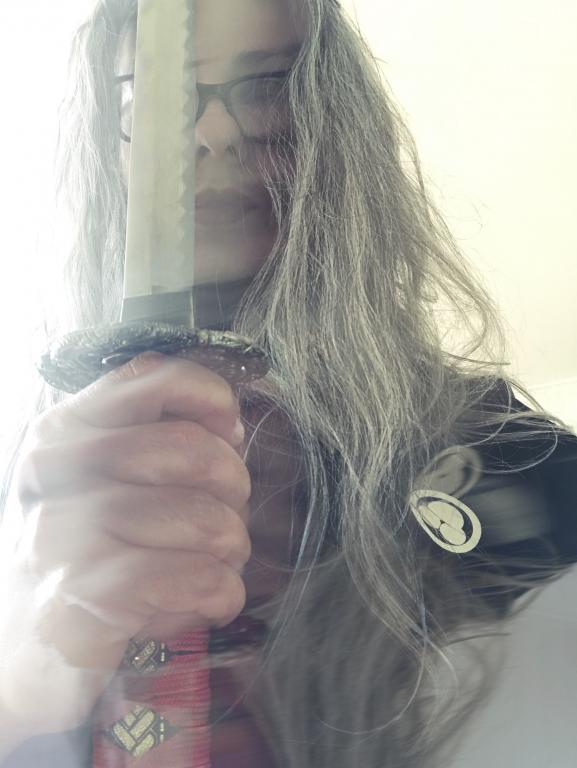
Getting in fencing mood with my sword.
I like to play with swords. I have several samurai swords in my zendo, the biggest room in the house that’s as large as a Zen temple in the mountains, mountains that here take the form of sand dunes. I also like to sharpen my Japanese knives. My philosophy surrounding the sharpening of my sharp objects is that they are never sharp enough, so I keep at it. This practice comes in handy also when I have to swing my sharp tools over concepts. Although I speak in conceptual terms whenever I refer to what is a good idea to do or not do, I’m ever aware of the fact that experience over conceptual thinking is infinitely smarter and therefore preferable. Experience over belief is preferable. Experience over ideas is preferable. If I happen to fall into being seduced by the world of ‘value,’ ‘meaning,’ ‘spiritual awakening,’ and ‘growth’ – of personal development and business alike – I reach for my swords. I will have none of that. Draw, cut, and sheathe. Arigatou.
As the internet abounds in offerings, ‘because people are struggling,‘ I let the sharp point of my sword discern between experience and idea. I will buy the experience and say pass to the idea. If an experience is sold as having a premise anchored in belief, I slash it. I will buy the toilet paper and slash the promise of how I can purify my soul, how I can take refuge in enjoying my isolation, if only I had access to the secret of how to refine my shadow, my aura, my kundalini force, or my inner witchcraft. Draw, cut, and sheathe. Arigatou gozaimasu.
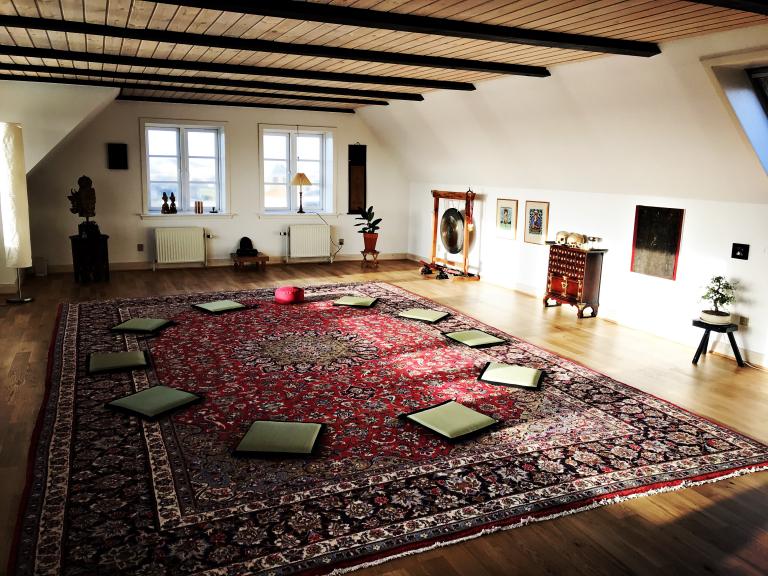
My zendo in the sand dunes of Agger on the West Coast of Denmark.
Why am I so against beliefs and the conceptual as keys to coping? Because the experience of form is not also the experience of value. Value is something we agree to assign to form. A form with assigned value can take the shape of these words: ‘my body,’ ‘my image,’ ‘my grief,’ ‘my fear,’ ‘my shadow.’ From the perspective of lived phenomena, while we can agree that just as there’s light there’s also shadow, and just as there’s a feeling of solidity when we tread on the earth, so there is a sense of substance, we can’t be so sure about the possessor. What we call ‘I’ is just a cultural value we assign to a body beholding the manifestation of some phenomena. But is this body that beholds phenomena ‘me?’ In my own experience of encountering smart people who are anything but shallow thinkers, especially the physicists and Zen masters alike would start laughing, before they’d answer this question. We can infer from their reaction that what they behold at the level of ‘belief’ is that while there is a body, there is also no such thing as my body.
In my own Zen practice the sharpening of my knives is all about not losing myself to the world of content. I am a formalist. As a formalist I look at how phenomena manifests, including how phenomena manifests as symbolic glyphs also knows as words. When I’m done with this looking, I don’t get excited and say to myself, ‘by Jove, I’ve just seen the light of this or that shadow on my wall, and it has value.’ If I see any writing on the wall at all, I leave it at its calligraphic appearance, as I like to pass aesthetic judgments. Some scribbling appeals to my sense of beauty and balance better than other.
‘Yes, but what does it all mean, the writing on the wall, as it sounds so ominous?’ some would like to know, because we’re all storytelling machines and we like to share. It’s a fair question, especially since both ‘beauty’ and ‘balance’ fall in the category of abstract thinking informed by a decision on parameters for the value of measurement. If I’m in a good mood, I invent something fantastic, often something sensual that would send the reader straight to the thickest pillow where tears of either joy or lamentation can be shed.
Some would think that this formalist approach to the world of invented content is harsh and hard, devoid of mercy and compassion. That may well be, but since I’ve also tried the soft cushions of ‘make yourself feel good in the company of sexy content’ and I didn’t like it, I prefer to stick to the story that says ‘everything is form and no content, not even very little content.’
Why I am I saying all these things, and how does this philosophy relate to reading cards, an activity that most would swear is excellent precisely in times of crisis, as predicting the future has a history of being comforting in hard times.
I’d say the following: if we struggle with anything then it’s with our own perceived vulnerability, which, in this day and age, has become a very hot commodity. Right now, the invented story about the vulnerable in the vulnerable story is that the vulnerable we transact with is not just hot but also very sexy, as it holds all the keys to our success. The vulnerable is our power, they say. The vulnerable is full of ripeness, a fertile land that’s both valuable and significant. It’s what makes us human… Wow, can you feel how exhilarating these clichés are? I can feel them in my bones. The vulnerable goes deep…
Intended sarcasm for instructional purpose aside, if you’re still listening here, try to turn it around. Try to simply stay with what you observe. Assign no value to what you observe. Don’t think: ‘my body, my grief,’ ‘my body, my fear,’ ‘my body, my passion,’ or ‘my body, my power.’ Think beyond the possessive story of ‘it’s all mine.’ Think ‘body, grief, fear, passion, power.’ How does this string of words feel now, without the story of the personal (feeling, experience of growth, development, improvement, valuable self, inherent worth, etc, the promised land all the way to hell and no return).
Sharpen your knives. Take out your cards, whatever deck, and go through the whole pack with this mantra in mind, as you draw pairs:
More of this (one card down).
Less of that (one card down).
You’re welcome to have a storyworld in your mind, such as the story of loss (of money, love, health, or work), or gain (of power, ambition, reputation, strength). Go through all the cards, and when you’re done, take each pile and inspect it carefully. Let the insistence on ‘more of this’ and then ‘less of that’ pound in your ears. At the end of this exercise you should have a clear sense of whether you live your life such as it is, through observing phenomena, or whether you live your life according to others’ interpretation of it for you in the form of ideas, beliefs, and concepts full of promises for ‘meaningful’ content.
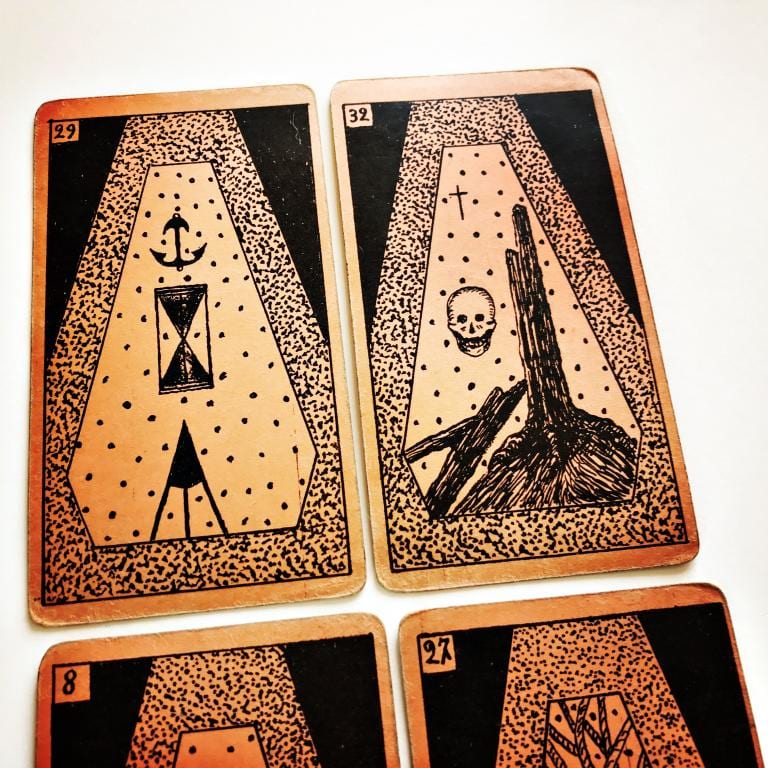
The unknown ‘Zoro’ deck (Photo: Camelia Elias)
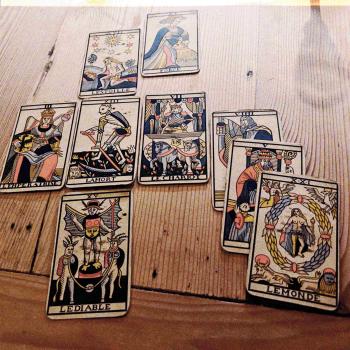
To give an example, I’ll use here an incomplete deck from the beginning of the 20th century, whose story I know nothing about. I haven’t a clue as to who made it and when exactly. 7 cards are missing from what I presume is a 48 card deck. I call it ‘Zoro’ for its masked significators.
What I also like about this deck also that it’s necromantic. Images rise out of coffins and the whole mood is quite fantastic. I like to think that the risen here form a story about ideas or the beliefs we put to rest in favor of experiencing more what presents itself to us in just the form that it does, before any value is assigned to it. The more subtle questions to ask here is this: when the performance of beliefs rises to new forms, then what? Does it become something else? The answer is no, as even the performance that we call ‘I am’ is still that, a performance, not something that has inherent value.
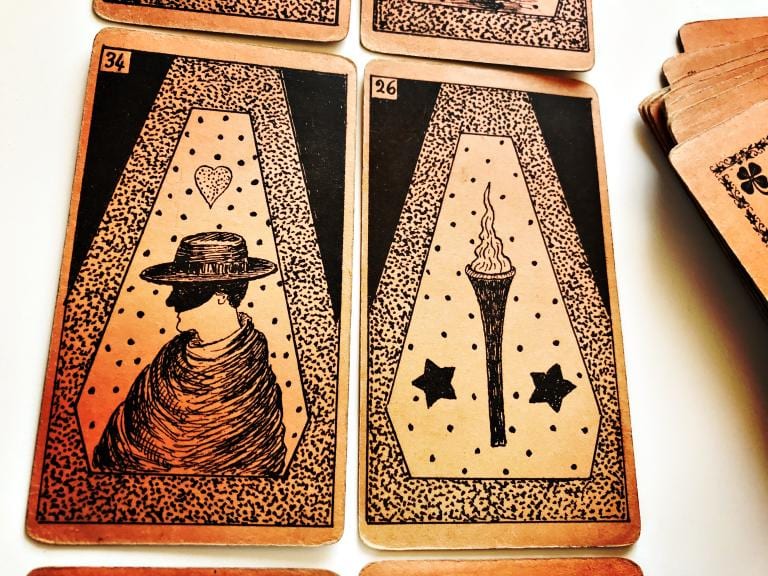
The unknown ‘Zoro’ deck (Photo: Camelia Elias)
But let’s do something concrete here, before we lose ourselves entirely to the question of ‘why’ we accept some things and not others. So let’s look at ‘more of this’ (left column) and ‘less of that’ (right column) – though the cards are drawn intermittently, first for the one, ‘more of this,’ and then the other, ‘less of that.’ Here I have 2 columns of 2 cards each, due to space, but the idea is to have just one trail of two cards running all the way through your own meditation zendo. I won’t go through all my cards, but just enough to give you the idea.
I’m reading the images as they appear to me in my spontaneous response to them. The philosophy of my method is driven by the martial arts nerve that operates with three moves, ‘draw’, cut and sheathe,’ a procedure I wrote more extensively about in What is Not.
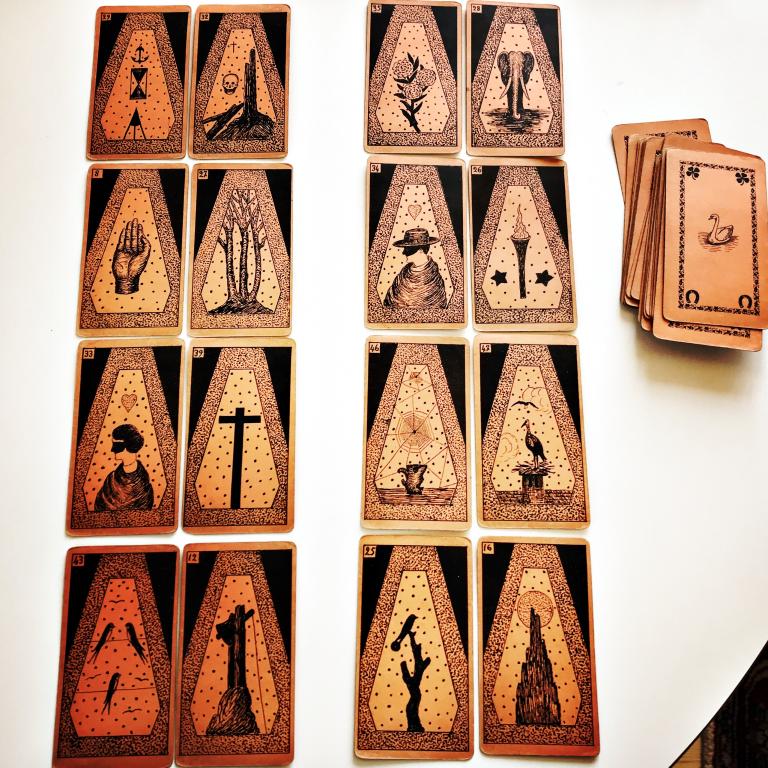
The unknown ‘Zoro’ deck (Photo: Camelia Elias)
We start with the top row of images, and go like this through the next pairs:
- More triangulating, less haunting of the rotten tree.
- More receiving, less giving.
- More anonymity, less grief.
- More singing, less ringing.
- More beauty, less power.
- More Zoro, less carrying the torch.
- More spinning, less nesting.
- More solitude, less reaching for the moon.
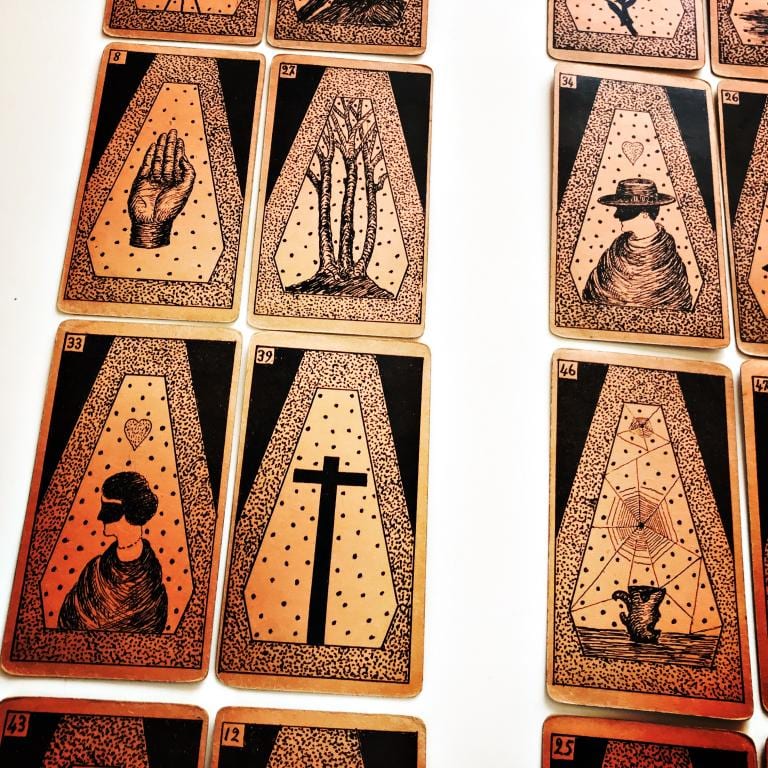
The unknown ‘Zoro’ deck (Photo: Camelia Elias)
Try it and enjoy your own stories, while knowing what they are, forms devoid of content. Have these stories come from you, if you can, so you can be sure that you’ll not be delivering merely trivial interpretations of your experiences. The Garden of Eden is not in the deep skin mediation, but on the surface of the form your narrative takes as you shape it beyond all platitudes. When it comes to knowledge in times of crisis, the comforting is not hearing what’s comforting, but knowing what is a good idea to do more of and less of.
♠
Stay in the loop for cartomantic courses. Read Like the Devil.

About Camelia Elias
Camelia Elias, PhD & Dr.Phil., is a former university professor. After 20 years in academia, she left her career to pursue her interests in teaching and writing on the philosophy and practice of reading cards. She works with contemplative arts, oracular language, and martial arts cartomancy and Zen at her own school, Aradia Academy. You can read more about the author here.
Previous Post
April 2, 2020
Power in the powerless
Next Post
April 24, 2020 Concepts at odds: the intuitive, the spiritual, the plain clear
Browse Our Archives
Select a Category Columns The Cartomancer Uncategorized
Select a Month January 2024 October 2023 August 2023 July 2023 June 2023 November 2022 October 2022 August 2022 May 2022 April 2022 February 2022 January 2022 November 2021 October 2021 September 2021 August 2021 June 2021 April 2021 March 2021 February 2021 January 2021 December 2020 November 2020 October 2020 September 2020 August 2020 July 2020 June 2020 May 2020 April 2020 March 2020 February 2020 January 2020 December 2019 November 2019 October 2019 September 2019 August 2019 July 2019 June 2019 May 2019 April 2019 March 2019 February 2019 January 2019 December 2018 November 2018 October 2018 September 2018 August 2018 July 2018 June 2018 May 2018 April 2018 March 2018 February 2018 January 2018 December 2017 November 2017 October 2017 September 2017 August 2017 July 2017 June 2017 May 2017 April 2017 March 2017 February 2017 January 2017 December 2016 November 2016 October 2016 September 2016 August 2016 July 2016 June 2016 May 2016 April 2016 March 2016 February 2016 January 2016 December 2015 November 2015 October 2015 September 2015 August 2015 July 2015
Follow Us!
TAKE THE
Religious Wisdom Quiz
Which king was known for his extravagant building projects and many wives?
Select your answer to see how you score.
Ahab Solomon David Hezekiah
Related posts from THE CARTOMANCER
TRENDING AT PATHEOS Pagan

When we talk about Greek religion, we often begin with the dodekatheion—the...

I was recently chatting with someone on Instagram. She asked me what...

While there are many people who share their results, the end of...

On July 23, I saw Christopher Nolan's The Odyssey which is Homer’s...

As I write this two big events have just finished up. One...

Restoring the Watershed of Divine Love
Perhaps cooperation is not something we manufacture through legislation, ideology, or moral...
view all Pagan blogs
Ad-Free & Subscriber Log-In Subscription Support
- About Us
- 2026 Calendar
- Videos
- Podcasts
- Library of World Religions
- Faith In Media Tracker
- Advertise With Us
- Write for Us
- Privacy Policy
- Terms of Service
- Do Not Sell My Data
- Contact Us
- Radiant Digital
- Manage Newsletter Subscriptions
- Unsubscribe From Notifications
- Sitemap
Copyright 2008-2026, Patheos. All rights reserved.
Subscription Support Ad-Free & Subscriber Log-In
Follow Patheos