
BuddhistCatholicContemplativeEvangelicalGeneral ChristianHinduJewishLatter-day SaintMuslimNew VisionsProgressive Christian
Beliefs
- Buddhist
- Catholic
- Contemplative
- Evangelical
- General Christian
- Hindu
- Jewish
- Latter-day Saint
- More Voices
- Muslim
- New Visions
- Pagan
- Progressive Christian
Topics
- Religion News
- Food and Religion
- Sports and Religion
- Religious Art
- Religious Music and Entertainment
- Religious Events
- History and Religion
- Style and Religion
- Politics and Religion
- Women in Religion
- Recreation Outdoors and Religion
- Business Finance and Religion
- Careers Workplace and Religion
- Education and Religion
- Family Parenting and Religion
- Health Fitness and Religion
- Home and Religion
- Relationships and Religion
- Technology and Religion
- Travel and Religion
Columnists
- Buddhist Columnists
- Business Finance and Religion Columnists
- Careers Workplace and Religion Columnists
- Catholic Columnists
- Contemplative Columnists
- Education and Religion Columnists
- Evangelists Columnists
- Family Parenting and Religion Columnists
- General Christian Columnists
- Health Fitness and Religion Columnists
- Hindu Columnists
- History and Religion Columnists
- Home and Religion Columnists
- Jewish Columnists
- More Voices Columnists
- Latter Day Columnists
- Muslim Columnists
- New Visions Columnists
- Nonreligious Columnists
- Pagan Columnists
- Politics and Religion Columnists
- Progressive Columnists
- Recreation Outdoors and Religion Columnists
- Relationships and Religion Columnists
- Religion News Columnists
- Religious Art Columnists
- Religious Events Columnists
- Religious Music and Entertainment Columnists
- Sports and Religion Columnists
- Style and Religion Columnists
- Technology and Religion Columnists
- Travel and Religion Columnists
- Women in Religion Columnists
Resource Library
- 2026 Calendar
- Library of World Religions
- The 100 Most Holy Places on Earth
- Patheos Answers
- Podcasts
- Videos
- Faith Leaders Database
- Anglican Episcopalian
- Bahai
- Baptist
- Buddhism
- Christianity
- Confucianism
- Eastern Orthodoxy
- Hinduism
- Holiness and Pentecostal
- ISKCON
- Islam
- Judaism
- Lutheran
- Methodist
- The Church of Jesus Christ of Latter-day Saints
- New Age
- Paganism
- Presbytarian and Reformed
- Protestantism
- Religion Behind the Scenes
- Roman Catholic
- Scientology
- Shia Islam
- Sikhism
- Sufism
- Sunni Islam
- Taoism
- Zen
- See all religions
Research Tools
 Ad-Free & Subscriber Log-In Subscription Support
Ad-Free & Subscriber Log-In Subscription Support
Follow Patheos 

- Trending:
- Forgiveness
- |
- Marriage
- |
- Consciousness
- |
- Death Penalty
- |
- Election
- |
- Halloween
 THE CARTOMANCER
- Home
- Pagan
- A strong death is a good death
A strong death is a good death
Last updated on: March 3, 2020 at 6:56 pm by Camelia Elias
A strong death is a good death 2020-03-03T18:56:07+02:00 Camelia Elias
Patheos Explore the world's faith through different perspectives on religion and spirituality! Patheos has the views of the prevalent religions and spiritualities of the world.
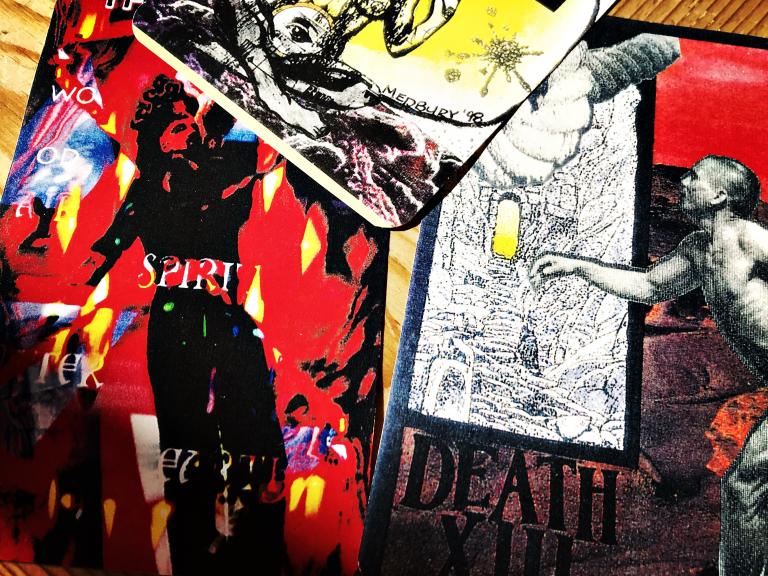
Capolan Tarot Project, mail art tarot (Photo: Camelia Elias)
In literary and cultural studies there’s a concept called ‘belatedness’. Someone invents a term that goes mainstream, and before you know it, you’ll find the same in a different culture on a different continent than where it first originated, like, 20 years later. As with everything mainstream I tend to reject it out of hand, not necessarily because I’m a contrarian or a genius culture critic, but mainly because Oscar Wilde messed with my head the day the coin really dropped on the implication of his famed proclamation: ‘Everything popular is wrong’ – often also quoted here on The Cartomancer, and quite recently.
Nothing proves this sentence more correct than belatedness. The Tarot for self-help that originates in the 60s America, blooming 20 years later in Denmark or Romania, demonstrates just what a plague the whole concept of self-help really is. Asking the Tarot to help you with knowing what you want is almost as lame as the thousand YouTube videos on the internet, all carrying the title, ‘How to know what you want’, or to be more precise actually, ‘How to know what you really want?’ Then the deluge of equally lame promises. There’s no end to the 12-step, 4-step, 10-step, 20-step programs, all promising the paradise. It’s a classic used in literary studies. After the fall, there’s nothing more exciting that the reconstruction of the Garden of Eden. That’s the basic template everyone is working out of, from high culture to low culture and all the stuff in between, including the occult, marketing, or anime.
Now, and speaking of classics, I grew up with books not podcasts, and I remember quite clearly that if I ever had an existential crisis, all I needed to do is read a classic, a novel by Dostoyevsky or Tolstoy. I’d get just the picture. And more. The ‘more’ was the result of competence. Some novelists are simply very competent at using the hell/heaven template so that the perennially successful manipulation of binary opposites doesn’t sound so goddamn trite, repetitive, lame, resting on hot air hyperboles, or clichés activating your fears and desires as if you didn’t already know you have both. ‘You’re in denial that you have taboo desires,’ the self-help propaganda heralds, leaving us all in awe: ‘Oh, wow, that’s so deep. I never realized this’. In this line I’m using the other literary trope called ‘irony.’ While the hyperbole is welcome in the discourse that will teach you how to know what you really want, irony is not.
I’m thinking of all this today, as I’m reading an art tarot, a mail art collaboration under the name of the Capolan Group Tarot Project. This Tarot is based on collages made by various artists, and I’m amazed at how cohesive it is. Reading these cards by following the rhyming patterns is a real pleasure, and it trumps the plague techniques that rest on reading the cards individually – because they’re so loaded esoterically – with view to shooting for the curse of the relatable. The last thing I want from my tarot is to make me exclaim: ‘Me too, I’m so like this too. I’ve been there too. I’m so validated. This Tarot understands me deeply and compassionately…’
What do I really want?
Let’s ask the cards, ‘what do I really want?,’ and see what they can say in such a way that I won’t feel that I’m drowning in the sea of good intentions, helping myself out of the feeling of being stuck, powerless, put upon, you know, that template called ‘from rags to riches’, the story of the self-empowered victim, because it feels, oh so good. I have no appreciation for feelings, as they’re all fictions conjured by myself into words, with words being nothing other than symbolic glyphs.
I’m not interested in contrasts and binary opposites being raised at the power of the unified ‘alchemized soul.’ I’m more interested in how I get beyond language, beyond the cauldron that boils my fictions, however enchanting they all are. I’m not interested in solve et coagula, another fancy concept for ‘dissolve and coagulate.’ I’m interested in what I see is the case, whether it has any relation to my fears and desires or not. The notion that you can dissolve your fears or coagulate your desires is fiction.
The Priestess, the Magician, and Death made an appearance.
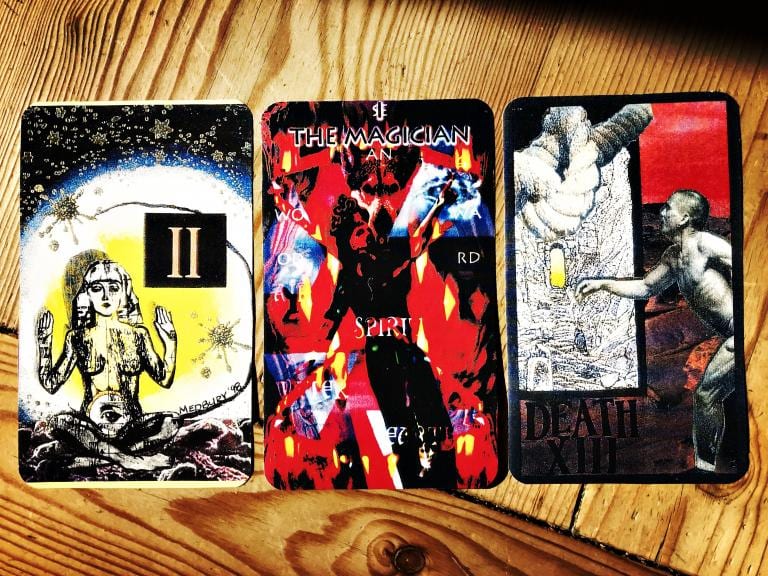
Capolan Tarot Project, mail art tarot (Photo: Camelia Elias)
Her theme is yellow. His is red. He’s not immune. Her shards of yellow got him. He falls over. Death.
If death must be in the picture, I like it when it’s strong.
Her yellow, a portal. His red, a sky.
Who dares to go through?
There’s no alchemy here. She is the portal, and he is the sky. That’s their death.
What do I really want? I haven’t a clue, and I prefer to keep it that way. But I may know what I most definitely don’t want. I don’t what for that third person here, represented on this Death card, to go through the yellow portal in order to find himself, his passion, or the dead magician, now a sky, well-integrated à la Jungian studies in platitudes galore.
I challenge you to ask your cards:’ What do I really want,’ and give yourself an answer that’s not part of a something-something step program. What will you come up with? And don’t worry. For this question, there’s no prerequisite. There’s no request that prior to this question you must have undergone ‘shadow work’, digging deeply into your unconscious.
Ask yourself: ‘What do I really want?, and go beyond language, any language, yours, your mother’s, your guru’s, your goddess’, mine. That’s the challenge, to put an end to stories, as there’s no story to tell. Not one where death is a strong one, and you’re spared the waste of your time.
♠
Stay in the loop for cartomantic courses.

About Camelia Elias
Camelia Elias, PhD & Dr.Phil., is a former university professor. After 20 years in the academia, she left her career to pursue her interests in teaching and writing on the philosophy and practice of reading cards. She works with contemplative arts, oracular language, and martial arts cartomancy and Zen at her own school, Aradia Academy. You can read more about the author here.
Previous Post
February 20, 2020
The witty sword and the sexy hermit
Next Post
March 18, 2020 The year of the Emperor, falling off his throne
Browse Our Archives
Select a Category Columns The Cartomancer Uncategorized
Select a Month January 2024 October 2023 August 2023 July 2023 June 2023 November 2022 October 2022 August 2022 May 2022 April 2022 February 2022 January 2022 November 2021 October 2021 September 2021 August 2021 June 2021 April 2021 March 2021 February 2021 January 2021 December 2020 November 2020 October 2020 September 2020 August 2020 July 2020 June 2020 May 2020 April 2020 March 2020 February 2020 January 2020 December 2019 November 2019 October 2019 September 2019 August 2019 July 2019 June 2019 May 2019 April 2019 March 2019 February 2019 January 2019 December 2018 November 2018 October 2018 September 2018 August 2018 July 2018 June 2018 May 2018 April 2018 March 2018 February 2018 January 2018 December 2017 November 2017 October 2017 September 2017 August 2017 July 2017 June 2017 May 2017 April 2017 March 2017 February 2017 January 2017 December 2016 November 2016 October 2016 September 2016 August 2016 July 2016 June 2016 May 2016 April 2016 March 2016 February 2016 January 2016 December 2015 November 2015 October 2015 September 2015 August 2015 July 2015
Follow Us!
TAKE THE
Religious Wisdom Quiz
What does "Abraham" mean?
Select your answer to see how you score.
Chosen One King of Peace Father of Many Man of Wisdom
Related posts from THE CARTOMANCER
TRENDING AT PATHEOS Pagan

I was recently chatting with someone on Instagram. She asked me what...

While there are many people who share their results, the end of...

On July 23, I saw Christopher Nolan's The Odyssey which is Homer’s...

As I write this two big events have just finished up. One...

Restoring the Watershed of Divine Love
Perhaps cooperation is not something we manufacture through legislation, ideology, or moral...

Many UUs don’t pray because of bad experiences in a previous religion,...
view all Pagan blogs
Ad-Free & Subscriber Log-In Subscription Support
- About Us
- 2026 Calendar
- Videos
- Podcasts
- Library of World Religions
- Faith In Media Tracker
- Advertise With Us
- Write for Us
- Privacy Policy
- Terms of Service
- Do Not Sell My Data
- Contact Us
- Radiant Digital
- Manage Newsletter Subscriptions
- Unsubscribe From Notifications
- Sitemap
Copyright 2008-2026, Patheos. All rights reserved.
Subscription Support Ad-Free & Subscriber Log-In
Follow Patheos