
BuddhistCatholicContemplativeEvangelicalGeneral ChristianHinduJewishLatter-day SaintMuslimNew VisionsProgressive Christian
Beliefs
- Buddhist
- Catholic
- Contemplative
- Evangelical
- General Christian
- Hindu
- Jewish
- Latter-day Saint
- More Voices
- Muslim
- New Visions
- Pagan
- Progressive Christian
Topics
- Religion News
- Food and Religion
- Sports and Religion
- Religious Art
- Religious Music and Entertainment
- Religious Events
- History and Religion
- Style and Religion
- Politics and Religion
- Women in Religion
- Recreation Outdoors and Religion
- Business Finance and Religion
- Careers Workplace and Religion
- Education and Religion
- Family Parenting and Religion
- Health Fitness and Religion
- Home and Religion
- Relationships and Religion
- Technology and Religion
- Travel and Religion
Columnists
- Buddhist Columnists
- Business Finance and Religion Columnists
- Careers Workplace and Religion Columnists
- Catholic Columnists
- Contemplative Columnists
- Education and Religion Columnists
- Evangelists Columnists
- Family Parenting and Religion Columnists
- General Christian Columnists
- Health Fitness and Religion Columnists
- Hindu Columnists
- History and Religion Columnists
- Home and Religion Columnists
- Jewish Columnists
- More Voices Columnists
- Latter Day Columnists
- Muslim Columnists
- New Visions Columnists
- Nonreligious Columnists
- Pagan Columnists
- Politics and Religion Columnists
- Progressive Columnists
- Recreation Outdoors and Religion Columnists
- Relationships and Religion Columnists
- Religion News Columnists
- Religious Art Columnists
- Religious Events Columnists
- Religious Music and Entertainment Columnists
- Sports and Religion Columnists
- Style and Religion Columnists
- Technology and Religion Columnists
- Travel and Religion Columnists
- Women in Religion Columnists
Resource Library
- 2026 Calendar
- Library of World Religions
- The 100 Most Holy Places on Earth
- Patheos Answers
- Podcasts
- Videos
- Faith Leaders Database
- Anglican Episcopalian
- Bahai
- Baptist
- Buddhism
- Christianity
- Confucianism
- Eastern Orthodoxy
- Hinduism
- Holiness and Pentecostal
- ISKCON
- Islam
- Judaism
- Lutheran
- Methodist
- The Church of Jesus Christ of Latter-day Saints
- New Age
- Paganism
- Presbytarian and Reformed
- Protestantism
- Religion Behind the Scenes
- Roman Catholic
- Scientology
- Shia Islam
- Sikhism
- Sufism
- Sunni Islam
- Taoism
- Zen
- See all religions
Research Tools
 Ad-Free & Subscriber Log-In Subscription Support
Ad-Free & Subscriber Log-In Subscription Support
Follow Patheos 

- Trending:
- Forgiveness
- |
- Marriage
- |
- Consciousness
- |
- Death Penalty
- |
- Election
- |
- Halloween
 THE CARTOMANCER
- Home
- Pagan
- The witty sword and the sexy hermit
The witty sword and the sexy hermit
Last updated on: February 20, 2020 at 7:17 pm by Camelia Elias
The witty sword and the sexy hermit 2020-02-20T19:17:58+02:00 Camelia Elias
Patheos Explore the world's faith through different perspectives on religion and spirituality! Patheos has the views of the prevalent religions and spiritualities of the world.
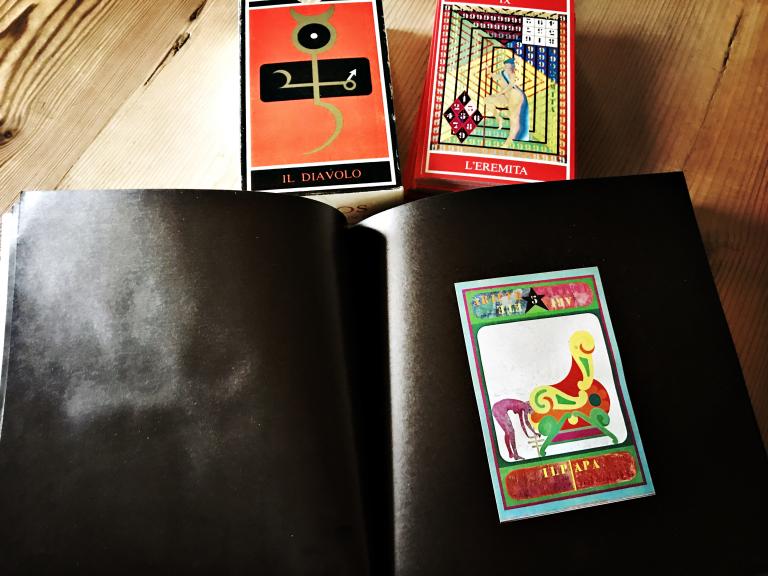
Andrea Picini, Il Diavolo, 1979 (Photo: Camelia Elias)
In my work with the cards I strongly emphasize that we look at the function of what we see represented on the cards. This means that I’m more interested in what a character or a particular suit is doing, rather than what it is.
In the mainstream cartomantic set of ideas, everything IS. An archetype IS. The suit of swords IS.
When I read the cards, the only IS I’m interested in is the obvious, and I find that the obvious is rarely about a set of identity markers, but rather more about a set of actions: With a sword we cut, with a cup we drink, and so on.
I like to read with art cards, because often the focus on what’s happening at the level of action is sharper than when I consider what I’m looking at as a matter of habitude, for instance the idea that the Empress is the embodiment of creativity, or Death the embodiment – or rather disembodiment as is actually the case here –of transformation. I mean, all cool with such ideas, until I get very tired of seeing the same image in the same way, which is the way of conceptual thinking, which is the way of not looking at the image at all, for, hey, the Emperor is the embodiment of control, they say, and it doesn’t matter how this power is represented, as long as I also say, ‘the Emperor means control.’
Let’s look at the implication of what I’m saying about paying attention to the idea of doing rather than being, or to function and action, rather nominal definitions.
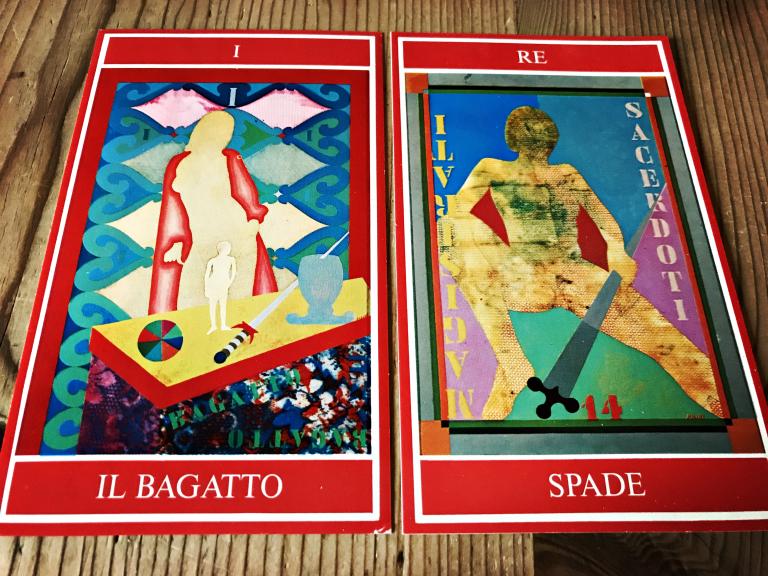
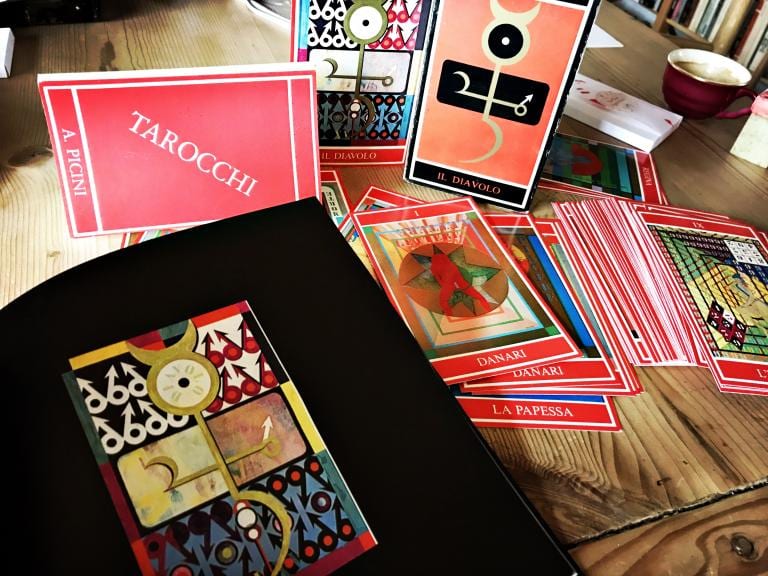
After a string of cards that spelt out the multiplication of enemies at work for the client I was reading for with one of my art tarots, namely Andrea Picini’s deck Il Diavolo, I pulled two more cards from the set, the Magician and the King of Spades.
Andrea Picini, Il Diavolo, 1979 (Photo: Camelia Elias)
The person asked immediately: ‘So, I have to be inventive about this enemy?’, clearly thinking about the Magician and the King of Spades in terms of being: one being clever, and the other one being mean.
‘No,’ I said, and then continued. ‘What you need is to focus on the sword on your table, sharpen it and use it like a master. Only a big focussed sword can get rid of 10 small ones.’
‘Ah, I see what you mean’, the person said, then lamenting about what ails her adversaries. ‘Everyone is so busy with speculating about my bank account. I don’t know how I can go against this.’
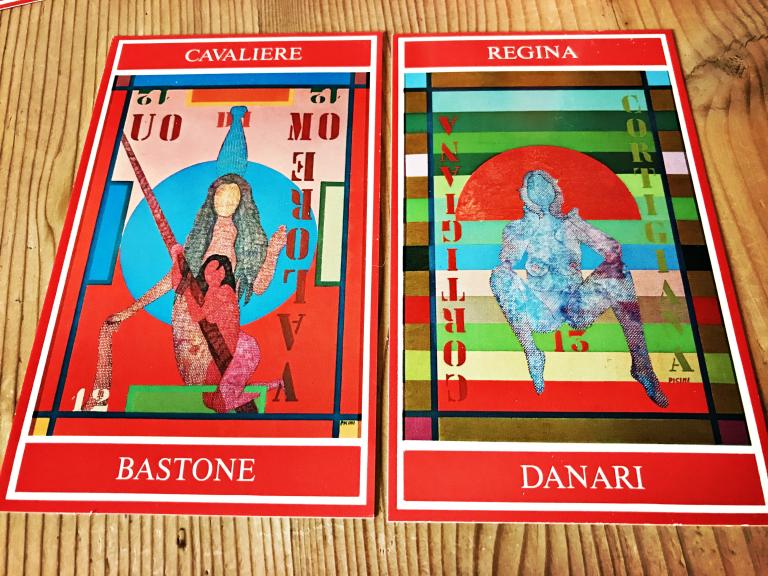
Two more cards fell on the table: The Knight of Batons and The Queen of Coins.
Andrea Picini, Il Diavolo, 1979 (Photo: Camelia Elias)
While turning them over I said the following: ‘It’s a classic. While no one ever speculates about how fat or thin their local grocery store’s bank account is, many are busy with yours. What you need to do is ride your broom, and move at considerable speed to make your own money. All those who have time to speculate on how you make your living will not be able to see how fast you move. And speed is important, especially if you have to wield the King of Spades’ sword so you can sit comfortably under the hot sun.’
‘Oh, wow, all this from these cards…’ the person said in awe, to which I replied: ‘Yes, we read the cards like the Devil, though the latter part comes from the war manuals and martial arts that I’ve beed studying.’
Andrea Picini, Il Diavolo, 1979 (Photo: Camelia Elias)
The point of this exchange is to demonstrate the power of looking at what we do with the cards, not what we know. A lot of what we know is pure nonsense.
In the case of Andrea Picini’s Diavolo deck, let me quote at random Ugo Moretti, the writer of the book that comes with the cards (both in art book form and as a booklet accompanying the deck).
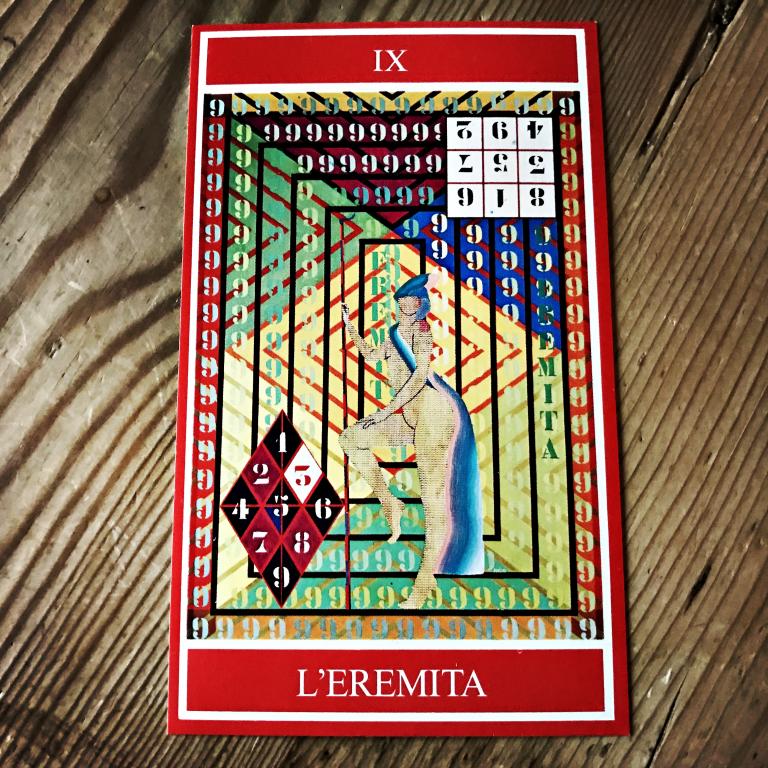
Here’s what he thinks the Hermit is:
Andrea Picini, Il Diavolo, 1979 (Photo: Camelia Elias)
‘He is without curiosity and heeds only ponderable factors. He is a meditative spirit, rigidly logical. Arid. Masturbator, misanthrope. Methodic, not empiric. Taciturn, energy-saving, Monotonous. A conserver of goods, able in appropriating others’ belongings. This is the Card of Stockbrokers, Real Estate Speculators, Middlemen, Procurers.’
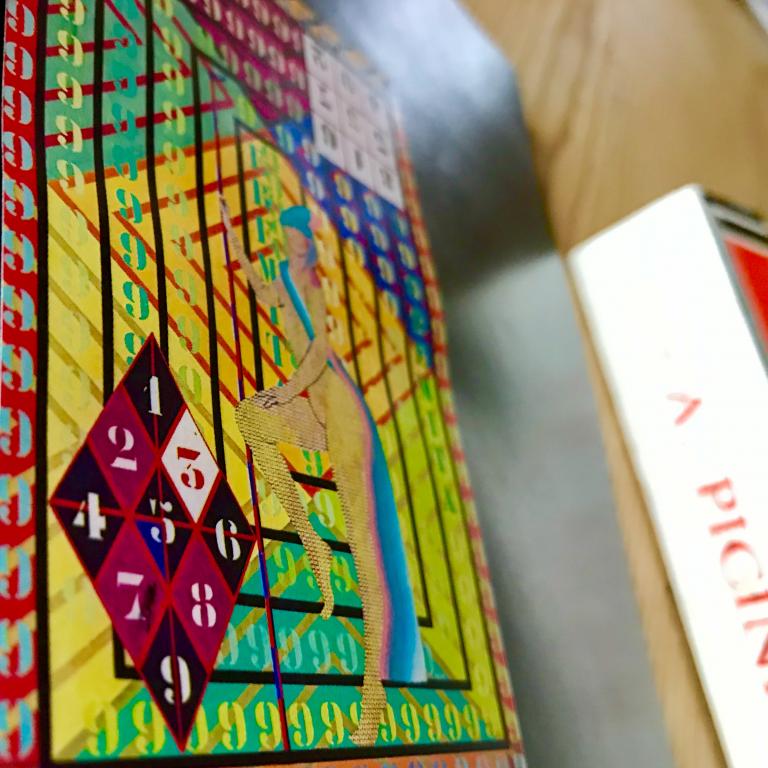
Now, this is a whole lot of ‘The Hermit is’… I want to say, ‘what Devil has gotten into Moretti’s head, for it sure as hell isn’t Picini’s Diavolo…’
In his visual rendition, the Hermit is a woman who is good at magic squares and numbers.
Andrea Picini, Il Diavolo, 1979 (Photo: Camelia Elias)
So much for meaning, naming, and proclaiming.
If you read cards, look at them and think in terms of who does what to whom. You may just discover that, on occasion, the Magician is not about mostly male inventiveness – ‘an architect, engineer, constructor, urbanist, chess player’ à la Moretti – but rather about picking the relevant tool on his table to prick his enemies with.
Thinking about intangible powers is not the same as being specific with your actions. If an image is well crafted, it will tell you what the obvious is, and it’s almost never a list of random keywords. Cards are fantastic tools for identifications, and there’s nothing like a good relatability fad, but if you want to render someone real service, the last thing you’ll do is place the cards in their face as mirrors, while going without discernment: ‘you are like this, your enemy is like this, your children are like this, your body is like this, your mother is like this, your boss is like this…’
Nothing is ever ‘like this’ by virtue of the law of impermanence. In this hall of mirrors, the only real option available to you is to look at what you do.
♠
Stay in the loop for cartomantic activities.

About Camelia Elias
Camelia Elias, PhD & Dr.Phil., is a former university professor. After 20 years in the academia, she left her career to pursue her interests in teaching and writing on the philosophy and practice of reading cards. She works with contemplative arts, oracular language, and martial arts cartomancy and Zen at her own school, Aradia Academy. You can read more about the author here.
Previous Post
February 10, 2020
Let us laugh, amen
Next Post

March 3, 2020 A strong death is a good death
Browse Our Archives
Select a Category Columns The Cartomancer Uncategorized
Select a Month January 2024 October 2023 August 2023 July 2023 June 2023 November 2022 October 2022 August 2022 May 2022 April 2022 February 2022 January 2022 November 2021 October 2021 September 2021 August 2021 June 2021 April 2021 March 2021 February 2021 January 2021 December 2020 November 2020 October 2020 September 2020 August 2020 July 2020 June 2020 May 2020 April 2020 March 2020 February 2020 January 2020 December 2019 November 2019 October 2019 September 2019 August 2019 July 2019 June 2019 May 2019 April 2019 March 2019 February 2019 January 2019 December 2018 November 2018 October 2018 September 2018 August 2018 July 2018 June 2018 May 2018 April 2018 March 2018 February 2018 January 2018 December 2017 November 2017 October 2017 September 2017 August 2017 July 2017 June 2017 May 2017 April 2017 March 2017 February 2017 January 2017 December 2016 November 2016 October 2016 September 2016 August 2016 July 2016 June 2016 May 2016 April 2016 March 2016 February 2016 January 2016 December 2015 November 2015 October 2015 September 2015 August 2015 July 2015
Follow Us!
TAKE THE
Religious Wisdom Quiz
True or False: Jeremiah was thrown into a cistern for prophesying against Jerusalem.
Select your answer to see how you score.
TRUE FALSE
Related posts from THE CARTOMANCER
TRENDING AT PATHEOS Pagan

I was recently chatting with someone on Instagram. She asked me what...

While there are many people who share their results, the end of...

On July 23, I saw Christopher Nolan's The Odyssey which is Homer’s...

As I write this two big events have just finished up. One...

Restoring the Watershed of Divine Love
Perhaps cooperation is not something we manufacture through legislation, ideology, or moral...

Many UUs don’t pray because of bad experiences in a previous religion,...
view all Pagan blogs
Ad-Free & Subscriber Log-In Subscription Support
- About Us
- 2026 Calendar
- Videos
- Podcasts
- Library of World Religions
- Faith In Media Tracker
- Advertise With Us
- Write for Us
- Privacy Policy
- Terms of Service
- Do Not Sell My Data
- Contact Us
- Radiant Digital
- Manage Newsletter Subscriptions
- Unsubscribe From Notifications
- Sitemap
Copyright 2008-2026, Patheos. All rights reserved.
Subscription Support Ad-Free & Subscriber Log-In
Follow Patheos