
BuddhistCatholicContemplativeEvangelicalGeneral ChristianHinduJewishLatter-day SaintMuslimNew VisionsProgressive Christian
Beliefs
- Buddhist
- Catholic
- Contemplative
- Evangelical
- General Christian
- Hindu
- Jewish
- Latter-day Saint
- More Voices
- Muslim
- New Visions
- Pagan
- Progressive Christian
Topics
- Religion News
- Food and Religion
- Sports and Religion
- Religious Art
- Religious Music and Entertainment
- Religious Events
- History and Religion
- Style and Religion
- Politics and Religion
- Women in Religion
- Recreation Outdoors and Religion
- Business Finance and Religion
- Careers Workplace and Religion
- Education and Religion
- Family Parenting and Religion
- Health Fitness and Religion
- Home and Religion
- Relationships and Religion
- Technology and Religion
- Travel and Religion
Columnists
- Buddhist Columnists
- Business Finance and Religion Columnists
- Careers Workplace and Religion Columnists
- Catholic Columnists
- Contemplative Columnists
- Education and Religion Columnists
- Evangelists Columnists
- Family Parenting and Religion Columnists
- General Christian Columnists
- Health Fitness and Religion Columnists
- Hindu Columnists
- History and Religion Columnists
- Home and Religion Columnists
- Jewish Columnists
- More Voices Columnists
- Latter Day Columnists
- Muslim Columnists
- New Visions Columnists
- Nonreligious Columnists
- Pagan Columnists
- Politics and Religion Columnists
- Progressive Columnists
- Recreation Outdoors and Religion Columnists
- Relationships and Religion Columnists
- Religion News Columnists
- Religious Art Columnists
- Religious Events Columnists
- Religious Music and Entertainment Columnists
- Sports and Religion Columnists
- Style and Religion Columnists
- Technology and Religion Columnists
- Travel and Religion Columnists
- Women in Religion Columnists
Resource Library
- 2026 Calendar
- Library of World Religions
- The 100 Most Holy Places on Earth
- Patheos Answers
- Podcasts
- Videos
- Faith Leaders Database
- Anglican Episcopalian
- Bahai
- Baptist
- Buddhism
- Christianity
- Confucianism
- Eastern Orthodoxy
- Hinduism
- Holiness and Pentecostal
- ISKCON
- Islam
- Judaism
- Lutheran
- Methodist
- The Church of Jesus Christ of Latter-day Saints
- New Age
- Paganism
- Presbytarian and Reformed
- Protestantism
- Religion Behind the Scenes
- Roman Catholic
- Scientology
- Shia Islam
- Sikhism
- Sufism
- Sunni Islam
- Taoism
- Zen
- See all religions
Research Tools
 Ad-Free & Subscriber Log-In Subscription Support
Ad-Free & Subscriber Log-In Subscription Support
Follow Patheos 

- Trending:
- Forgiveness
- |
- Marriage
- |
- Consciousness
- |
- Death Penalty
- |
- Election
- |
- Halloween
 THE CARTOMANCER
- Home
- Pagan
- THE SOLUTION AS A QUESTION
THE SOLUTION AS A QUESTION
Last updated on: January 15, 2020 at 5:51 pm by Camelia Elias
THE SOLUTION AS A QUESTION 2020-01-15T17:51:18+02:00 Camelia Elias
Patheos Explore the world's faith through different perspectives on religion and spirituality! Patheos has the views of the prevalent religions and spiritualities of the world.
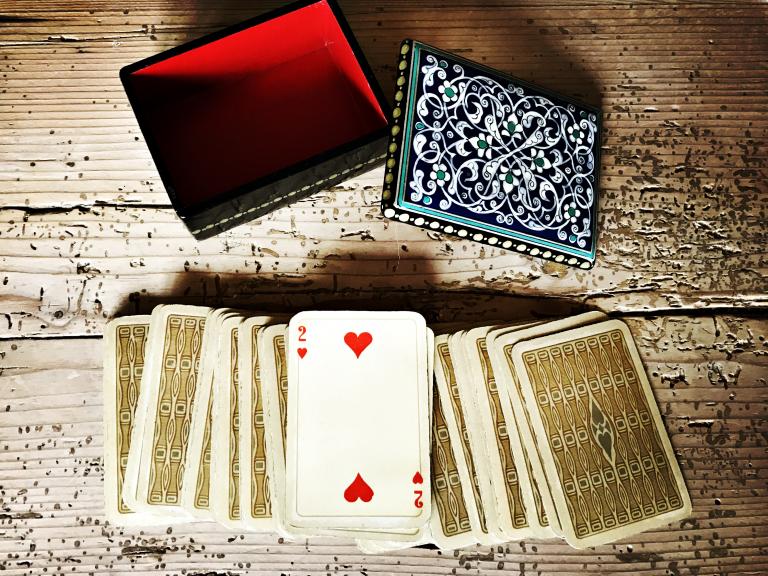
Otto Tragy playing cards, 1910 (Photo: Camelia Elias)
As with all things divination, we often come to the cards, not because we’re lazy, or live a life of superstition or belief. Rather, we come to the cards simply because we like to see what images tell us about a situation that we can’t put into words first.
And why do we want to see images, or go to images before we activate our linguistic vocabulary and competence when we have to address or describe a situation? Because words, more than images, are set in conventional thinking.
Reading an image is, of course, also subject to ‘what we make of it’ in terms of words, for words are all we’re got to navigate what we call an understanding of the world and our surroundings. An image presents itself to us in form, color, lines, and a rhythm that’s different than the rhythm of our voice when we articulate the words, whether loudly or silently. So we see things in images that the words can only sense.
Granted, words are also made up of form, lines, color, and rhythm – anyone working with calligraphy and typography would tell you just how much – but how many notice that? How many think, ‘it’s all calligraphy, glyphs, and symbolic images I’m dealing with when I say, ‘I’m sad today?” To my knowledge and experience, the only people holding this awareness are the Zen masters, or the ones deeply invested in deconstructing language and what it does to us.
Most other mortals simply assume that words have meaning, or that they designate a meaningful situation representing ‘reality’ – that is, until the point when the meaning of ‘I do’ declared in church also acquires the nature of deep hatred, when ‘I don’t anymore’ is declared in the divorce court. Indeed, meaning that’s meaningful galore…
I’ve written on just what I think of the idea that ‘words have meaning’ on a number of occasions – in larger format in my book, What is Not: Marseille Tarot à la Carte – and I experience it almost every day that people ask me about ‘the meaningless’ in word and image, but here I actually want to bring your attention to a similar situation, namely the situation when looking at the cards for an answer prompts you with more questions, questions that arise from a place right beyond the words.
Just today I read the cards for a pain in the body, more precisely in my left foot. It’s been there for a while, and it doesn’t look like it’s going away. I’ve no idea what causes it.
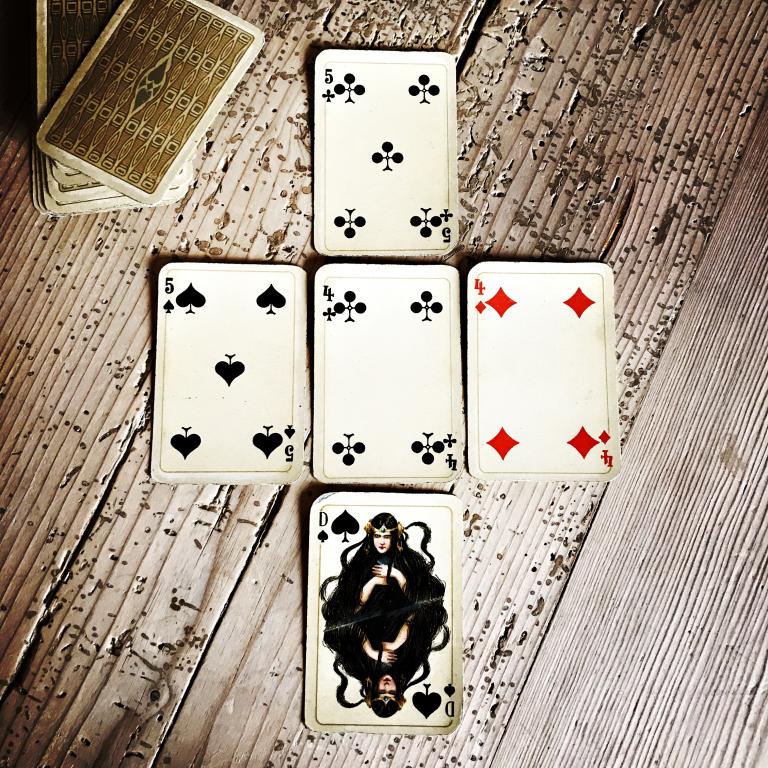
Otto Tragy playing cards, 1910 (Photo: Camelia Elias)
The pain got represented here by the 5 spades. Two 4 cards, 4 clubs and 4 diamonds, suggesting the set and the solid following the 5, made me respond with, ‘it can’t be helped,’ or at its most optimistic my response to the image was that ‘it is what it is.’
Then, however, instead of finding a solution, in spite of declaring that things are as they are, I went with a question to myself, looking at the card on top, the 5 clubs: ‘are you sure you’ve stretched that muscle the proper way,’ as in exercise the foot? ‘Don’t hex yourself,’ I then said to myself, before I even answered the question. The Queen of Spades is not exactly the healer in this context, so I took her gaze as a warning not to inflict more pain unto myself beyond the physical one. The Queen of Swords is not one who hesitates to take the pain out with more pain, but that approach in this situation was discouraged, being more drastic. Perhaps I don’t need a surgeon with a scalpel yet.
The point is that we read the cards for an answer inasmuch as we do for a question that the cards prompt us with. In my work with people who come to me precisely to hear what the cards have to say, I often start with delivering follow-up questions to the one that’s put on my table, as there are things in the images that can make us think of alternative phrasing, or putting it ‘in other words’, words that we wouldn’t normally think of to use, simply because we’re not anchored in seeing an alternative view first, quite literally.
So training yourself to ask questions with the cards is as valuable as training yourself to sound like a veritable oracle, or like the best consultant or fortuneteller on the planet, who just ‘says it like it is.’ Sometimes the smart thing to do is not to say it like it is, but rather to think the better question.
Twice a year I run a series of prompts that train the faculty of asking questions with the cards. This time around the topic is BEAUTY. Have a look at the description on the registration page, and join the questioning enthusiasts, if you’d like to try it. There’s great beauty in working with the cards in this way already, yet thinking also of how the ‘ugly’ cards in the Tarot, or a pack of playing cards can say something about what we make of beauty and how we participate in creating it, gives us just the thing to consider and marvel about, helping us in seeing with the eyes of form, rather than the eyes of informed symbolic thinking.
♠
Stay in the loop for cartomantic courses. The Tarot Prompts cycle starts this Friday. Following it, the Playing Cards Foundation Course opens for registration on February 1.

About Camelia Elias
Camelia Elias, PhD & Dr.Phil., is a former university professor. After 20 years in the academia, she left her career to pursue her interests in teaching and writing on the philosophy and practice of reading cards. She works with contemplative arts, oracular language, and martial arts cartomancy and Zen at her own school, Aradia Academy. You can read more about the author here.
Previous Post

January 6, 2020
THE FORTUNETELLER'S DEN
Next Post

January 24, 2020 The new dark moon is for infinity, not intentions
Browse Our Archives
Select a Category Columns The Cartomancer Uncategorized
Select a Month January 2024 October 2023 August 2023 July 2023 June 2023 November 2022 October 2022 August 2022 May 2022 April 2022 February 2022 January 2022 November 2021 October 2021 September 2021 August 2021 June 2021 April 2021 March 2021 February 2021 January 2021 December 2020 November 2020 October 2020 September 2020 August 2020 July 2020 June 2020 May 2020 April 2020 March 2020 February 2020 January 2020 December 2019 November 2019 October 2019 September 2019 August 2019 July 2019 June 2019 May 2019 April 2019 March 2019 February 2019 January 2019 December 2018 November 2018 October 2018 September 2018 August 2018 July 2018 June 2018 May 2018 April 2018 March 2018 February 2018 January 2018 December 2017 November 2017 October 2017 September 2017 August 2017 July 2017 June 2017 May 2017 April 2017 March 2017 February 2017 January 2017 December 2016 November 2016 October 2016 September 2016 August 2016 July 2016 June 2016 May 2016 April 2016 March 2016 February 2016 January 2016 December 2015 November 2015 October 2015 September 2015 August 2015 July 2015
Follow Us!
TAKE THE
Religious Wisdom Quiz
What baby was placed in a basket in the river?
Select your answer to see how you score.
Samuel Moses Jesus Joseph
Related posts from THE CARTOMANCER
TRENDING AT PATHEOS Pagan

I was recently chatting with someone on Instagram. She asked me what...

While there are many people who share their results, the end of...

On July 23, I saw Christopher Nolan's The Odyssey which is Homer’s...

As I write this two big events have just finished up. One...

Restoring the Watershed of Divine Love
Perhaps cooperation is not something we manufacture through legislation, ideology, or moral...

Many UUs don’t pray because of bad experiences in a previous religion,...
view all Pagan blogs
Ad-Free & Subscriber Log-In Subscription Support
- About Us
- 2026 Calendar
- Videos
- Podcasts
- Library of World Religions
- Faith In Media Tracker
- Advertise With Us
- Write for Us
- Privacy Policy
- Terms of Service
- Do Not Sell My Data
- Contact Us
- Radiant Digital
- Manage Newsletter Subscriptions
- Unsubscribe From Notifications
- Sitemap
Copyright 2008-2026, Patheos. All rights reserved.
Subscription Support Ad-Free & Subscriber Log-In
Follow Patheos