
BuddhistCatholicContemplativeEvangelicalGeneral ChristianHinduJewishLatter-day SaintMuslimNew VisionsProgressive Christian
Beliefs
- Buddhist
- Catholic
- Contemplative
- Evangelical
- General Christian
- Hindu
- Jewish
- Latter-day Saint
- More Voices
- Muslim
- New Visions
- Pagan
- Progressive Christian
Topics
- Religion News
- Food and Religion
- Sports and Religion
- Religious Art
- Religious Music and Entertainment
- Religious Events
- History and Religion
- Style and Religion
- Politics and Religion
- Women in Religion
- Recreation Outdoors and Religion
- Business Finance and Religion
- Careers Workplace and Religion
- Education and Religion
- Family Parenting and Religion
- Health Fitness and Religion
- Home and Religion
- Relationships and Religion
- Technology and Religion
- Travel and Religion
Columnists
- Buddhist Columnists
- Business Finance and Religion Columnists
- Careers Workplace and Religion Columnists
- Catholic Columnists
- Contemplative Columnists
- Education and Religion Columnists
- Evangelists Columnists
- Family Parenting and Religion Columnists
- General Christian Columnists
- Health Fitness and Religion Columnists
- Hindu Columnists
- History and Religion Columnists
- Home and Religion Columnists
- Jewish Columnists
- More Voices Columnists
- Latter Day Columnists
- Muslim Columnists
- New Visions Columnists
- Nonreligious Columnists
- Pagan Columnists
- Politics and Religion Columnists
- Progressive Columnists
- Recreation Outdoors and Religion Columnists
- Relationships and Religion Columnists
- Religion News Columnists
- Religious Art Columnists
- Religious Events Columnists
- Religious Music and Entertainment Columnists
- Sports and Religion Columnists
- Style and Religion Columnists
- Technology and Religion Columnists
- Travel and Religion Columnists
- Women in Religion Columnists
Resource Library
- 2026 Calendar
- Library of World Religions
- The 100 Most Holy Places on Earth
- Patheos Answers
- Podcasts
- Videos
- Faith Leaders Database
- Anglican Episcopalian
- Bahai
- Baptist
- Buddhism
- Christianity
- Confucianism
- Eastern Orthodoxy
- Hinduism
- Holiness and Pentecostal
- ISKCON
- Islam
- Judaism
- Lutheran
- Methodist
- The Church of Jesus Christ of Latter-day Saints
- New Age
- Paganism
- Presbytarian and Reformed
- Protestantism
- Religion Behind the Scenes
- Roman Catholic
- Scientology
- Shia Islam
- Sikhism
- Sufism
- Sunni Islam
- Taoism
- Zen
- See all religions
Research Tools
 Ad-Free & Subscriber Log-In Subscription Support
Ad-Free & Subscriber Log-In Subscription Support
Follow Patheos 

- Trending:
- Forgiveness
- |
- Marriage
- |
- Consciousness
- |
- Death Penalty
- |
- Election
- |
- Halloween
 THE CARTOMANCER
- Home
- Pagan
- THE FORTUNETELLER’S DEN
THE FORTUNETELLER’S DEN
Last updated on: January 6, 2020 at 5:58 pm by Camelia Elias
THE FORTUNETELLER’S DEN 2020-01-06T17:58:31+02:00 Camelia Elias
Patheos Explore the world's faith through different perspectives on religion and spirituality! Patheos has the views of the prevalent religions and spiritualities of the world.
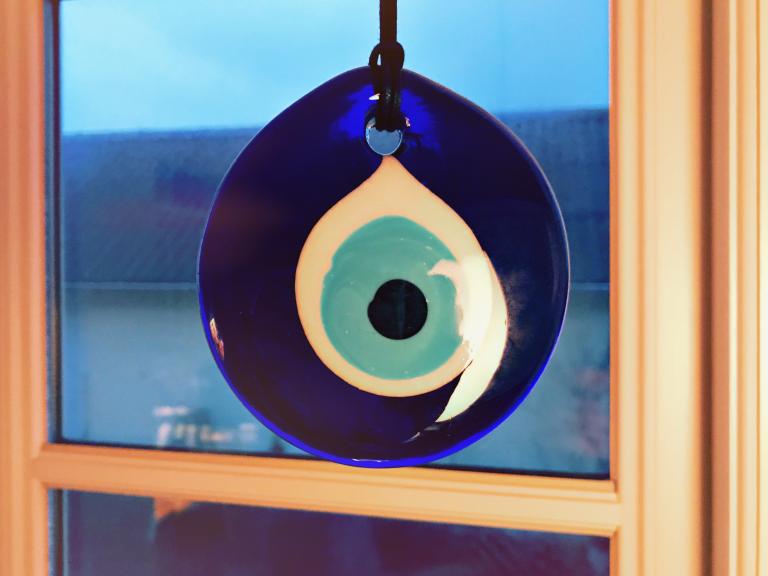
Photo: Camelia Elias
Visibility demands a clearly defined identity, and identity demands the recognition of the socially constructed needs and desires of people. We all embody types. There’s no such thing as a ‘true self’ and because of that there’s no discovery of what we call an ‘inner landscape.’ All of what we call identity is empty of substance.
What there is, however, is speaking from certain positions. Think about the role played by a diviner, a fortuneteller, or the village’s cunning woman or witch. If we use modifiers that describe the role, we find that they are often attached to geography. Stereotypes are good to go to, as they have a way of spelling out the essence of what the mainstream population is thinking: The fortuneteller lives in a tent at the edge of town, the witch’s house is the last in the row of houses in the lower district in town, with the witch herself sitting on the hedge. The oracular diviner lives in a cave, promulgating her prophecies while enveloped in the natural, mineral fumes of the earth’s resources.
Now think of this: While the times have changed since these socially constructed images, and we now tend to encounter the diviner, the witch, and the oracle at fairs, sitting in big offices downtown LA, or doing online business, the aura of the ‘marginal’ that a tent, a cave, and a shady house exudes is still maintained as an extension of one’s identity as a ‘modern something special.’
This is all fine, until we realize that the fortuneteller’s den is not anymore the site of an identity that’s desired secret, silent, and subtle, or the opposite of ‘being at the center of the world’, imparting wisdom and advice, encouragement and empathy, validation and endorsement, all part of a carefully crafted world domination program.
I’ve had the great fortune of being schooled by women who spoke from a position of seeing the obvious. They were not 7-figure earning professionals, having access to 100 thousand plus email addresses. Nor were they in the business of coaching, psychotherapy, professional sorcery, or psychics tending the phone lines. They were simple women devoid of identity fancies. They were my Zen masters, who would often say things like, ‘how the fuck should I know?’ when asked to corroborate a projected future. ‘I’m only here answer a goddamn question, by looking at what’s obvious in the cards.’
I approach divination from this perspective, one that avoids all linguistic modifiers, amplifiers, and broadcasting ‘reach.’ If a person comes and asks: ‘How was it for him?’ – meaning, sex, I look at the cards and have three options: to say, ‘good,’ ‘bad,’ or ‘of no consequence.’ I leave it at that. I don’t offer sympathy or support. What has that got to do with what’s obvious? We see that we see. There’s no knowledge beyond this seeing. To imply that I know better, or that I know more would be an insult to the person I’m reading the cards for.
In a recent reading these cards fell on the table, precisely for the question, ‘how was it for him?’
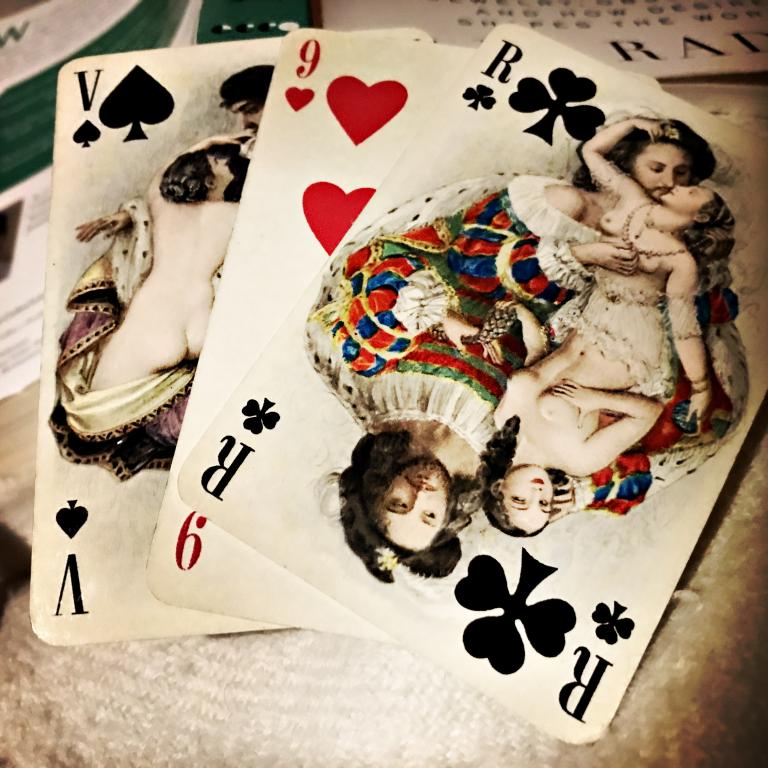
Le Florentin playing cards, 1954 (Photo: Camelia Elias)
Jack of Spades, 9 Hearts, King of Clubs
‘It left him want for more,’ I said, and then kept silent.
‘What do you make of that?’, the woman asked, given that she and him are not together anymore.
‘I don’t make anything of it’, I said. ‘Sex with you just left him want for more. That’s all there’s to it.’
‘Yes, but we’re not together anymore, so there’s no next time’, the woman said.
‘So what?,’ I said. ‘How does knowing that he wanted more change anything?’ I then continued along some Zen lines: ‘desire is desire, now you fulfil it and now you don’t. It’s better to not have any, and thus be free. Taking other people’s desires on you is even worse, as it’s a sure waste of your own energy.’
‘Yes, but…’ I closed the talk, for as I said, I’m not in the business of giving support to fantasy, and wasting my time is not on my list of desires. Also, I didn’t feel the urge to dig deeper, and ‘help’ the person see how she can break a presupposed ‘sticky pattern’; ask her to probe who she really is, so she can find her inner self-reliance. In my experience, I’ve encountered people who did find themselves via work with the cards, meditation or other spiritual endeavor, who spoke from the position of having an answer to all the ‘why’s’ in their lives, only to discover three months later that they were in the market for a new identity re-fashioning. In other words, what we can conclude is that the ‘true self’, well integrated and what not, is often boring, leading to more discovery of new experiences, all breeding more experience and hence more desire. Now that’s a sticky pattern that’s worth killing off.
I’ll say this here: Next time you read the cards don’t think of yourself as embodying a desired identity that locks you in words associated with some fad notions of what compassion and support is all about. Look at the space you occupy, and how your voice as a diviner fits it. Essentially, no one is interested in who you are and how you went from rags to riches. What people want is an answer to a question. Some may be addicted to your ‘soothing’, ’embracing’, and ‘nurturing’ nature, your wisdom galore, and your sounding like a self-help book of the better caliber. But if you are to render service that’s beyond reproach, you’ll know that just as you don’t fall for any bullshit, period, you won’t fall for people’s addiction to you, or, indeed, as the case may also well be, your own addiction to them. People’s need of fantasy is not even flattering.
If you want to speak from the fortuneteller’s den, you will also remember that what applied to Margaret Thatcher applies to you too: ‘if you have to tell people you are, you aren’t.‘ I serve this mantra to myself on a daily basis, as it saves me from committing the error of forgetting to be condescending where being condescending is way past due its time.
♠
Stay in the loop for ‘Read like the Devil’ courses. Next is the Playing Cards Foundation Course, opening for registration in late January.

About Camelia Elias
Camelia Elias, PhD & Dr.Phil., is a former university professor. After 20 years in the academia, she left her career to pursue her interests in teaching and writing on the philosophy and practice of reading cards. She works with contemplative arts, oracular language, and martial arts cartomancy and Zen at her own school, Aradia Academy. You can read more about the author here.
Previous Post
December 26, 2019
Marrying a concept
Next Post

January 15, 2020 THE SOLUTION AS A QUESTION
Browse Our Archives
Select a Category Columns The Cartomancer Uncategorized
Select a Month January 2024 October 2023 August 2023 July 2023 June 2023 November 2022 October 2022 August 2022 May 2022 April 2022 February 2022 January 2022 November 2021 October 2021 September 2021 August 2021 June 2021 April 2021 March 2021 February 2021 January 2021 December 2020 November 2020 October 2020 September 2020 August 2020 July 2020 June 2020 May 2020 April 2020 March 2020 February 2020 January 2020 December 2019 November 2019 October 2019 September 2019 August 2019 July 2019 June 2019 May 2019 April 2019 March 2019 February 2019 January 2019 December 2018 November 2018 October 2018 September 2018 August 2018 July 2018 June 2018 May 2018 April 2018 March 2018 February 2018 January 2018 December 2017 November 2017 October 2017 September 2017 August 2017 July 2017 June 2017 May 2017 April 2017 March 2017 February 2017 January 2017 December 2016 November 2016 October 2016 September 2016 August 2016 July 2016 June 2016 May 2016 April 2016 March 2016 February 2016 January 2016 December 2015 November 2015 October 2015 September 2015 August 2015 July 2015
Follow Us!
TAKE THE
Religious Wisdom Quiz
Four beasts rose from the sea—one like a lion with eagle's wings, one like a bear, one like a leopard, and a fourth terrifying beast. What did these represent?
Select your answer to see how you score.
Four kingdoms Four ages Four judgments Four kings
Related posts from THE CARTOMANCER
TRENDING AT PATHEOS Pagan

When we talk about Greek religion, we often begin with the dodekatheion—the...

I was recently chatting with someone on Instagram. She asked me what...

While there are many people who share their results, the end of...

On July 23, I saw Christopher Nolan's The Odyssey which is Homer’s...

As I write this two big events have just finished up. One...

Restoring the Watershed of Divine Love
Perhaps cooperation is not something we manufacture through legislation, ideology, or moral...
view all Pagan blogs
Ad-Free & Subscriber Log-In Subscription Support
- About Us
- 2026 Calendar
- Videos
- Podcasts
- Library of World Religions
- Faith In Media Tracker
- Advertise With Us
- Write for Us
- Privacy Policy
- Terms of Service
- Do Not Sell My Data
- Contact Us
- Radiant Digital
- Manage Newsletter Subscriptions
- Unsubscribe From Notifications
- Sitemap
Copyright 2008-2026, Patheos. All rights reserved.
Subscription Support Ad-Free & Subscriber Log-In
Follow Patheos