
BuddhistCatholicContemplativeEvangelicalGeneral ChristianHinduJewishLatter-day SaintMuslimNew VisionsProgressive Christian
Beliefs
- Buddhist
- Catholic
- Contemplative
- Evangelical
- General Christian
- Hindu
- Jewish
- Latter-day Saint
- More Voices
- Muslim
- New Visions
- Pagan
- Progressive Christian
Topics
- Religion News
- Food and Religion
- Sports and Religion
- Religious Art
- Religious Music and Entertainment
- Religious Events
- History and Religion
- Style and Religion
- Politics and Religion
- Women in Religion
- Recreation Outdoors and Religion
- Business Finance and Religion
- Careers Workplace and Religion
- Education and Religion
- Family Parenting and Religion
- Health Fitness and Religion
- Home and Religion
- Relationships and Religion
- Technology and Religion
- Travel and Religion
Columnists
- Buddhist Columnists
- Business Finance and Religion Columnists
- Careers Workplace and Religion Columnists
- Catholic Columnists
- Contemplative Columnists
- Education and Religion Columnists
- Evangelists Columnists
- Family Parenting and Religion Columnists
- General Christian Columnists
- Health Fitness and Religion Columnists
- Hindu Columnists
- History and Religion Columnists
- Home and Religion Columnists
- Jewish Columnists
- More Voices Columnists
- Latter Day Columnists
- Muslim Columnists
- New Visions Columnists
- Nonreligious Columnists
- Pagan Columnists
- Politics and Religion Columnists
- Progressive Columnists
- Recreation Outdoors and Religion Columnists
- Relationships and Religion Columnists
- Religion News Columnists
- Religious Art Columnists
- Religious Events Columnists
- Religious Music and Entertainment Columnists
- Sports and Religion Columnists
- Style and Religion Columnists
- Technology and Religion Columnists
- Travel and Religion Columnists
- Women in Religion Columnists
Resource Library
- 2026 Calendar
- Library of World Religions
- The 100 Most Holy Places on Earth
- Patheos Answers
- Podcasts
- Videos
- Faith Leaders Database
- Anglican Episcopalian
- Bahai
- Baptist
- Buddhism
- Christianity
- Confucianism
- Eastern Orthodoxy
- Hinduism
- Holiness and Pentecostal
- ISKCON
- Islam
- Judaism
- Lutheran
- Methodist
- The Church of Jesus Christ of Latter-day Saints
- New Age
- Paganism
- Presbytarian and Reformed
- Protestantism
- Religion Behind the Scenes
- Roman Catholic
- Scientology
- Shia Islam
- Sikhism
- Sufism
- Sunni Islam
- Taoism
- Zen
- See all religions
Research Tools
 Ad-Free & Subscriber Log-In Subscription Support
Ad-Free & Subscriber Log-In Subscription Support
Follow Patheos 

- Trending:
- Forgiveness
- |
- Marriage
- |
- Consciousness
- |
- Death Penalty
- |
- Election
- |
- Halloween
 THE CARTOMANCER
- Home
- Pagan
- VALIDATE OR MOTIVATE
VALIDATE OR MOTIVATE
Last updated on: April 23, 2019 at 11:12 am by Camelia Elias
VALIDATE OR MOTIVATE 2019-04-23T11:12:54+02:00 Camelia Elias
Patheos Explore the world's faith through different perspectives on religion and spirituality! Patheos has the views of the prevalent religions and spiritualities of the world.

Photo: Camelia Elias
As a counselor I make an effort to motivate. I don’t do validations, even through validation is all the rage.
The reason why I don’t do validation – such as validate others in their beliefs and feelings, sympathize, empathize and all the other ‘path’ words – is because I’ve no interest in putting my words into other people’s mouths.
For instance there’s nothing that gets my blood pressure up more than the narratives that have a premise of putting me on the spot, with the simple, grammatical conceit that’s called ‘using the second person voice’.
‘You feel small, you’ve been hurt, you’re like a beautiful bird in a cage, you’re miserable and confused, your heart is broken, you reach for the knife, you go down to your favorite bar…’
You get the picture.
The only thing I get out of this second person address is an instant reaction followed by two words: ‘Fuck off’.
I can’t say that it never ceases to amaze me seeing just how much assumption about ‘me’ there’s out there, coming out of the mouths of complete strangers, because I’m not surprised at all. When people go ‘you are like this’, there’s always the implicit promise, ‘and I can fix it’. Right.
Which brings me to the point I actually want to make, regarding living according to what is always another person’s story.
‘My words, your story’
The second person address is powerful, as it makes feelings tangible. You’ll hear people say or comment whenever someone is ‘in the know’ again about how ‘you’ feel, that they are grateful. They’re grateful because another person can articulate what they’ve been feeling for ages, yet unable to put it into words. ‘I’m grateful for your words,’ people say, without actually thinking of the implication of this gratefulness.
This is where the problem actually is. Whenever someone tells their own ‘vulnerable’ and ‘honest’ story that you so happily relate to, what you do in this relating is actually borrow a story about feelings that are not yours at all. You may think that another person’s assumptions about you are one hundred percent correct. You may even feel validated and supported in your feelings, but the reality of it remains that there’s no such thing as others having access to what you are and how you feel.
We go with other people’s stories of heartbreak, misery, and living on a couch, because they make it easy for us to ‘accept’ ourselves, but in reality, whenever we fall for the story of ‘me’ as told by another, what we do is evade the work of looking at ourselves on our own.
The fact that you can’t quite articulate your feelings is actually a great state to be in, as it means that you’re free of framing. As language frames what we feel, language is not reliable for the simple reason that it operates with shifting signifiers. When people tell you that you feel small, what does that actually mean? That you fail to fit your britches (the British informal designation of small for underwear); that you’re having a problem with scaling (if small is here, then big is here too, and you had better ‘feel’ that); that you’re insignificant and unimportant, and it’s too bad that no one respects you? How can anyone capture into their words just what you feel?
When people tell you a story about how you feel, it’s worth considering the fact that they have no real access to how you actually feel. It’s a story they serve up for a particular motivation: Validating you in your feelings means motivating the other to profit from your ‘confusion’.
It’s also worth considering that it’s never a given that the people who are good with words are also wise. Possessing linguistic competence and the ability to frame a story does not equal clarity and insight. Being good with words simply means being good with words, cultivating eloquence and the art of speech at best, and rehashing the worst clichés at worst. Wisdom is something else. In my book wisdom resides in knowing your place.
People make all sorts of proclamations – big is better than small, the cultural and ‘spiritual’ story goes – and statements of embodying specific identities that are then broadcast as ‘desired’ abound. But is ‘relating’ to the shoutouts the same as what you actually feel? What you relate to is the words of another, framing a story for you of ‘you’, because that’s what makes the transactional world go round. If you can’t know what and who you are, or where you’re going and what ‘purpose’ you have in life, you can be sure that others out there are more than willing to enlighten you. At a small cost.
What do the cards say?
In my work with the cards, people often approach me with this ad verbatim request: ‘What do the cards say about me?’
I squint, thinking to myself that it’s nice to have an intermediary: ‘I am not saying you’re like this. The cards say it.’ But I prefer to not follow this kind of thinking with the action that enforces it. ‘Yes, the cards say you’re like this…’ I may come close to it and even write about ‘personality tests‘ because I’m a storyteller, but at the end of the day, I don’t let the words I put into my own mouth win the argument over what reality is. Therefore I tend to disregard the request for a descriptive narrative of what the cards have to say about another person. I do that in the name of personal professional integrity.
‘He left me abruptly, and I’m not sure how I feel about it’.
Three cards fell on the table:
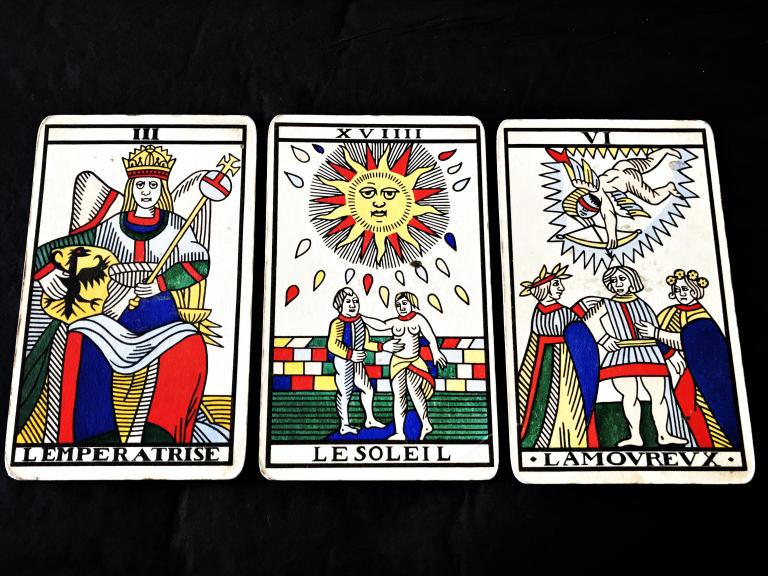
Jean Noblet Marseille Tarot as reconstructed by Jean-Claude Flornoy (Photo: Camelia Elias)
The Empress, the Sun, and the Lovers
I read them in this way:
He left you for another woman. There was great love between you, until another woman got in the picture.
There’s nothing to feel. You’re your own sovereign. You could feel small, scaled down in size and put on a par with another of your kind, but is subjecting yourself to a comparison that turns the odds against you useful to you?
Think about the man who leaves an Empress, thinking that she is comparable, subject to being weighed and measured against another. Think about the suspicious man who ultimately sees both women pretty small in size.
If we must press the small/big button, then let’s say that going from full power to divided identity is not useful. Being stunned and thrown into self-doubt about the man who chooses small is not useful either.
If you’re not sure about what you feel, you can look at how being passed over impacts on your sovereignty. Is there an impact at all, or are we dealing with a story of regret – regret because the other you love is unable to see your actual size? Why would you even want to be with a man who thinks you’re half the size you are, and ultimately less than that one he chooses over you? Go cry over that, if you think such a regret enriches your life.
Words in your mouth
The point with this reading is to demonstrate that we can give efficient counsel, without putting words into the other person’s mouth about what they feel, how they’re doing, and, what’s worse, how successful they’re at either failing – delicious trendy story of the value of the vulnerable – or at acknowledging their so-called shadows.
Reading cards is not about validation of any kind. It’s about motivation. It’s about how you inspire the other to see things as they are, not to hop on your story of eloquence in which the heartbreak is a bestselling act, making you a bestselling author, standing there all shining and basking in the glorious rays of your own seductive words. Reading cards is about asking provocative questions: ‘How do you feel about your feelings being nothing other than another person’s words for them?’
If you don’t know how you feel, be happy, because in that ‘not-knowing’ you can find a measure of true freedom; freedom from words, words that are never yours or that tell a true story about you.
You are not your words, nor are you the words of another about you. How is that as a sale’s argument?
♠
Stay in loop for cartomantic courses of the nasty Zen kind.

About Camelia Elias
Camelia Elias, PhD & Dr.Phil., is a former university professor. After 20 years in the academia, she left her career to pursue her interests in teaching and writing on the philosophy and practice of reading cards. She works with contemplative arts, oracular language, and martial arts cartomancy and Zen at her own school, Aradia Academy. You can read more about the author here.
Previous Post
April 10, 2019
22 TRUMPS ACCORDING TO THE QUESTION – PART TWO
Next Post
May 2, 2019 LOVER'S HATRED
Browse Our Archives
Select a Category Columns The Cartomancer Uncategorized
Select a Month January 2024 October 2023 August 2023 July 2023 June 2023 November 2022 October 2022 August 2022 May 2022 April 2022 February 2022 January 2022 November 2021 October 2021 September 2021 August 2021 June 2021 April 2021 March 2021 February 2021 January 2021 December 2020 November 2020 October 2020 September 2020 August 2020 July 2020 June 2020 May 2020 April 2020 March 2020 February 2020 January 2020 December 2019 November 2019 October 2019 September 2019 August 2019 July 2019 June 2019 May 2019 April 2019 March 2019 February 2019 January 2019 December 2018 November 2018 October 2018 September 2018 August 2018 July 2018 June 2018 May 2018 April 2018 March 2018 February 2018 January 2018 December 2017 November 2017 October 2017 September 2017 August 2017 July 2017 June 2017 May 2017 April 2017 March 2017 February 2017 January 2017 December 2016 November 2016 October 2016 September 2016 August 2016 July 2016 June 2016 May 2016 April 2016 March 2016 February 2016 January 2016 December 2015 November 2015 October 2015 September 2015 August 2015 July 2015
Follow Us!
TAKE THE
Religious Wisdom Quiz
Who is the "chosen lady" addressed in a New Testament letter?
Select your answer to see how you score.
Lydia Mary Phoebe Unspecified church
Related posts from THE CARTOMANCER
TRENDING AT PATHEOS Pagan

I was recently chatting with someone on Instagram. She asked me what...

While there are many people who share their results, the end of...

On July 23, I saw Christopher Nolan's The Odyssey which is Homer’s...

As I write this two big events have just finished up. One...

Restoring the Watershed of Divine Love
Perhaps cooperation is not something we manufacture through legislation, ideology, or moral...

Many UUs don’t pray because of bad experiences in a previous religion,...
view all Pagan blogs
Ad-Free & Subscriber Log-In Subscription Support
- About Us
- 2026 Calendar
- Videos
- Podcasts
- Library of World Religions
- Faith In Media Tracker
- Advertise With Us
- Write for Us
- Privacy Policy
- Terms of Service
- Do Not Sell My Data
- Contact Us
- Radiant Digital
- Manage Newsletter Subscriptions
- Unsubscribe From Notifications
- Sitemap
Copyright 2008-2026, Patheos. All rights reserved.
Subscription Support Ad-Free & Subscriber Log-In
Follow Patheos