
BuddhistCatholicContemplativeEvangelicalGeneral ChristianHinduJewishLatter-day SaintMuslimNew VisionsProgressive Christian
Beliefs
- Buddhist
- Catholic
- Contemplative
- Evangelical
- General Christian
- Hindu
- Jewish
- Latter-day Saint
- More Voices
- Muslim
- New Visions
- Pagan
- Progressive Christian
Topics
- Religion News
- Food and Religion
- Sports and Religion
- Religious Art
- Religious Music and Entertainment
- Religious Events
- History and Religion
- Style and Religion
- Politics and Religion
- Women in Religion
- Recreation Outdoors and Religion
- Business Finance and Religion
- Careers Workplace and Religion
- Education and Religion
- Family Parenting and Religion
- Health Fitness and Religion
- Home and Religion
- Relationships and Religion
- Technology and Religion
- Travel and Religion
Columnists
- Buddhist Columnists
- Business Finance and Religion Columnists
- Careers Workplace and Religion Columnists
- Catholic Columnists
- Contemplative Columnists
- Education and Religion Columnists
- Evangelists Columnists
- Family Parenting and Religion Columnists
- General Christian Columnists
- Health Fitness and Religion Columnists
- Hindu Columnists
- History and Religion Columnists
- Home and Religion Columnists
- Jewish Columnists
- More Voices Columnists
- Latter Day Columnists
- Muslim Columnists
- New Visions Columnists
- Nonreligious Columnists
- Pagan Columnists
- Politics and Religion Columnists
- Progressive Columnists
- Recreation Outdoors and Religion Columnists
- Relationships and Religion Columnists
- Religion News Columnists
- Religious Art Columnists
- Religious Events Columnists
- Religious Music and Entertainment Columnists
- Sports and Religion Columnists
- Style and Religion Columnists
- Technology and Religion Columnists
- Travel and Religion Columnists
- Women in Religion Columnists
Resource Library
- 2026 Calendar
- Library of World Religions
- The 100 Most Holy Places on Earth
- Patheos Answers
- Podcasts
- Videos
- Faith Leaders Database
- Anglican Episcopalian
- Bahai
- Baptist
- Buddhism
- Christianity
- Confucianism
- Eastern Orthodoxy
- Hinduism
- Holiness and Pentecostal
- ISKCON
- Islam
- Judaism
- Lutheran
- Methodist
- The Church of Jesus Christ of Latter-day Saints
- New Age
- Paganism
- Presbytarian and Reformed
- Protestantism
- Religion Behind the Scenes
- Roman Catholic
- Scientology
- Shia Islam
- Sikhism
- Sufism
- Sunni Islam
- Taoism
- Zen
- See all religions
Research Tools
 Ad-Free & Subscriber Log-In Subscription Support
Ad-Free & Subscriber Log-In Subscription Support
Follow Patheos 

- Trending:
- Forgiveness
- |
- Marriage
- |
- Consciousness
- |
- Death Penalty
- |
- Election
- |
- Halloween
 THE CARTOMANCER
- Home
- Pagan
- WHEN VOCABULARY IMPRESSES YOU
WHEN VOCABULARY IMPRESSES YOU
Last updated on: September 4, 2023 at 5:55 pm by Camelia Elias
WHEN VOCABULARY IMPRESSES YOU 2023-09-04T17:55:17+02:00 Camelia Elias
Patheos Explore the world's faith through different perspectives on religion and spirituality! Patheos has the views of the prevalent religions and spiritualities of the world.
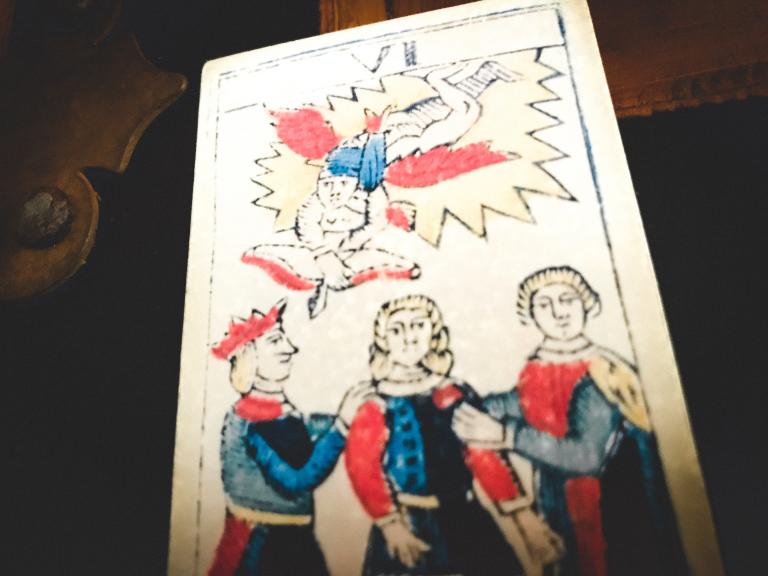
Carolus Zoya Marseille Tarot (Photo: Camelia Elias)
If there’s a difference between the way people read cards, then it’s all cultural. Method creates this difference to an extent, but culture has more impact. And what is culture in this context? Language and attitude. It’s all vocabulary.
I have the advantage of speaking several languages, having lived in several countries too. I hear things that the native people don’t. Where cards are concerned, there’s always a difference in vocabulary that discloses many things. For example, most of Anglo-American readers refer to the suit of 22 cards in a Marseille Tarot pack as ‘the major arcana.’ Non-English speakers of the European fortune-telling school call them ‘trumps.’ This difference is consistent.
If you’re in the first camp, following the Marseille trend, think: how might it change your view of the cards, if you started referring to the 22 cards as ‘trumps,’ rather than ‘majors’? If you stopped to think about it, what would you understand by the concept of ‘trump’ in the context of divination? This further invites to this question:
- How might it help your perception to know that some readers actually never think of the 22-suit as having anything whatsoever to do with secrets, mysteries, or personal gnosis?
Among the French readers I know, there are some who are heavily invested in the esoteric aspect of the trumps, seeing a secret in every detail that is either linked to the building of cathedrals, or to the unconscious mind that rules you through the inescapable mother/father symbolic dyad.
And yet, among the ones who are not so high-mindedly ambitious, a trump card is just that: a card that has the power to take a trick in a game. It’s not about revealing anything. It’s about winning.
If this never crossed your mind, imagine actually sitting with the cards and not thinking of the trumps as ‘arcana.’ Now try also to sit with your querent and instead of thinking, ‘I’m going to reveal secrets for this person,’ adopt the warrior’s attitude, and say to yourself instead: ‘this is a battlefield and I’m going to win this war.’
The war metaphor is a given to me, as I never presume to fix anything for another person. Instead of the aim ‘to help,’ or to downright fix things, when I read the cards, I have this intent: to overpower whatever the querent brings to the table in the form of a problem or concern. My ambition is to transmit a winning verdict to the person I read the cards for. While sitting and revelling in dream and mystery may be fascinating, that’s not what I go for first.
Also, if you import French names into your reading practice, how do you hear the cultural differences between what you make of it and what the French make of it? It may be a good idea, once in a while, to question the conceptual premise for the way in which you understand the function of the cards, as this function is inherently described by a specific foreign name.
Here then the question: what does a trump card do that a major arcana card doesn’t?
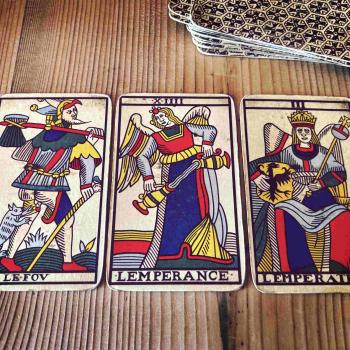
The Lovers, The Hanged Man & Temperance make an appearance.
A trump card will not reveal the secret of your impotence due to your ambivalence. But it will point to how you can bottle the shit, mix it up, so that at the end of the day not even you will know the difference. A trump card will not speak of your sacrifice, but will address your regret, especially the one connected to questioning which lover to pick, and for what absurd purpose.
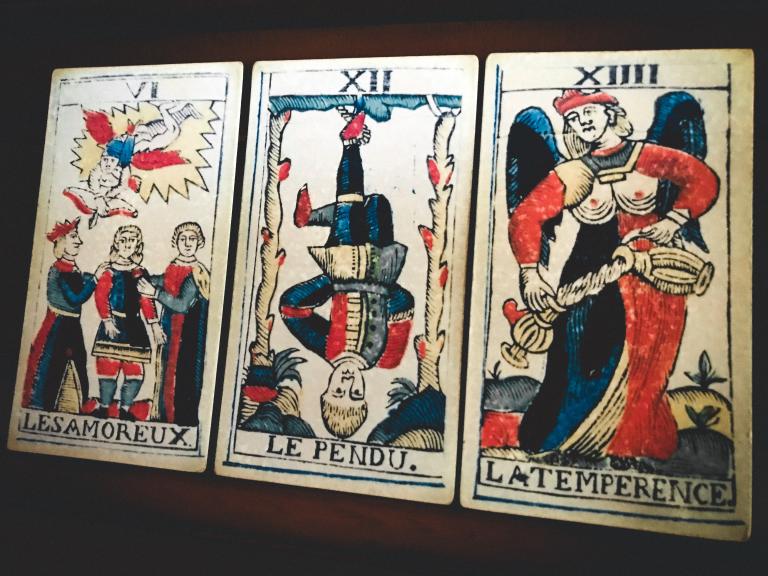
Carolus Zoya Marseille Tarot (Photo: Camelia Elias)
Loud but not so expert
In the last couple of years the Marseille trend has grown exponentially, and so has the army of experts. But you will note that not all who loudly now go French on you, have also changed their old attitude or conceptual frame of reference.
Since we’re comparing cultures, for your own entertainment, you might want to start noticing to what extent attitude actually follows vocabulary. You may want to ask yourself: how does the expert crew actually read a line of three cards, or the French Cross, a tableau or a square of 9 cards, carrying the sound of the fortuneteller’s French into the practice of ‘empathic,’ ‘ethical’ or ‘intuitive reading’?
It’s an old hat that names mean nothing, but that didn’t stop Shakespeare from asking, adopting an air of mystique, ‘what’s in a name…?’ What makes the difference in claims to knowledge is not the French that you can now speak, but the attitude that you bring to the table when you can demonstrate how you go from processing the visual and cultural information that the cards present you with to your core wisdom based on the essential knowledge that you’re able to extract from the cards.
Knowing your vocabulary is knowing the language of description. This is crucial, especially when you’re dealing with images, ambiguous content, and poetic input.
As they say about picking your own battles, the same applies to picking who or what impresses you. Try to know why you’re impressed, and why you fall for some words and systems merely because they sound authoritative or exotic in some people’s mouths. Not knowing why exactly you’re impressed amounts to losing the battle with the art of distinction.
I leave you with an apt statement from Ursula K. LeGuin’s book, Late in the Day, where she also compares vocabularies:
Poetry is the human language that can try to say what a tree or a rock or a river is, that is, to speak humanly for it, in both senses of the word “for.” A poem can do so by relating the quality of an individual human relationship to a thing, a rock or river or tree, or simply by describing the thing as truthfully as possible. Science describes accurately from outside, poetry describes accurately from inside. Science explicates, poetry implicates. Both celebrate what they describe. We need the languages of both science and poetry to save us from merely stockpiling endless “information” that fails to inform our ignorance or our irresponsibility (from the forward).
♦
For more comparison, you may like my essay: Three Ways of Reading Cards: In Line, Singling-out, and Layout.
For more on the consequences of being impressionable, see my essay: When the Lovers are Ridiculous.
For more such thinking with the cards:
- Join the Read like the Devil Club.
- Visit also Aradia Academy and sign up for the newsletter that will keep you informed on upcoming courses and cartomantic activities. Note the Off the Shelf offering that also includes free resources.
- Check out my books on the philosophy and practice of divination at EyeCorner Press.
- Get a reading. When I perform a reading, I also teach, simply because I can’t help myself, so you will be twice served.

About Camelia Elias
Writer, Cartomancer, Zen You can read more about the author here.
Previous Post

August 3, 2018
WHEN A CARD FALLS OUT OF THE DECK
Next Post
August 17, 2018 IN A LEAGUE OF YOUR OWN
Browse Our Archives
Select a Category Columns The Cartomancer Uncategorized
Select a Month January 2024 October 2023 August 2023 July 2023 June 2023 November 2022 October 2022 August 2022 May 2022 April 2022 February 2022 January 2022 November 2021 October 2021 September 2021 August 2021 June 2021 April 2021 March 2021 February 2021 January 2021 December 2020 November 2020 October 2020 September 2020 August 2020 July 2020 June 2020 May 2020 April 2020 March 2020 February 2020 January 2020 December 2019 November 2019 October 2019 September 2019 August 2019 July 2019 June 2019 May 2019 April 2019 March 2019 February 2019 January 2019 December 2018 November 2018 October 2018 September 2018 August 2018 July 2018 June 2018 May 2018 April 2018 March 2018 February 2018 January 2018 December 2017 November 2017 October 2017 September 2017 August 2017 July 2017 June 2017 May 2017 April 2017 March 2017 February 2017 January 2017 December 2016 November 2016 October 2016 September 2016 August 2016 July 2016 June 2016 May 2016 April 2016 March 2016 February 2016 January 2016 December 2015 November 2015 October 2015 September 2015 August 2015 July 2015
Follow Us!
TAKE THE
Religious Wisdom Quiz
Who was the first king of Judah after Israel split?
Select your answer to see how you score.
Jeroboam Ahab Rehoboam Asa
Related posts from THE CARTOMANCER
TRENDING AT PATHEOS Pagan

When we talk about Greek religion, we often begin with the dodekatheion—the...

I was recently chatting with someone on Instagram. She asked me what...

While there are many people who share their results, the end of...

On July 23, I saw Christopher Nolan's The Odyssey which is Homer’s...

As I write this two big events have just finished up. One...

Restoring the Watershed of Divine Love
Perhaps cooperation is not something we manufacture through legislation, ideology, or moral...
view all Pagan blogs
Ad-Free & Subscriber Log-In Subscription Support
- About Us
- 2026 Calendar
- Videos
- Podcasts
- Library of World Religions
- Faith In Media Tracker
- Advertise With Us
- Write for Us
- Privacy Policy
- Terms of Service
- Do Not Sell My Data
- Contact Us
- Radiant Digital
- Manage Newsletter Subscriptions
- Unsubscribe From Notifications
- Sitemap
Copyright 2008-2026, Patheos. All rights reserved.
Subscription Support Ad-Free & Subscriber Log-In
Follow Patheos