
BuddhistCatholicContemplativeEvangelicalGeneral ChristianHinduJewishLatter-day SaintMuslimNew VisionsProgressive Christian
Beliefs
- Buddhist
- Catholic
- Contemplative
- Evangelical
- General Christian
- Hindu
- Jewish
- Latter-day Saint
- More Voices
- Muslim
- New Visions
- Pagan
- Progressive Christian
Topics
- Religion News
- Food and Religion
- Sports and Religion
- Religious Art
- Religious Music and Entertainment
- Religious Events
- History and Religion
- Style and Religion
- Politics and Religion
- Women in Religion
- Recreation Outdoors and Religion
- Business Finance and Religion
- Careers Workplace and Religion
- Education and Religion
- Family Parenting and Religion
- Health Fitness and Religion
- Home and Religion
- Relationships and Religion
- Technology and Religion
- Travel and Religion
Columnists
- Buddhist Columnists
- Business Finance and Religion Columnists
- Careers Workplace and Religion Columnists
- Catholic Columnists
- Contemplative Columnists
- Education and Religion Columnists
- Evangelists Columnists
- Family Parenting and Religion Columnists
- General Christian Columnists
- Health Fitness and Religion Columnists
- Hindu Columnists
- History and Religion Columnists
- Home and Religion Columnists
- Jewish Columnists
- More Voices Columnists
- Latter Day Columnists
- Muslim Columnists
- New Visions Columnists
- Nonreligious Columnists
- Pagan Columnists
- Politics and Religion Columnists
- Progressive Columnists
- Recreation Outdoors and Religion Columnists
- Relationships and Religion Columnists
- Religion News Columnists
- Religious Art Columnists
- Religious Events Columnists
- Religious Music and Entertainment Columnists
- Sports and Religion Columnists
- Style and Religion Columnists
- Technology and Religion Columnists
- Travel and Religion Columnists
- Women in Religion Columnists
Resource Library
- 2026 Calendar
- Library of World Religions
- The 100 Most Holy Places on Earth
- Patheos Answers
- Podcasts
- Videos
- Faith Leaders Database
- Anglican Episcopalian
- Bahai
- Baptist
- Buddhism
- Christianity
- Confucianism
- Eastern Orthodoxy
- Hinduism
- Holiness and Pentecostal
- ISKCON
- Islam
- Judaism
- Lutheran
- Methodist
- The Church of Jesus Christ of Latter-day Saints
- New Age
- Paganism
- Presbytarian and Reformed
- Protestantism
- Religion Behind the Scenes
- Roman Catholic
- Scientology
- Shia Islam
- Sikhism
- Sufism
- Sunni Islam
- Taoism
- Zen
- See all religions
Research Tools
 Ad-Free & Subscriber Log-In Subscription Support
Ad-Free & Subscriber Log-In Subscription Support
Follow Patheos 

- Trending:
- Forgiveness
- |
- Marriage
- |
- Consciousness
- |
- Death Penalty
- |
- Election
- |
- Halloween
 THE CARTOMANCER
- Home
- Pagan
- WHEN THE MAGICIAN DOESN’T IMPROVISE
WHEN THE MAGICIAN DOESN’T IMPROVISE
Last updated on: July 6, 2018 at 4:09 pm by Camelia Elias
WHEN THE MAGICIAN DOESN’T IMPROVISE 2018-07-06T16:09:55+02:00 Camelia Elias
Patheos Explore the world's faith through different perspectives on religion and spirituality! Patheos has the views of the prevalent religions and spiritualities of the world.

Butoh Magician Hijikata Tatsumi (Photo: Camelia Elias)
Among the Zen masters that I venerate, there are some who are not exactly either Zen monks or Zen masters, at least not by any of the definitions we impose on the people who are in the state of having clarity about everything.
Hijikata Tatsumi, the founder of the butoh dance, the ‘dance of utter darkness’ usually sits right next to me, between an antique Tibetan Buddhist thangka from Lhasa, and a calligraphy of the Heart Sutra. There’s a reason for that.
I consider Hijikata profoundly Zen, in spite of his weird philosophy and performances. He is known for having said many strange things that, however, ring a bell with me.
Everything he formulated in the form of principles around dance and life, insist on choreography, as choreography gives you access to the most precise bodily movements that we have forgotten all about, due to growing up and subjecting to culture.
Not many get ‘the butoh thing’, as a butoh dance may look like something very haphazardly done, improvisation being in the high seat. But Hijikata himself hated improvisation, and insisted on choreographing a dance by using conceptual thinking and visualization that would be wrung through a naming machine, giving life to scenes and movements. For instance, if he decided that a dancer must dance a gold fish, then the dance had to follow 43 movements and 45 names of movements (Costume En Face, p. 133)
Since the 50s, butoh became more and more popular, but it’s clear to anyone that it wasn’t because of Hijikata’s stringency. I won’t launch here into the history and controversies surrounding butoh, but there’s something that I want to take from Hijikata to illustrate a point.
In an interview, he addressed why he opposed improvisation. He said: ‘life is improvisation enough. I don’t need it on stage too.’
I find this statement utterly intriguing, because what it implies is an irony: Everything that we improvise in life revolves around dictations. When we say that we need to cut corners, what we actually mean is that we need to devise strategies to bypass whatever cultural impasse we’re at. When we improvise at work, we do so because of the unrealistic pressures on us. When we improvise in our relationships, we do it because we find ourselves subject to unreasonable expectations.
So indeed, who the hell needs improvisation in the arts, if we still grant it that the function of art is to move our hearts, and to derail our habitual patterns of thinking, putting us back on track towards freedom?
I’m with Hijikata on this one, because I can see how what he insists on is of great relevance to what we make of the card of the Magician in the tarot.
The Magician’s Act
Contrary to popular belief, the Magician is not merely ‘good at improvisation’. If you think twice about it, you realize that improvisation is actually never on the Magician’s table. Everything he does is carefully choreographed. He’s probably right up there with Hijikata: If he has to make a white rabbit appear, he would have a whole list of scenes and named movements that he would go to, that would enable him to not only manifest the white rabbit, but also go to the heart of it.
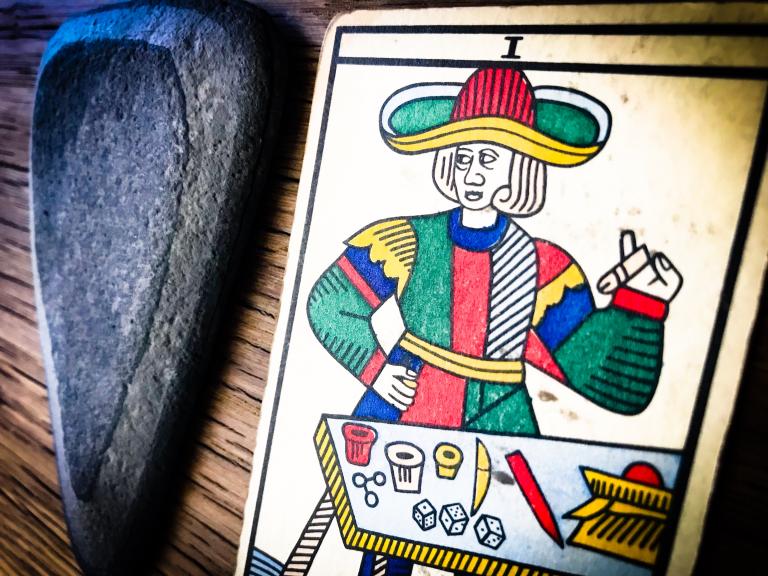
Photo: Camelia Elias
Whether in a traditional setting as a conman, or as a mediator between the above and the below in esoteric tarot, the Magician is simply never about improvised acts. A fake Magician is.
If the Magician is worth his salt, he is highly educated in all things staged and choreographed, down to the subtlest movements, facial expression, and costume. He also exhibits high discipline, perseverance, and genius, all in equal measure.
The fakes
The Magicians who improvise, what of them?
I hope never to meet them face to face, though I come across them in all sorts of other contexts. I see them getting high and mighty on their improvisation throne, all theatrical and no substance. Being truly theatrical actually takes a whole lot of work; work that involves bearing humiliation from a master. Without humiliation how are you to learn the art and craft of acceptance? The fake magician would never stoop to that, as it would mean exposing his limitations, and having to go back to the drawing board to polish on the failed act. Too much work.
The Magician who improvises due to shallow thinking is thoroughly insecure. You know him by measuring the extent of his improvisation. The more improvised the act, the lesser the understanding of the premise for the act.
I’ve developed a habit of quickly noticing what I’m dealing with, whenever the Magician is in the picture: Is this a Magician who seduces me with his discipline, and demonstrates to me how ‘anything goes’ is not part of his routine for a reason? Or is this a fake Magician, conning the con, pretending to have worked on his act, when in reality he never?
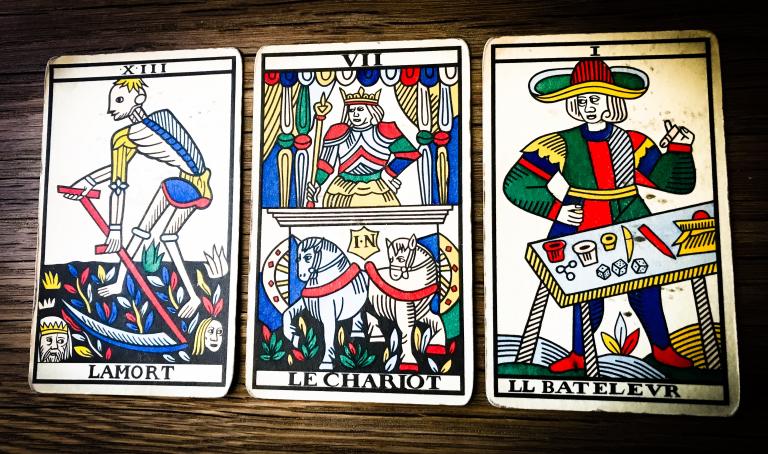
Jean Noblet Marseille Tarot, 1650, as reconstructed by Jean-Claude Flornoy (Photo: Camelia Elias)
A Magician who can eyeball the contrast between boldness and bones is a magician versed in study. Polishing an act is high art, and it goes somewhere, often to the essence of the act.
As a choreographer, the Magician is not a Fool, stumbling into things, and taking pride in the improvised act, all in the name of some perceived idea of freedom anchored in a complete lack of precision.
Know thy Magician
Ask yourself this question: How many times did you read the Magician as a Fool in a divination session, attributing to him the Fool’s qualities, without realizing that what differentiates between these two cards is precisely discipline versus disorder?
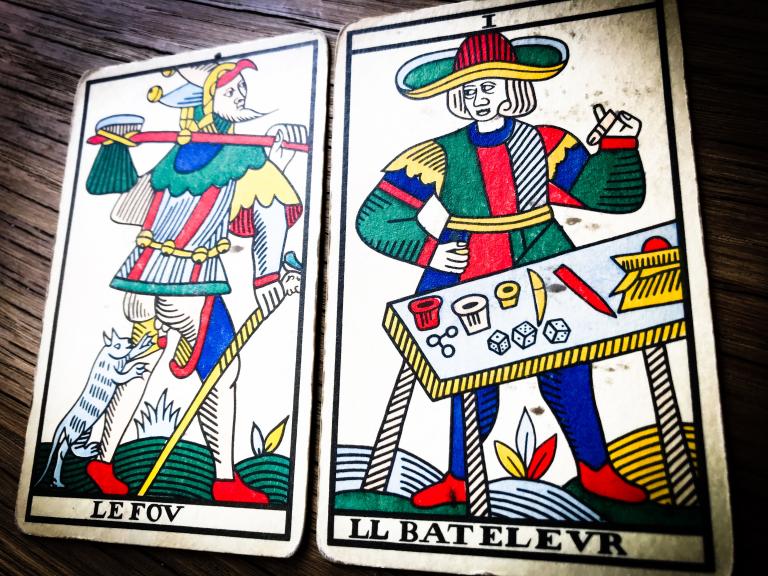 How often do you consider the idea of stage, study, and choreography when you see the Magician land on your table, as against the Fool’s improvisations?
How often do you think of the Magician’s ability to show you the reason for his existence beyond the improvised act, beyond the colorful mask that bores you to death, because it’s nothing but a cover of laziness and limitation?
I’m asking because it occurred to me that at the end of this study in deconstructing the tarot trumps, there’s a neat serendipity: I started with the Fool and I ended with the Magician. Not planned. Now I might as well call my deconstructed cards series, ‘stumbling into the rehearsed act’, distinguishing between the actions and reactions of the magicians of the world who are caught with their pants down.
Perhaps the deconstructed cards series has been an exercise in pointing out the consequences of dramatic sublimation, and what we tend to fall for when it comes to discourse around the tarot. Who do we listen to, and why? Let deconstruction of sublimation be the nerve that runs throughout this series, and then some more.
At the end of the day, I want my Magician to be Zen, and say to me: ‘Here’s my act, perfected throughout many years. I’ve no idea what it means. I’m not here to improvise ‘meaning.’ I’m here to choreograph the hell out of this dance of darkness, and eat you all up with my act, an act that comes in exactly 22 scenes, 78 movements, and ten thousand names.’
♠
Stay in the loop for cartomantic activities.

About Camelia Elias
Camelia Elias, PhD, Dr.Phil., is a former university professor. After 20 years in the academia, she left her career to pursue her interests in teaching and writing on the philosophy and practice of reading cards. She works with contemplative arts, oracular language, and martial arts cartomancy and Zen at her own school, Aradia Academy. You can read more about the author here.
Previous Post

June 28, 2018
WHEN THE WORLD IS NOT A CHEATSHEET

Browse Our Archives
Select a Category Columns The Cartomancer Uncategorized
Select a Month January 2024 October 2023 August 2023 July 2023 June 2023 November 2022 October 2022 August 2022 May 2022 April 2022 February 2022 January 2022 November 2021 October 2021 September 2021 August 2021 June 2021 April 2021 March 2021 February 2021 January 2021 December 2020 November 2020 October 2020 September 2020 August 2020 July 2020 June 2020 May 2020 April 2020 March 2020 February 2020 January 2020 December 2019 November 2019 October 2019 September 2019 August 2019 July 2019 June 2019 May 2019 April 2019 March 2019 February 2019 January 2019 December 2018 November 2018 October 2018 September 2018 August 2018 July 2018 June 2018 May 2018 April 2018 March 2018 February 2018 January 2018 December 2017 November 2017 October 2017 September 2017 August 2017 July 2017 June 2017 May 2017 April 2017 March 2017 February 2017 January 2017 December 2016 November 2016 October 2016 September 2016 August 2016 July 2016 June 2016 May 2016 April 2016 March 2016 February 2016 January 2016 December 2015 November 2015 October 2015 September 2015 August 2015 July 2015
Follow Us!
TAKE THE
Religious Wisdom Quiz
The glory of this present house will be greater than the glory of the former house. What building is being reconstructed?
Select your answer to see how you score.
The palace The city wall The whole of Jerusalem The temple
Related posts from THE CARTOMANCER
TRENDING AT PATHEOS Pagan

I was recently chatting with someone on Instagram. She asked me what...

While there are many people who share their results, the end of...

On July 23, I saw Christopher Nolan's The Odyssey which is Homer’s...

As I write this two big events have just finished up. One...

Restoring the Watershed of Divine Love
Perhaps cooperation is not something we manufacture through legislation, ideology, or moral...

Many UUs don’t pray because of bad experiences in a previous religion,...
view all Pagan blogs
Ad-Free & Subscriber Log-In Subscription Support
- About Us
- 2026 Calendar
- Videos
- Podcasts
- Library of World Religions
- Faith In Media Tracker
- Advertise With Us
- Write for Us
- Privacy Policy
- Terms of Service
- Do Not Sell My Data
- Contact Us
- Radiant Digital
- Manage Newsletter Subscriptions
- Unsubscribe From Notifications
- Sitemap
Copyright 2008-2026, Patheos. All rights reserved.
Subscription Support Ad-Free & Subscriber Log-In
Follow Patheos