
BuddhistCatholicContemplativeEvangelicalGeneral ChristianHinduJewishLatter-day SaintMuslimNew VisionsProgressive Christian
Beliefs
- Buddhist
- Catholic
- Contemplative
- Evangelical
- General Christian
- Hindu
- Jewish
- Latter-day Saint
- More Voices
- Muslim
- New Visions
- Pagan
- Progressive Christian
Topics
- Religion News
- Food and Religion
- Sports and Religion
- Religious Art
- Religious Music and Entertainment
- Religious Events
- History and Religion
- Style and Religion
- Politics and Religion
- Women in Religion
- Recreation Outdoors and Religion
- Business Finance and Religion
- Careers Workplace and Religion
- Education and Religion
- Family Parenting and Religion
- Health Fitness and Religion
- Home and Religion
- Relationships and Religion
- Technology and Religion
- Travel and Religion
Columnists
- Buddhist Columnists
- Business Finance and Religion Columnists
- Careers Workplace and Religion Columnists
- Catholic Columnists
- Contemplative Columnists
- Education and Religion Columnists
- Evangelists Columnists
- Family Parenting and Religion Columnists
- General Christian Columnists
- Health Fitness and Religion Columnists
- Hindu Columnists
- History and Religion Columnists
- Home and Religion Columnists
- Jewish Columnists
- More Voices Columnists
- Latter Day Columnists
- Muslim Columnists
- New Visions Columnists
- Nonreligious Columnists
- Pagan Columnists
- Politics and Religion Columnists
- Progressive Columnists
- Recreation Outdoors and Religion Columnists
- Relationships and Religion Columnists
- Religion News Columnists
- Religious Art Columnists
- Religious Events Columnists
- Religious Music and Entertainment Columnists
- Sports and Religion Columnists
- Style and Religion Columnists
- Technology and Religion Columnists
- Travel and Religion Columnists
- Women in Religion Columnists
Resource Library
- 2026 Calendar
- Library of World Religions
- The 100 Most Holy Places on Earth
- Patheos Answers
- Podcasts
- Videos
- Faith Leaders Database
- Anglican Episcopalian
- Bahai
- Baptist
- Buddhism
- Christianity
- Confucianism
- Eastern Orthodoxy
- Hinduism
- Holiness and Pentecostal
- ISKCON
- Islam
- Judaism
- Lutheran
- Methodist
- The Church of Jesus Christ of Latter-day Saints
- New Age
- Paganism
- Presbytarian and Reformed
- Protestantism
- Religion Behind the Scenes
- Roman Catholic
- Scientology
- Shia Islam
- Sikhism
- Sufism
- Sunni Islam
- Taoism
- Zen
- See all religions
Research Tools
 Ad-Free & Subscriber Log-In Subscription Support
Ad-Free & Subscriber Log-In Subscription Support
Follow Patheos 

- Trending:
- Forgiveness
- |
- Marriage
- |
- Consciousness
- |
- Death Penalty
- |
- Election
- |
- Halloween
 THE CARTOMANCER
- Home
- Pagan
- WHEN THE SUN IS ABOUT LOVE WITHOUT TRUST
WHEN THE SUN IS ABOUT LOVE WITHOUT TRUST
Last updated on: April 12, 2018 at 1:36 am by Camelia Elias
WHEN THE SUN IS ABOUT LOVE WITHOUT TRUST 2018-04-12T01:36:35+02:00 Camelia Elias
Patheos Explore the world's faith through different perspectives on religion and spirituality! Patheos has the views of the prevalent religions and spiritualities of the world.
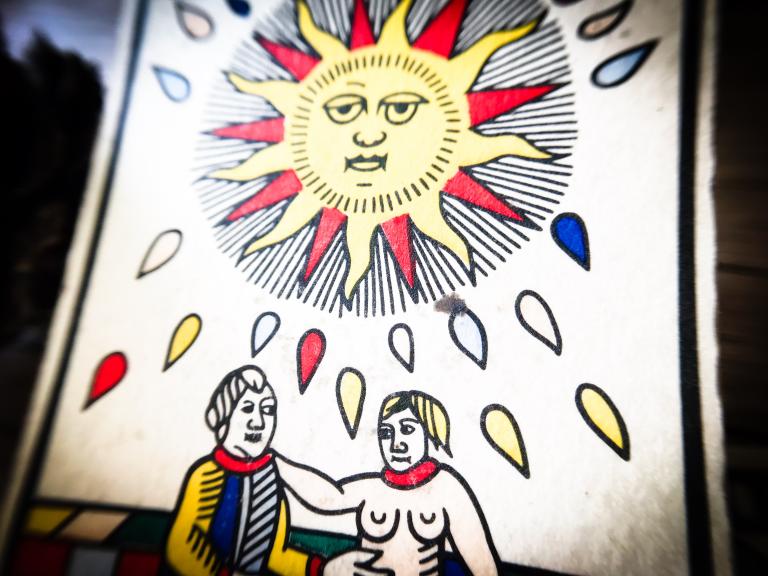
Photo: Camelia Elias
At least three influential Buddhists and Zen masters are reported to have said that they never trust anyone. The three are D.T. Suzuki, Chögyam Trungpa, and Dainin Katagiri. A 15th c. manuscript at the Vatican also states that ‘trust is the mother of all misfortune’. We’re with the wise folks here.
What’s going on?
In their cultural constitution, our relational selves are based on trust, and it goes to show that without trust, there’s no transaction.
Our cultures and societies are built around our capability to give and receive trust. Those who fail are called traitors.
At a functional level, this is very simple and very clear: Either you are reliable or you are not.
But how clear is this reliability, when we want to talk about truth and its realization, which is something different than talking about relative and absolute states, or mundane and sacred manifestations?
That Zen masters don’t trust anyone may come as a surprize to people living in a world where ‘trust’ is a highly valued commodity – you go to a Zen center or seek a spiritual master because you trust the teaching – but the truth is that in light of the impermanence of all things, trust as a fixed, stable, and reliable entity becomes nothing but another subject to be suspicious of.
As with everything else, the question to ask is about what makes a situation trustworthy, what makes a relationship reliable, and what makes acting according to the situation appropriate.
So it’s not trust that comes first, but rather responding to situations that have trust as a concept in a fluid and transactional mode.
If you think just a little bit about the obvious here, ask yourself: Just how much point is there in trusting people, when people change all the time?
What does it mean, also, to ask that others trust us?
When we ask for trust, aren’t we actually obligating others to rise to our expectation of reliability?
We value consistency in actions that follow the speech-acts, but when we do that, is it really trustworthiness as a stable thing that we value, or more the expectation that, ‘if I do you the favour of trusting you, you also do the same for me?’
And when others don’t rise to our expectations of consistent behaviour, then what?
Zen centers are populated with enthusiastic students who trust masters who don’t trust them. Not all are aware of this, to begin with. Students are devoted in their love to the masters, while the masters keep a hard line that’s called: ‘I’m not impressed.’ Some get the point of that, others take it personally. When the latter happens, it’s easy to see how the initial trust turns into resentment anchored in stories of denigration: ‘Another Zen master implicated in a sex scandal,’ as if a Zen master’s sex life is ever anybody’s business.
That last remark aside, as it requires a different a context to unfold than the cartomantic one, what we can observe here that’s interesting is the intentional asymmetry in the student/master relationship – which has a long history, by the way.
Underlying this asymmetry is an inherent wisdom behind the scene of trustworthiness, where the master simply suggests that if you can act it, you can be it, be that devotion, love, reliability, trust. Being enthusiastic is a mode that activates your emotional field; acting according to the situation, when you show diligence and simply just work towards better self-scrutiny is another story.
Meanwhile, you simply don’t say to others: ‘I trust you.’ I’ve always found this claim completely inappropriate, as it’s devoid of correct functionality in relation to identifying properly the context of the other’s situation. What does, ‘I trust you’, presuppose? That I know you?; that I know your situation? What do we actually know of others? Nothing.
Also, do you don’t go around asking people when you want to divulge secrets: ‘Can I trust you?’, as this is an equally inappropriate way of putting it when dealing with sensitive information.
The reason why trust in such situations comes across as awkward is because it lacks illumination, which is what brings me to the card of the Sun in the Tarot.
Graphically and at the level of the image, everyone can see that two people share their mutual trust. But how many think of the underlying structure to this symmetrical relationship: ‘I give you my love, and you give me yours?’
The Sun makes things clear, and it can also burn like a laser through muddled agendas. So here’s what I think of the two people in the Sun card: They invite us to inhabit the space where we can maintain double vision, that is to say, when we can maintain seeing the other from a double perspective.
The subtle question that we can ask ourselves here, as inspired by the idea of the double vision, is the following:
How can I be flexible in my certainty about another? The inverse can also apply: How can I be flexible in my uncertainty about another?
It serves us well to think that when gazing at the moon and minding our own business is not available to us, as far as having to act towards others is concerned, we can think of how to maintain double vision; after all, we have two eyes, suggesting that it’s best not to gaze for too long in just one direction.
In the Sun card people see each other, which is why the Sun has traditionally been associated with vision, especially as it pertains to readings and consultations for health situations.
But how flexible are they in this act of seeing, especially since seeing is culturally informed, often acquiring particular shades that’s constitutive of identity?
Why double vision?
One of my favorite literary critics, Gabriel Josipovici, has this to say in his brilliant book, On Trust, where he makes a very apt comment on what happens when, in our desire to experience the fullness of love, or its continuos expression, we forget to think of it in terms of its finitude once death occurs. He calls this situation “the double vision” of the sense of life’s abundance that entails the event of death, also as an abundance.
“[The] denial of the dual vision… in the end entails a denial of the world we live in and, ultimately, of ourselves as embodied beings existing within that world. Yet such is the nature of suspicion that, once unleashed, it appears to produce a totally convincing and self-consistent world, not simply an alternative way of looking at things but the only way there can possibly be.”
Zen masters are masters because of their suspicion and their ability to maintain double vision in doubting everything they know. When they say, ‘I trust no one’, you can stake your life on it that what they’re doing is demonstrate correct function in accordance with identifying properly what the situation always IS. If you doubt this, ask your cards:
How can I love without trusting anyone?
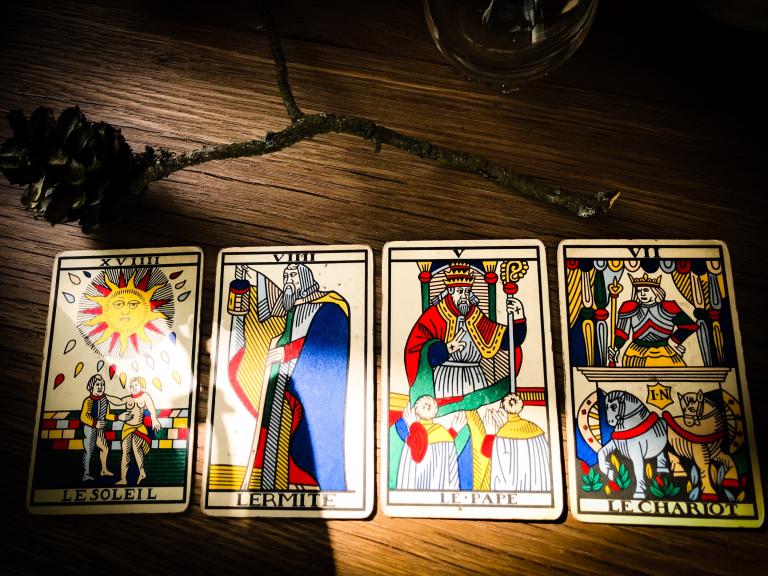
Jean Noblet Marseille Tarot, 1650, by Jean-Claude Flornoy (Photo: Camelia Elias)
Perhaps they’ll say something of this sort:
You think you know what the other wants. Think again, and then consider your commitments. What function do they have? ‘Keep going’ is the same as acknowledging movement, and that includes the movement of your consecrations. You can love without trust if your moving is seemly.
♠
Stay in the loop. Read like the Devil. The next cartomancy course, Radiant Reading opens for registration on April 19. Hop on board for a run of advanced Marseille.
Previous Post

April 4, 2018
WHEN FORCE IS ON THE DOT
Next Post

April 20, 2018 THE NOT-TO-BE-DENIED HEART
Browse Our Archives
Select a Category Columns The Cartomancer Uncategorized
Select a Month January 2024 October 2023 August 2023 July 2023 June 2023 November 2022 October 2022 August 2022 May 2022 April 2022 February 2022 January 2022 November 2021 October 2021 September 2021 August 2021 June 2021 April 2021 March 2021 February 2021 January 2021 December 2020 November 2020 October 2020 September 2020 August 2020 July 2020 June 2020 May 2020 April 2020 March 2020 February 2020 January 2020 December 2019 November 2019 October 2019 September 2019 August 2019 July 2019 June 2019 May 2019 April 2019 March 2019 February 2019 January 2019 December 2018 November 2018 October 2018 September 2018 August 2018 July 2018 June 2018 May 2018 April 2018 March 2018 February 2018 January 2018 December 2017 November 2017 October 2017 September 2017 August 2017 July 2017 June 2017 May 2017 April 2017 March 2017 February 2017 January 2017 December 2016 November 2016 October 2016 September 2016 August 2016 July 2016 June 2016 May 2016 April 2016 March 2016 February 2016 January 2016 December 2015 November 2015 October 2015 September 2015 August 2015 July 2015
Follow Us!
TAKE THE
Religious Wisdom Quiz
What was the disciple Luke's profession?
Select your answer to see how you score.
Carpenter Physician Fisherman Tentmaker
Related posts from THE CARTOMANCER
TRENDING AT PATHEOS Pagan

I was recently chatting with someone on Instagram. She asked me what...

While there are many people who share their results, the end of...

On July 23, I saw Christopher Nolan's The Odyssey which is Homer’s...

As I write this two big events have just finished up. One...

Restoring the Watershed of Divine Love
Perhaps cooperation is not something we manufacture through legislation, ideology, or moral...

Many UUs don’t pray because of bad experiences in a previous religion,...
view all Pagan blogs
Ad-Free & Subscriber Log-In Subscription Support
- About Us
- 2026 Calendar
- Videos
- Podcasts
- Library of World Religions
- Faith In Media Tracker
- Advertise With Us
- Write for Us
- Privacy Policy
- Terms of Service
- Do Not Sell My Data
- Contact Us
- Radiant Digital
- Manage Newsletter Subscriptions
- Unsubscribe From Notifications
- Sitemap
Copyright 2008-2026, Patheos. All rights reserved.
Subscription Support Ad-Free & Subscriber Log-In
Follow Patheos