
BuddhistCatholicContemplativeEvangelicalGeneral ChristianHinduJewishLatter-day SaintMuslimNew VisionsProgressive Christian
Beliefs
- Buddhist
- Catholic
- Contemplative
- Evangelical
- General Christian
- Hindu
- Jewish
- Latter-day Saint
- More Voices
- Muslim
- New Visions
- Pagan
- Progressive Christian
Topics
- Religion News
- Food and Religion
- Sports and Religion
- Religious Art
- Religious Music and Entertainment
- Religious Events
- History and Religion
- Style and Religion
- Politics and Religion
- Women in Religion
- Recreation Outdoors and Religion
- Business Finance and Religion
- Careers Workplace and Religion
- Education and Religion
- Family Parenting and Religion
- Health Fitness and Religion
- Home and Religion
- Relationships and Religion
- Technology and Religion
- Travel and Religion
Columnists
- Buddhist Columnists
- Business Finance and Religion Columnists
- Careers Workplace and Religion Columnists
- Catholic Columnists
- Contemplative Columnists
- Education and Religion Columnists
- Evangelists Columnists
- Family Parenting and Religion Columnists
- General Christian Columnists
- Health Fitness and Religion Columnists
- Hindu Columnists
- History and Religion Columnists
- Home and Religion Columnists
- Jewish Columnists
- More Voices Columnists
- Latter Day Columnists
- Muslim Columnists
- New Visions Columnists
- Nonreligious Columnists
- Pagan Columnists
- Politics and Religion Columnists
- Progressive Columnists
- Recreation Outdoors and Religion Columnists
- Relationships and Religion Columnists
- Religion News Columnists
- Religious Art Columnists
- Religious Events Columnists
- Religious Music and Entertainment Columnists
- Sports and Religion Columnists
- Style and Religion Columnists
- Technology and Religion Columnists
- Travel and Religion Columnists
- Women in Religion Columnists
Resource Library
- 2026 Calendar
- Library of World Religions
- The 100 Most Holy Places on Earth
- Patheos Answers
- Podcasts
- Videos
- Faith Leaders Database
- Anglican Episcopalian
- Bahai
- Baptist
- Buddhism
- Christianity
- Confucianism
- Eastern Orthodoxy
- Hinduism
- Holiness and Pentecostal
- ISKCON
- Islam
- Judaism
- Lutheran
- Methodist
- The Church of Jesus Christ of Latter-day Saints
- New Age
- Paganism
- Presbytarian and Reformed
- Protestantism
- Religion Behind the Scenes
- Roman Catholic
- Scientology
- Shia Islam
- Sikhism
- Sufism
- Sunni Islam
- Taoism
- Zen
- See all religions
Research Tools
 Ad-Free & Subscriber Log-In Subscription Support
Ad-Free & Subscriber Log-In Subscription Support
Follow Patheos 

- Trending:
- Forgiveness
- |
- Marriage
- |
- Consciousness
- |
- Death Penalty
- |
- Election
- |
- Halloween
 THE CARTOMANCER
- Home
- Pagan
- READER AND SITTER DYNAMICS
READER AND SITTER DYNAMICS
Last updated on: January 12, 2018 at 4:32 pm by Camelia Elias
READER AND SITTER DYNAMICS 2018-01-12T16:32:11+02:00 Camelia Elias
Patheos Explore the world's faith through different perspectives on religion and spirituality! Patheos has the views of the prevalent religions and spiritualities of the world.
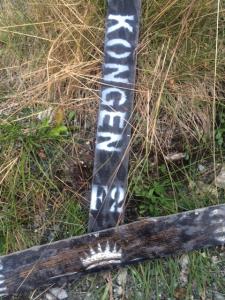
Photo: Camelia Elias
My new book The Power of the Pips: Courting Numbers in Cartomancy will be out next month. There are three distinct qualities to it where the level of information is concerned: in your face, waxing poetic, and then philosophical.
Here’s an excerpt of an example of the latter. It comes from the chapter called ‘Wait for It,’ where I talk about the empire of the senses vs. emotions, obsolete but still valid sayings, and strange questions. Enjoy!
♦
A cartomantic reading session with the full deck goes through four stages of recognizing what’s happening:
Intensity, arousal of curiosity (though this can also have sexual content), nonsense and silence, and repetition. On this list I particularly like the last two: When the reader establishes intensity through reference to basic curiosity, ‘nonsense’ takes over and articulates itself forcefully, yet paradoxically, through silence.
There’s always a moment in the reading session when both, the reader and the sitter can be baffled, so they ‘say’ nothing. Because silence is instituted, there is thus a need for the repetition of all the other movements. This repetition is what constitutes transgression.
While this transgression often comes close to being interpreted as a form of obsession – the reader is obsessed with decoding, and the sitter is obsessed with the urgency to know things – it also ensures that something interesting happens between the reader spinning off a story that the sitter brings to the table and the sitter whose story is often one of secrets.
The brilliant insight is that because transgression is what it is, a site of struggle and tension with language and ideas, it cannot per se also be the vehicle for communication as a result of precise readings (across and between the agents involved).
In other words, everybody misreads everybody else – but not entirely. That’s the beauty of cartomancy. A reader may estimate a sitter’s response quite accurately, but not because she is able to read her opponent with infallible precision – via classical cold reading or through the plain clarity of the cards – but because there is always a chance that she is wrong precisely and inasmuch as she is also right.
I like this idea, especially as it relates to an ethical question:
How much responsibility does the reader of cards have to show to their sitters? Here the correct answer must be this one: None.
Not a single nerve of responsibility must be shown, if waiting for the good thing to happen is to stand a chance of survival in its intense, ravishing, illuminating, and for the most part violent mode – violent in the sense that such a waiting act violates the most basic cultural expectation, which is to wait for dictations from above to know what is appropriate and what is not, instead of just knowing due to seeing things as they are, and as they unfold in the ever-mysterious NOW.
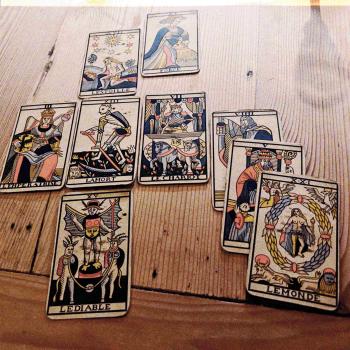
Tarot cards are sensorial triggers. The trumps make us aware of the order of things, and they give us a blueprint for how we can transgress such orders. The pip cards and the courts connect us to modalities of transgressing our inherent limits of being in the world.
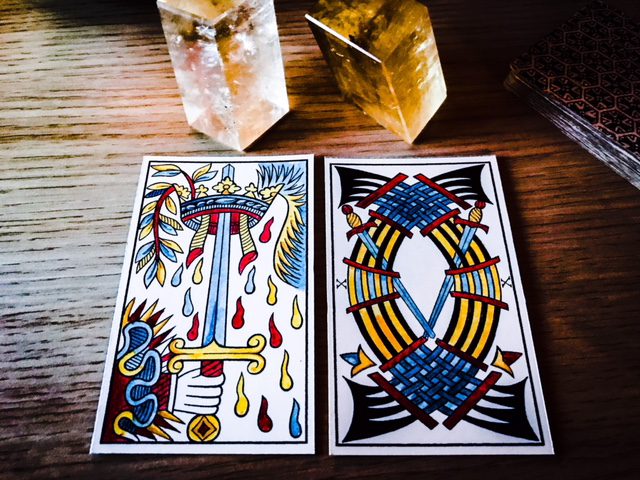
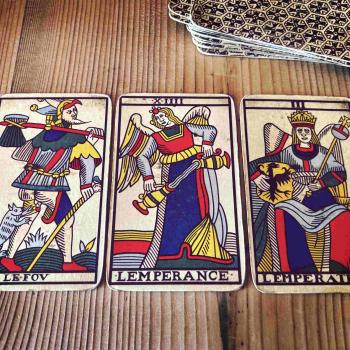
Marseille Tarot as reconstructed by Jean-Claude Flornoy (Photo: Camelia Elias)
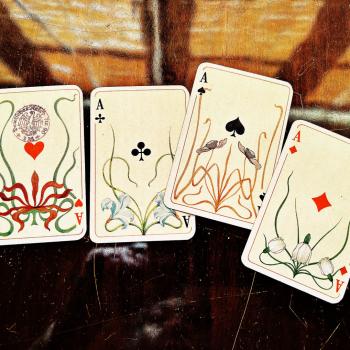
You see the Ace of Spades. Now ask yourself without thinking of standard meanings: How many times was your sense of this card similar to this decision: ‘That’s it. Up until here, and no more’?
Here some would ask: ‘Wait, isn’t that the job of the 10 Swords, to make us realize that we’ve had it’? I would suggest that by the time we got to the 10 after the initial, ultimate decision was made, what we would say is this: ‘I did it. I have fully realized the big NO. I’m now connected to the full stops of my life.’
♠
Stay tuned for more cartomantic activities.
The Marseille foundation course also starts in early February.
Previous Post
January 4, 2018
A short theory of the pip cards
Next Post
January 17, 2018 Fate or Flow?
Browse Our Archives
Select a Category Columns The Cartomancer Uncategorized
Select a Month January 2024 October 2023 August 2023 July 2023 June 2023 November 2022 October 2022 August 2022 May 2022 April 2022 February 2022 January 2022 November 2021 October 2021 September 2021 August 2021 June 2021 April 2021 March 2021 February 2021 January 2021 December 2020 November 2020 October 2020 September 2020 August 2020 July 2020 June 2020 May 2020 April 2020 March 2020 February 2020 January 2020 December 2019 November 2019 October 2019 September 2019 August 2019 July 2019 June 2019 May 2019 April 2019 March 2019 February 2019 January 2019 December 2018 November 2018 October 2018 September 2018 August 2018 July 2018 June 2018 May 2018 April 2018 March 2018 February 2018 January 2018 December 2017 November 2017 October 2017 September 2017 August 2017 July 2017 June 2017 May 2017 April 2017 March 2017 February 2017 January 2017 December 2016 November 2016 October 2016 September 2016 August 2016 July 2016 June 2016 May 2016 April 2016 March 2016 February 2016 January 2016 December 2015 November 2015 October 2015 September 2015 August 2015 July 2015
Follow Us!
TAKE THE
Religious Wisdom Quiz
Which Christian holiday marks the beginning of the Lenten season?
Select your answer to see how you score.
Epiphany Ash Wednesday Good Friday Advent
Related posts from THE CARTOMANCER
TRENDING AT PATHEOS Pagan

I was recently chatting with someone on Instagram. She asked me what...

While there are many people who share their results, the end of...

On July 23, I saw Christopher Nolan's The Odyssey which is Homer’s...

As I write this two big events have just finished up. One...

Restoring the Watershed of Divine Love
Perhaps cooperation is not something we manufacture through legislation, ideology, or moral...

Many UUs don’t pray because of bad experiences in a previous religion,...
view all Pagan blogs
Ad-Free & Subscriber Log-In Subscription Support
- About Us
- 2026 Calendar
- Videos
- Podcasts
- Library of World Religions
- Faith In Media Tracker
- Advertise With Us
- Write for Us
- Privacy Policy
- Terms of Service
- Do Not Sell My Data
- Contact Us
- Radiant Digital
- Manage Newsletter Subscriptions
- Unsubscribe From Notifications
- Sitemap
Copyright 2008-2026, Patheos. All rights reserved.
Subscription Support Ad-Free & Subscriber Log-In
Follow Patheos