
BuddhistCatholicContemplativeEvangelicalGeneral ChristianHinduJewishLatter-day SaintMuslimNew VisionsProgressive Christian
Beliefs
- Buddhist
- Catholic
- Contemplative
- Evangelical
- General Christian
- Hindu
- Jewish
- Latter-day Saint
- More Voices
- Muslim
- New Visions
- Pagan
- Progressive Christian
Topics
- Religion News
- Food and Religion
- Sports and Religion
- Religious Art
- Religious Music and Entertainment
- Religious Events
- History and Religion
- Style and Religion
- Politics and Religion
- Women in Religion
- Recreation Outdoors and Religion
- Business Finance and Religion
- Careers Workplace and Religion
- Education and Religion
- Family Parenting and Religion
- Health Fitness and Religion
- Home and Religion
- Relationships and Religion
- Technology and Religion
- Travel and Religion
Columnists
- Buddhist Columnists
- Business Finance and Religion Columnists
- Careers Workplace and Religion Columnists
- Catholic Columnists
- Contemplative Columnists
- Education and Religion Columnists
- Evangelists Columnists
- Family Parenting and Religion Columnists
- General Christian Columnists
- Health Fitness and Religion Columnists
- Hindu Columnists
- History and Religion Columnists
- Home and Religion Columnists
- Jewish Columnists
- More Voices Columnists
- Latter Day Columnists
- Muslim Columnists
- New Visions Columnists
- Nonreligious Columnists
- Pagan Columnists
- Politics and Religion Columnists
- Progressive Columnists
- Recreation Outdoors and Religion Columnists
- Relationships and Religion Columnists
- Religion News Columnists
- Religious Art Columnists
- Religious Events Columnists
- Religious Music and Entertainment Columnists
- Sports and Religion Columnists
- Style and Religion Columnists
- Technology and Religion Columnists
- Travel and Religion Columnists
- Women in Religion Columnists
Resource Library
- 2026 Calendar
- Library of World Religions
- The 100 Most Holy Places on Earth
- Patheos Answers
- Podcasts
- Videos
- Faith Leaders Database
- Anglican Episcopalian
- Bahai
- Baptist
- Buddhism
- Christianity
- Confucianism
- Eastern Orthodoxy
- Hinduism
- Holiness and Pentecostal
- ISKCON
- Islam
- Judaism
- Lutheran
- Methodist
- The Church of Jesus Christ of Latter-day Saints
- New Age
- Paganism
- Presbytarian and Reformed
- Protestantism
- Religion Behind the Scenes
- Roman Catholic
- Scientology
- Shia Islam
- Sikhism
- Sufism
- Sunni Islam
- Taoism
- Zen
- See all religions
Research Tools
 Ad-Free & Subscriber Log-In Subscription Support
Ad-Free & Subscriber Log-In Subscription Support
Follow Patheos 

- Trending:
- Forgiveness
- |
- Marriage
- |
- Consciousness
- |
- Death Penalty
- |
- Election
- |
- Halloween
 THE CARTOMANCER
- Home
- Pagan
- Ordinary and Extraordinary Questions
Ordinary and Extraordinary Questions
Last updated on: November 14, 2017 at 4:02 pm by Camelia Elias
Ordinary and Extraordinary Questions 2017-11-14T16:02:32+02:00 Camelia Elias
Patheos Explore the world's faith through different perspectives on religion and spirituality! Patheos has the views of the prevalent religions and spiritualities of the world.

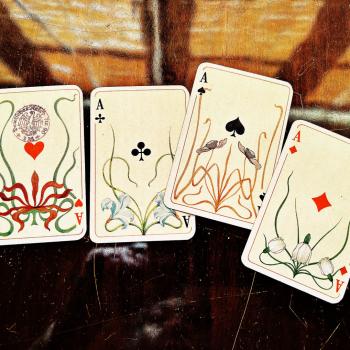
Otto Tragy playing cards, 1905. Originals in author’s collection
In my cartomancy classes I often make this point:
You can cultivate a sense of progression, from brainstorming on a 3-card set to hitting a nuanced tone in reading larger sets, simply by training asking questions that maintain a balanced focus between ordinary concerns and extraordinary interests.
That is to say, the extraordinary questions have a much higher propensity for storytelling, than the mundane questions.
All questions are good and have great value, but if you never make the effort to ask difficult, inspiring, invigorating, piquant, or downright quirky questions will soon find that your divination stales, that your cards don’t ‘talk’ to you anymore.
Likewise, if you only ask deeply involved questions, you will find that your divination will come across as convoluted and completely attached to your verbosity.
Cartomancy is all about the ability to create a coherent story that relates to a specific situation. It is also about your ability to move easily between the sacred and the profane, the mundane and the special, the snapshot (often the domain of the 3-card layout) and the dynamic crossing of relations (often the domain of a 9-card layout).
Why do you need a coherent story?
Because divination is not about life set in stone, but rather, about the possibility of discovery.
The more you train your ability to move from tired questions to the more galvanizing questions the more skilful you get in using tone, nuance, rhythm, color in your snappy deliveries of a message that will not only make sense in a precise way, but also give the other you read the cards for something to think about.
Here is a short list of examples of questions that fall into 4 categories of mainstream concerns.
We find these concerns already stylized to the 4 suits of a deck of cards, so the idea is to think of what crosses you over, from the ordinary and commonplace to the extraordinary and thrilling. And vice versa.
LOVE
The ordinary questions:
- Does he love me?
- What can I do to make myself more appreciated?
- How can I love in a disinterested way?
The extraordinary questions:
- Is love sacred or profane? You will find opinions equally divided, with some claiming the first, and others claiming the latter. When you ask an either/or question, you can do a 3-card sided by side for each of the situations. Compare the two scenarios.
- In what can I find the highest manifestation of love?
- To what extent is love subject to what I’m capable of?
WORK
The ordinary questions:
- What does it take for me to score this job?
- How can I improve my skills?
- I’m a jack of all trades and lack focus. What am I best at, so I can cultivate it?
The extraordinary questions:
- Why mandates me to desire recognition for my work?
- If I work through my illusions, how can work itself take the place of my illusions? What would this work consist of?
- ‘Chop wood and carry water’. That’s work. ‘Integrate your shadow’. That’s work. ‘Make a pact with the Devil, so he can work for you (haha, but let’s pretend this is so). That’s work. What is the reality of work? Which of the three scenarios here is ‘true’? For fun, you can use 3 sets of 3 cards for each, and then compare. Use the same cut, without shuffling for each.
- What is the one aspect of my work that can be used as a spell to enchant my boss with, by simply referring to it through the mundane channels of manifestation? Ex. ‘Boss, my work cuts through shit like a Samurai’s sword (You, thinking ‘Ace of Spades’, the boss hearing: ‘Samurai sword’).
HEALTH
The ordinary questions:
- How will these antidepressants improve my life?
- What is the cause of my fatigue?
- What type of fitness is appropriate for my body? (Think the 4 suits: Ex. hearts, swimming; clubs, yoga; diamonds, golf; spades, fencing).
The extraordinary questions:
- Mens sana in corpore sano, they say, and they are right. A healthy mind in a healthy body. What is the nature of what preoccupies my mind?
- What is pain? Why can’t people feel the pain of others it, no matter how advanced they are on the scale of true compassion?
- As there’s no reality outside of my perception, what strategy can I employ to change the narrative around the demons of fear and desire grasping at my body (the mind is part of the body)? Ex: I fear I’m going to die from this disease à change of metaphor: This disease has no substance, hence, I can vanquish it by dissolving the conceptual framework around it; I desire this wine more than anything else in the world à change of metaphor: This wine before two glasses tells the truth, at three glasses it talks bullshit).
MONEY
The ordinary questions:
- How can I pay off my loans in the fastest way possible?
- Which portfolio can I invest in? (A 3-card side by side describing each is a good idea, as you can compare them and pick the one that’s best).
- How can I negotiate a better pay for my work?
The extraordinary questions:
- Money is a highly symbolic, virtual thing. How can I apply this truth to the way in which I think of money as a material thing, thus being at odds with what money really is, always fucking with my expectations, and therefore always disappointing?
- Everything passes. This truth applies to money. How can I simply let go of my being invested in accumulating?
- How can I experience ‘cash flow’ as flow, rather than a fixation with the idea of ‘I must have it, now?’
Let’s end here with justifying the feature image below.

Otto Tragy playing cards, 1905. Originals in author’s collection
Why does the mind cling to appearances?
Because it is emotionally invested in changing outlook and tune. That, and then the fact that we like the idea of royally controlling it.
♠
Stay in the loop for cartomantic courses and activities.
Previous Post

November 1, 2017
Formless Sigils
Next Post

November 14, 2017 Three Ways of Reading Cards: In Line, Singling Out, and Layout
Browse Our Archives
Select a Category Columns The Cartomancer Uncategorized
Select a Month January 2024 October 2023 August 2023 July 2023 June 2023 November 2022 October 2022 August 2022 May 2022 April 2022 February 2022 January 2022 November 2021 October 2021 September 2021 August 2021 June 2021 April 2021 March 2021 February 2021 January 2021 December 2020 November 2020 October 2020 September 2020 August 2020 July 2020 June 2020 May 2020 April 2020 March 2020 February 2020 January 2020 December 2019 November 2019 October 2019 September 2019 August 2019 July 2019 June 2019 May 2019 April 2019 March 2019 February 2019 January 2019 December 2018 November 2018 October 2018 September 2018 August 2018 July 2018 June 2018 May 2018 April 2018 March 2018 February 2018 January 2018 December 2017 November 2017 October 2017 September 2017 August 2017 July 2017 June 2017 May 2017 April 2017 March 2017 February 2017 January 2017 December 2016 November 2016 October 2016 September 2016 August 2016 July 2016 June 2016 May 2016 April 2016 March 2016 February 2016 January 2016 December 2015 November 2015 October 2015 September 2015 August 2015 July 2015
Follow Us!
TAKE THE
Religious Wisdom Quiz
Who did God call as a boy in the Tabernacle, saying his name three times?
Select your answer to see how you score.
David Samuel Saul Eli
Related posts from THE CARTOMANCER
TRENDING AT PATHEOS Pagan

I was recently chatting with someone on Instagram. She asked me what...

While there are many people who share their results, the end of...

On July 23, I saw Christopher Nolan's The Odyssey which is Homer’s...

As I write this two big events have just finished up. One...

Restoring the Watershed of Divine Love
Perhaps cooperation is not something we manufacture through legislation, ideology, or moral...

Many UUs don’t pray because of bad experiences in a previous religion,...
view all Pagan blogs
Ad-Free & Subscriber Log-In Subscription Support
- About Us
- 2026 Calendar
- Videos
- Podcasts
- Library of World Religions
- Faith In Media Tracker
- Advertise With Us
- Write for Us
- Privacy Policy
- Terms of Service
- Do Not Sell My Data
- Contact Us
- Radiant Digital
- Manage Newsletter Subscriptions
- Unsubscribe From Notifications
- Sitemap
Copyright 2008-2026, Patheos. All rights reserved.
Subscription Support Ad-Free & Subscriber Log-In
Follow Patheos