
BuddhistCatholicContemplativeEvangelicalGeneral ChristianHinduJewishLatter-day SaintMuslimNew VisionsProgressive Christian
Beliefs
- Buddhist
- Catholic
- Contemplative
- Evangelical
- General Christian
- Hindu
- Jewish
- Latter-day Saint
- More Voices
- Muslim
- New Visions
- Pagan
- Progressive Christian
Topics
- Religion News
- Food and Religion
- Sports and Religion
- Religious Art
- Religious Music and Entertainment
- Religious Events
- History and Religion
- Style and Religion
- Politics and Religion
- Women in Religion
- Recreation Outdoors and Religion
- Business Finance and Religion
- Careers Workplace and Religion
- Education and Religion
- Family Parenting and Religion
- Health Fitness and Religion
- Home and Religion
- Relationships and Religion
- Technology and Religion
- Travel and Religion
Columnists
- Buddhist Columnists
- Business Finance and Religion Columnists
- Careers Workplace and Religion Columnists
- Catholic Columnists
- Contemplative Columnists
- Education and Religion Columnists
- Evangelists Columnists
- Family Parenting and Religion Columnists
- General Christian Columnists
- Health Fitness and Religion Columnists
- Hindu Columnists
- History and Religion Columnists
- Home and Religion Columnists
- Jewish Columnists
- More Voices Columnists
- Latter Day Columnists
- Muslim Columnists
- New Visions Columnists
- Nonreligious Columnists
- Pagan Columnists
- Politics and Religion Columnists
- Progressive Columnists
- Recreation Outdoors and Religion Columnists
- Relationships and Religion Columnists
- Religion News Columnists
- Religious Art Columnists
- Religious Events Columnists
- Religious Music and Entertainment Columnists
- Sports and Religion Columnists
- Style and Religion Columnists
- Technology and Religion Columnists
- Travel and Religion Columnists
- Women in Religion Columnists
Resource Library
- 2026 Calendar
- Library of World Religions
- The 100 Most Holy Places on Earth
- Patheos Answers
- Podcasts
- Videos
- Faith Leaders Database
- Anglican Episcopalian
- Bahai
- Baptist
- Buddhism
- Christianity
- Confucianism
- Eastern Orthodoxy
- Hinduism
- Holiness and Pentecostal
- ISKCON
- Islam
- Judaism
- Lutheran
- Methodist
- The Church of Jesus Christ of Latter-day Saints
- New Age
- Paganism
- Presbytarian and Reformed
- Protestantism
- Religion Behind the Scenes
- Roman Catholic
- Scientology
- Shia Islam
- Sikhism
- Sufism
- Sunni Islam
- Taoism
- Zen
- See all religions
Research Tools
 Ad-Free & Subscriber Log-In Subscription Support
Ad-Free & Subscriber Log-In Subscription Support
Follow Patheos 

- Trending:
- Forgiveness
- |
- Marriage
- |
- Consciousness
- |
- Death Penalty
- |
- Election
- |
- Halloween
 THE CARTOMANCER
- Home
- Pagan
- The Cartomancer: Negotiate, Compromise, or Say NO?
The Cartomancer: Negotiate, Compromise, or Say NO?
Last updated on: August 10, 2017 at 3:24 pm by Camelia Elias
The Cartomancer: Negotiate, Compromise, or Say NO? 2017-08-10T15:24:59+02:00 Camelia Elias
Patheos Explore the world's faith through different perspectives on religion and spirituality! Patheos has the views of the prevalent religions and spiritualities of the world.
Marseille Playing Cards by Ryan Edward, 2017 (Photo: Camelia Elias)
I say no. This is my magical weapon for many wars. Not that I go to war all the time, but I like the idea of following whatever I have come to realize about my nature, rather than following dictations.
Lately I’ve been having marketing conversations.
Since I’ve left the academy for the less prestigious job of working for myself, I’ve been confronted with many fears. Not mine, to be sure, as I have none such, but others’.
‘You must do this, or that, figure out who your customers are, what you want, what they want, what you’re good at, etc…’
All fine up to the point when I’m strongly advised to address people directly, call them by their names, address their individual needs, imagine what they want, and bow to the illusion of ‘it’s all about them’.
Well, you see, I don’t fall for automated marketing emails that address me by my name, that assume to know what I want, what I struggle with, what my needs are, and what I imagine about embodying a particular desired identity, if any at all.
Just as I don’t get impressed by such tactics I can’t imagine anyone I address in my own email campaigns does. So I don’t. I don’t assume.
In other words, I find myself following absolutely none of the strategies that market gurus out there devise in the name of surviving in business.
I pretty much say no to all of it. I say no to the idea of catering to imaginary clients and potential clients. A potential client is exactly that, potential. And I don’t waste time with ‘potential’.
My own so-called surviving strategy has been very simple: ‘Those who are like me will find me.’ I don’t put any effort into imagining who, out there, might be my potential client.
I do what I do and fling it to the public to the best of my ability and investments that I want to bother with where the channels of distribution are concerned. If people want it, excellent, if they don’t want it, excellent. There’s no difference in my attitude towards what I expect. Because I expect exactly nothing.
What I put energy into is what I create and how well. No one can be a better judge than myself of what I create, how well, and where it all comes from.
This premise alone means that I entertain no illusion about how many or who exactly I ‘reach’, simply because I’m always alone in what I do and what I think.
I don’t fall for the illusion of ‘community’, as, funny enough, when it comes down to it, it turns out that, in spite of contrary claims, the community minds its own business at individual level and separate level. Last I’ve checked communities are not exactly Zen.
I value this aloneness a great deal, as it affords me the space that’s completely devoid of making assumptions, presumptions, and second-guessing.
This also means that nothing of what I create and put out there into the world is ever up to negotiation.
I just do my thing, and entertain zero concerns about potential responses, whether positive or negative.
You may call this a conscious act of embodying the attitude of ‘take it or leave it’.
Why does this work for me?
Simply because of the realization that if there’s feedback, or response to what I create, then that particular feedback or response will also very much be the manifestation of someone else’s aloneness – even when it happens that it’s the expression of some consensus opinion.
If a hundred people read my stuff, watch my videos, buy my courses or services, I have one hundred percent confidence that, at the end of the day, what I sit with is a hundred opinions, impressions, critiques, or praises. Whoa… so much for reaching The One.
The way in which we perceive the world is not through an assessment of the world such as it is, but rather through a realization that what we perceive at any given time is our own perception of perception.
We don’t perceive the world. We perceive our perception of the world. So we’re always one level lower than ‘the thing itself’.
Given this realization, it makes very little sense for me to create anything in the name of what I perceive is even my own desire.
I don’t have any desire. I just do what I perceive I’m good at, which is to give sharp advice, say no, not transact for illusions, or expect miracles.
The only miracle that excites me is the nothingness of it all; the fact that nothing has any substance.
Given this premise, I like to move mountains, speak to their silent wisdom, and pulverize the shit out of expectation.
I practice entering the void because that is my vehicle to the absolute beyond. In this state of mind, there’s no mind, there’s no compromise, there’s no ‘be careful not to offend,’ there’s no illusion.
Things are as they are. Take it or leave it.
What are your questions?
If you’re struggling with your business, what questions do you ask of yourself in your strategy of going about it?
Are your questions client related?
- Who are your people?
- What do they want?
Are your questions product related?
- What are you selling?
- What is the value of what you’re selling?
Are your questions problem related?
- What problems do you imagine you’re solving?
- Is your effort informed by any ‘savior’ syndrome that you also imagine is aligned with what you promise?
Are your questions distribution related?
- How is your image and that of your product in the world, on social media, or some other such channels?
- What narrative does your product tell, what story do you invest in?
Lastly, are your questions ‘self’ related, or ‘other’ related?
- Do you ask yourself about the illusions you maintain?
- How prone are you to falling for slogans such as: ‘it’s all about them’, ‘the customer is always right’, ‘know everything about your customer’, ‘be ruthless’?
- What is your vehicle to the realization of truth, which is another way of asking, what is your vehicle to seeing things as they are?
Sometimes I run a check with myself and read a set of three cards for each of these questions, or some other similar ones.
Though I have to admit that since my philosophy is simple and rather one-sided, as I don’t negotiate, what I check is just strength:
- I check the strength of my attitude of ‘take it or leave it,’ as I don’t want it to be the manifestation of indifference or even resentment.
- I check the strength of my acceptance of what is, whether this is feedback that translates into monetary value and appreciation, or critique.
- I check the strength of my fearlessness and what informs my discernment. If I’m cautious, what is this a manifestation of? Fear, or wisdom?
Nine cards for your strategy
Doing a 9-card reading for these considerations can be rewarding, as you get to see the dynamics of morphing: Your attitude and perception morphing with the state of things such as they are, not such as they are part of whatever narrative you serve yourself.
Here’s an example of a question that combines interrelated statements: one about your skills, another about your attitude towards what you do with those skills, and a third about your concern with how what you do is received by the public – assuming you’re not Zen already, in which case, the latter will not be part of your overall aim of serving.
‘What is the best marketing strategy for me beyond mainstream marketing dictations?
What is my vehicle towards embodying a completely fearless attitude towards what I’m creating, for what purpose and for whom?
Again, if you’re pretty Zen, then you will also know that ‘purpose’ and ‘direction’ are just concepts devoid of any substance whatsoever, so your strategy will take that attitude into account.
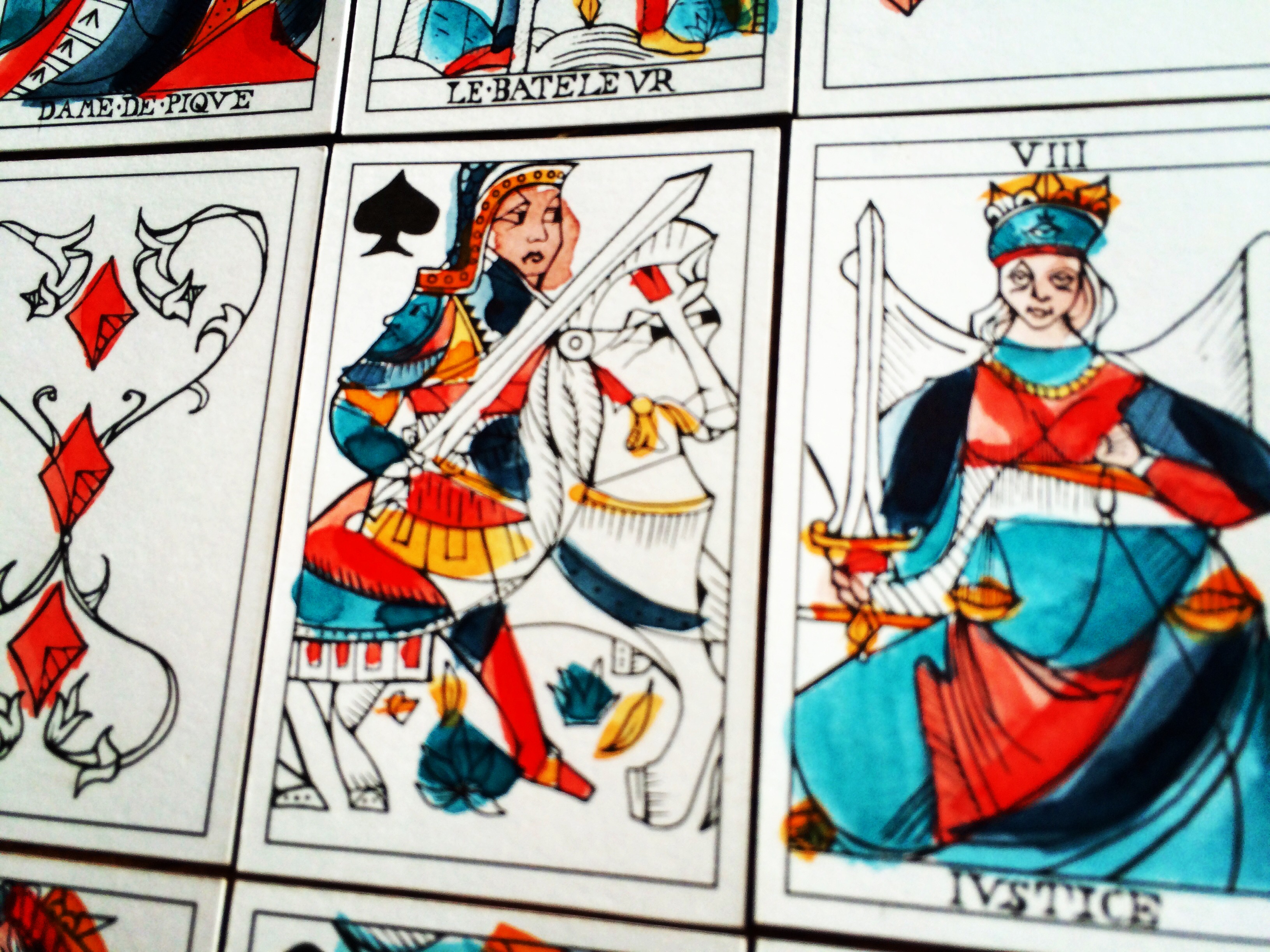
Let’s do a quick reading of Ryan Edward’s Marseille Playing cards.

Marseille Playing Cards by Ryan Edward, 2017 (Photo: Camelia Elias)
A fun draw.
The Queen of Spades is in immediate conversation with the Magician. Their encounter is backed by the 10 Hearts. These two are definitely in agreement. They entertain no illusions whatsoever, though the Magician makes a living selling it.

Marseille Playing Cards by Ryan Edward, 2017 (Photo: Camelia Elias)
There’s money to be made, and there’s drive in it, but not so much towards it. The Knight of Spades charges towards truth and fairness, towards Justice, which is something that a Zen-inclined person such as myself can only approve of.
Here I like the suggestion that if you know the exact value of what you’re offering, and you’re fair about it, then the only natural thing that you can expect to happen is flow. Your business simply flows if you abide in truth, and stand your ground unsentimentally. Your cash flows.
Marseille Playing Cards by Ryan Edward, 2017 (Photo: Camelia Elias)
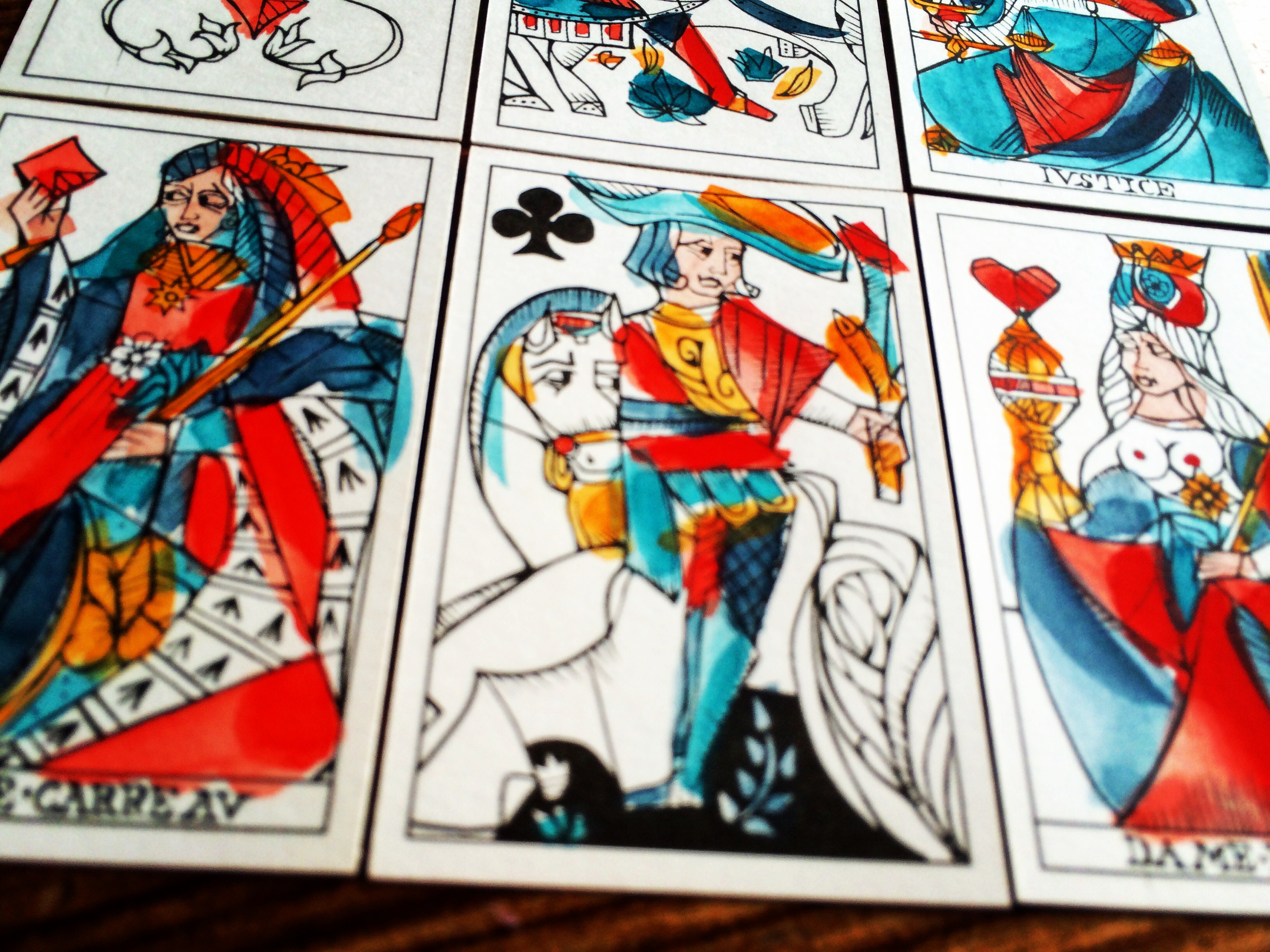
The Queen of Diamonds has the necessary experience. We see this from her position, turned not towards the one making an offering, but rather turned towards the void.
If you have experience, you don’t need to worry about what happens when work power is exchanged for pleasure. You will work because you love it. The last conversation here is between the Knight of Batons and the Queen of Hearts.
Marseille Playing Cards by Ryan Edward, 2017 (Photo: Camelia Elias)
I can’t help but laugh a little at the middle column: The Magician knows how to move mountains, how to make the horsemen act in accordance with his will, or magical power.
Running a business is knowing the power of magic, knowing the power of fairness, the power of the hard rocks, diamonds and coins forged in fire, and the power of love.
If you don’t love what you do, you can’t lose yourself to your true nature.
That’s the best marketing strategy: To do what you love and to abide in justice.
Abiding in truth is not about emotional narratives, melodrama and vulnerable stories that sell, ‘big me’ or ‘small me’. It is about flow, the flow of nothingness from where moving mountains is not even a big deal but something that you do, any time, as a matter of course, effortlessly and completely fearlessly.
As for nuance, you can ask yourself this: ‘A spade for a heart; a heart for a diamond… What is the difference?’
♠
Stay in the loop for cartomantic activities.
For similar ideas, listen to the recent podcast for Rune Soup , read the interview with me for Little Fox Tarot, or visit my YouTube channel.
Previous Post

July 25, 2017
The Cartomancer: Eating the Ancestors
Next Post
August 25, 2017 The Cartomancer: Intention and Implementation
Browse Our Archives
Select a Category Columns The Cartomancer Uncategorized
Select a Month January 2024 October 2023 August 2023 July 2023 June 2023 November 2022 October 2022 August 2022 May 2022 April 2022 February 2022 January 2022 November 2021 October 2021 September 2021 August 2021 June 2021 April 2021 March 2021 February 2021 January 2021 December 2020 November 2020 October 2020 September 2020 August 2020 July 2020 June 2020 May 2020 April 2020 March 2020 February 2020 January 2020 December 2019 November 2019 October 2019 September 2019 August 2019 July 2019 June 2019 May 2019 April 2019 March 2019 February 2019 January 2019 December 2018 November 2018 October 2018 September 2018 August 2018 July 2018 June 2018 May 2018 April 2018 March 2018 February 2018 January 2018 December 2017 November 2017 October 2017 September 2017 August 2017 July 2017 June 2017 May 2017 April 2017 March 2017 February 2017 January 2017 December 2016 November 2016 October 2016 September 2016 August 2016 July 2016 June 2016 May 2016 April 2016 March 2016 February 2016 January 2016 December 2015 November 2015 October 2015 September 2015 August 2015 July 2015
Follow Us!
TAKE THE
Religious Wisdom Quiz
Who was the first king of Israel?
Select your answer to see how you score.
Solomon David Josiah Saul
Related posts from THE CARTOMANCER
TRENDING AT PATHEOS Pagan

I was recently chatting with someone on Instagram. She asked me what...

While there are many people who share their results, the end of...

On July 23, I saw Christopher Nolan's The Odyssey which is Homer’s...

As I write this two big events have just finished up. One...

Restoring the Watershed of Divine Love
Perhaps cooperation is not something we manufacture through legislation, ideology, or moral...

Many UUs don’t pray because of bad experiences in a previous religion,...
view all Pagan blogs
Ad-Free & Subscriber Log-In Subscription Support
- About Us
- 2026 Calendar
- Videos
- Podcasts
- Library of World Religions
- Faith In Media Tracker
- Advertise With Us
- Write for Us
- Privacy Policy
- Terms of Service
- Do Not Sell My Data
- Contact Us
- Radiant Digital
- Manage Newsletter Subscriptions
- Unsubscribe From Notifications
- Sitemap
Copyright 2008-2026, Patheos. All rights reserved.
Subscription Support Ad-Free & Subscriber Log-In
Follow Patheos