
BuddhistCatholicContemplativeEvangelicalGeneral ChristianHinduJewishLatter-day SaintMuslimNew VisionsProgressive Christian
Beliefs
- Buddhist
- Catholic
- Contemplative
- Evangelical
- General Christian
- Hindu
- Jewish
- Latter-day Saint
- More Voices
- Muslim
- New Visions
- Pagan
- Progressive Christian
Topics
- Religion News
- Food and Religion
- Sports and Religion
- Religious Art
- Religious Music and Entertainment
- Religious Events
- History and Religion
- Style and Religion
- Politics and Religion
- Women in Religion
- Recreation Outdoors and Religion
- Business Finance and Religion
- Careers Workplace and Religion
- Education and Religion
- Family Parenting and Religion
- Health Fitness and Religion
- Home and Religion
- Relationships and Religion
- Technology and Religion
- Travel and Religion
Columnists
- Buddhist Columnists
- Business Finance and Religion Columnists
- Careers Workplace and Religion Columnists
- Catholic Columnists
- Contemplative Columnists
- Education and Religion Columnists
- Evangelists Columnists
- Family Parenting and Religion Columnists
- General Christian Columnists
- Health Fitness and Religion Columnists
- Hindu Columnists
- History and Religion Columnists
- Home and Religion Columnists
- Jewish Columnists
- More Voices Columnists
- Latter Day Columnists
- Muslim Columnists
- New Visions Columnists
- Nonreligious Columnists
- Pagan Columnists
- Politics and Religion Columnists
- Progressive Columnists
- Recreation Outdoors and Religion Columnists
- Relationships and Religion Columnists
- Religion News Columnists
- Religious Art Columnists
- Religious Events Columnists
- Religious Music and Entertainment Columnists
- Sports and Religion Columnists
- Style and Religion Columnists
- Technology and Religion Columnists
- Travel and Religion Columnists
- Women in Religion Columnists
Resource Library
- 2026 Calendar
- Library of World Religions
- The 100 Most Holy Places on Earth
- Patheos Answers
- Podcasts
- Videos
- Faith Leaders Database
- Anglican Episcopalian
- Bahai
- Baptist
- Buddhism
- Christianity
- Confucianism
- Eastern Orthodoxy
- Hinduism
- Holiness and Pentecostal
- ISKCON
- Islam
- Judaism
- Lutheran
- Methodist
- The Church of Jesus Christ of Latter-day Saints
- New Age
- Paganism
- Presbytarian and Reformed
- Protestantism
- Religion Behind the Scenes
- Roman Catholic
- Scientology
- Shia Islam
- Sikhism
- Sufism
- Sunni Islam
- Taoism
- Zen
- See all religions
Research Tools
 Ad-Free & Subscriber Log-In Subscription Support
Ad-Free & Subscriber Log-In Subscription Support
Follow Patheos 

- Trending:
- Forgiveness
- |
- Marriage
- |
- Consciousness
- |
- Death Penalty
- |
- Election
- |
- Halloween
 THE CARTOMANCER
- Home
- Pagan
- The Cartomancer: The Samurai’s Cut
The Cartomancer: The Samurai’s Cut
Last updated on: November 18, 2017 at 12:28 pm by Camelia Elias
The Cartomancer: The Samurai’s Cut 2017-11-18T12:28:37+02:00 Camelia Elias
Patheos Explore the world's faith through different perspectives on religion and spirituality! Patheos has the views of the prevalent religions and spiritualities of the world.
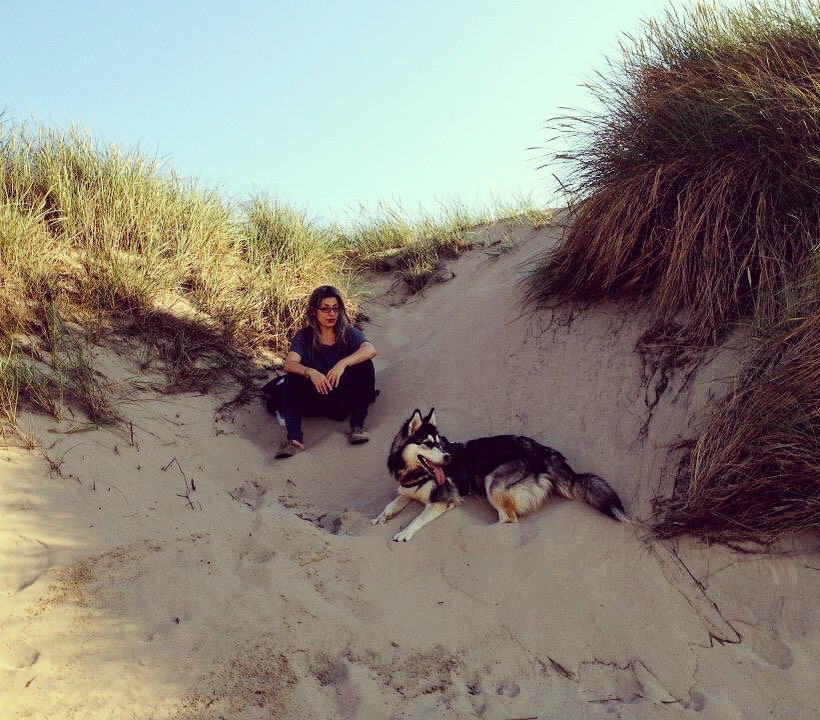
Photo: Camelia Elias
Yesterday I had a 3-hour business meeting in the middle of the magical sand dunes of Hanstholm, not far from where I live, in the Danish national park Thy.
I felt a specific exhilaration about having the freedom to talk about small money and big money, ranging from 2-figure to 7-figure plans.
But what excited me the most was the fact that the whole time I went about explaining and demonstrating what I work with and why, I needed to press no buttons whatsoever.
It was as if I walked into things and things walked into me because things were exactly as they were, in that moment, focused and moving with the precision of a samurai’s cut between zooming in and zooming out.
Zooming in and zooming out is an interesting activity in and of itself, but I have to say that I get a particular kick out of noticing what happens in the space between zooming in and zooming out, for you see, that’s when the samurai knows what happens next before whatever it is to happen happens.
In much of my cartomantic teachings I refer to martial arts and the sword of a master samurai. I like to think of my work with the cards as making perfect cuts.
I’m interested in ‘killing it,’ no matter what IT is.
But what I don’t often stress is that a samurai is only a master if he can die a natural death.
Why does this fascinate me?
For the simple reason because I find that to stay a master, you must be willing to learn new moves all the time. In this learning you take risks, you dumb yourself down, and pay acute attention.
So the condition for maintaining mastery when your tool is a sharp blade is not to relax – now you killed your competition – but to stay vigilant and learn. If you can die a natural death with your sword by your bed, then you’re a master. I aim for that.
Meanwhile, when we talk about small money and big money, what we’re talking about is a way of developing method strategies that can fit personal business and juridical business.
In legal parlance we distinguish between natural persons (such as a human being) and juridical persons (such as a firm).
I like to work with both because I like the dynamics of shifting between concerns: When working with people there are ‘feelings’ involved, and I like to check with my own mind about just what I make of feelings (mine and the other’s alike).
How do I bend my sword over the thought ‘feeling’, and make the other and myself understand that ‘feeling’ is just a word, a consequence, a bi-product of the mind and its linguistic competence?
When working with firms there’s just steel. Firms have different ‘feelings’. Sometimes I like a firm, whose spine is made of steel, to cross its blade with my cartomatic sword. The sound makes me nostalgic for 2 reasons: Once I seriously entertained the idea of a career as a judge, and then I often have dreams in which I am a skilled knife thrower. I say ‘skilled’ because I never die in the dream, while a lot of others do.
What I do for firms is design models with cards, and sometimes send the staff to hell for a baptism of detachment. On my terms, as I’m the boss.
In this context I also honor a different code of confidence and discretion. For instance, the models I design for firms don’t get shared on Patheos or in the social media. I take big money to keep this secret.
Your genius unsurpassed
But what I find that I can share is this:
You can go far with your genius if you know two things:
1) How to survey the scope of what you’re doing, how you’re doing it, and why (or for how much, if you’re a business).
2) How to focus. For each of the three – what, how, and why – you can have a hundred brilliant ideas. But which of the one hundred brilliant ideas gets your 5-year plan realized in 5 months?
That’s your million-dollar question right there.
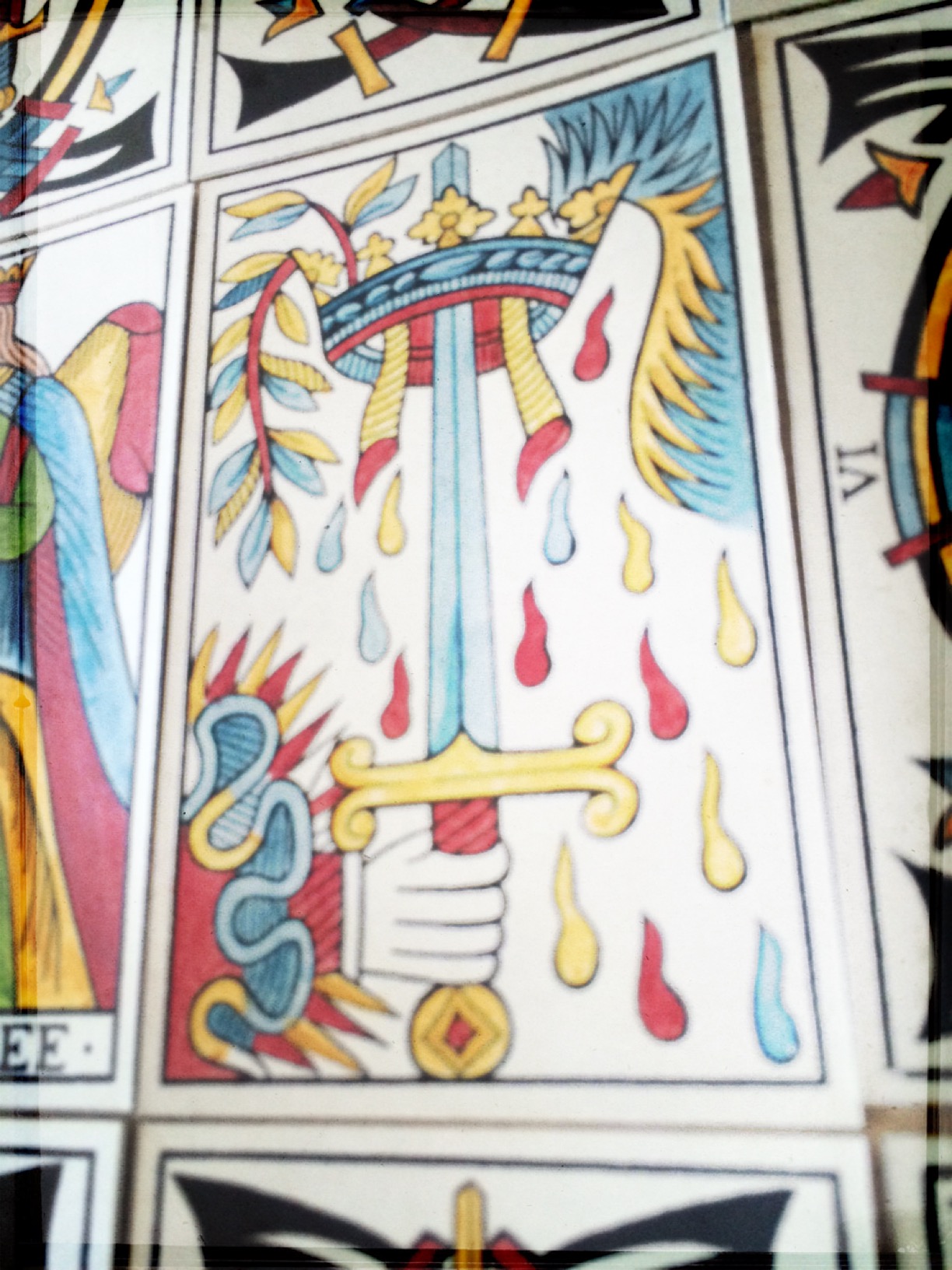
Photo: Camelia Elias
The essential cut
In lieu of an answer, here is a magical model that can help you make some sharp cuts into your projects, so that their outline gets to be so clear and precise that even you could mistake it for your samurai’s blade in daylight.
In any work that requires a process of scaling (up or down), what you work with is essentializing.
The beautiful thing about essentializing is that it never requires anything but attention to intensity.
- How intense are you? How soft?
- When do you charge? When do you retreat?
- When do you go into offence? When do you go into defense?
- When do you expand? When do you contract?
- When do you inhale? When do you exhale?
Imagine you have a project (whether business or marriage) and you get the momentum wrong. You go to war when you’d be better off retreating. You take a break and hide, when you’d better off filling your lungs with breath and shout at the top of them so the whole land can hear you, or you relax when you’d be better of alert.
Momentum is key, because focus requires the recognition of when the time is right for something.
So let’s see if this model below can inspire you to get more conscious of your moves.
The idea is to align your choice to charge ahead, which is anchored into a moment that you have control over, with the consequence of having charged ahead, which is anchored in a moment that you don’t have control over.
Choices are yours. Consequences are not. Choices are subject to internal conditions. Consequences are subject to external conditions. The art is to know the difference and make your cuts in accordance.
As this model is original, yet based on a classical spread, I call it The Samurai’s Cut. If you refer to it outside of the context of this essay, please give courteous credit to my work with cartomantic models.
The Samurai’s Cut
Take out the suit of swords, pip cards and court cards alike (you can also use a plain playing cards deck if you prefer).
Place the Ace of Swords or Spades in the middle. Make your significator the King of Swords (even if you’re a woman).
Shuffle the remaining cards. Place them on top and around the Ace of Swords in the following order.
9
10 5 12
7 3 1 2 6
13 4 11
8
Let your first card cover the Ace. The Ace, the initial power to cut, is your invisible cloak. If you use a playing card deck, there isn’t a 14th card, an an extra card to cover your Ace at random. This is not a problem. You let the Ace shine in its essential power and read the rest of the cards around it as you normally would in a divination setting.
The center card (1) is your card of focus for your ‘what, how, and why.’
The inner cross (2, 3, 4, 5) relates to the intensity of what you give (2) and what you receive (3) and to the intensity of how you go from the many ideas you literally walk on (5) to the one essential idea in your head (4).
The outer cross (6, 7, 8, 9) relates to the same as above, but here with an added consciousness of cardinality. Think cardinal points: East, West, South, North.
Can you see beyond your immediate circle, out into the world? What agency do you have there? Is your project strong enough beyond your own agency?
This involves taking the intensity of your one, essential idea to the power of 10. This is another way of saying that you think essentially, but way beyond your power to act.
This is also another way of saying that you take the intensity of your one essential idea to a magical realm, where it receives special oomph, or mojo, from the very fixity of the point (a point that is either contracted or expanded, active or passive). The pip cards are in passive or active mode, while the court cards represent the hands of another, helping or opposing.
The diagonal lines going from cards 10 to 11 across the center card and 12 to 13 also across the center card, is your X marking the spot.
What intensity crosses your focus? One of inhaling, or one of exhaling? One of charging ahead, or one of retreating?
Getting to know this is important if you want to hit the target of your ‘what, how, and why.’
Let’s look at an example:
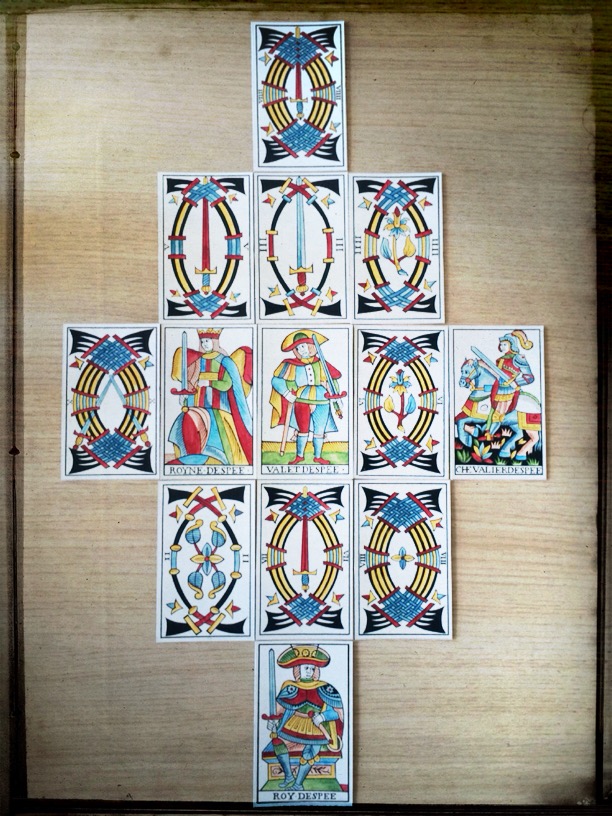
Marseille Tarot by Jean Noblet, 1650, reconstructed by Jean Claude Flornoy and hand-painted by Edmund Zebrowsky (my photo).
A quick glance at the image here may seem daunting, but you have to keep in mind the scope of this, which is to get a sense of the intensity required for you to cut things to the bone.
So what we’re looking for is this: Big time breathing time? Or big time pausing time? A brief inhaling or exhaling moment, or a quick draw?
One is little, ten is a lot. If you’re looking at a lot of swords in your strategic positions, then chances are that things are heavily intense.
The next thing you want to assess is this:
Is this heavy intensity active or passive? Do we have just clenched swords ready to burst, and hence can detect some breathing suggested by the white space with flowers in the middle, or do we have an interlocking of swords and an active one stabbing in the middle? (the difference between the even cards, the ‘breathing’ ones, and the odd ones, the ‘eager’ ones).
Focus
Let’s see what we got here, more concretely as it relates to where the focus is and how this focus relates to the ‘what, how, and why.’
The center card also indicates what needs work on in terms of focus.
Here, over the Ace of Swords, we find the Page of Swords, an inactive card. Among the court cards, the Page of Swords is the one that lacks focus the most. A young man is often distracted and hardly ever on point.
This is also a card that spells out suspicion. You neither go to war, nor stay at home. In either case, if someone were to ask the Page of Swords what his agenda was, he’d be very much in doubt.
The only thing he’d know is that it’s related to learning something vague about fencing.
Now, if the project at hand is one that needs a lift off, because it operates with a brilliant idea, finding the Page of Swords here, rendering everything cloudy and grey, already gives us something to think about:
There’s trouble precisely with the momentum. The Page of Swords doesn’t have it.
How to get it, then?
We want to ask this question, simply because this model is intended as a magical model aimed at enhancing your awareness of how your many ideas about ‘what, how, and why’ can be reduced to one essential idea.
The underlying structure of this magical model is to cut. Cut through, and cut to the bones. Cut through emotion, intellect, and eagerness. What we want is a cold blade, not a shoulder to cry on.
If we wanted sympathy, we might just as well use the whole deck, and look at the variables outlined in the model above in that way, from the perspective of the whole force of the Tarot deck. Mind you, you can try that too already, as it’s fun and enlightening. But my aim here is to simply say something about the dynamics involved in reducing scope.
So, the Page of Swords. On the inner cross level, he gives nothing (6 swords in passive mode) without checking first with mother (Queen of Swords).
This can be both good and bad, depending on what the aim is. What we do know, by just looking at the horizontal axis, is that giving and receiving is mediated by a higher force. The Queen is higher in rank, creating here a relation of dependency. So the project’s focus as represented by the Page of Swords – who is not very focused – needs a helping pair of eyes, or, indeed, an extra sword.
How does the Page of Swords move from many ideas to the one? It looks like he’s doing a good job at reducing. We go from 7 swords to 3, all in active mode, with one sword piercing each its group. So the gloomy project can get sharper and simpler.
We can infer that the moment of inhaling, checking with the higher power is beneficial. We take this message as part of what is essential in this project. Better safe than sorry.
In terms of scaling, we find the querent’s significator, the King of Swords in the South, mirroring 9 Swords in the North. The pole star itself is guiding this.
Those who are familiar with classical cartomancy would immediately identify these positions with the major kill. Traditionally, the card of 9 Swords has been associated with Death. The King mirroring the most intense card in the suit of swords is indicative of a lot of expansive deadly power. You don’t just go for it, but you kill it too. This is excellent.
What we also can say here is this: While the project is in hesitant mode, the power to execute it beyond mere pro-action or even doubt is great. This is good news for the project, as it means that whatever it consists of, even clouds, and insofar as here it can be reduced to simpler and therefore more powerful forms, it has the potential to exceed its specific locality and its weather forecast.
The horizontal axis of the outer cross is also powerful, as we find here more active and intense cards. The Knight of Swords charges ahead from the East, impacting on the Page, and all the way to the Queen via the 6 as a vehicle, a Queen who is busy orchestrating the world in the West. Ten swords in her face is a lot of swords, but it looks like she can handle unclenching them with her one powerful act.
Thus, to have the cardinal points covered by a lot of active power is good news, as this tells us that the project can go somewhere, especially if it stays focused on what it can receive locally: a shot (6 swords) of truth (the Queen being an emblem thereof).
In other words, the magic here is to be aware of the power to stay informed without exhibiting eagerness, until the many ideas become no more than 3, with one sword covering, indeed, each of the areas of focus: what, how, and why.
If we look at how the X marks the spot, the diagonal lines, we observe the following:
We go from 5 to 8, with the 5 swords in active mode, and from 4 to 2 swords, another reduction, in the final card in the model.
Translating this relation into the samurai’s move, we can say that what crosses the project, in the sense of sealing it, is playing an active part (5S) that’s then thrust upon a receiving community (8S).
Well, the good news is that the King can do that. As it happens here, he even touches the very cards, from a warm, domestic spot often associated with the South.
Consequently, as there are no surprises, things stabilize in the 4, with the final distribution of power going to 2.
We could continue by looking also at the trios of cards surrounding the inner cross, as they also show impacting influences. For instance, the trio, 5 swords, 10 swords, 2 swords impacting the Queen, indicates what the Queen is up against, namely, an increasing active force that she however cuts through, thus lessening the tension surrounding the project’s expansive potentiality.
Killing it softly
In conclusion, we can say that the magic of this project consists in the power to kill IT, after dealing with hesitation, and then to stay sovereign.
Since the Ace is always hidden at the center, the 2 Swords is the lowest visible in the spread, and therefore singular. The King touches it, as noted already, receives its gift of singularity, and then passes it on to the group of 8, the other card that he touches.
What you want to observe in the end is precisely what cards the significator touches. Card 13 ends the model, so to speak, but the King of Swords must be seen in relation to how this ending goes.
At the level of personhood, insofar as the first card down, signifying the focus of the project, is a court card, we can say that the project and the significator are linked by having the same nature, they are in the same family, both being courts.
The project starts small, as a child would, but is in the hands of someone who has direct power to act, as testified here also by the presence of the killer card itself in mirror relation to the King, the 9 Swords.
If the King mirrored the 2 swords in the position of marking the possibility to get this project boosted to ’10 times more its power,’ then the conclusion would have been different, as the intensity to carry out the one essential idea would not have been enough to sustain momentum.
Thus it goes to show. Just looking at one suit of cards placed in a strategic model that answers specific concerns is enough to give us an impression precisely of the extent to which the idea for a project matches momentum and the determined focus for it.
Now, the above is a magic model because you can take the conclusion of your analysis and turn it into a mantra for what you want to achieve. For example this:
Hesitance kills it. By killing hesitance you kill IT. Honor your protectors.
Slightly unpacked, this is to say that if you hesitate too much, you’re in danger of losing momentum, thus killing the very potentiality of the simplified idea to get beyond even your own power to act. By killing hesitance, you make the other kill, which is the power kill that the King of Swords is capable of when he teams up with the killer card.
Conversely, it’s good to have higher power surround you, protecting you, if you absolutely must take some time to reflect on what you’re doing. In this case here, having the Queen and the Knight in your line of what is given and what is received is not the worst.
We live by scaling our focus up and down, wide and narrow.
The art is to find the soft spot and cut through it like through a moonbeam. The soft spot will stay, as does a moonbeam, no matter how sharp the sword, but it will carry the trace of your swiftness and precision, and that’s exactly what you want to bring in alignment and achieve: vision, vigilance, and vigor.
♠
Note: You can use this layout for the other three suits in the deck. Just create the appropriate question and context.
Stay in the loop for new cartomantic activities.
Previous Post

April 12, 2017
The Cartomancer: Priestess, Oh Priestess...
Next Post
May 9, 2017 The Cartomancer: So what? On the tyranny of inheritance
Browse Our Archives
Select a Category Columns The Cartomancer Uncategorized
Select a Month January 2024 October 2023 August 2023 July 2023 June 2023 November 2022 October 2022 August 2022 May 2022 April 2022 February 2022 January 2022 November 2021 October 2021 September 2021 August 2021 June 2021 April 2021 March 2021 February 2021 January 2021 December 2020 November 2020 October 2020 September 2020 August 2020 July 2020 June 2020 May 2020 April 2020 March 2020 February 2020 January 2020 December 2019 November 2019 October 2019 September 2019 August 2019 July 2019 June 2019 May 2019 April 2019 March 2019 February 2019 January 2019 December 2018 November 2018 October 2018 September 2018 August 2018 July 2018 June 2018 May 2018 April 2018 March 2018 February 2018 January 2018 December 2017 November 2017 October 2017 September 2017 August 2017 July 2017 June 2017 May 2017 April 2017 March 2017 February 2017 January 2017 December 2016 November 2016 October 2016 September 2016 August 2016 July 2016 June 2016 May 2016 April 2016 March 2016 February 2016 January 2016 December 2015 November 2015 October 2015 September 2015 August 2015 July 2015
Follow Us!
TAKE THE
Religious Wisdom Quiz
What does "Abraham" mean?
Select your answer to see how you score.
Chosen One King of Peace Father of Many Man of Wisdom
Related posts from THE CARTOMANCER
TRENDING AT PATHEOS Pagan

I was recently chatting with someone on Instagram. She asked me what...

While there are many people who share their results, the end of...

On July 23, I saw Christopher Nolan's The Odyssey which is Homer’s...

As I write this two big events have just finished up. One...

Restoring the Watershed of Divine Love
Perhaps cooperation is not something we manufacture through legislation, ideology, or moral...

Many UUs don’t pray because of bad experiences in a previous religion,...
view all Pagan blogs
Ad-Free & Subscriber Log-In Subscription Support
- About Us
- 2026 Calendar
- Videos
- Podcasts
- Library of World Religions
- Faith In Media Tracker
- Advertise With Us
- Write for Us
- Privacy Policy
- Terms of Service
- Do Not Sell My Data
- Contact Us
- Radiant Digital
- Manage Newsletter Subscriptions
- Unsubscribe From Notifications
- Sitemap
Copyright 2008-2026, Patheos. All rights reserved.
Subscription Support Ad-Free & Subscriber Log-In
Follow Patheos