
BuddhistCatholicContemplativeEvangelicalGeneral ChristianHinduJewishLatter-day SaintMuslimNew VisionsProgressive Christian
Beliefs
- Buddhist
- Catholic
- Contemplative
- Evangelical
- General Christian
- Hindu
- Jewish
- Latter-day Saint
- More Voices
- Muslim
- New Visions
- Pagan
- Progressive Christian
Topics
- Religion News
- Food and Religion
- Sports and Religion
- Religious Art
- Religious Music and Entertainment
- Religious Events
- History and Religion
- Style and Religion
- Politics and Religion
- Women in Religion
- Recreation Outdoors and Religion
- Business Finance and Religion
- Careers Workplace and Religion
- Education and Religion
- Family Parenting and Religion
- Health Fitness and Religion
- Home and Religion
- Relationships and Religion
- Technology and Religion
- Travel and Religion
Columnists
- Buddhist Columnists
- Business Finance and Religion Columnists
- Careers Workplace and Religion Columnists
- Catholic Columnists
- Contemplative Columnists
- Education and Religion Columnists
- Evangelists Columnists
- Family Parenting and Religion Columnists
- General Christian Columnists
- Health Fitness and Religion Columnists
- Hindu Columnists
- History and Religion Columnists
- Home and Religion Columnists
- Jewish Columnists
- More Voices Columnists
- Latter Day Columnists
- Muslim Columnists
- New Visions Columnists
- Nonreligious Columnists
- Pagan Columnists
- Politics and Religion Columnists
- Progressive Columnists
- Recreation Outdoors and Religion Columnists
- Relationships and Religion Columnists
- Religion News Columnists
- Religious Art Columnists
- Religious Events Columnists
- Religious Music and Entertainment Columnists
- Sports and Religion Columnists
- Style and Religion Columnists
- Technology and Religion Columnists
- Travel and Religion Columnists
- Women in Religion Columnists
Resource Library
- 2026 Calendar
- Library of World Religions
- The 100 Most Holy Places on Earth
- Patheos Answers
- Podcasts
- Videos
- Faith Leaders Database
- Anglican Episcopalian
- Bahai
- Baptist
- Buddhism
- Christianity
- Confucianism
- Eastern Orthodoxy
- Hinduism
- Holiness and Pentecostal
- ISKCON
- Islam
- Judaism
- Lutheran
- Methodist
- The Church of Jesus Christ of Latter-day Saints
- New Age
- Paganism
- Presbytarian and Reformed
- Protestantism
- Religion Behind the Scenes
- Roman Catholic
- Scientology
- Shia Islam
- Sikhism
- Sufism
- Sunni Islam
- Taoism
- Zen
- See all religions
Research Tools
 Ad-Free & Subscriber Log-In Subscription Support
Ad-Free & Subscriber Log-In Subscription Support
Follow Patheos 

- Trending:
- Forgiveness
- |
- Marriage
- |
- Consciousness
- |
- Death Penalty
- |
- Election
- |
- Halloween
 THE CARTOMANCER
- Home
- Pagan
- The Cartomancer: Spirit Personalities
The Cartomancer: Spirit Personalities
Last updated on: January 11, 2017 at 1:09 pm by Camelia Elias
The Cartomancer: Spirit Personalities 2017-01-11T13:09:14+02:00 Camelia Elias
Patheos Explore the world's faith through different perspectives on religion and spirituality! Patheos has the views of the prevalent religions and spiritualities of the world.
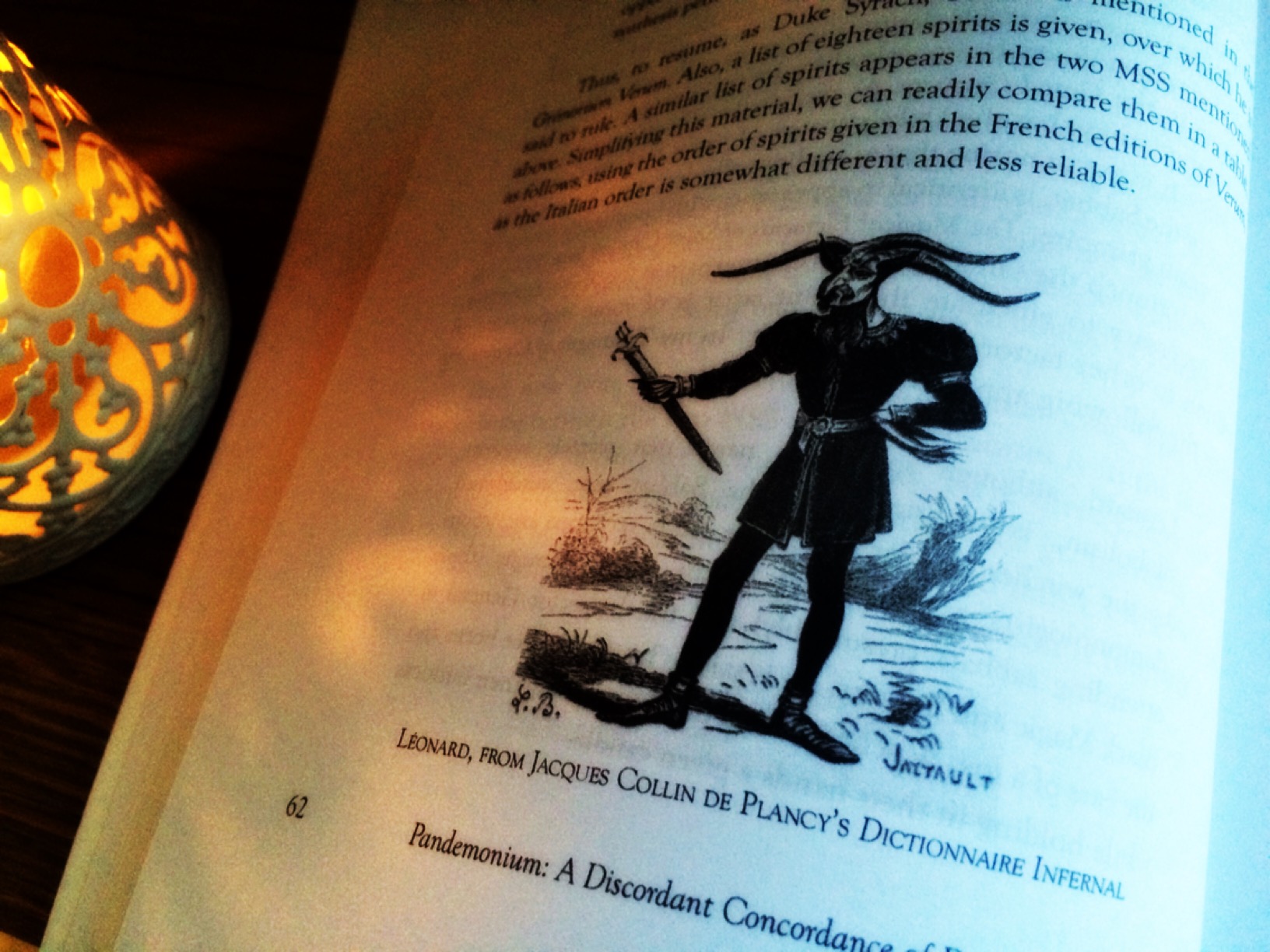
Pandemonium by Jake Stratton-Kent (Photo: Camelia Elias)
One could argue that the whole mystery tradition in the West is characterized by typologies and catalogues.
The general rule is that when you catalogue, you categorize and when you categorize, you make distinctions.
Making distinctions is in fact precisely that which separates the various mystical and magical traditions. You go East, distinctions tend to blur and nondualism is in focus. You go West, you go structuralist, focusing on binary opposites and exclusion.
Categorization creates exclusion by definition. So when you create a catalogue you relegate the idea of exclusion to a higher level. This can be either good or bad, depending on your cultural orientation. I myself don’t get too excited, as my leanings are precisely nondualist.
But I do get excited when I see what people do when they catalogue and classify. In fact, in academic circles where I’ve been roaming for most of my life, cataloguing equals human imagination.
The whole Western discourse on magic can be said to be about human imagination and its intricate ways of mediating embodiment. That’s right, you heard that correctly: embodiment.
Although what we call Western mysteries is mostly all about spirits, high and low, what we make of these spirits is very much the work of imagining embodiment and form. If you think that you’re good at scrying, conjuring, or reading smoke, what you do is conceptualize form. This is indeed a very useful method, and can be very efficient in your magical working. Especially if you don’t dig nondualism.
Cataloguing various forms of spirits, all according to their embodiments and functions, is a way of conceptualizing what you think in words. Imagine invoking or conjuring Baal and not having a clue as to what Baal looks like or what he can do for you. It’s rather time consuming to sit there and stare into emptiness, scratching your brain. You will get not only tired of it, but also disappointed.
As a general rule, in any act of conjuring or working with the spirits of the grimoires, if you expect to see a particular kind of demon, you see precisely a particular kind of demon. If you expect to have an encounter with a particular kind of angel or a spirit king, you will have precisely an encounter with a particular kind of angel or a spirit king.
In fact, we could argue that your imagination rules over your distinctions, but the inverse is also the case, your distinctions rule over your imagination. That’s what we call a system of classification.
Classified spirits is called a grimoir. According to what rule exactly we classify spirits and gather them in various grimoirs is very much a matter of cultural distinction, but we could argue that while spirits are not of your mind, they are very much part of your awareness of them, with awareness overruling your own internal and external psychology that is mainly the product of your own cultural history.
In other words, while your mind creates worlds, spirit worlds and other, awareness is busy with mirrors and modalities of holding mirrors up in your face, if we care to assign agency to awareness – a rather dumb thing to do, but for the sake of illustrating, we’ll go with it.
Say, you decide to hang out with Lucifer at the crossroads. How do you do that? You can do that in several ways: some easy, some hard.
Here is the easy way: You can pick up a grimoir and start reading descriptions. What is Lucifer? How does he manifest? What is his history? What is his personality? What is his rank? What can he do for you?
I hear he’s very beautiful, and a prince of princes. But how do we know that? The truth is that we don’t know anything. If you think you know, then think of where this knowledge is derived from: Either you’ve just read that about Lucifer in a book, or, you’ve ‘seen’ it with our own eyes. Fair enough. Each event is valid as it is based on experience: The experience of reading, and the experience of emotion. When Lucifer hits you in the gut, you can swear he hit you in the gut. So you can’t be in doubt.
If you’re a little bit in doubt, you can grab some item in your magical arsenal and divine for your experience. My specialty, for instance, is cards, or smoke from burning wormwood. Take out your cards and pay attention. The story of your experience can suddenly become very specific: It’s not just a world you encounter, but the infernal world of Hell itself. Cards for me can make that world very vivid and specific. According to the good books, Lucifer presides in Hell and spirits obey him in recognition of his lordship over hell. How do they all go about it? Read some bones and some stones, while you sit there sweating through your fears.
Here is the hard way: You go to the crossroads and consciously use language to utter the words of conjuration as a means of conceptualization of form. You can list all the names too. Preferably in Latin.
If you’re good at practicing awareness, you can allow for each name to move from conjuration to co-creation. If you are an adept at awareness, you will look into an empty mirror, for what is there that you conjure? Names? Language? Alphabets made up of symbolic glyphs? You start laughing at yourself.
This is the point where it gets interesting, for you realize instantly that as you gaze into the empty mirror, you actually gaze into the very working of Lucifer. Above all, and in my own experience, Lucifer loves language. He gives life to your glyphs. That’s his domain.
Pandemonium
I won’t make a fuss about this here, as what I actually want to talk about is Jake Stratton-Kent’s new book with Haden Press: Pandemonium: A Discordant Concordance of Diverse Spirit Catalogues, and its usefulness in navigating through what you aim to experience in the spirit world.
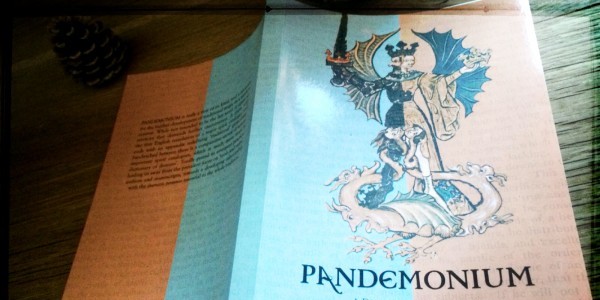
Photo: Camelia Elias
Those familiar with Stratton-Kent’s work know already what to expect: Solid and robust scholarship. Pandemonium lives up to this reputation: It’s solid and robust. It is an excellent reference-work in the grimoir tradition with focus precisely on the personalities of spirits, rather than their strictly contextual histories.
As a storyteller myself I like this very much, just as I also appreciate greatly the research that went to into gathering spirit stories. Stratton-Kent is a meticulous historian with a penchant for the painful work of classification. In this aspect, his Pandemonium is nothing short of marvelous.
As to the stories that this book tells, by way of charting spirit hierarchies, from Lucifer to the Four Kings and a host of Goetic spirits, one can say that they are all stories of encounters. Told in a clever and witty way.
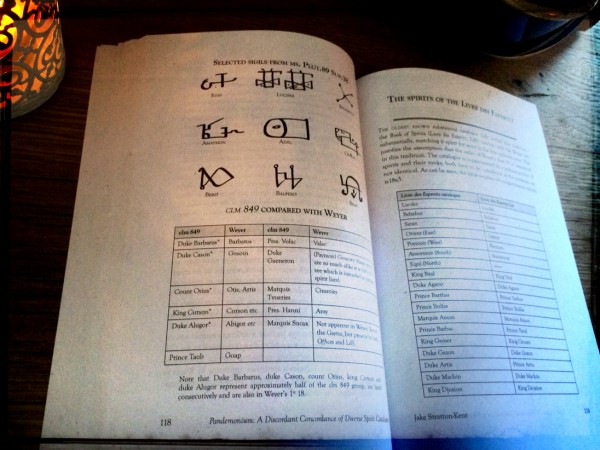
Photo: Camelia Elias
Any conjuration act is a story of an encounter. Pandemonium delivers concrete opportunities for such experiences, and it does a great job at creating exactly what it promises: A discordant concordance.
The work suggests that when we deal with the grimoirs, we deal invariably with what Stratton-Kent calls ‘infernal multiplication’ (52). Here, in reference of how names undergo transliterations that can change the story of a particular spirit.
The work is packed with charts, side-by-side hierarchies, spirit functions and embodiments, and visual representations. I commend the great job that went into the layout of this book, as it’s not easy to fit everything elegantly onto a page.
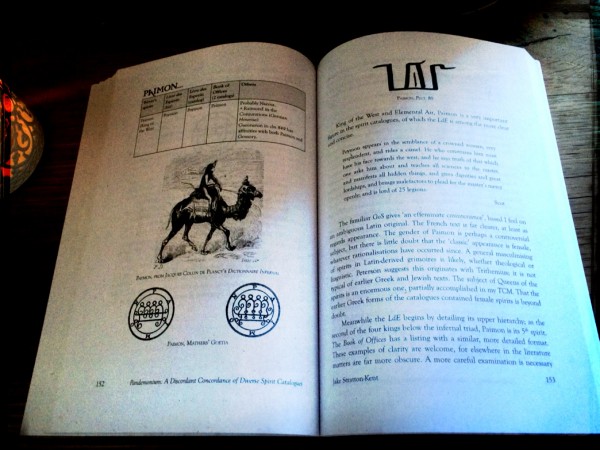
Photo: Camelia Elias
Some dictionaries choose to define the word Pandemonium by first referring to Milton’s Paradise Lost, a work of poetry and the imagination in which the infernal in envisioned very graphically and elaborately.
Although no reference is made here to Milton, as his is a work that falls into the category of literary grimoir, the poetic aspect that goes into the descriptions of the spirits in Stratton-Kent’s Pandemonium, as precisely dramatis personae, is not lost on this reader. For this alone, I recommend this book.
But I also recommend it for this other reason: Jake Stratton-Kent’s Pandemonium is a rare treasure. It actually makes you think that what makes the world go round is fear. Fear of the infernal and demonic forces.
Indeed, unless, you’re completely Zen – if such a state is possible – and unimpressed by the movement of the holy and unholy ghosts in you, you’re bound to be fascinated by the way grimoirists throughout the ages suggest you transact for your experiences of the occult, exchanging your fear for something else.
Don’t hesitate to get this book if you like stories of the human imagination, solid research and scholarship, and the promise of fantastic encounters if you dare to do the work of uttering the name.
♠
Stay in the loop for cartomantic activities.
Click here to like
Patheos Pagan on Facebook.
Click here to like
the Agora on Facebook
The Cartomancer is published twice monthly on the Wednesdays here on the Agora. Subscribe via RSS or e-mail!
Please use the links to the right to keep on top of activities here on the Agora as well as across the entire Patheos Pagan channel.
Previous Post

December 28, 2016
The Cartomancer: The 10-minute Devil in 2 Parts
Next Post
January 25, 2017 The Cartomancer: Tarot for Dreams
Browse Our Archives
Select a Category Columns The Cartomancer Uncategorized
Select a Month January 2024 October 2023 August 2023 July 2023 June 2023 November 2022 October 2022 August 2022 May 2022 April 2022 February 2022 January 2022 November 2021 October 2021 September 2021 August 2021 June 2021 April 2021 March 2021 February 2021 January 2021 December 2020 November 2020 October 2020 September 2020 August 2020 July 2020 June 2020 May 2020 April 2020 March 2020 February 2020 January 2020 December 2019 November 2019 October 2019 September 2019 August 2019 July 2019 June 2019 May 2019 April 2019 March 2019 February 2019 January 2019 December 2018 November 2018 October 2018 September 2018 August 2018 July 2018 June 2018 May 2018 April 2018 March 2018 February 2018 January 2018 December 2017 November 2017 October 2017 September 2017 August 2017 July 2017 June 2017 May 2017 April 2017 March 2017 February 2017 January 2017 December 2016 November 2016 October 2016 September 2016 August 2016 July 2016 June 2016 May 2016 April 2016 March 2016 February 2016 January 2016 December 2015 November 2015 October 2015 September 2015 August 2015 July 2015
Follow Us!
TAKE THE
Religious Wisdom Quiz
According to Romans, what is the power of God that brings salvation to everyone who believes?
Select your answer to see how you score.
Faith The Holy Spirit Prayer The gospel
Related posts from THE CARTOMANCER
TRENDING AT PATHEOS Pagan

I was recently chatting with someone on Instagram. She asked me what...

While there are many people who share their results, the end of...

On July 23, I saw Christopher Nolan's The Odyssey which is Homer’s...

As I write this two big events have just finished up. One...

Restoring the Watershed of Divine Love
Perhaps cooperation is not something we manufacture through legislation, ideology, or moral...

Many UUs don’t pray because of bad experiences in a previous religion,...
view all Pagan blogs
Ad-Free & Subscriber Log-In Subscription Support
- About Us
- 2026 Calendar
- Videos
- Podcasts
- Library of World Religions
- Faith In Media Tracker
- Advertise With Us
- Write for Us
- Privacy Policy
- Terms of Service
- Do Not Sell My Data
- Contact Us
- Radiant Digital
- Manage Newsletter Subscriptions
- Unsubscribe From Notifications
- Sitemap
Copyright 2008-2026, Patheos. All rights reserved.
Subscription Support Ad-Free & Subscriber Log-In
Follow Patheos