
BuddhistCatholicContemplativeEvangelicalGeneral ChristianHinduJewishLatter-day SaintMuslimNew VisionsProgressive Christian
Beliefs
- Buddhist
- Catholic
- Contemplative
- Evangelical
- General Christian
- Hindu
- Jewish
- Latter-day Saint
- More Voices
- Muslim
- New Visions
- Pagan
- Progressive Christian
Topics
- Religion News
- Food and Religion
- Sports and Religion
- Religious Art
- Religious Music and Entertainment
- Religious Events
- History and Religion
- Style and Religion
- Politics and Religion
- Women in Religion
- Recreation Outdoors and Religion
- Business Finance and Religion
- Careers Workplace and Religion
- Education and Religion
- Family Parenting and Religion
- Health Fitness and Religion
- Home and Religion
- Relationships and Religion
- Technology and Religion
- Travel and Religion
Columnists
- Buddhist Columnists
- Business Finance and Religion Columnists
- Careers Workplace and Religion Columnists
- Catholic Columnists
- Contemplative Columnists
- Education and Religion Columnists
- Evangelists Columnists
- Family Parenting and Religion Columnists
- General Christian Columnists
- Health Fitness and Religion Columnists
- Hindu Columnists
- History and Religion Columnists
- Home and Religion Columnists
- Jewish Columnists
- More Voices Columnists
- Latter Day Columnists
- Muslim Columnists
- New Visions Columnists
- Nonreligious Columnists
- Pagan Columnists
- Politics and Religion Columnists
- Progressive Columnists
- Recreation Outdoors and Religion Columnists
- Relationships and Religion Columnists
- Religion News Columnists
- Religious Art Columnists
- Religious Events Columnists
- Religious Music and Entertainment Columnists
- Sports and Religion Columnists
- Style and Religion Columnists
- Technology and Religion Columnists
- Travel and Religion Columnists
- Women in Religion Columnists
Resource Library
- 2026 Calendar
- Library of World Religions
- The 100 Most Holy Places on Earth
- Patheos Answers
- Podcasts
- Videos
- Faith Leaders Database
- Anglican Episcopalian
- Bahai
- Baptist
- Buddhism
- Christianity
- Confucianism
- Eastern Orthodoxy
- Hinduism
- Holiness and Pentecostal
- ISKCON
- Islam
- Judaism
- Lutheran
- Methodist
- The Church of Jesus Christ of Latter-day Saints
- New Age
- Paganism
- Presbytarian and Reformed
- Protestantism
- Religion Behind the Scenes
- Roman Catholic
- Scientology
- Shia Islam
- Sikhism
- Sufism
- Sunni Islam
- Taoism
- Zen
- See all religions
Research Tools
 Ad-Free & Subscriber Log-In Subscription Support
Ad-Free & Subscriber Log-In Subscription Support
Follow Patheos 

- Trending:
- Forgiveness
- |
- Marriage
- |
- Consciousness
- |
- Death Penalty
- |
- Election
- |
- Halloween
 THE CARTOMANCER
- Home
- Pagan
- The Cartomancer: Four Steps to Fearlessness
The Cartomancer: Four Steps to Fearlessness
Last updated on: November 9, 2016 at 2:22 pm by Camelia Elias
The Cartomancer: Four Steps to Fearlessness 2016-11-09T14:22:18+02:00 Camelia Elias
Patheos Explore the world's faith through different perspectives on religion and spirituality! Patheos has the views of the prevalent religions and spiritualities of the world.
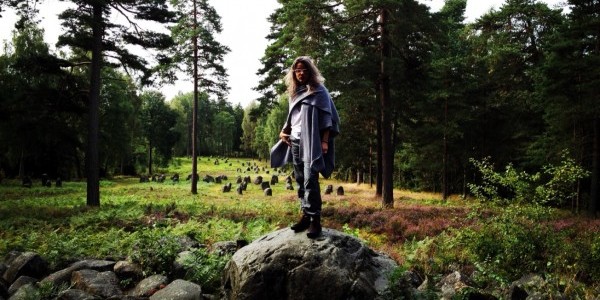
Roaming fearlessly at the stone circle in Hunn, Norway (Photo: Bent Søresen)
Last night I found myself comforting a student of Cards and Magic who has been worried about election day: If Trump wins…
‘Relax,’ I said, and then continued: ‘Things are as they are. Acknowledging this is a fearless act. Being fearless takes courage and requires discernment.’
I often talk about fearlessness in my cartomantic lessons, for the simple reason that this is why we read cards, namely, to get fearless. But there’s a catch to fearlessness that most people don’t think about.
Fearlessness is not for everybody. You must hide your fearlessness if you want to escape subjecting yourself to the constitutive gaze of others: ‘There goes the mad one’, people tend to say, when they look at you and all they see is your freedom: Freedom from fear.
Says culture: “What do you mean you’re fearless? You can’t be serious. We’re here to make you fearful, because that’s the only way in which we can sell you shit, from ideology to irritable colon remedies that our pharmaceutical industry has devised just for you, because you’re so special and because you deserve it.” Right.
What I’m saying is this:
Hiding that you are fearless is not only a means of protection, but it is necessary.
Hiding your fearlessness is the only way to counter the claims against madness. What did you think that all that talk about being silent is all about? Some sort of a mystical act that no one really understands, unless you are the sphinx or some ugly witch from Romania? No.
The advice about being silent, after you have done your share of willing, daring, and knowing, is related to being silent about your fearlessness.
You flaunt your fearlessness, you pay the price of subjecting yourself to pointy fingers: ‘Look at that fool,’ culture would say, and perhaps, for once, culture would be right about it.
In this sense, hiding your fearlessness is a subtle act that displays discernment and the capacity to remain dispassionate in the face of escalating threats.
What am I afraid of?
So here’s a short practice that takes its point of departure in the question I hope everyone poses to themselves as a matter of common sense practice: “What am I afraid of?”
Go through these simple steps, beginning with this very question:
- What am I afraid of?
- Make a list of your immediate concerns, for example: “I’m afraid that Trump will win today”, or “I’m afraid that my coffee doesn’t prompt me the way it used to with the regular existential question I pose about the meaning of life every morning”, or “I’m afraid that my children are not very bright”, or “I’m afraid that my husband is an asshole”, or “I’m afraid that my wife is vulgar”, or “I’m afraid that I’m lazy and incompetent”.
- Once you have identified your fear – keep to one at a time – lay down three cards and ask: “What is the purpose of my fear of . . . Trump, uninspiring coffee, children, husband, wife, myself?”
- Read your cards and devise a magical spell for yourself inspired by the cards that aims at dissolving your fear.
Here’s a recent example:
What is the purpose of my fear of my desire to be my own boss?
But first, bear in mind that you may already have an answer to the why: ‘Why am I afraid of being my own boss?,’ as this is not the most interesting.
What you want is to go beyond the why to identifying the purpose of your fear. For example, your fear of desiring to be your own boss may well be buried in your unconscious identification of ‘boss’ with ‘a lot of responsibility’ that you would prefer not to have for whatever reason. What you want is to identify the purpose of your fear. That’s a hell of a lot more sophisticated, as I hope you will discover if you try to answer this question.
The Sun, Justice, Temperance
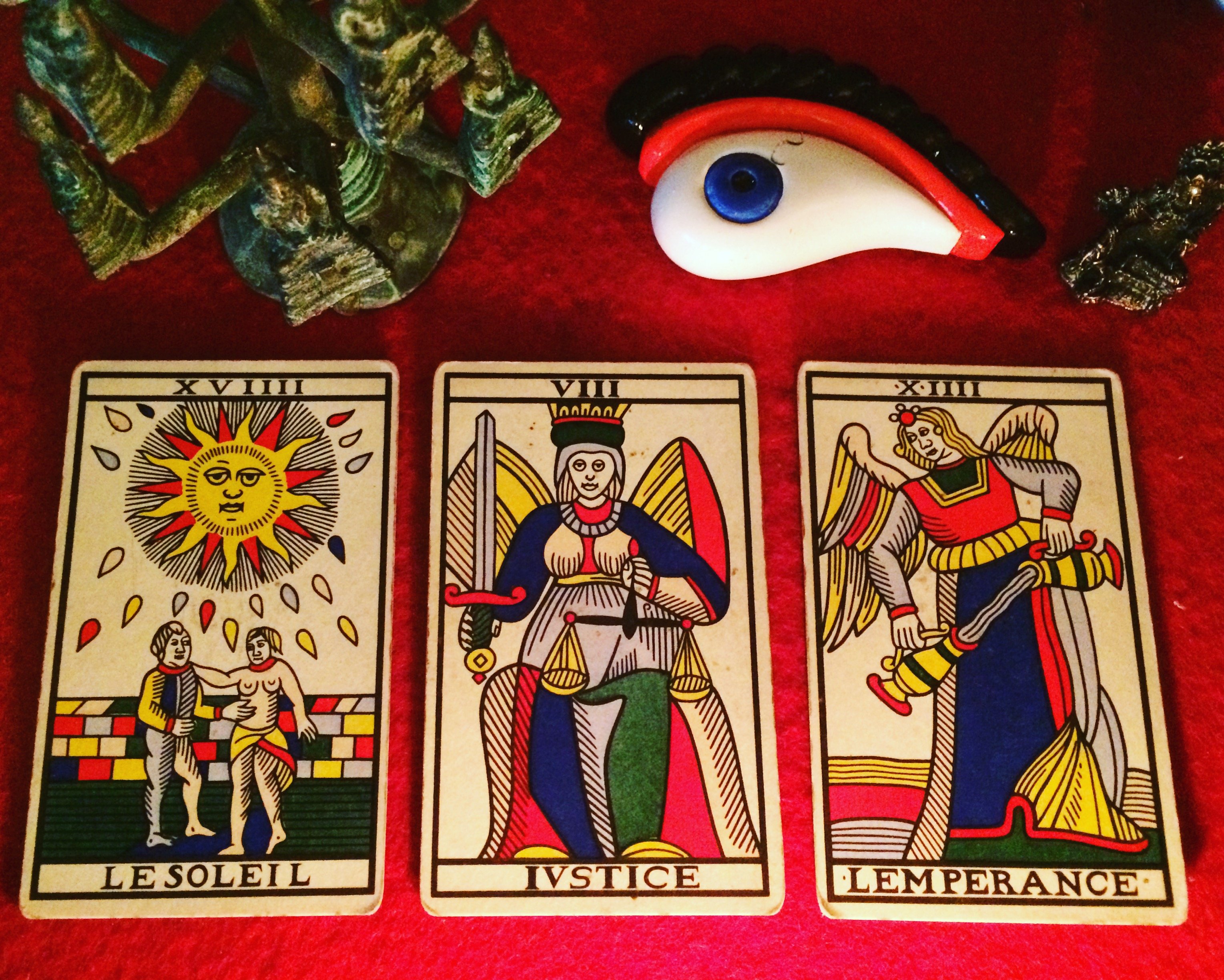
Jean Noblet Marseille Tarot, 1650, by J.C. Flornoy (Photo: Camelia Elias)
A purpose operates with referential points, points of identification between motivation and end result. In other words, when there’s a purpose, there’s movement and direction. The dictionary defines purpose as “the reason for which something exits”. It’s good practice to transliterate your question so you really get a sense of what is at stake when you ask it, here thus: “What is the reason for which my fear exists?” that is, my fear of my desire to be my own boss.
In light of this definition of purpose, I’d read the cards like this:
The reason why this fear exists is because there’s the assumption of warm sharing in a community where no one is the boss (the Sun). If you have to rise to that function, you have to be discerning and impartial (Justice) and smooth things out if needed, making compromises (Temperance) you would rather not.
Fair enough. This is a very good reason why anyone with the desire to be their own boss may fear fulfilling that role. But is this reason, or to get back to our formulation, purpose, not based on projection?
While this situation, going from carefree sharing to policing others, may arise at any time, upon further reflection we discover that it does not validate the fear itself.
Upon even further reflection, we discover that fear has no anchor. Things flow as they flow. While flow may be regulated (Temperance) and regimented (Justice), it is still flow, pulsating from heart to heart (Sun).
So we’re back to the old noble truth: Just as nothing has substance, fear has no substance. But in a play with fear using the visual language of the cards, you may discover just how your fear dissolves and through which concrete channels of manifestation.
Once you know this, you can then hide the particulars of your fearlessness, and thus enjoy your madness beyond the vigilant and watchful eyes of your culture, passing judgment on what it deems appropriate and not.
Eat your fear
In your madness you can try this:
- Take a slice of bread and toast it (Sun).
- Cut it into two halves and weigh each of them in your hands (Justice). Get a clear sense of this balancing act. What does it need for perfection? How about some some milk and honey?
- Make a concoction of the mix and pour it over each of your two slices (Temperance).
- When you’re done, take the first slice and eat it, saying these words: This is my fear. I offer it to my body to digest and dissolve.
- Eat the second slice of toast, saying these words: This is the purpose of my fear. I offer it to my body to digest and dissolve.
- Go out in the sun and say ‘thank you’ for the illumination.
♠
More of this work?
Stay in the loop for new cartomantic activities.

Click here to like
Patheos Pagan on Facebook.
Click here to like
the Agora on Facebook
The Cartomancer is published twice monthly on the Wednesdays here on the Agora. Subscribe via RSS or e-mail!
Please use the links to the right to keep on top of activities here on the Agora as well as across the entire Patheos Pagan channel.
Previous Post

October 26, 2016
The Cartomancer: Attending to the Supernatural
Next Post
November 23, 2016 The Cartomancer: Coping or Cutting?
Browse Our Archives
Select a Category Columns The Cartomancer Uncategorized
Select a Month January 2024 October 2023 August 2023 July 2023 June 2023 November 2022 October 2022 August 2022 May 2022 April 2022 February 2022 January 2022 November 2021 October 2021 September 2021 August 2021 June 2021 April 2021 March 2021 February 2021 January 2021 December 2020 November 2020 October 2020 September 2020 August 2020 July 2020 June 2020 May 2020 April 2020 March 2020 February 2020 January 2020 December 2019 November 2019 October 2019 September 2019 August 2019 July 2019 June 2019 May 2019 April 2019 March 2019 February 2019 January 2019 December 2018 November 2018 October 2018 September 2018 August 2018 July 2018 June 2018 May 2018 April 2018 March 2018 February 2018 January 2018 December 2017 November 2017 October 2017 September 2017 August 2017 July 2017 June 2017 May 2017 April 2017 March 2017 February 2017 January 2017 December 2016 November 2016 October 2016 September 2016 August 2016 July 2016 June 2016 May 2016 April 2016 March 2016 February 2016 January 2016 December 2015 November 2015 October 2015 September 2015 August 2015 July 2015
Follow Us!
TAKE THE
Religious Wisdom Quiz
What was the name of the disciple who replaced Judas Iscariot?
Select your answer to see how you score.
Matthias Timothy Silas Barnabas
Related posts from THE CARTOMANCER
TRENDING AT PATHEOS Pagan

I was recently chatting with someone on Instagram. She asked me what...

While there are many people who share their results, the end of...

On July 23, I saw Christopher Nolan's The Odyssey which is Homer’s...

As I write this two big events have just finished up. One...

Restoring the Watershed of Divine Love
Perhaps cooperation is not something we manufacture through legislation, ideology, or moral...

Many UUs don’t pray because of bad experiences in a previous religion,...
view all Pagan blogs
Ad-Free & Subscriber Log-In Subscription Support
- About Us
- 2026 Calendar
- Videos
- Podcasts
- Library of World Religions
- Faith In Media Tracker
- Advertise With Us
- Write for Us
- Privacy Policy
- Terms of Service
- Do Not Sell My Data
- Contact Us
- Radiant Digital
- Manage Newsletter Subscriptions
- Unsubscribe From Notifications
- Sitemap
Copyright 2008-2026, Patheos. All rights reserved.
Subscription Support Ad-Free & Subscriber Log-In
Follow Patheos