
BuddhistCatholicContemplativeEvangelicalGeneral ChristianHinduJewishLatter-day SaintMuslimNew VisionsProgressive Christian
Beliefs
- Buddhist
- Catholic
- Contemplative
- Evangelical
- General Christian
- Hindu
- Jewish
- Latter-day Saint
- More Voices
- Muslim
- New Visions
- Pagan
- Progressive Christian
Topics
- Religion News
- Food and Religion
- Sports and Religion
- Religious Art
- Religious Music and Entertainment
- Religious Events
- History and Religion
- Style and Religion
- Politics and Religion
- Women in Religion
- Recreation Outdoors and Religion
- Business Finance and Religion
- Careers Workplace and Religion
- Education and Religion
- Family Parenting and Religion
- Health Fitness and Religion
- Home and Religion
- Relationships and Religion
- Technology and Religion
- Travel and Religion
Columnists
- Buddhist Columnists
- Business Finance and Religion Columnists
- Careers Workplace and Religion Columnists
- Catholic Columnists
- Contemplative Columnists
- Education and Religion Columnists
- Evangelists Columnists
- Family Parenting and Religion Columnists
- General Christian Columnists
- Health Fitness and Religion Columnists
- Hindu Columnists
- History and Religion Columnists
- Home and Religion Columnists
- Jewish Columnists
- More Voices Columnists
- Latter Day Columnists
- Muslim Columnists
- New Visions Columnists
- Nonreligious Columnists
- Pagan Columnists
- Politics and Religion Columnists
- Progressive Columnists
- Recreation Outdoors and Religion Columnists
- Relationships and Religion Columnists
- Religion News Columnists
- Religious Art Columnists
- Religious Events Columnists
- Religious Music and Entertainment Columnists
- Sports and Religion Columnists
- Style and Religion Columnists
- Technology and Religion Columnists
- Travel and Religion Columnists
- Women in Religion Columnists
Resource Library
- 2026 Calendar
- Library of World Religions
- The 100 Most Holy Places on Earth
- Patheos Answers
- Podcasts
- Videos
- Faith Leaders Database
- Anglican Episcopalian
- Bahai
- Baptist
- Buddhism
- Christianity
- Confucianism
- Eastern Orthodoxy
- Hinduism
- Holiness and Pentecostal
- ISKCON
- Islam
- Judaism
- Lutheran
- Methodist
- The Church of Jesus Christ of Latter-day Saints
- New Age
- Paganism
- Presbytarian and Reformed
- Protestantism
- Religion Behind the Scenes
- Roman Catholic
- Scientology
- Shia Islam
- Sikhism
- Sufism
- Sunni Islam
- Taoism
- Zen
- See all religions
Research Tools
 Ad-Free & Subscriber Log-In Subscription Support
Ad-Free & Subscriber Log-In Subscription Support
Follow Patheos 

- Trending:
- Forgiveness
- |
- Marriage
- |
- Consciousness
- |
- Death Penalty
- |
- Election
- |
- Halloween
 THE CARTOMANCER
- Home
- Pagan
- The Cartomancer: Mirror, Mirror on the Wall
The Cartomancer: Mirror, Mirror on the Wall
Last updated on: April 13, 2016 at 4:00 pm by Camelia Elias
The Cartomancer: Mirror, Mirror on the Wall 2016-04-13T16:00:57+02:00 Camelia Elias
Patheos Explore the world's faith through different perspectives on religion and spirituality! Patheos has the views of the prevalent religions and spiritualities of the world.
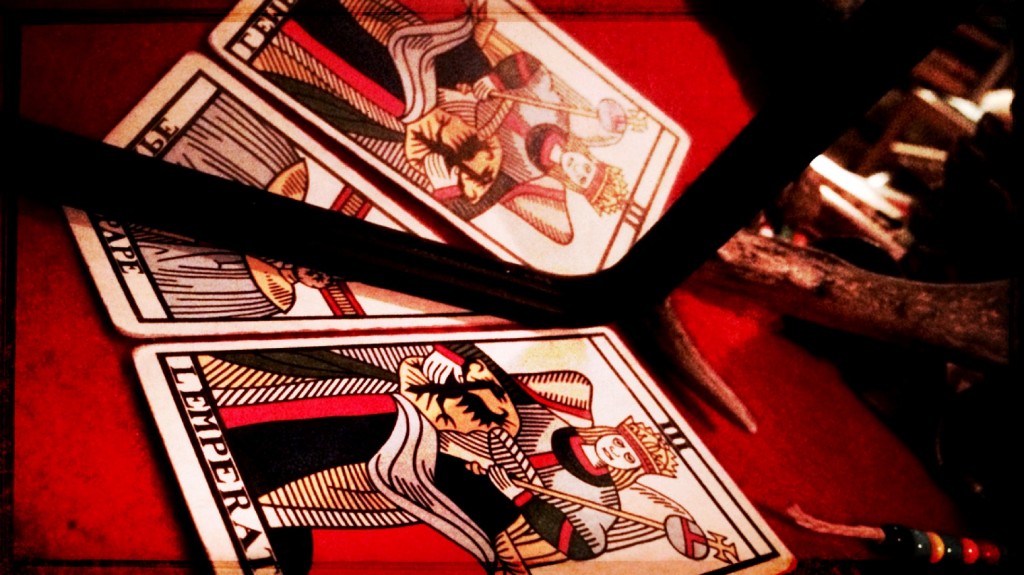
Jean Noblet Marseille Tarot, 1650, as reconstructed by Jean-Claude Flornoy (Photo: Camelia Elias)
When you get up in the morning, what do you do when you catch yourself in the mirror? Do you say anything? Do you avert your gaze, or do you politely put on lots of mascara? – for you see, masquerade has a very specific function.
But if you say anything, what do you say?
‘Today is a good day’ – your right foot confirms your confidence too, as you hear the sound of your heels going, ‘wheez, it’s the Wizard of Oz time.’
Or, ‘Today will be a good day’ – your voice trembles a bit, but as you instruct it to be more firm, and show belief in what it utters, the voice obeys, and a ‘feel good’ narrative takes off.
Or, ‘Today I feel some shit is gonna hit the fan.’ You say this while donning your red, martial arts costume, getting ready to retaliate.
Or, ‘Today is a good day, because what I see in the mirror is just a reflection.’ This you say while staring at yourself, seeing nothing, looking into the void smiling.
Fictions of the self
What you see in the mirror when you penetrate your own reflection is a narrative of the self, not the self. A fiction. ‘Oh, this fiction needs a bit more lipstick today, for I need to play Venus. I need to score that job interview, so it’s important I make an impression.’
What happens here amounts to what you can easily call a process of living by proxy, or outsourcing your experience. This in turn creates a counter-narrative that dictates that your source of success, happiness, achievement, and accomplishment is necessarily dependent on others.
It usually starts with this: ‘It’s important that…’ – insert here your favorite role to play, such as, it’s important that the boss/husband/lover/children/in-laws/friends like me; It’s important that I finish my degree, and preferably at an Ivy league something something, so that I can make sure I’m attractive to this and that other thing or something something.’
Mirror, mirror on the wall . . . keep talking
The funny thing is that the mirror doesn’t care about your self-empowering fragments of fiction. It doesn’t care about your eloquent words and firm voice. The mirror reflects, not judges. As such, it helps you none. So whom are you sending to your words of power, when you either whisper or shout them into the mirror? When the mirror just tells you back what you want to hear? Is the mirror a good ally?
‘I talk to the mirror to stay in power,’ I often hear people say, and I get the electric spark in this statement. But such enunciations are neither lasting nor real. This reminds me of the widely circulated meme on the internet, in which a puttytat looks at herself in the mirror, and while admiring her shadow, she declares that she’s a tiger. She’s a tiger alright, until the minute she’s on the street again, confronting her reality such as it is, not such as it is invented by a reflection at home, or by a story of the domestic cat gone wild.
Staying in your power is not about staying in symbolic power, which amounts to being a protagonist in a narrative, whether self-invented or other-constructed. Staying in your power means being able to distinguish between reality and fiction. Simply being is not the same as being what you tell yourself you are.

Frigg (Photo: Camelia Elias)
The implication of this is great, for this reason: you realize that whatever feeling arises in you, of raw intensity, loneliness, or loveliness, is part of your current vocabulary and cultural competence, not reality.
Identifying with the content of your felt experience is the same as validating your roles performed in the mirror. However, as these roles are not reality, but precisely the result of reflection, what you end up validating is the illusion of what you are and who you are, an invented content, a story in your own head.
While happiness and sadness can make you ‘feel’ your heart – you can feel hurt or joyous – they are not ‘the thing itself,’ they are not your vastness, they are not you as vastness. They are not your shared context.
How big thy art
But what is the ‘thing itself’, this thing that poets and Zen masters like to talk about? When I say, ‘mirror, mirror on the wall,’ what do I see? What do I say, really? What do these words refer to? What do they mean? Where can I feel them in the body?
Let’s see some cards:
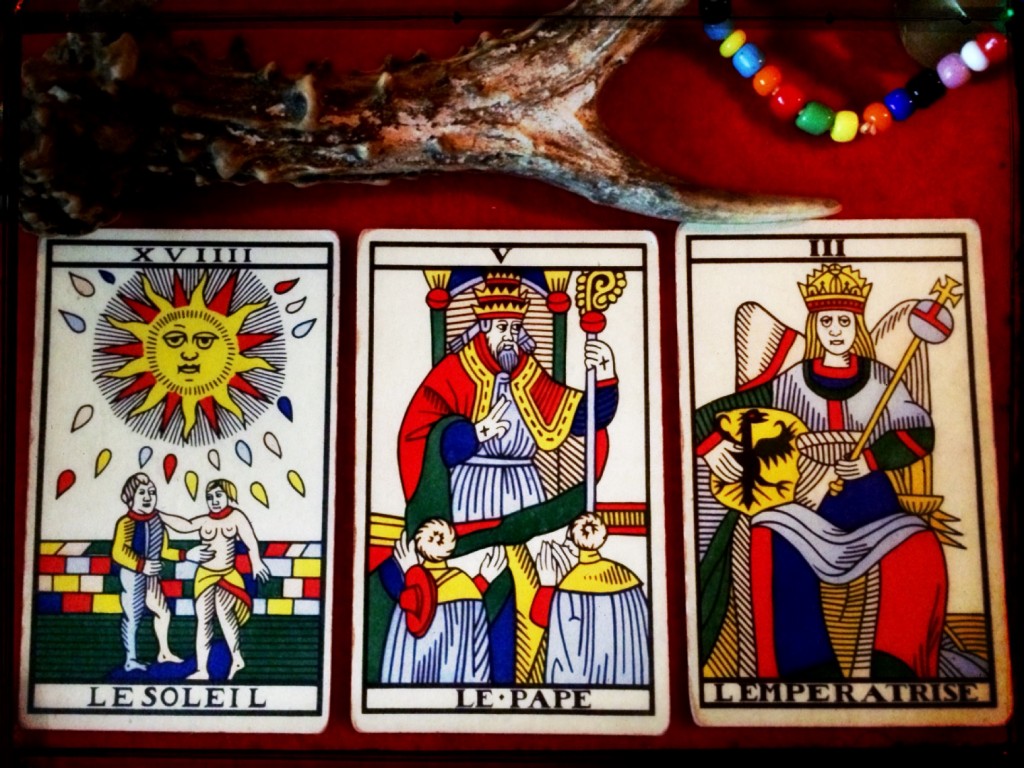
Jean Noblet Marseille Tarot, 1650, as reconstructed by Jean-Claude Flornoy (Photo: Camelia Elias)
The Sun, The Pope, The Empress
Clever cards. The first card, the Sun is the card of light, a card that illuminates everything. So ‘the thing itself’ is not the Moon, a reflective body, but rather, light. Light that warms and makes us share ourselves. We can teach others too about this space, this light that just is, the light that makes no discriminations. ‘Listen’ the Pope says, ‘there’s light.’
There is such a thing as reality. As you sit and breathe on your throne, you can meditate on your crowning achievements, like the Empress, but these achievements are not You. They are emblematic stamps on your shield. Stories of consecration. ‘The thing itself’ is you-plus-the-spiritual-man-in-the-garden. ‘The thing itself’ is also the others listening and watching, the disciples. The thing itself is you, when you dissolve into connection.
I like it very much how the Sun card subtly suggests a double mirroring of both, the man and the woman, and of the two disciples, as if saying: we were all naked once. We are still naked, in our present, in our perception of what is not fiction, of what is not a costume we don for the sake of convenience, but we don’t always realize this.
Mirror, mirror on the wall. I see you see me. . . as shared space.
♠
More words of power? Stay in the loop.

Click here to like
Patheos Pagan on Facebook.
Click here to like
the Agora on Facebook
The Cartomancer is published bi-monthly on the second and fourth Wednesday here on the Agora. Subscribe via RSS or e-mail!
Please use the links to the right to keep on top of activities here on the Agora as well as across the entire Patheos Pagan channel.
Previous Post

March 23, 2016
The Cartomancer: How to Speak with your Tree Ally
Next Post
April 27, 2016 The Cartomancer: Your Second Chance
Browse Our Archives
Select a Category Columns The Cartomancer Uncategorized
Select a Month January 2024 October 2023 August 2023 July 2023 June 2023 November 2022 October 2022 August 2022 May 2022 April 2022 February 2022 January 2022 November 2021 October 2021 September 2021 August 2021 June 2021 April 2021 March 2021 February 2021 January 2021 December 2020 November 2020 October 2020 September 2020 August 2020 July 2020 June 2020 May 2020 April 2020 March 2020 February 2020 January 2020 December 2019 November 2019 October 2019 September 2019 August 2019 July 2019 June 2019 May 2019 April 2019 March 2019 February 2019 January 2019 December 2018 November 2018 October 2018 September 2018 August 2018 July 2018 June 2018 May 2018 April 2018 March 2018 February 2018 January 2018 December 2017 November 2017 October 2017 September 2017 August 2017 July 2017 June 2017 May 2017 April 2017 March 2017 February 2017 January 2017 December 2016 November 2016 October 2016 September 2016 August 2016 July 2016 June 2016 May 2016 April 2016 March 2016 February 2016 January 2016 December 2015 November 2015 October 2015 September 2015 August 2015 July 2015
Follow Us!
TAKE THE
Religious Wisdom Quiz
Who said "as for me and my house, we will serve the Lord"?
Select your answer to see how you score.
Paul Joshua Peter Abraham
Related posts from THE CARTOMANCER
TRENDING AT PATHEOS Pagan

I was recently chatting with someone on Instagram. She asked me what...

While there are many people who share their results, the end of...

On July 23, I saw Christopher Nolan's The Odyssey which is Homer’s...

As I write this two big events have just finished up. One...

Restoring the Watershed of Divine Love
Perhaps cooperation is not something we manufacture through legislation, ideology, or moral...

Many UUs don’t pray because of bad experiences in a previous religion,...
view all Pagan blogs
Ad-Free & Subscriber Log-In Subscription Support
- About Us
- 2026 Calendar
- Videos
- Podcasts
- Library of World Religions
- Faith In Media Tracker
- Advertise With Us
- Write for Us
- Privacy Policy
- Terms of Service
- Do Not Sell My Data
- Contact Us
- Radiant Digital
- Manage Newsletter Subscriptions
- Unsubscribe From Notifications
- Sitemap
Copyright 2008-2026, Patheos. All rights reserved.
Subscription Support Ad-Free & Subscriber Log-In
Follow Patheos