
BuddhistCatholicContemplativeEvangelicalGeneral ChristianHinduJewishLatter-day SaintMuslimNew VisionsProgressive Christian
Beliefs
- Buddhist
- Catholic
- Contemplative
- Evangelical
- General Christian
- Hindu
- Jewish
- Latter-day Saint
- More Voices
- Muslim
- New Visions
- Pagan
- Progressive Christian
Topics
- Religion News
- Food and Religion
- Sports and Religion
- Religious Art
- Religious Music and Entertainment
- Religious Events
- History and Religion
- Style and Religion
- Politics and Religion
- Women in Religion
- Recreation Outdoors and Religion
- Business Finance and Religion
- Careers Workplace and Religion
- Education and Religion
- Family Parenting and Religion
- Health Fitness and Religion
- Home and Religion
- Relationships and Religion
- Technology and Religion
- Travel and Religion
Columnists
- Buddhist Columnists
- Business Finance and Religion Columnists
- Careers Workplace and Religion Columnists
- Catholic Columnists
- Contemplative Columnists
- Education and Religion Columnists
- Evangelists Columnists
- Family Parenting and Religion Columnists
- General Christian Columnists
- Health Fitness and Religion Columnists
- Hindu Columnists
- History and Religion Columnists
- Home and Religion Columnists
- Jewish Columnists
- More Voices Columnists
- Latter Day Columnists
- Muslim Columnists
- New Visions Columnists
- Nonreligious Columnists
- Pagan Columnists
- Politics and Religion Columnists
- Progressive Columnists
- Recreation Outdoors and Religion Columnists
- Relationships and Religion Columnists
- Religion News Columnists
- Religious Art Columnists
- Religious Events Columnists
- Religious Music and Entertainment Columnists
- Sports and Religion Columnists
- Style and Religion Columnists
- Technology and Religion Columnists
- Travel and Religion Columnists
- Women in Religion Columnists
Resource Library
- 2026 Calendar
- Library of World Religions
- The 100 Most Holy Places on Earth
- Patheos Answers
- Podcasts
- Videos
- Faith Leaders Database
- Anglican Episcopalian
- Bahai
- Baptist
- Buddhism
- Christianity
- Confucianism
- Eastern Orthodoxy
- Hinduism
- Holiness and Pentecostal
- ISKCON
- Islam
- Judaism
- Lutheran
- Methodist
- The Church of Jesus Christ of Latter-day Saints
- New Age
- Paganism
- Presbytarian and Reformed
- Protestantism
- Religion Behind the Scenes
- Roman Catholic
- Scientology
- Shia Islam
- Sikhism
- Sufism
- Sunni Islam
- Taoism
- Zen
- See all religions
Research Tools
 Ad-Free & Subscriber Log-In Subscription Support
Ad-Free & Subscriber Log-In Subscription Support
Follow Patheos 

- Trending:
- Forgiveness
- |
- Marriage
- |
- Consciousness
- |
- Death Penalty
- |
- Election
- |
- Halloween
 THE CARTOMANCER
- Home
- Pagan
- The Cartomancer: Questions of Excellence
The Cartomancer: Questions of Excellence
Last updated on: September 9, 2015 at 4:00 pm by Camelia Elias
The Cartomancer: Questions of Excellence 2015-09-09T16:00:32+02:00 Camelia Elias
Patheos Explore the world's faith through different perspectives on religion and spirituality! Patheos has the views of the prevalent religions and spiritualities of the world.
Most of the time we assume that people seek a fortuneteller because they need answers to their questions. Wrong. Most of the time what people are seeking is excellence: The excellence that goes into formulating a good question. The excellence in knowing that a good, focused question can lead you to making the good, right decision. The excellence in knowing exactly that which we are really good at, and which serves both others and ourselves.
What we fear the most is the paralysis induced by ambivalence: This job, or that job? This woman or the other one? This school or that school? The woods or the city? Ambivalence is a nasty state. When it doesn’t lead to apathy, it leads to indifference: ‘Who cares that I need to do something about my physical workout? I can just sit here and watch professional alpinists conquer the Everest on TV.’ Ambivalence is connected to not taking risks. And when we don’t take risks we risk never finding out what we love, who we love, and why we love.
My whole professional life has revolved around asking questions. While I also comply with the rules of reforms and bureaucracy, however stupid, and pay my dues to Caesar, I teach students to ask questions. I myself try to get better at formulating questions. I prompt people to ask the right questions. What is really interesting? Does it have a soul? Is it really useful in that way which bypasses capitalism and self-promotion and self-interest? I’m all for self-promotion and self-interest, but it has to go somewhere. Some real sharing must be at the heart of it.
What do you want to know?
What I like about the cards is that we can come to them with anything.
We can pose a meta-question:
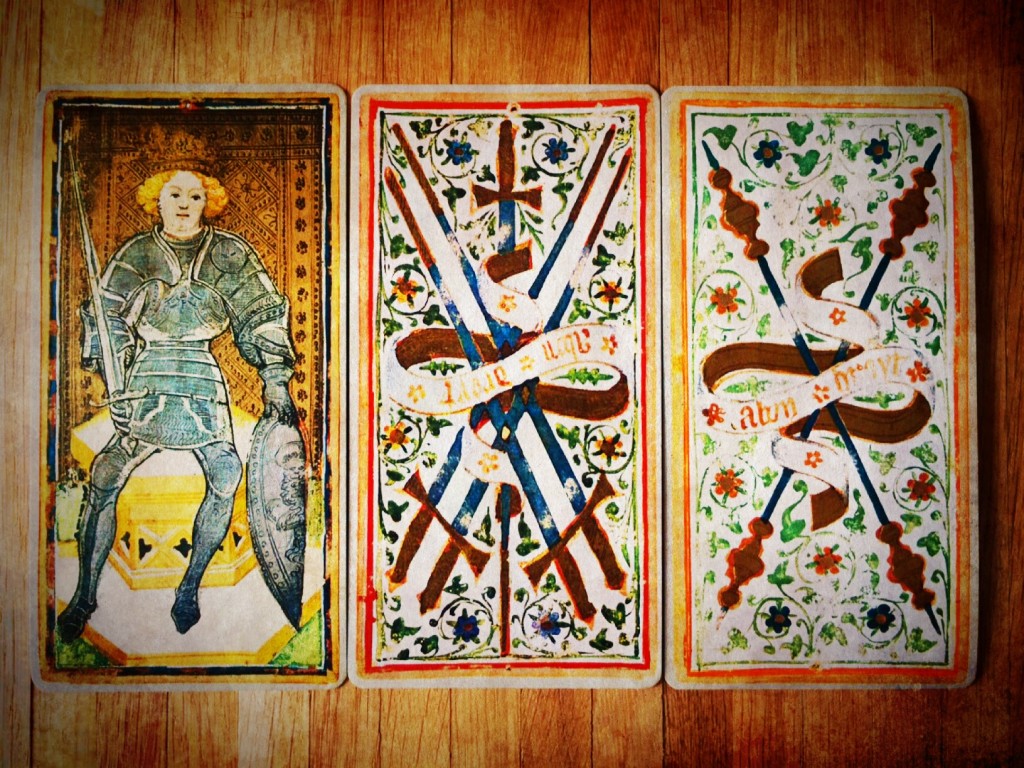
Visconti Sforza Tarot, Gabriele Mandel Edition: Monumenta Longobardica, 1975 (Photo: Camelia Elias)
Cards, why are you so clever?
Because, as a pack, I’m a master strategist. Because posing a good question is like going to war with yourself, and then negotiating for the best course of action.
We can ask the cards a personal question:
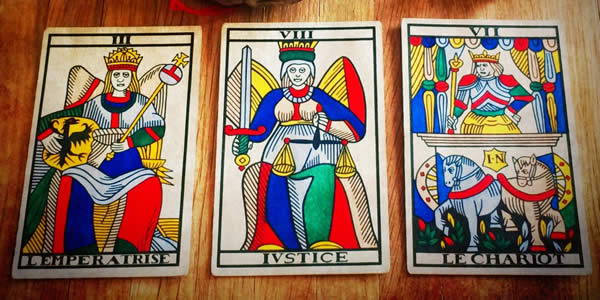
Jean Noblet Marseille Tarot, 1650, as reconstructed by Jean-Claude Flornoy (Photo: Camelia Elias)
Cards, why am I so stupid?
Because you fail to see that not all rides into town are good for you.
We can ask the cards a spying question:
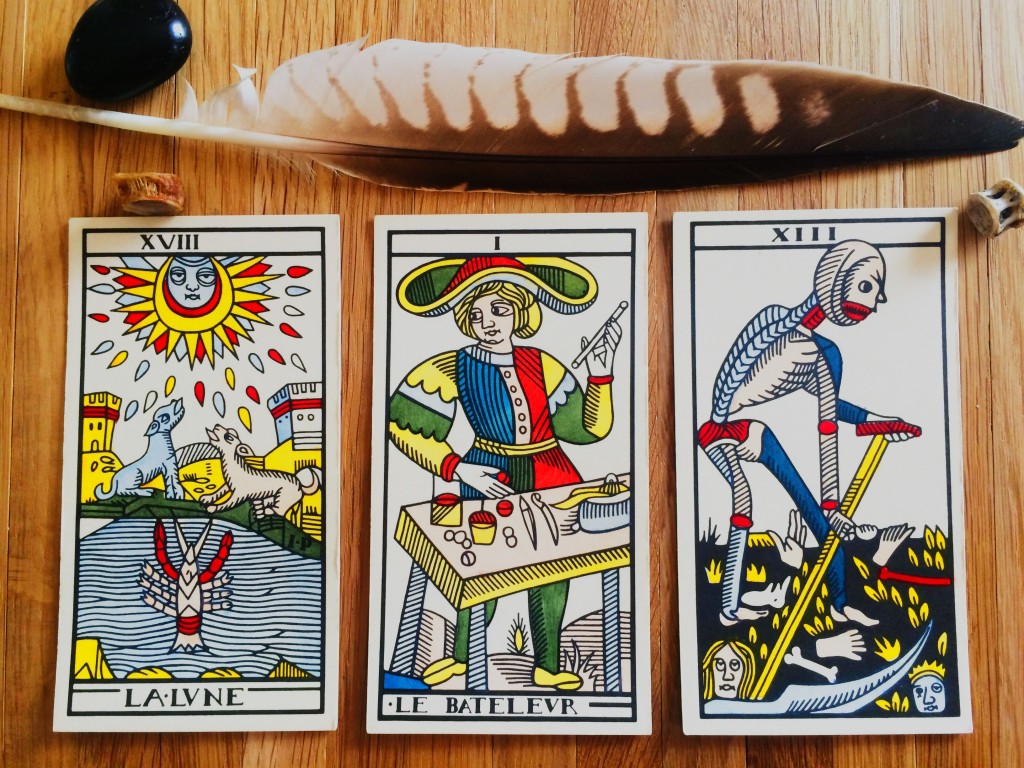
Jean Dodal Marseille Tarot, 1701, as reconstructed by Jean-Claude Flornoy (Photo: Camelia Elias)
Cards, what does he think of me?
He thinks you’re fascinating. But he’s probably asking: ‘Can I seduce the moon? Hell no.’ Alas…
We can ask the cards to enable an encounter:
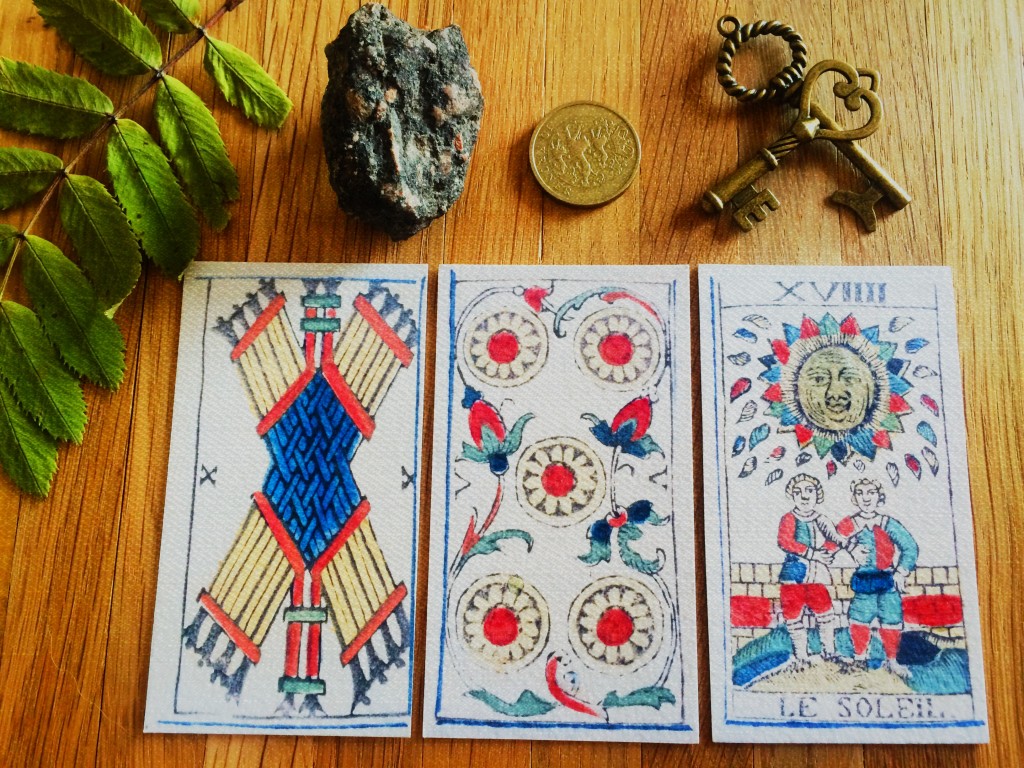
Carolus Zoya Marseille Tarot, ca. 1790, facsimile of the original in K. Frank Jensen’s collection (Photo: Camelia Elias)
Cards, how can I meet the Devil?
Go into some dense woods. Make an offering of 5 coins. Wait until sunrise.
We can ask the cards to perform magic:
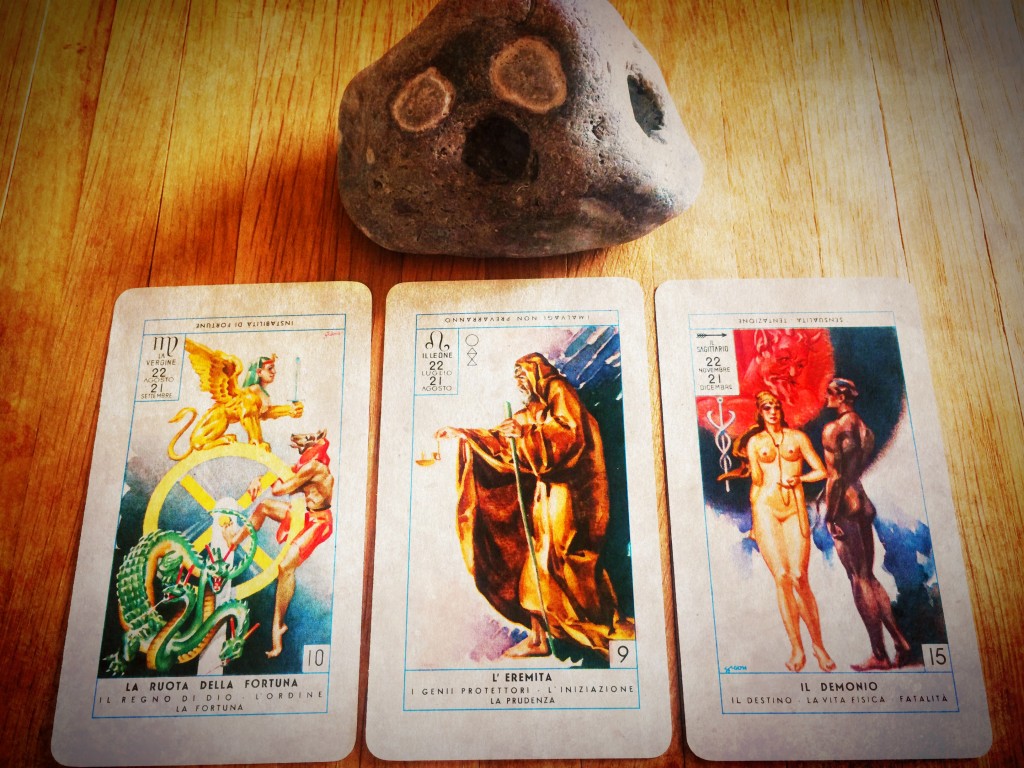
Cartomanzia 184, Modiano Trieste, 1955 (Photo: Camelia Elias)
Cards, how can I tie the tongue of my lying boss?
Wait for good tidings, when the dragon is asleep and you hold the sword upwards. Then take your cane and an oil lamp and go to a remote place. There, remember what Eve did. She struck a deal with the serpent for knowledge. Make an open fire and cook some tongue on a spear. Eat it.
The Question is Everything
Why is the question so important? Unlike many diviners, in my personal practice I never ever read the cards without having a properly formulated question. The cards have a way of telling a story that makes us aware of the power of understanding ourselves in context. Understanding ourselves in a situation where we don’t just use analogy to create more clichés about our lives. If we get to the point where we can proudly declare: ‘I’ve worked my socks off, and here I am, all powerful and all-knowing,’ are we also able to remember what question got us there? Was our ambition even connected to a question at all? In my counseling with the cards, I often come across this very situation: Successful entrepreneur, miserable soul. If your life trajectory is not the result of a really good question, chances are that it goes to hell.
If you are under the pressure to tell a good story about your achievements, or lack thereof, you will not tell a good story at all. You will fall into melodrama, and start repeating a point about your life that makes us all yawn: ‘Tell me something I don’t know’.
How do we keep the Geist then? Finding a good question to pose is like hunting. First you have to quiet yourself. Then allow for your sense of smell to kick in. A good question follows the nose. Are you curious enough about what you hunt for? Do you even have an idea of what it looks like? The best question will also allow for some mystery to occur: ‘I want to ask about how I can become the governor of California.’ Good. How is your sex life? Do you remember the essential rule of political hunting: ‘If it ain’t sex, follow the money’. I apply this rule to everything.
What we call excellence is often related to acts of violence: You cut. You essentialize to the truth even when some insist that there’s no truth out there. It takes real skill to be able to cut the crap. Skill and diplomacy. Some things you need to keep to yourself. Spilling the beans and rendering yourself irrelevant and predictable in the process will not get you there, to what keeps the Geist, namely, to the point that allows you to exercise some excellence in your ability to give and receive an idea to work with. For free.
Intellectual Fortuneteller
I often tell people that I’m an intellectual fortuneteller, as I make en effort to not only get the other who comes to me to formulate a good question but also make sure that in that question there’s a real idea we can both work with. Sometimes I send people three times around the block of formulating a good question before I actually get to lay down the cards. What fascinates me the most is when people formulate a very clear question, but in that question I sense a mystery, or a secret that they keep to themselves. The cards have a way of uncovering that part in a way that makes me feel like Sherlock Holms. Or better yet, forget about Sherlock Holms. How about some black magic conjuring à la the Raven in Edgar Allan Poe?
In the conversation thread following my latest post here about the personality test, I suggested that what we call the secret card – what we know about ourselves but we don’t want others to know – is all about diplomacy. But I could just as well have said that it’s about keeping the mystery of ourselves. Your question has a red thread. Good. But does it have a black one too? The one that excites you in the dark? The one that makes the fortuneteller give you the squinting look? How do you weave what you know already into what you don’t know? Are your threads dancing yet? Is your nose filled with the smell of your prey? Even when you ask about how you can better your communication skills so that you score your dream job? What do you keep to yourself that’s most fascinating, which, however, others can also sense? Do you allow others to hunt you for your excellence? Or are you still watching the alpinists on TV conquering the Everest?
Distinction
I don’t get the idiotic New Age insistence on ‘tell all’ because only so can you create a connection with others. Such nonsense. I like distinction, and I like essential stuff, not the ‘everything’ of the cliché life, not the ‘I totally get you’, when it’s as plain as daylight that the one saying this is completely clueless about everything. Some fortunetellers aim for that. I don’t. I don’t exercise my empathy by ‘totally getting you.’ I use my excellence to cut to the bones, but in the process, I go mercilessly for the mysterious beauty of the impenetrable obvious.
§
For my program in Tarot Prompts, you’re welcome to check a full cycle here.
All the cards shown here are in my collection.

Click here to like
Patheos Pagan on Facebook.
Click here to like
the Agora on Facebook
The Cartomancer is published bi-monthly on the second and fourth Wednesday here on the Agora. Subscribe via RSS or e-mail!
Please use the links to the right to keep on top of activities here on the Agora as well as across the entire Patheos Pagan channel.
Previous Post

August 26, 2015
The Cartomancer: Personality Test
Next Post
September 23, 2015 The Cartomancer: In Love and War
Browse Our Archives
Select a Category Columns The Cartomancer Uncategorized
Select a Month January 2024 October 2023 August 2023 July 2023 June 2023 November 2022 October 2022 August 2022 May 2022 April 2022 February 2022 January 2022 November 2021 October 2021 September 2021 August 2021 June 2021 April 2021 March 2021 February 2021 January 2021 December 2020 November 2020 October 2020 September 2020 August 2020 July 2020 June 2020 May 2020 April 2020 March 2020 February 2020 January 2020 December 2019 November 2019 October 2019 September 2019 August 2019 July 2019 June 2019 May 2019 April 2019 March 2019 February 2019 January 2019 December 2018 November 2018 October 2018 September 2018 August 2018 July 2018 June 2018 May 2018 April 2018 March 2018 February 2018 January 2018 December 2017 November 2017 October 2017 September 2017 August 2017 July 2017 June 2017 May 2017 April 2017 March 2017 February 2017 January 2017 December 2016 November 2016 October 2016 September 2016 August 2016 July 2016 June 2016 May 2016 April 2016 March 2016 February 2016 January 2016 December 2015 November 2015 October 2015 September 2015 August 2015 July 2015
Follow Us!
TAKE THE
Religious Wisdom Quiz
Which Christian movement began with John Wesley in the 18th century?
Select your answer to see how you score.
Presbyterianism Calvinism Methodism Lutheranism
Related posts from THE CARTOMANCER
TRENDING AT PATHEOS Pagan

When we talk about Greek religion, we often begin with the dodekatheion—the...

I was recently chatting with someone on Instagram. She asked me what...

While there are many people who share their results, the end of...

On July 23, I saw Christopher Nolan's The Odyssey which is Homer’s...

As I write this two big events have just finished up. One...

Restoring the Watershed of Divine Love
Perhaps cooperation is not something we manufacture through legislation, ideology, or moral...
view all Pagan blogs
Ad-Free & Subscriber Log-In Subscription Support
- About Us
- 2026 Calendar
- Videos
- Podcasts
- Library of World Religions
- Faith In Media Tracker
- Advertise With Us
- Write for Us
- Privacy Policy
- Terms of Service
- Do Not Sell My Data
- Contact Us
- Radiant Digital
- Manage Newsletter Subscriptions
- Unsubscribe From Notifications
- Sitemap
Copyright 2008-2026, Patheos. All rights reserved.
Subscription Support Ad-Free & Subscriber Log-In
Follow Patheos