
BuddhistCatholicContemplativeEvangelicalGeneral ChristianHinduJewishLatter-day SaintMuslimNew VisionsProgressive Christian
Beliefs
- Buddhist
- Catholic
- Contemplative
- Evangelical
- General Christian
- Hindu
- Jewish
- Latter-day Saint
- More Voices
- Muslim
- New Visions
- Pagan
- Progressive Christian
Topics
- Religion News
- Food and Religion
- Sports and Religion
- Religious Art
- Religious Music and Entertainment
- Religious Events
- History and Religion
- Style and Religion
- Politics and Religion
- Women in Religion
- Recreation Outdoors and Religion
- Business Finance and Religion
- Careers Workplace and Religion
- Education and Religion
- Family Parenting and Religion
- Health Fitness and Religion
- Home and Religion
- Relationships and Religion
- Technology and Religion
- Travel and Religion
Columnists
- Buddhist Columnists
- Business Finance and Religion Columnists
- Careers Workplace and Religion Columnists
- Catholic Columnists
- Contemplative Columnists
- Education and Religion Columnists
- Evangelists Columnists
- Family Parenting and Religion Columnists
- General Christian Columnists
- Health Fitness and Religion Columnists
- Hindu Columnists
- History and Religion Columnists
- Home and Religion Columnists
- Jewish Columnists
- More Voices Columnists
- Latter Day Columnists
- Muslim Columnists
- New Visions Columnists
- Nonreligious Columnists
- Pagan Columnists
- Politics and Religion Columnists
- Progressive Columnists
- Recreation Outdoors and Religion Columnists
- Relationships and Religion Columnists
- Religion News Columnists
- Religious Art Columnists
- Religious Events Columnists
- Religious Music and Entertainment Columnists
- Sports and Religion Columnists
- Style and Religion Columnists
- Technology and Religion Columnists
- Travel and Religion Columnists
- Women in Religion Columnists
Resource Library
- 2026 Calendar
- Library of World Religions
- The 100 Most Holy Places on Earth
- Patheos Answers
- Podcasts
- Videos
- Faith Leaders Database
- Anglican Episcopalian
- Bahai
- Baptist
- Buddhism
- Christianity
- Confucianism
- Eastern Orthodoxy
- Hinduism
- Holiness and Pentecostal
- ISKCON
- Islam
- Judaism
- Lutheran
- Methodist
- The Church of Jesus Christ of Latter-day Saints
- New Age
- Paganism
- Presbytarian and Reformed
- Protestantism
- Religion Behind the Scenes
- Roman Catholic
- Scientology
- Shia Islam
- Sikhism
- Sufism
- Sunni Islam
- Taoism
- Zen
- See all religions
Research Tools
 Ad-Free & Subscriber Log-In Subscription Support
Ad-Free & Subscriber Log-In Subscription Support
Follow Patheos 

- Trending:
- Forgiveness
- |
- Marriage
- |
- Consciousness
- |
- Death Penalty
- |
- Election
- |
- Halloween

- Home
- Contemplative
- “This Loving, Uniting Embrace”: the Holy Ordinary
“This Loving, Uniting Embrace”: the Holy Ordinary
Last updated on: February 7, 2025 at 12:44 pm by Guest Contributor
“This Loving, Uniting Embrace”: the Holy Ordinary 2025-02-07T12:44:11-04:00 Guest Contributor
Patheos Explore the world's faith through different perspectives on religion and spirituality! Patheos has the views of the prevalent religions and spiritualities of the world.
Today’s guest post is by Mark Longhurst, author of The Holy Ordinary: A Way to God
I feel drawn to a life of spiritual depth, inspired by the mystics, but I’m not a monk, nun, or even a professional pastor serving a church anymore. I’m just an ordinary dude working a job I am privileged to love, raising boys who play soccer. I go to my local art cinema, read spirituality books and occasionally science fiction, spend time with my wife, and go on hikes with my dog. I am also, frankly, not very good at slowing down and appreciating the holiness of the ordinary. I have an anxious and task-oriented psyche that leads me into obsessive thought patterns more than it does a trusting posture of enjoying the moment.
But as I say in The Holy Ordinary, I’m convinced that “underneath the rhythmic contours of each day are deepening roots that sip from mystical streams.” I sit in silent meditation or chant morning psalms—which is something monks and nuns have been doing for centuries—and I’m reminded at some level that my true life is not found in the things that I’m doing and that my belonging lies in a deeper, divine love in which I am invited to participate.

Here’s the thing: once you know that there’s a deeper love pulsing behind and through all things, you can’t unknow it. It doesn’t mean I’m special; I’ve just glimpsed something beautiful that I believe is true, and I know I’m not the only one. I meet so many people who are living regular lives on the surface, who are perfectly ordinary in our wounds and failures, many of whom do not go to church or find belonging in traditional religious structures but who have glimpsed something deeply loving about reality—and can’t unsee it.
This is the call that the “mystic” has traditionally responded to. For about 1,500 years, the “mystical” meant *monastic—*but we’re living in a time where this is no longer true. In our ecumenical era, the divisions that once caused wars between Protestants and Catholics are no longer ultimate. Lots of people are leaving Christianity altogether, and often with good reason—but lots of people are also realizing that there are treasures hidden in Christianity and that they don’t need to belong to one denominational group or the other to enjoy. So, in today’s religious landscape, I’ve run into evangelical Christians praying Psalms like monks and liberal Protestants singing songs from the French monastery Taizé. Thousands of people who don’t belong to any tradition hike a former medieval pilgrimage path—the Camino de Santiago. Christians practice silent meditation and yoga now, practices traditionally reserved for Christian monks, Buddhists, and Hindu renunciates.
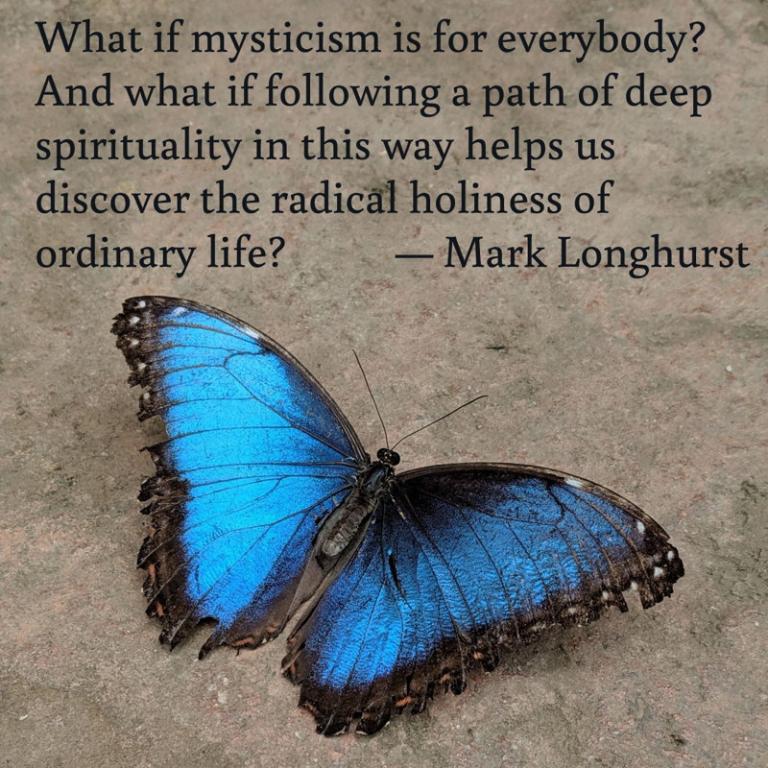
What if mysticism is for everybody? What if it’s not for those special people but for me—for us? And what if following a path of deep spirituality in this way helps us discover the radical holiness of ordinary life?
So, what is the holy ordinary? What is mysticism, and how do you begin talking about the ineffable? I don’t have a specific answer, but I can tell you what I’ve learned from others. One medieval scholar, Jean Gerson, described it as “the experiential knowledge that comes from God through the embrace of unitive love.” So, it’s experiential and not something we learn from reading books. That’s extremely difficult for someone like me who loves reading theology and spirituality books. I often can trick myself into believing that because I’ve read or thought something, I’ve experienced it fully—but that’s decidedly not the case. Mysticism comes from God, or ultimate reality, whatever word you want to use, through an embrace of love. It has everything to do with knowing, feeling, and trusting that an embrace of love is at the heart of it all. But it’s also “unitive,” meaning that it unites us and connects us to God, each other, and the earth. It’s a love that heals, brings together and does not separate. I’m convinced that that’s what we most need today.
This loving, uniting embrace is available to us in all our ordinary moments, from standing waiting at the bus stop to doing the dishes to working on a deadline for our jobs. It’s available when we’re cooking, walking in nature, or playing with our kids. This loving, uniting embrace is also available as a resource to me and each of us in the hard moments. It’s available when we’re mad, sad, and hurting. It holds us in the grief of our heartbreaks, diagnoses, and deaths, ever prompting us to solidarity with those who are most suffering and are marginalized. Discovering the “holy” ordinary means living a life that trusts this loving embrace.
About Mark Longhurst: Writer, author of The Holy Ordinary, and ordinary mystic, Mark is a member of the new monastic Community of the Incarnation and works as the Publications Manager at the Center for Action and Contemplation. A former pastor, he served United Church of Christ churches for ten years and worked as a faith-based social justice activist in the Boston area for ten more. A graduate of Harvard Divinity School and a longtime yoga practitioner, Mark lives in western Massachusetts with his family. You can follow him on Substack at marklonghurst.substack.com and Instagram @ordinary.mystic.


Previous Post
November 5, 2024
Let's Elect Silence
Next Post

February 14, 2025 Can Love Be Saved? Some Thoughts on the World Today
Recent Comments
"This piece insightfully explores how psychedelic therapy can support both anxiety relief and spiritual growth. ..."
LSD, Anxiety, and Contemplation: Can Psychedelic ..."
"As I read your comment, I cannot help but suspect that you have misunderstood the ..."
If You Worship an Angry God, ..."
"Monotheists believe only one Deity exists, and whether angry or jolly it's not for us, ..."
If You Worship an Angry God, ..."
"Excellent article.People should remember, the Bible was written in an era when the theologians thought ..."
If You Worship an Angry God, ..."
Browse Our Archives
Select a Category Activism Announcements Art Books Catholicism Celtic Christianity Christian mysticism Christianity Contemplation Current events Etc. Family humor interfaith dialogue Interfaith Wisdom Interspirituality Lay Cistercians Living the Faith Meditation movies Mysticism Mystics nature Poetry Reviews Scripture silence Spirituality Uncategorized Writing
Select a Month February 2025 January 2025 November 2024 September 2024 August 2024 July 2024 June 2024 May 2024 March 2024 January 2024 December 2023 November 2023 August 2023 June 2023 April 2023 March 2023 February 2023 January 2023 December 2022 November 2022 October 2022 September 2022 August 2022 July 2022 June 2022 May 2022 April 2022 February 2022 January 2022 December 2021 November 2021 October 2021 September 2021 August 2021 July 2021 June 2021 May 2021 April 2021 March 2021 February 2021 January 2021 December 2020 November 2020 October 2020 September 2020 August 2020 July 2020 June 2020 May 2020 April 2020 March 2020 February 2020 January 2020 December 2019 November 2019 October 2019 September 2019 August 2019 July 2019 June 2019 May 2019 April 2019 March 2019 February 2019 January 2019 December 2018 November 2018 October 2018 September 2018 August 2018 July 2018 June 2018 May 2018 April 2018 March 2018 February 2018 January 2018 December 2017 November 2017 October 2017 September 2017 August 2017 July 2017 June 2017 May 2017 April 2017 March 2017 February 2017 January 2017 December 2016 November 2016 October 2016 September 2016 August 2016 July 2016 June 2016 May 2016 March 2016 February 2016 January 2016 December 2015 November 2015 October 2015 September 2015 August 2015 July 2015 June 2015 May 2015 April 2015 March 2015 February 2015 January 2015 December 2014 November 2014 October 2014 September 2014 August 2014 July 2014 June 2014 May 2014 April 2014 March 2014 February 2014 January 2014 December 2013 October 2013 September 2013 July 2013 May 2013 January 2013 December 2012 November 2012 August 2012 July 2012 June 2012 March 2012 December 2011 September 2011 October 2010 August 2010 March 2010 September 2009 July 2008 January 2008 December 2007 September 2007 February 2007 January 2007 December 2004
Follow Us!
TAKE THE
Religious Wisdom Quiz
Besides Samuel, Elkanah and Hannah had this many children.
Select your answer to see how you score.
2 5 0 8
Support this
Column


Related posts from Carl McColman

I Believe Prayer Changes Things. Here's a Few...

If You Worship an Angry God, You'll Be...

The Difference Between Apophatic and Kataphatic Spirituality
TRENDING AT PATHEOS Contemplative

Handy Contemplative Practices for Political Spaces
A Spiritually Grounded Presence In order to bring a spiritually grounded presence...

Halloween: The Holiday of Loving Your Neighbor
All Hallows Eve Is Halloween the least Christian holiday in America, or...
Can Love Be Saved? Some Thoughts on the...
Happy Valentine's Day! I recently published a post on Patreon called Can...

"This Loving, Uniting Embrace": the Holy Ordinary
Today's guest post is by Mark Longhurst, author of The Holy Ordinary:...

How Are We Called to Live?: More About...
How Are We Called to Live? Many of us struggle with discerning...

A Spiritual Practice of Reading: Join Us Online
A Spiritual Practice of Reading A healthy spiritual practice of reading is...
view all Contemplative blogs
What Are Your Thoughts?leave a comment
Ad-Free & Subscriber Log-In Subscription Support
- About Us
- 2026 Calendar
- Videos
- Podcasts
- Library of World Religions
- Faith In Media Tracker
- Advertise With Us
- Write for Us
- Privacy Policy
- Terms of Service
- Do Not Sell My Data
- Contact Us
- Radiant Digital
- Manage Newsletter Subscriptions
- Unsubscribe From Notifications
- Sitemap
Copyright 2008-2026, Patheos. All rights reserved.
Subscription Support Ad-Free & Subscriber Log-In
Follow Patheos