
BuddhistCatholicContemplativeEvangelicalGeneral ChristianHinduJewishLatter-day SaintMuslimNew VisionsProgressive Christian
Beliefs
- Buddhist
- Catholic
- Contemplative
- Evangelical
- General Christian
- Hindu
- Jewish
- Latter-day Saint
- More Voices
- Muslim
- New Visions
- Pagan
- Progressive Christian
Topics
- Religion News
- Food and Religion
- Sports and Religion
- Religious Art
- Religious Music and Entertainment
- Religious Events
- History and Religion
- Style and Religion
- Politics and Religion
- Women in Religion
- Recreation Outdoors and Religion
- Business Finance and Religion
- Careers Workplace and Religion
- Education and Religion
- Family Parenting and Religion
- Health Fitness and Religion
- Home and Religion
- Relationships and Religion
- Technology and Religion
- Travel and Religion
Columnists
- Buddhist Columnists
- Business Finance and Religion Columnists
- Careers Workplace and Religion Columnists
- Catholic Columnists
- Contemplative Columnists
- Education and Religion Columnists
- Evangelists Columnists
- Family Parenting and Religion Columnists
- General Christian Columnists
- Health Fitness and Religion Columnists
- Hindu Columnists
- History and Religion Columnists
- Home and Religion Columnists
- Jewish Columnists
- More Voices Columnists
- Latter Day Columnists
- Muslim Columnists
- New Visions Columnists
- Nonreligious Columnists
- Pagan Columnists
- Politics and Religion Columnists
- Progressive Columnists
- Recreation Outdoors and Religion Columnists
- Relationships and Religion Columnists
- Religion News Columnists
- Religious Art Columnists
- Religious Events Columnists
- Religious Music and Entertainment Columnists
- Sports and Religion Columnists
- Style and Religion Columnists
- Technology and Religion Columnists
- Travel and Religion Columnists
- Women in Religion Columnists
Resource Library
- 2026 Calendar
- Library of World Religions
- The 100 Most Holy Places on Earth
- Patheos Answers
- Podcasts
- Videos
- Faith Leaders Database
- Anglican Episcopalian
- Bahai
- Baptist
- Buddhism
- Christianity
- Confucianism
- Eastern Orthodoxy
- Hinduism
- Holiness and Pentecostal
- ISKCON
- Islam
- Judaism
- Lutheran
- Methodist
- The Church of Jesus Christ of Latter-day Saints
- New Age
- Paganism
- Presbytarian and Reformed
- Protestantism
- Religion Behind the Scenes
- Roman Catholic
- Scientology
- Shia Islam
- Sikhism
- Sufism
- Sunni Islam
- Taoism
- Zen
- See all religions
Research Tools
 Ad-Free & Subscriber Log-In Subscription Support
Ad-Free & Subscriber Log-In Subscription Support
Follow Patheos 

- Trending:
- Forgiveness
- |
- Marriage
- |
- Consciousness
- |
- Death Penalty
- |
- Election
- |
- Halloween

- Home
- Contemplative
- A Contemplative Reflection on the Death of Christ
A Contemplative Reflection on the Death of Christ
Last updated on: June 19, 2024 at 11:40 pm by Carl "Skye" McColman
A Contemplative Reflection on the Death of Christ 2024-06-19T23:40:45-04:00 Carl "Skye" McColman
Patheos Explore the world's faith through different perspectives on religion and spirituality! Patheos has the views of the prevalent religions and spiritualities of the world.
Allen, who is a reader of this blog, recently sent me a thoughtful email; here are some excerpts from what he wrote:
I have a profound connection with the teachings of Jesus, yet I struggle with certain aspects of Christian fundamentalism, particularly the exclusivity that sometimes accompanies it… For me, life seems to be about recognizing that we’re all essentially “children of God,” each of us being eternal spiritual beings. It feels like we’ve forgotten this truth and the journey is about rediscovering and reconnecting with our spiritual essence, often found in the stillness of the present moment. God’s presence is to be found in the present moment.
My evolving beliefs see the world as a battle between consciousness and unconsciousness, symbolized by the duality of Good and Evil. I strongly believe in the reality of the risen Christ, but I perceive this presence as something far larger and more encompassing than traditional Christian narratives suggest. To me, Christ isn’t confined within the structures of Christian religion but is omnipresent—in everything and everywhere.
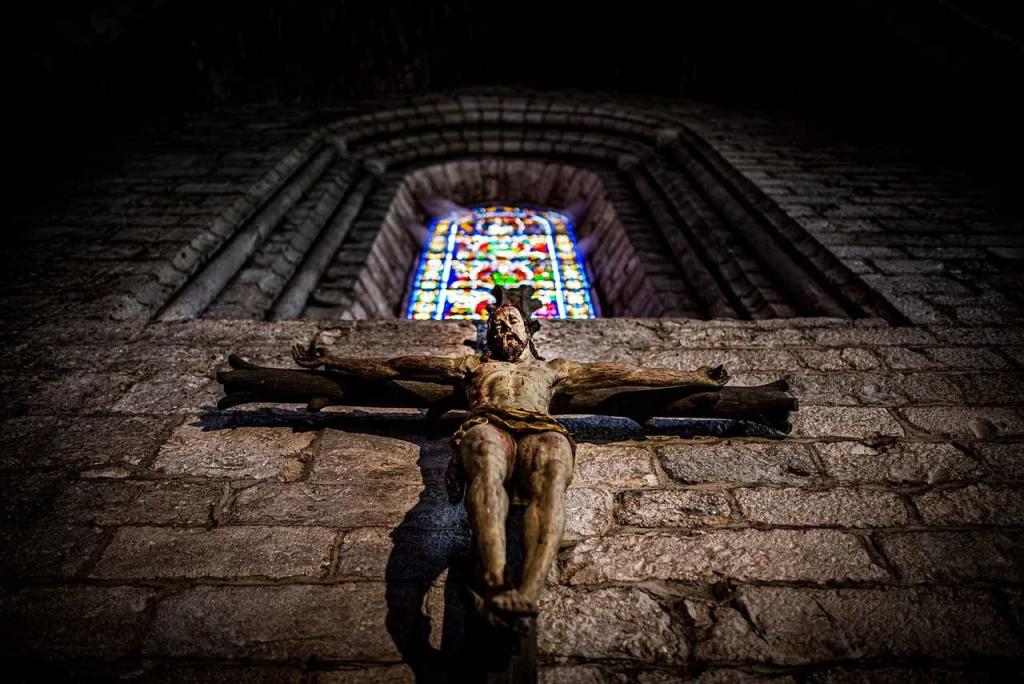
I still cannot reconcile the meaning of the death of Jesus on the cross, the atonement etc. with my evolving beliefs.
Thanks for taking the time to write, Allen, and I’m happy to share a few of my own thoughts in response.
As I read and re-read your words, I am reminded of a couple of quotations, one from John Lennon, the other from Rick Doblin.
John Lennon: “Jesus was all right, but his disciples were thick and ordinary. It’s them twisting it that ruins it for me.” This was part of his infamous “The Beatles are more famous than Jesus” interview, which got him into a lot of hot water at least in America. But frankly, he was saying in 1966 pretty much the same thing that my reader is saying now.
Rick Doblin: “Mysticism is the antidote to fundamentalism.” He is quoted saying this in Michael Pollan’s book How to Change Your Mind, and although Doblin is to the best of my knowledge not a particularly religious or spiritual person, I believe his insight holds true for any kind of mysticism, in response to any kind of fundamentalism.
And that seems to take me to the heart of what Allen is saying: that the beauty, power and wonder of Jesus’s message has become all but lost thanks to the “twisting” that the fundamentalist mindset, prevalent in authoritarian religion, does, effectively replacing Jesus’s message of unconditional love, radical inclusivity and equality with a much more dualistic message of moral legalism and a reward/punishment system presided over by an angry and judgmental image of God.
So how do we sort all this out?
First, I simply want to affirm what Alan is experiencing. I am hardly a fundamentalist, but nevertheless I feel the tension, too. I feel the tension whenever I read the ranting of a Christian nationalist on social media, or when I someone like Harrison Butker make sexist and anti-queer comments that just prove too many Christians are as “thick and ordinary” as ever.
I think it is good that people who love the radical teachings of Jesus feel the tension when we are confronted with the bigotry and judgmentalism of fundamentalism. That tension is a reminder that we who are committed to compassion, mercy, forgiveness, unconditional love, and mystical joy have to remember that not everyone sees the world the way we do — including not every Christian.
Yes, Allen, I agree. We are all essentially children of God: no exceptions. And like you, I am horrified that too many Christians seem to have forgotten this. Followers of Jesus, of all people, should know better.
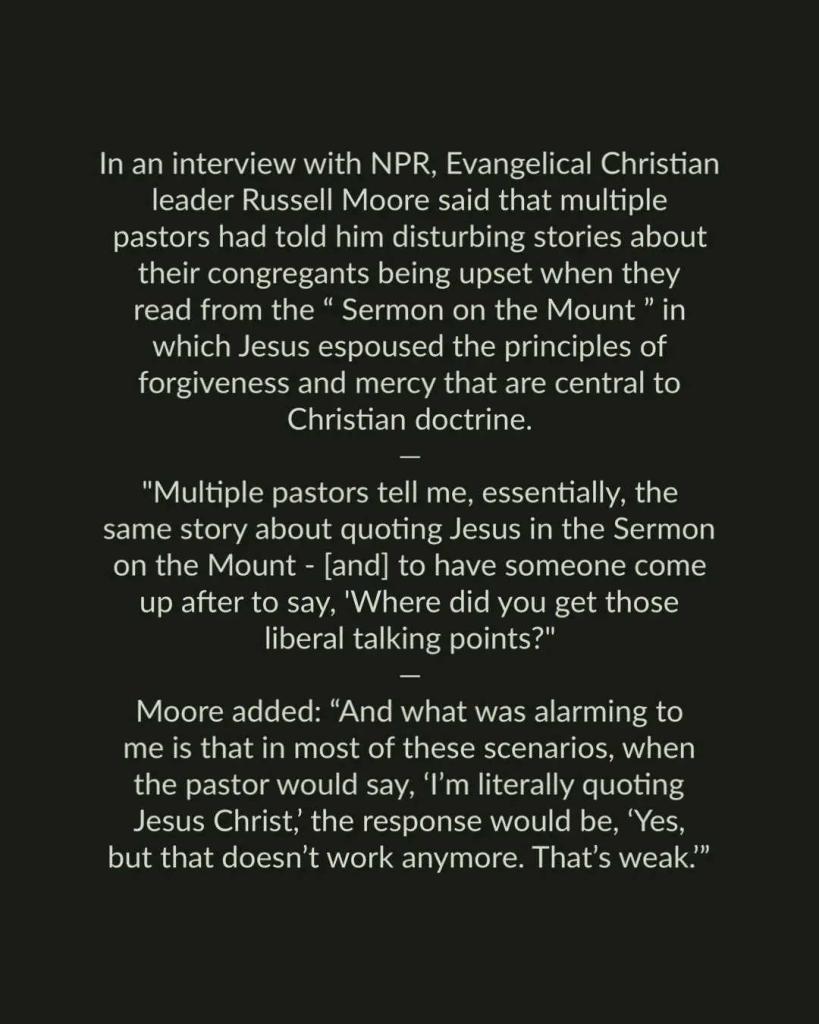
This reminds me of a meme I saw recently on Facebook. I don’t know if this is true or not, you know how memes are. I ‘d rather it not be true. But I worry that it is.
Duality and Nonduality
Allen ends his email to me by saying this:
My evolving beliefs see the world as a battle between consciousness and unconsciousness, symbolized by the duality of Good and Evil. I strongly believe in the reality of the risen Christ, but I perceive this presence as something far larger and more encompassing than traditional Christian narratives suggest. To me, Christ isn’t confined within the structures of Christian religion but is omnipresent—in everything and everywhere.
I still cannot reconcile the meaning of the death of Jesus on the cross, the atonement etc. with my evolving beliefs.
I certainly hope we can all promote consciousness over unconsciousness. Yes, “the risen Christ” is far bigger than what the churches proclaim. Yes, Christ cannot be confined to Christianity — or to any religion, creed, or dogma.
But reading these last sentences, I’d like to suggest to Allen that you still have a task ahead of you: an invitation that you might want to consider. Perhaps seeing things as a “battle” is getting in the way of this invitation. Christ’s death, after all, was the event that triggered his resurrection: no risen Christ without a crucified Christ. I am going to set aside for now theologies of the atonement. I believe Christianity, as a religion, began in trauma: the trauma of seeing our beloved leader brutally executed by an uncaring occupying force. Watching an innocent person suffer and die is traumatizing — and Christianity has been trying to make sense of the trauma of the cross for some two thousand years now.
As far as I’m concerned, theologies of the atonement are simply efforts that Christians have made over the centuries to try to make sense of the trauma of the cross. It seems to me that most atonement theories have big holes in them (why would a loving God require a death to prevent him from punishing the people he created and supposedly loves?), and that is probably because theology seems to be inherently dualistic — when we try to express our faith through language, we are limited by language, and find ourselves drawing distinctions (between God and not-God, between good and evil, heaven and hell, angels and demons, matter and spirit, life and death…) that seem to be inherent in language and doctrine. It has been said that a problem cannot be solved at the same level of consciousness that created it; philosophical dualism is a by-product of human language (our cognitive need to separate out categories like “good” and “bad”) and language (including doctrine and theology) cannot erase the dualism that emerges from the cognitive mind. We only find nondual consciousness and awareness through radical silence — beyond language. Which is why nondual teachers (like the Buddha, and I believe Jesus too, although the New Testament doesn’t document it) teach silent meditation as a way to access nondual consciousness.
So that’s the invitation for Alan (and all of us) — when we approach spirituality, religion, Christianity, etc. through the medium of language (including theology and even the writings of the mystics) we are left with binaries and dualities, from “good” and “evil” to “consciousness” and “unconsciousness” — or “the death of Christ” and “the risen Christ.” Only in the radical silence that we access by grace through contemplation do we begin to see where the crucified Christ and the risen Christ are “not-two” — and that even consciousness and unconsciousness share a unity (in God) that is greater than the separation that we normally experience on an earthly/human level. Nonduality is not about “anything goes” — evil is something we must fight, whether we do so dualistically or non-dualistically. But to oppose evil from a nondual place is to recognize that God is still present in all things, and therefore even those who perpetrate evil deserve compassion and fair treatment and the opportunity for reconciliation and restoration where appropriate. A dualistic opposition to evil just wants to destroy it (something we see all too often in our political discourse these days!)
So: how to reconcile the meaning of the death of Christ with the risen Christ? First, stop worrying about the “meaning” of it all. Simply rest in love. Then, seek through prayerful silence to be able to see all things through the grace and wisdom and love of God. When we see the crucifixion through the eyes of divine love, we don’t see “atonement” but we do see an infinite expression of love — that is one with the resurrection that follows it so quickly.
To Allen: thanks for a fascinating email for me to respond to! And I hope anyone who reads this has found something of interest to ponder.
Previous Post

May 19, 2024
The Difference Between Apophatic and Kataphatic Spirituality
Next Post

July 4, 2024 If You Worship an Angry God, You'll Be An Angry Person
Recent Comments
"This piece insightfully explores how psychedelic therapy can support both anxiety relief and spiritual growth. ..."
LSD, Anxiety, and Contemplation: Can Psychedelic ..."
"As I read your comment, I cannot help but suspect that you have misunderstood the ..."
If You Worship an Angry God, ..."
"Monotheists believe only one Deity exists, and whether angry or jolly it's not for us, ..."
If You Worship an Angry God, ..."
"Excellent article.People should remember, the Bible was written in an era when the theologians thought ..."
If You Worship an Angry God, ..."
Browse Our Archives
Select a Category Activism Announcements Art Books Catholicism Celtic Christianity Christian mysticism Christianity Contemplation Current events Etc. Family humor interfaith dialogue Interfaith Wisdom Interspirituality Lay Cistercians Living the Faith Meditation movies Mysticism Mystics nature Poetry Reviews Scripture silence Spirituality Uncategorized Writing
Select a Month February 2025 January 2025 November 2024 September 2024 August 2024 July 2024 June 2024 May 2024 March 2024 January 2024 December 2023 November 2023 August 2023 June 2023 April 2023 March 2023 February 2023 January 2023 December 2022 November 2022 October 2022 September 2022 August 2022 July 2022 June 2022 May 2022 April 2022 February 2022 January 2022 December 2021 November 2021 October 2021 September 2021 August 2021 July 2021 June 2021 May 2021 April 2021 March 2021 February 2021 January 2021 December 2020 November 2020 October 2020 September 2020 August 2020 July 2020 June 2020 May 2020 April 2020 March 2020 February 2020 January 2020 December 2019 November 2019 October 2019 September 2019 August 2019 July 2019 June 2019 May 2019 April 2019 March 2019 February 2019 January 2019 December 2018 November 2018 October 2018 September 2018 August 2018 July 2018 June 2018 May 2018 April 2018 March 2018 February 2018 January 2018 December 2017 November 2017 October 2017 September 2017 August 2017 July 2017 June 2017 May 2017 April 2017 March 2017 February 2017 January 2017 December 2016 November 2016 October 2016 September 2016 August 2016 July 2016 June 2016 May 2016 March 2016 February 2016 January 2016 December 2015 November 2015 October 2015 September 2015 August 2015 July 2015 June 2015 May 2015 April 2015 March 2015 February 2015 January 2015 December 2014 November 2014 October 2014 September 2014 August 2014 July 2014 June 2014 May 2014 April 2014 March 2014 February 2014 January 2014 December 2013 October 2013 September 2013 July 2013 May 2013 January 2013 December 2012 November 2012 August 2012 July 2012 June 2012 March 2012 December 2011 September 2011 October 2010 August 2010 March 2010 September 2009 July 2008 January 2008 December 2007 September 2007 February 2007 January 2007 December 2004
Follow Us!
TAKE THE
Religious Wisdom Quiz
What does "Apocalypse" mean in Greek?
Select your answer to see how you score.
Revelation The End God's Wrath Destruction
Support this
Column


Related posts from Carl McColman

Four Dimensions of Mindfulness and Centering Prayer

LSD, Anxiety, and Contemplation: Can Psychedelic Therapy Support...

Discover the Three Forms of Contemplation, according to...

Memento Mori: The Contemplation of Death and the...
TRENDING AT PATHEOS Contemplative

Handy Contemplative Practices for Political Spaces
A Spiritually Grounded Presence In order to bring a spiritually grounded presence...

Halloween: The Holiday of Loving Your Neighbor
All Hallows Eve Is Halloween the least Christian holiday in America, or...

Can Love Be Saved? Some Thoughts on the...
Happy Valentine's Day! I recently published a post on Patreon called Can...

"This Loving, Uniting Embrace": the Holy Ordinary
Today's guest post is by Mark Longhurst, author of The Holy Ordinary:...

How Are We Called to Live?: More About...
How Are We Called to Live? Many of us struggle with discerning...

A Spiritual Practice of Reading: Join Us Online
A Spiritual Practice of Reading A healthy spiritual practice of reading is...
view all Contemplative blogs
What Are Your Thoughts?leave a comment
Ad-Free & Subscriber Log-In Subscription Support
- About Us
- 2026 Calendar
- Videos
- Podcasts
- Library of World Religions
- Faith In Media Tracker
- Advertise With Us
- Write for Us
- Privacy Policy
- Terms of Service
- Do Not Sell My Data
- Contact Us
- Radiant Digital
- Manage Newsletter Subscriptions
- Unsubscribe From Notifications
- Sitemap
Copyright 2008-2026, Patheos. All rights reserved.
Subscription Support Ad-Free & Subscriber Log-In
Follow Patheos