
BuddhistCatholicContemplativeEvangelicalGeneral ChristianHinduJewishLatter-day SaintMuslimNew VisionsProgressive Christian
Beliefs
- Buddhist
- Catholic
- Contemplative
- Evangelical
- General Christian
- Hindu
- Jewish
- Latter-day Saint
- More Voices
- Muslim
- New Visions
- Pagan
- Progressive Christian
Topics
- Religion News
- Food and Religion
- Sports and Religion
- Religious Art
- Religious Music and Entertainment
- Religious Events
- History and Religion
- Style and Religion
- Politics and Religion
- Women in Religion
- Recreation Outdoors and Religion
- Business Finance and Religion
- Careers Workplace and Religion
- Education and Religion
- Family Parenting and Religion
- Health Fitness and Religion
- Home and Religion
- Relationships and Religion
- Technology and Religion
- Travel and Religion
Columnists
- Buddhist Columnists
- Business Finance and Religion Columnists
- Careers Workplace and Religion Columnists
- Catholic Columnists
- Contemplative Columnists
- Education and Religion Columnists
- Evangelists Columnists
- Family Parenting and Religion Columnists
- General Christian Columnists
- Health Fitness and Religion Columnists
- Hindu Columnists
- History and Religion Columnists
- Home and Religion Columnists
- Jewish Columnists
- More Voices Columnists
- Latter Day Columnists
- Muslim Columnists
- New Visions Columnists
- Nonreligious Columnists
- Pagan Columnists
- Politics and Religion Columnists
- Progressive Columnists
- Recreation Outdoors and Religion Columnists
- Relationships and Religion Columnists
- Religion News Columnists
- Religious Art Columnists
- Religious Events Columnists
- Religious Music and Entertainment Columnists
- Sports and Religion Columnists
- Style and Religion Columnists
- Technology and Religion Columnists
- Travel and Religion Columnists
- Women in Religion Columnists
Resource Library
- 2026 Calendar
- Library of World Religions
- The 100 Most Holy Places on Earth
- Patheos Answers
- Podcasts
- Videos
- Faith Leaders Database
- Anglican Episcopalian
- Bahai
- Baptist
- Buddhism
- Christianity
- Confucianism
- Eastern Orthodoxy
- Hinduism
- Holiness and Pentecostal
- ISKCON
- Islam
- Judaism
- Lutheran
- Methodist
- The Church of Jesus Christ of Latter-day Saints
- New Age
- Paganism
- Presbytarian and Reformed
- Protestantism
- Religion Behind the Scenes
- Roman Catholic
- Scientology
- Shia Islam
- Sikhism
- Sufism
- Sunni Islam
- Taoism
- Zen
- See all religions
Research Tools
 Ad-Free & Subscriber Log-In Subscription Support
Ad-Free & Subscriber Log-In Subscription Support
Follow Patheos 

- Trending:
- Forgiveness
- |
- Marriage
- |
- Consciousness
- |
- Death Penalty
- |
- Election
- |
- Halloween

- Home
- Contemplative
- Happy Birthday, Dawn Treader!
Happy Birthday, Dawn Treader!
Last updated on: September 15, 2022 at 8:23 am by Carl "Skye" McColman
Happy Birthday, Dawn Treader! 2022-09-15T08:23:34-04:00 Carl "Skye" McColman
Patheos Explore the world's faith through different perspectives on religion and spirituality! Patheos has the views of the prevalent religions and spiritualities of the world.
The year 1952 in England has gotten a lot of attention lately, with the passing of Queen Elizabeth II. Her seventy-year reign, the longest ever for a British monarch, began with the death of her father, King George VI, on February 6, 1952.
But on September 15 of that year, C. S. Lewis published the third of his seven Narnia books: The Voyage of the Dawn Treader. So happy birthday, Dawn Treader!
People who know me know that I love this book, which I consider a flawed masterpiece of Christian literature written for children (of all ages). Let’s get the “flawed” bits out of the way. Lewis was philosophically very much a Platonist, and that shapes the story, giving it an unfortunate feel of “to find God you must leave the world.” This works on two levels: the children who are the stars of the story — Lucy, Edmund and Eustace — leave our world (symbolized by their homeland, England), to embark upon their adventure in the magical land of Narnia, but then even in Narnia itself, the children accompanied by King Caspian and the crew of the good ship Dawn Treader have to sail to the very end of the world merely to get a glimpse of “Aslan’s Country” (for those uninitiated into the mysteries of Narnia, Aslan the Lion is the symbol for Christ in these tales). This is redeemed somewhat at the very end of the story, when Aslan tells the children, “For you the door into Aslan’s country is from your own world.” Granted, the idea of divine transcendence is a part of Christian mysticism and contemplative spirituality — but it’s only a part, it needs to be balanced with the paradoxical but equal true understanding that God/Christ/heaven are immanent, entirely present in our world, our bodies, our lives. So… The Voyage of the Dawn Treader tells a beautiful and wonderful story, but it’s built on an incomplete understanding of mystical theology, and that needs to be recognized.
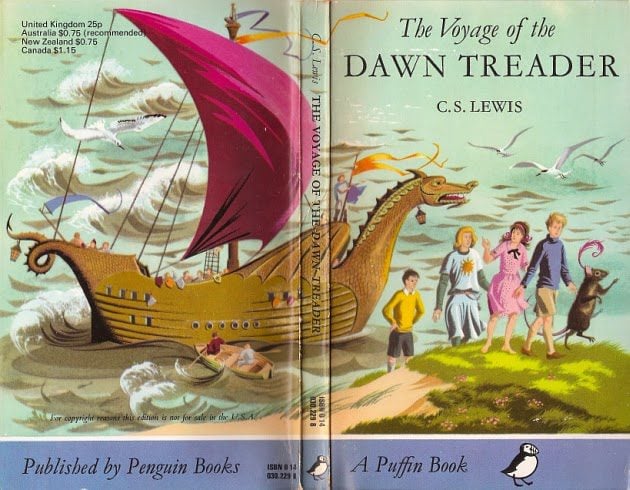
Cover art of “The Voyage of the Dawn Treader” by Pauline Baynes.
My other gripe with the book is a bit more prosaic, but it still needs to be mentioned. Lewis, very much a cultural conservative, tends to have a moralistic understanding of what “being a Christian” is all about, so much of the story’s conflict centers on the “naughtiness” of Eustace, and his eventual repentance and conversion after his greediness turns him into a dragon. Even worse, Lewis tries to jokingly pass off Eustace’s nastiness on the fact that his parents were “very up-to-date and advanced people. They were vegetarians, non-smokers and teetotalers and wore a special kind of underclothes.” I don’t know how being a vegetarian and a non-smoker gets equated with raising spoiled narcissistic children, but let’s just say that lame attempt at a joke has not aged well at all and now chiefly serves as a warning that Lewis is on some levels a prisoner of his own dualism. He was patriarchal, and lacked self-awareness regarding his own privilege and prejudices: in other words, a typical white man of the 1950s, and the book suffers because of it.
Okay, so the book has its imperfections. But it’s still a masterpiece. And that’s because it weaves together a charming (despite its flaws) children’s story with a subtle but obvious-if-you-know-what-you’re-looking-for overview of the Christian mystical life. Sailing from Narnia to Aslan’s Country on the Dawn Treader is a metaphor for the life of purification, illumination, and union with God; with all the key elements of such a lifelong journey: conversion, contrition, overcoming the ego, surrender, repentance/cleansing (a wonderful scene where Aslan tenderly bathes Eustace has clear baptismal overtones), discovering silence, the dark night of the soul, the Eucharist, and eventually ever-deepening immersion into serenity and light. The entire second half of the book is profoundly contemplative, and once Eustace gets over his spoiled-brat selfishness, the story doesn’t even have much in the way of conflict, beyond the internal struggles that we all face as we seek to move ever deeper into how we respond to divine love.
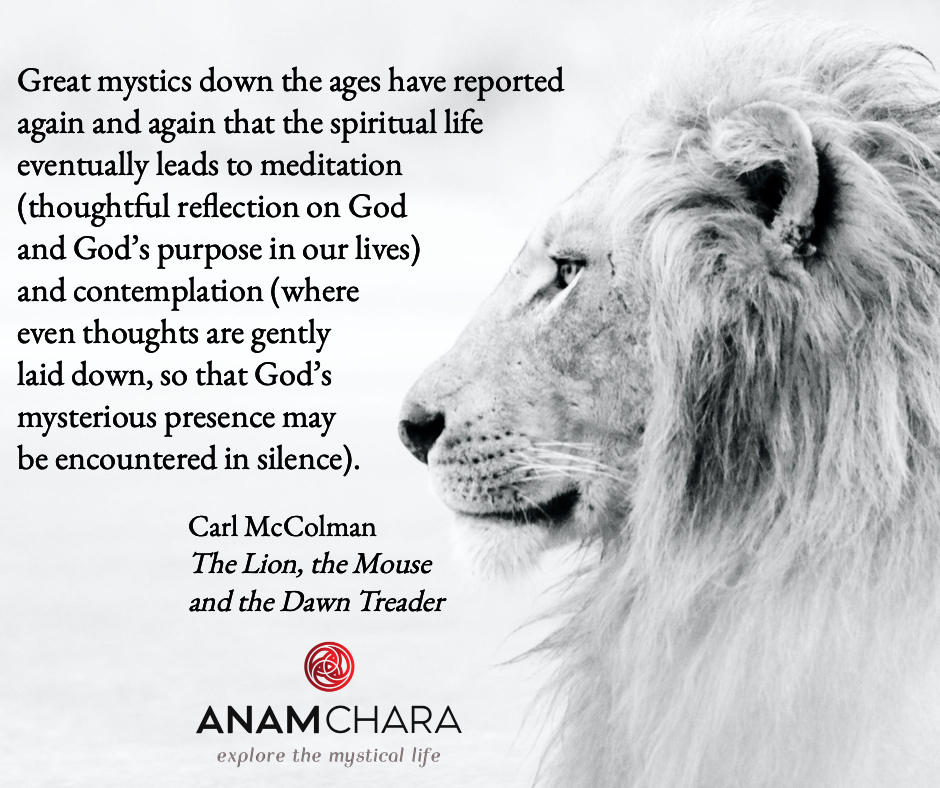
Lewis is a poetic and imaginative writer, and really shines in books like The Voyage of the Dawn Treader, Perelandra and Till We Have Faces when he attempts to describe the inexpressible. Consider this description of the first glimpse of Aslan’s country, as the children and their dear friend Reepicheep the talking mouse approach the culmination fo their quest:
None of them slept or ate. All that night and all next day they glided eastward, and when the third day dawned—with a brightness you or I could not bear even if we had dark glasses on—they saw a wonder ahead. It was as if a wall stood up between them and the sky, a greenish-gray, trembling, shimmering wall. Then up came the sun, and at its first rising they saw it through the wall and it turned into wonderful rainbow colors. Then they knew that the wall was really a long, tall wave—a wave endlessly fixed in one place as you may often see at the edge of a waterfall. It seemed to be about thirty feet high, and the current was gliding them swiftly toward it. You might have supposed they would have thought of their danger. They didn’t. I don’t think anyone could have in their position. For now they saw something not only behind the wave but behind the sun. They could not have seen even the sun if their eyes had not been strengthened by the water of the Last Sea. But now they could look at the rising sun and see it clearly and see things beyond it. What they saw—eastward, beyond the sun—was a range of mountains. It was so high that either they never saw the top of it or they forgot it. None of them remembers seeing any sky in that direction. And the mountains must really have been outside the world. For any mountains even a quarter of a twentieth of that height ought to have had ice and snow on them. But these were warm and green and full of forests and waterfalls however high you looked. And suddenly there came a breeze from the east, tossing the top of the wave into foamy shapes and ruffling the smooth water all round them. It lasted only a second or so but what it brought them in that second none of those three children will ever forget. It brought both a smell and a sound, a musical sound. Edmund and Eustace would never talk about it afterward. Lucy could only say, “It would break your heart.” “Why,” said I, “was it so sad?” “Sad!! No,” said Lucy.
Still very Platonic and one-sided… but oh so beautiful. May we all trust that our capacity to receive the heaven of divine love — which is not only beyond the world, but accessible in it — will be shaped by such beauty.
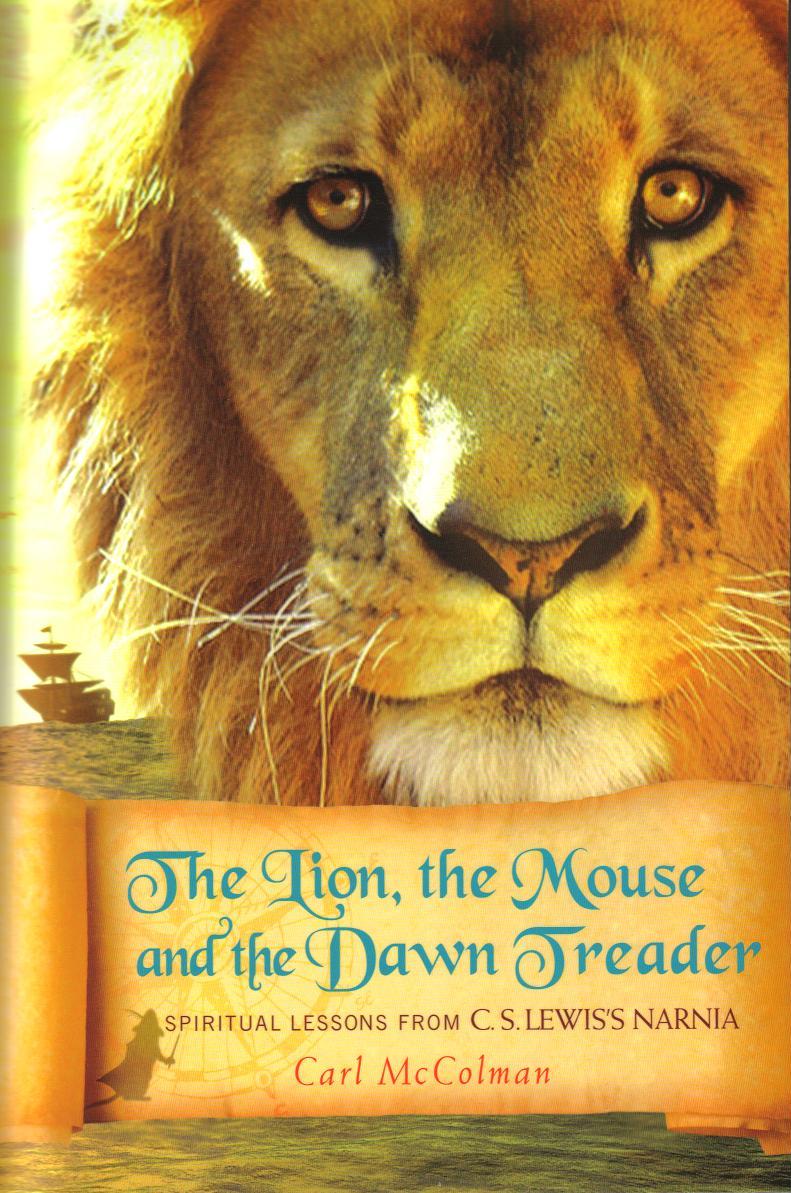
So happy birthday, Dawn Treader. I encourage you to go find your copy of the Narnia books and spend some time sailing those magical waters, today or sometime soon. And if you would like a bit more of my own insights into this wonderful book, check out my commentary: The Lion, the Mouse and the Dawn Treader: Spiritual Lessons from Narnia. The link takes you to Amazon, but you can also order an autographed copy from me by clicking here.
One last thought: in 2010 a major motion picture adaptation of The Voyage of the Dawn Treader was released, and a few years prior to that the BBC did an adaptation for television as part of an overall series of The Chronicles of Narnia. The BBC version is more faithful to the original story. I enjoyed both adaptations, but please, read the book first. This is a classic example of “the book is better”!

Next Post
September 24, 2022 Twelve Mystical Anthologies That Belong in Every Contemplative Library
Browse Our Archives
Select a Category Activism Announcements Art Books Catholicism Celtic Christianity Christian mysticism Christianity Contemplation Current events Etc. Family humor interfaith dialogue Interfaith Wisdom Interspirituality Lay Cistercians Living the Faith Meditation movies Mysticism Mystics nature Poetry Reviews Scripture silence Spirituality Uncategorized Writing
Select a Month February 2025 January 2025 November 2024 September 2024 August 2024 July 2024 June 2024 May 2024 March 2024 January 2024 December 2023 November 2023 August 2023 June 2023 April 2023 March 2023 February 2023 January 2023 December 2022 November 2022 October 2022 September 2022 August 2022 July 2022 June 2022 May 2022 April 2022 February 2022 January 2022 December 2021 November 2021 October 2021 September 2021 August 2021 July 2021 June 2021 May 2021 April 2021 March 2021 February 2021 January 2021 December 2020 November 2020 October 2020 September 2020 August 2020 July 2020 June 2020 May 2020 April 2020 March 2020 February 2020 January 2020 December 2019 November 2019 October 2019 September 2019 August 2019 July 2019 June 2019 May 2019 April 2019 March 2019 February 2019 January 2019 December 2018 November 2018 October 2018 September 2018 August 2018 July 2018 June 2018 May 2018 April 2018 March 2018 February 2018 January 2018 December 2017 November 2017 October 2017 September 2017 August 2017 July 2017 June 2017 May 2017 April 2017 March 2017 February 2017 January 2017 December 2016 November 2016 October 2016 September 2016 August 2016 July 2016 June 2016 May 2016 March 2016 February 2016 January 2016 December 2015 November 2015 October 2015 September 2015 August 2015 July 2015 June 2015 May 2015 April 2015 March 2015 February 2015 January 2015 December 2014 November 2014 October 2014 September 2014 August 2014 July 2014 June 2014 May 2014 April 2014 March 2014 February 2014 January 2014 December 2013 October 2013 September 2013 July 2013 May 2013 January 2013 December 2012 November 2012 August 2012 July 2012 June 2012 March 2012 December 2011 September 2011 October 2010 August 2010 March 2010 September 2009 July 2008 January 2008 December 2007 September 2007 February 2007 January 2007 December 2004
Follow Us!
TAKE THE
Religious Wisdom Quiz
Who was known for interpreting dreams in Babylon?
Select your answer to see how you score.
Moses Daniel Joseph David
Support this
Column


Related posts from Carl McColman

You don't have to become a monk to...

LSD, Anxiety, and Contemplation: Can Psychedelic Therapy Support...

Mysticism, Faith, and "Knowing" God's Will

TRENDING AT PATHEOS Contemplative

Handy Contemplative Practices for Political Spaces
A Spiritually Grounded Presence In order to bring a spiritually grounded presence...

Halloween: The Holiday of Loving Your Neighbor
All Hallows Eve Is Halloween the least Christian holiday in America, or...

Can Love Be Saved? Some Thoughts on the...
Happy Valentine's Day! I recently published a post on Patreon called Can...

"This Loving, Uniting Embrace": the Holy Ordinary
Today's guest post is by Mark Longhurst, author of The Holy Ordinary:...

How Are We Called to Live?: More About...
How Are We Called to Live? Many of us struggle with discerning...

A Spiritual Practice of Reading: Join Us Online
A Spiritual Practice of Reading A healthy spiritual practice of reading is...
view all Contemplative blogs
Ad-Free & Subscriber Log-In Subscription Support
- About Us
- 2026 Calendar
- Videos
- Podcasts
- Library of World Religions
- Faith In Media Tracker
- Advertise With Us
- Write for Us
- Privacy Policy
- Terms of Service
- Do Not Sell My Data
- Contact Us
- Radiant Digital
- Manage Newsletter Subscriptions
- Unsubscribe From Notifications
- Sitemap
Copyright 2008-2026, Patheos. All rights reserved.
Subscription Support Ad-Free & Subscriber Log-In
Follow Patheos