
BuddhistCatholicContemplativeEvangelicalGeneral ChristianHinduJewishLatter-day SaintMuslimNew VisionsProgressive Christian
Beliefs
- Buddhist
- Catholic
- Contemplative
- Evangelical
- General Christian
- Hindu
- Jewish
- Latter-day Saint
- More Voices
- Muslim
- New Visions
- Pagan
- Progressive Christian
Topics
- Religion News
- Food and Religion
- Sports and Religion
- Religious Art
- Religious Music and Entertainment
- Religious Events
- History and Religion
- Style and Religion
- Politics and Religion
- Women in Religion
- Recreation Outdoors and Religion
- Business Finance and Religion
- Careers Workplace and Religion
- Education and Religion
- Family Parenting and Religion
- Health Fitness and Religion
- Home and Religion
- Relationships and Religion
- Technology and Religion
- Travel and Religion
Columnists
- Buddhist Columnists
- Business Finance and Religion Columnists
- Careers Workplace and Religion Columnists
- Catholic Columnists
- Contemplative Columnists
- Education and Religion Columnists
- Evangelists Columnists
- Family Parenting and Religion Columnists
- General Christian Columnists
- Health Fitness and Religion Columnists
- Hindu Columnists
- History and Religion Columnists
- Home and Religion Columnists
- Jewish Columnists
- More Voices Columnists
- Latter Day Columnists
- Muslim Columnists
- New Visions Columnists
- Nonreligious Columnists
- Pagan Columnists
- Politics and Religion Columnists
- Progressive Columnists
- Recreation Outdoors and Religion Columnists
- Relationships and Religion Columnists
- Religion News Columnists
- Religious Art Columnists
- Religious Events Columnists
- Religious Music and Entertainment Columnists
- Sports and Religion Columnists
- Style and Religion Columnists
- Technology and Religion Columnists
- Travel and Religion Columnists
- Women in Religion Columnists
Resource Library
- 2026 Calendar
- Library of World Religions
- The 100 Most Holy Places on Earth
- Patheos Answers
- Podcasts
- Videos
- Faith Leaders Database
- Anglican Episcopalian
- Bahai
- Baptist
- Buddhism
- Christianity
- Confucianism
- Eastern Orthodoxy
- Hinduism
- Holiness and Pentecostal
- ISKCON
- Islam
- Judaism
- Lutheran
- Methodist
- The Church of Jesus Christ of Latter-day Saints
- New Age
- Paganism
- Presbytarian and Reformed
- Protestantism
- Religion Behind the Scenes
- Roman Catholic
- Scientology
- Shia Islam
- Sikhism
- Sufism
- Sunni Islam
- Taoism
- Zen
- See all religions
Research Tools
 Ad-Free & Subscriber Log-In Subscription Support
Ad-Free & Subscriber Log-In Subscription Support
Follow Patheos 

- Trending:
- Forgiveness
- |
- Marriage
- |
- Consciousness
- |
- Death Penalty
- |
- Election
- |
- Halloween

- Home
- Contemplative
- Even Your Breath Can Be Your “Sacred Word”
Even Your Breath Can Be Your “Sacred Word”
Last updated on: July 22, 2021 at 6:51 pm by Carl "Skye" McColman
Even Your Breath Can Be Your “Sacred Word” 2021-07-22T18:51:06-04:00 Carl "Skye" McColman
Patheos Explore the world's faith through different perspectives on religion and spirituality! Patheos has the views of the prevalent religions and spiritualities of the world.
A reader of this blog submitted this question:
How explicitly Christian does the prayer word need to be in contemplative prayer (e.g., Centering Prayer)?
My quiet-time practice is a hybrid of Lectio Divina with the Liturgy of the Hours. “No problem” with the three discursive steps of Lectio, but when I get to the non-discursive contemplatio, I struggle with monkey brain… Frankly, zazen’s breath counting “works” best for me over the years. I’ve tried using the Jesus Prayer, infused with my breathing. But I find that still too discursive (maybe I need to try it for more than six weeks?).
Thanks!
I know this is a technique question. But technique is what is getting in the way for me. Is zazen breath counting problematic for a Christian practitioner?
Thanks for your question. Here’s the short answer: yes, even your breath can function as your “sacred word.”
A Centering Prayer presenter who worked closely with Father Thomas Keating, David Frenette, wrote a lovely book called The Path of Centering Prayer: Deepening Your Experience of God. It’s well worth reading. As you might expect from a close associate of Keating, Frenette offers a fairly straightforward approach to the practice of silent prayer, consistent with the guidelines for Centering Prayer developed by Keating and Contemplative Outreach. But he is clear that the concept of the “sacred word” needs to be understood in as broad a way as possible. Thus, in addition to an actual word that we can silently recite whenever we find ourselves distracted by thought, Frenette offers insight into how we can deepen our prayer practice, not only with a word, but also with the breath, or a glance (as at a candle or an icon), or even the sheer experience of spacious silence, as types of “sacred words.” Devoting an entire chapter to “Deepening the Sacred Breath,” he writes:
…while the basic teaching on centering prayer generally focuses on the use of the sacred word, it is also possible to practice with other sacred symbols, including the sacred breath. Because the breath is such an embodied and receptive symbol, many people are drawn to practicing centering prayer with the sacred breath at certain seasons of the spiritual journey, to help with the deepening of their prayer into contemplation and as a way of integrating and embodying their spiritual practice with their physical, human experience.
This is not necessarily the same method as counting one’s breath, which is a common instruction for zazen. Technically speaking, if one is counting one’s breath, then the actual counting itself functions as the sacred word (one, two, three, etc.), rather than simply the breath itself. Remember, the sacred word is simply a gentle point of attention to which we can return whenever we are distracted during prayer by random thoughts, feelings, sensations or daydreams. Since any word can be used as your sacred word — it doesn’t have to be an explicitly religious or spiritual word — it’s certainly fine to use counting your breath in this way. But what Frenette is offering is something a bit more radical: allowing the breath itself to be that gentle point of attention, to which we return our focal point of awareness whenever the monkey-mind has become distracted.
This is not easy, and it might not be the best approach for beginners at centering prayer. A word, compared to the breath, might be an easier “anchor” for the awareness. But seasoned practitioners of centering prayer sometimes find that even a silently recited word feels distracting. As we learn to more stably remain attentive to objectless silence in our prayer, we may find that we need a more “silent” way of retrieving the wandering mind, when it wanders. Learning to simply place our attention on the breath — and to return it to the breath, as often as needed — can be a beautiful, deeply silent, ultimately very spacious practice of praying silently.
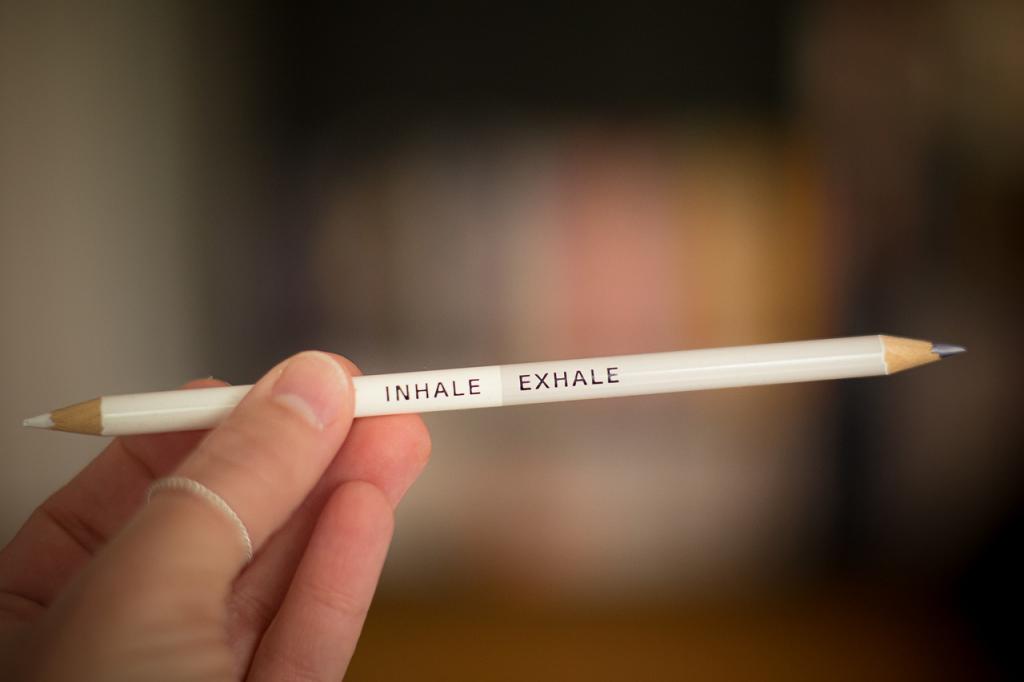
It may be helpful here to remind ourselves that centering prayer, unlike many other forms of meditative practice, does not use the sacred word as a mantra. In other words, the point is not simply to keep reciting the sacred word for the duration of your prayer time. Rather, you simply introduce the sacred word when, and only when, you notice that you have become distracted by thoughts, feelings, etc. It often happens, even to relative beginners, that we reach a graced place of simple, silent, objectless awareness as we pray. When that happens, the sacred word seems to simply fall away — and that is exactly what we are invited to do! Alas, such moments of graced silence often do not last very long — the thoughts keep wandering in to our awareness, like boats floating down a river, to use Keating’s famous analogy. So when we get caught up in another thought, which inevitably will happen, that’s when we return to the sacred word (or the attentiveness to the sacred breath*. And only then*.
Of course, the beauty of placing one’s attention on one’s breath during silent prayer is that we keep breathing, even when our attention is distracted… so in a way, the breath is very much like a mantra. But our engagement with the breath, like any other “sacred word,” is meant to be gentle, light, and spacious. We attend to it as much as we need to. At times, our attention to the breath may shade off into a more vast, objectless awareness, which is the true heart of the centering prayer. We’re still breathing of course, but it’s no longer the center of our attention. And then, along comes a thought, and noticing that, we return our attention to the breath. And this cycle of random thought > attentiveness to the breath or sacred word > graced moment of pure objectless awareness until distracted by another random thought continues for the duration of the centering prayer process.
So back to my reader. If counting your breath is the best sacred word for you, then count away. I also invite you to try to take your practice a bit deeper, by seeing if even the counting can be released, allowing simply the breath — our embodied sacrament of the presence of the Holy Spirit in your heart — to be your guide.
Enjoy reading this blog?
Click here to become a patron.

Previous Post

June 24, 2021
Come to the Eternal Heart Publication Day Celebration — June 29, 2021!
Next Post

July 28, 2021 How Do Contemplatives Make a Difference?
Browse Our Archives
Select a Category Activism Announcements Art Books Catholicism Celtic Christianity Christian mysticism Christianity Contemplation Current events Etc. Family humor interfaith dialogue Interfaith Wisdom Interspirituality Lay Cistercians Living the Faith Meditation movies Mysticism Mystics nature Poetry Reviews Scripture silence Spirituality Uncategorized Writing
Select a Month February 2025 January 2025 November 2024 September 2024 August 2024 July 2024 June 2024 May 2024 March 2024 January 2024 December 2023 November 2023 August 2023 June 2023 April 2023 March 2023 February 2023 January 2023 December 2022 November 2022 October 2022 September 2022 August 2022 July 2022 June 2022 May 2022 April 2022 February 2022 January 2022 December 2021 November 2021 October 2021 September 2021 August 2021 July 2021 June 2021 May 2021 April 2021 March 2021 February 2021 January 2021 December 2020 November 2020 October 2020 September 2020 August 2020 July 2020 June 2020 May 2020 April 2020 March 2020 February 2020 January 2020 December 2019 November 2019 October 2019 September 2019 August 2019 July 2019 June 2019 May 2019 April 2019 March 2019 February 2019 January 2019 December 2018 November 2018 October 2018 September 2018 August 2018 July 2018 June 2018 May 2018 April 2018 March 2018 February 2018 January 2018 December 2017 November 2017 October 2017 September 2017 August 2017 July 2017 June 2017 May 2017 April 2017 March 2017 February 2017 January 2017 December 2016 November 2016 October 2016 September 2016 August 2016 July 2016 June 2016 May 2016 March 2016 February 2016 January 2016 December 2015 November 2015 October 2015 September 2015 August 2015 July 2015 June 2015 May 2015 April 2015 March 2015 February 2015 January 2015 December 2014 November 2014 October 2014 September 2014 August 2014 July 2014 June 2014 May 2014 April 2014 March 2014 February 2014 January 2014 December 2013 October 2013 September 2013 July 2013 May 2013 January 2013 December 2012 November 2012 August 2012 July 2012 June 2012 March 2012 December 2011 September 2011 October 2010 August 2010 March 2010 September 2009 July 2008 January 2008 December 2007 September 2007 February 2007 January 2007 December 2004
Follow Us!
TAKE THE
Religious Wisdom Quiz
What is the main literary style of Psalms and Proverbs?
Select your answer to see how you score.
Apocalypse Prophecy Poetry Historical narrative
Support this
Column


Related posts from Carl McColman

"This Loving, Uniting Embrace": the Holy Ordinary

Four Dimensions of Mindfulness and Centering Prayer

I Believe Prayer Changes Things. Here's a Few...

If You Worship an Angry God, You'll Be...
TRENDING AT PATHEOS Contemplative

Handy Contemplative Practices for Political Spaces
A Spiritually Grounded Presence In order to bring a spiritually grounded presence...

Halloween: The Holiday of Loving Your Neighbor
All Hallows Eve Is Halloween the least Christian holiday in America, or...

Can Love Be Saved? Some Thoughts on the...
Happy Valentine's Day! I recently published a post on Patreon called Can...

"This Loving, Uniting Embrace": the Holy Ordinary
Today's guest post is by Mark Longhurst, author of The Holy Ordinary:...

How Are We Called to Live?: More About...
How Are We Called to Live? Many of us struggle with discerning...

A Spiritual Practice of Reading: Join Us Online
A Spiritual Practice of Reading A healthy spiritual practice of reading is...
view all Contemplative blogs
Ad-Free & Subscriber Log-In Subscription Support
- About Us
- 2026 Calendar
- Videos
- Podcasts
- Library of World Religions
- Faith In Media Tracker
- Advertise With Us
- Write for Us
- Privacy Policy
- Terms of Service
- Do Not Sell My Data
- Contact Us
- Radiant Digital
- Manage Newsletter Subscriptions
- Unsubscribe From Notifications
- Sitemap
Copyright 2008-2026, Patheos. All rights reserved.
Subscription Support Ad-Free & Subscriber Log-In
Follow Patheos