
BuddhistCatholicContemplativeEvangelicalGeneral ChristianHinduJewishLatter-day SaintMuslimNew VisionsProgressive Christian
Beliefs
- Buddhist
- Catholic
- Contemplative
- Evangelical
- General Christian
- Hindu
- Jewish
- Latter-day Saint
- More Voices
- Muslim
- New Visions
- Pagan
- Progressive Christian
Topics
- Religion News
- Food and Religion
- Sports and Religion
- Religious Art
- Religious Music and Entertainment
- Religious Events
- History and Religion
- Style and Religion
- Politics and Religion
- Women in Religion
- Recreation Outdoors and Religion
- Business Finance and Religion
- Careers Workplace and Religion
- Education and Religion
- Family Parenting and Religion
- Health Fitness and Religion
- Home and Religion
- Relationships and Religion
- Technology and Religion
- Travel and Religion
Columnists
- Buddhist Columnists
- Business Finance and Religion Columnists
- Careers Workplace and Religion Columnists
- Catholic Columnists
- Contemplative Columnists
- Education and Religion Columnists
- Evangelists Columnists
- Family Parenting and Religion Columnists
- General Christian Columnists
- Health Fitness and Religion Columnists
- Hindu Columnists
- History and Religion Columnists
- Home and Religion Columnists
- Jewish Columnists
- More Voices Columnists
- Latter Day Columnists
- Muslim Columnists
- New Visions Columnists
- Nonreligious Columnists
- Pagan Columnists
- Politics and Religion Columnists
- Progressive Columnists
- Recreation Outdoors and Religion Columnists
- Relationships and Religion Columnists
- Religion News Columnists
- Religious Art Columnists
- Religious Events Columnists
- Religious Music and Entertainment Columnists
- Sports and Religion Columnists
- Style and Religion Columnists
- Technology and Religion Columnists
- Travel and Religion Columnists
- Women in Religion Columnists
Resource Library
- 2026 Calendar
- Library of World Religions
- The 100 Most Holy Places on Earth
- Patheos Answers
- Podcasts
- Videos
- Faith Leaders Database
- Anglican Episcopalian
- Bahai
- Baptist
- Buddhism
- Christianity
- Confucianism
- Eastern Orthodoxy
- Hinduism
- Holiness and Pentecostal
- ISKCON
- Islam
- Judaism
- Lutheran
- Methodist
- The Church of Jesus Christ of Latter-day Saints
- New Age
- Paganism
- Presbytarian and Reformed
- Protestantism
- Religion Behind the Scenes
- Roman Catholic
- Scientology
- Shia Islam
- Sikhism
- Sufism
- Sunni Islam
- Taoism
- Zen
- See all religions
Research Tools
 Ad-Free & Subscriber Log-In Subscription Support
Ad-Free & Subscriber Log-In Subscription Support
Follow Patheos 

- Trending:
- Forgiveness
- |
- Marriage
- |
- Consciousness
- |
- Death Penalty
- |
- Election
- |
- Halloween

- Home
- Contemplative
- Companionship as a Key to the Spiritual Life: Therese Schroeder-Sheker Reflects on “Eternal Heart”
Companionship as a Key to the Spiritual Life: Therese Schroeder-Sheker Reflects on “Eternal Heart”
Last updated on: June 21, 2021 at 1:04 am by Guest Contributor
Companionship as a Key to the Spiritual Life: Therese Schroeder-Sheker Reflects on “Eternal Heart” 2021-06-21T01:04:37-04:00 Guest Contributor
Patheos Explore the world's faith through different perspectives on religion and spirituality! Patheos has the views of the prevalent religions and spiritualities of the world.
N.B. Today’s guest post is by noted musician and thanatologist Therese Schroeder-Sheker. She wrote this piece in response to Carl McColman’s latest book, Eternal Heart.
I remember seeing an exquisite painting in a small private gallery in Brussels many years ago. Two souls were walking together side by side as the sun was setting in the west. Their heads were bowed, slightly inclined toward one another, and their glowing hands gestured gracefully like birds held aloft in mid-air. It seemed to me that something almost palpable was streaming from the painter’s canvas. Perhaps it was the intimacy of shared dialogue or maybe it was the tranquility generated from such noble mutuality, but either way, the image not only made my heart leap. It befriended me, embedded itself in me. I am not describing a sympathetic response to a pleasing aesthetic. Those tend to come and go speedily on the currents of emotion and unconscious cultural conditioning. No. This painterly image was speaking of something eternal, and everything about it activated an interior recollection, offering much about the unity of the three Transcendentals: Truth, Beauty and Goodness. When they are woven together in a single framework, they move mountains and sustain life.
Drawing close to this luminous source, I discovered that the painter had chosen to reference the work as Tobias and Raphael Walking Together at Dusk. The narrative of Tobias and Raphael is found in the Book of Tobit and tells a story of transformative healing. In it, the Archangel Raphael lovingly chooses to disguise himself as a human being so that two could speak with one another in trust, “shoulder-to-shoulder,” listening and responding. Conversation occurred organically, naturally, wisdom stirring amidst breathing cadences, silences and sounds. Raphael walks alongside the ailing Tobias and offers the exact kind of encouragement needed to help him heal and repair the gaps of his imperfect life.
During the last six-hundred years, this vision of the two walking together in sundown’s transformative communion has been taken up by many artists. Even so, the painting in front of me that day thirty-some years ago was a 20th century imagination, almost a vision, and I am so sorry that I cannot remember the name of the painter, nor can I find the image from any on-line search.
Regardless, that transcendent painting allowed me to remember how both Pythagorean and Christian Traditions once espoused the wisdom of walking together, two-by-two, shoulder-to-shoulder, rhythmically. Companions would walk together outside; they would walk in Nature, moving through forested groves, or across quiet fields, alongside lapping shorelines or over rugged landscapes. Two would walk together as part and parcel of a spiritual praxis and their mutually fructifying conversation allowed something new to come into being and sight. The walking cure invited a full spectrum of risking, trusting, uttering, listening, responding, questioning, grappling, suggesting, nurturing and encouraging. How powerfully true and intimate this time-honored embodiment of the intelligence of the heart. Two meet one another and grapple together over paradox and mystery, meaning and ultimacy, vulnerability and radiance, strength and tenderness, success and failure. The companions share affliction and the bread of insight.
The philosophical or theological debate from which so many of us emerge takes place in the confines of the beige-colored harshly lit classroom. Debate accommodates many people at the same time, emphasizes expertise, lauds brilliance, rewards competition, and begins and ends by the strict ticking of the clock. Nearby, a dean, abbot or abbess might have a fireside chat for a select few, the most promising and hardworking of the current students and emerging novices. Finally, we have the sermon. It is delivered from a raised platform or pulpit inside the enclosed church or synagogue. No matter how pastoral or inspired, the priest or rabbi stands. While vertical and elevated, the homilist speaks to a seated congregation. The listeners below, clustered with family, friends, neighbors, and dotted with solitary strangers have this in common: each receives the living word in silence. Some are fully awake and thoughtfully engaged, while famously, a few almost always snooze or let preoccupied thoughts wander. Such models offer the world much yet operate within institutional needs and collectives.
How different the soul’s companionship. The footsteps of two tread the earth in open friendship, treading at the same pace, at the same elevation, and gradually, synchronization takes place. The originally separate drumming of heartbeat and pulse begin to transform because the two companions are breathing together. The originally differentiated circulatory systems begin to harmonize, and as attunement begins to unfold, a mysterious third possibility emerges. Some would even say that the mysterious presence of the third takes place. No wonder St. Augustine said “Solvitur ambulando” – it is solved by walking.
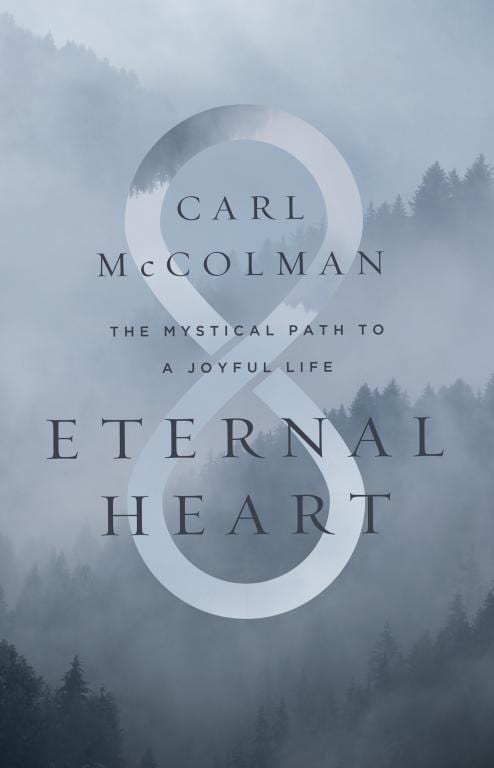
By the time you have completed reading the fourth chapter of Carl McColman’s Eternal Heart, you may discover that you can hear his voice and that you are being accompanied! His modest, warm, gracious companionship fills your room not only because he reflects upon things that matter but because his eight chapters emerge naturally. The voice is authentic, resounding at a breathing tempo, at a walking pace, not unlike when two are shoulder-to-shoulder, in loving and thoughtful sustained conversation. His reflections sound at the octave rather than at a tonic, because they are born from embodied and ensouled human experience. Ambitious scholarly summations, talking heads abstraction and doctrinaire rigidity are absent from these pages, and instead, the author is at peace with referring sometimes to one of the historical exemplars in the same way that a painter might introduce a single brushstroke or a nuanced hue to draw attention to and amplify a certain reality.
Precisely because of the quality of his ability to companion, McColman demonstrates and integrates the wisdom born of his own movement through the sacrament of failure. He does this while avoiding the sensationalism of extravagant disclosure. Exploring themes as lofty as infinity, as complex as discernment, as deep as silence or forgiveness, as creative as hospitality, as uncomfortable as stinginess, as timeless as love, he quietly, lovingly, naturally, rhythmically and prayerfully introduces readers to profound themes, practical exercises and beloved friends. He brings us those people whom he has taken into his own heart and life, and to whom he has given of himself, at times, at great cost. He also shares with us those praxes which have been personally purifying, transformative and regenerative. His friends include the Greeks, the Jews, the Christians, the Buddhists, Cistercians, Trappists, Benedictines and more. They include Plotinus, Julian of Norwich, Ignatius of Loyola, Benedict, Augustine, Abraham Joshua Heschel, Thomas Merton, William Blake, Paramahansa Yogananda, Sylvia Boorstein, Caryll Houselander, Rabbi Zalman Schacter, the prophets, the saints, the faithful, all of whom are ultimately and gloriously subversive.
Like that painting on the wall that depicted how the archangel once descended to companion a human, Eternal Heart is a work of humanly sung companionship. The year 2021 may seem to operate at the crossroads of urgency and probation, so this book is as timely as it is transcendent. The author reminds us that becoming more truly human is not only the first step toward the mystical vocation; it is the primary practical assignment of life on earth and the first step toward a fruitful and contemporary holiness. I am writing these words amidst the pandemic; all norms have been disrupted. Many across the globe have entered solitude by choice and by default, and many are searching deeply, wanting to recalibrate, in need of an extended spiritual retreat. Sister Wendy Becket once described prayer as God’s taking possession of us. “We expose Him,“ she said, “to what we are, and He gazes on us with the creative eye of Holy Love.” My sense of things is that Carl McColman’s open door and warm companionship will direct many sincere readers to a radical rediscovery of essentials both mystical and transcendent. Read this unpretentious book slowly and prayerfully. It teaches metanoia and kenosis in the most practical ways. Enter into sustained conversation with the author, as if you were walking together with him in a meadow. The influence of the healing angel who can help us repair our fragmentation can be found in these quiet pages, precisely because of the creative eye of holy love, an ensouled capacity that Carl McColman inhabits and shares with all.
— Therese Schroeder-Sheker, Candlemas 2021.
 About the Author: Harpist, singer and composer Therese Schroeder-Sheker has devoted more than forty years to serving the physical and spiritual needs of the dying with prescriptive music. Ms. Schroeder-Sheker founded the palliative medical modality of music-thanatology and The Chalice of Repose Project, the first music-thanatology organization in the world. Her beautiful and award-winning recordings include The Queen’s Minstrel, Rosa Mystica, and The Geography of the Soul. She is the author of Transitus: A Blessed Death in the Modern World. As the title of that book suggests, her work has a contemplative dimension that explores how music can be a gift to those who are dying or in hospice or palliative care.
Previous Post
May 24, 2021
Union, Intimacy, and Love: the Dynamics of Christian Mysticism
Next Post

June 24, 2021 Come to the Eternal Heart Publication Day Celebration — June 29, 2021!
Browse Our Archives
Select a Category Activism Announcements Art Books Catholicism Celtic Christianity Christian mysticism Christianity Contemplation Current events Etc. Family humor interfaith dialogue Interfaith Wisdom Interspirituality Lay Cistercians Living the Faith Meditation movies Mysticism Mystics nature Poetry Reviews Scripture silence Spirituality Uncategorized Writing
Select a Month February 2025 January 2025 November 2024 September 2024 August 2024 July 2024 June 2024 May 2024 March 2024 January 2024 December 2023 November 2023 August 2023 June 2023 April 2023 March 2023 February 2023 January 2023 December 2022 November 2022 October 2022 September 2022 August 2022 July 2022 June 2022 May 2022 April 2022 February 2022 January 2022 December 2021 November 2021 October 2021 September 2021 August 2021 July 2021 June 2021 May 2021 April 2021 March 2021 February 2021 January 2021 December 2020 November 2020 October 2020 September 2020 August 2020 July 2020 June 2020 May 2020 April 2020 March 2020 February 2020 January 2020 December 2019 November 2019 October 2019 September 2019 August 2019 July 2019 June 2019 May 2019 April 2019 March 2019 February 2019 January 2019 December 2018 November 2018 October 2018 September 2018 August 2018 July 2018 June 2018 May 2018 April 2018 March 2018 February 2018 January 2018 December 2017 November 2017 October 2017 September 2017 August 2017 July 2017 June 2017 May 2017 April 2017 March 2017 February 2017 January 2017 December 2016 November 2016 October 2016 September 2016 August 2016 July 2016 June 2016 May 2016 March 2016 February 2016 January 2016 December 2015 November 2015 October 2015 September 2015 August 2015 July 2015 June 2015 May 2015 April 2015 March 2015 February 2015 January 2015 December 2014 November 2014 October 2014 September 2014 August 2014 July 2014 June 2014 May 2014 April 2014 March 2014 February 2014 January 2014 December 2013 October 2013 September 2013 July 2013 May 2013 January 2013 December 2012 November 2012 August 2012 July 2012 June 2012 March 2012 December 2011 September 2011 October 2010 August 2010 March 2010 September 2009 July 2008 January 2008 December 2007 September 2007 February 2007 January 2007 December 2004
Follow Us!
TAKE THE
Religious Wisdom Quiz
What happened to Lot's wife as they fled Sodom?
Select your answer to see how you score.
She fell into a well She died by fire She became blind She turned into a pillar of salt
Support this
Column


Related posts from Carl McColman

Contemplative Books to Read and Savor During Advent...

New From Encountering Silence: Exploring the Lost History...
Twelve Mystical Anthologies That Belong in Every Contemplative...

TRENDING AT PATHEOS Contemplative

Handy Contemplative Practices for Political Spaces
A Spiritually Grounded Presence In order to bring a spiritually grounded presence...

Halloween: The Holiday of Loving Your Neighbor
All Hallows Eve Is Halloween the least Christian holiday in America, or...

Can Love Be Saved? Some Thoughts on the...
Happy Valentine's Day! I recently published a post on Patreon called Can...

"This Loving, Uniting Embrace": the Holy Ordinary
Today's guest post is by Mark Longhurst, author of The Holy Ordinary:...

How Are We Called to Live?: More About...
How Are We Called to Live? Many of us struggle with discerning...

A Spiritual Practice of Reading: Join Us Online
A Spiritual Practice of Reading A healthy spiritual practice of reading is...
view all Contemplative blogs
Ad-Free & Subscriber Log-In Subscription Support
- About Us
- 2026 Calendar
- Videos
- Podcasts
- Library of World Religions
- Faith In Media Tracker
- Advertise With Us
- Write for Us
- Privacy Policy
- Terms of Service
- Do Not Sell My Data
- Contact Us
- Radiant Digital
- Manage Newsletter Subscriptions
- Unsubscribe From Notifications
- Sitemap
Copyright 2008-2026, Patheos. All rights reserved.
Subscription Support Ad-Free & Subscriber Log-In
Follow Patheos