
BuddhistCatholicContemplativeEvangelicalGeneral ChristianHinduJewishLatter-day SaintMuslimNew VisionsProgressive Christian
Beliefs
- Buddhist
- Catholic
- Contemplative
- Evangelical
- General Christian
- Hindu
- Jewish
- Latter-day Saint
- More Voices
- Muslim
- New Visions
- Pagan
- Progressive Christian
Topics
- Religion News
- Food and Religion
- Sports and Religion
- Religious Art
- Religious Music and Entertainment
- Religious Events
- History and Religion
- Style and Religion
- Politics and Religion
- Women in Religion
- Recreation Outdoors and Religion
- Business Finance and Religion
- Careers Workplace and Religion
- Education and Religion
- Family Parenting and Religion
- Health Fitness and Religion
- Home and Religion
- Relationships and Religion
- Technology and Religion
- Travel and Religion
Columnists
- Buddhist Columnists
- Business Finance and Religion Columnists
- Careers Workplace and Religion Columnists
- Catholic Columnists
- Contemplative Columnists
- Education and Religion Columnists
- Evangelists Columnists
- Family Parenting and Religion Columnists
- General Christian Columnists
- Health Fitness and Religion Columnists
- Hindu Columnists
- History and Religion Columnists
- Home and Religion Columnists
- Jewish Columnists
- More Voices Columnists
- Latter Day Columnists
- Muslim Columnists
- New Visions Columnists
- Nonreligious Columnists
- Pagan Columnists
- Politics and Religion Columnists
- Progressive Columnists
- Recreation Outdoors and Religion Columnists
- Relationships and Religion Columnists
- Religion News Columnists
- Religious Art Columnists
- Religious Events Columnists
- Religious Music and Entertainment Columnists
- Sports and Religion Columnists
- Style and Religion Columnists
- Technology and Religion Columnists
- Travel and Religion Columnists
- Women in Religion Columnists
Resource Library
- 2026 Calendar
- Library of World Religions
- The 100 Most Holy Places on Earth
- Patheos Answers
- Podcasts
- Videos
- Faith Leaders Database
- Anglican Episcopalian
- Bahai
- Baptist
- Buddhism
- Christianity
- Confucianism
- Eastern Orthodoxy
- Hinduism
- Holiness and Pentecostal
- ISKCON
- Islam
- Judaism
- Lutheran
- Methodist
- The Church of Jesus Christ of Latter-day Saints
- New Age
- Paganism
- Presbytarian and Reformed
- Protestantism
- Religion Behind the Scenes
- Roman Catholic
- Scientology
- Shia Islam
- Sikhism
- Sufism
- Sunni Islam
- Taoism
- Zen
- See all religions
Research Tools
 Ad-Free & Subscriber Log-In Subscription Support
Ad-Free & Subscriber Log-In Subscription Support
Follow Patheos 

- Trending:
- Forgiveness
- |
- Marriage
- |
- Consciousness
- |
- Death Penalty
- |
- Election
- |
- Halloween

- Home
- Contemplative
- Why Julian of Norwich Matters to Me
Why Julian of Norwich Matters to Me
Last updated on: May 8, 2021 at 7:39 am by Carl "Skye" McColman
Why Julian of Norwich Matters to Me 2021-05-08T07:39:02-04:00 Carl "Skye" McColman
Patheos Explore the world's faith through different perspectives on religion and spirituality! Patheos has the views of the prevalent religions and spiritualities of the world.
I first “met” Julian of Norwich through reading Evelyn Underhill’s magisterial book Mysticism: The Nature and Development of Spiritual Consciousness.
Underhill’s book changed my life, for a number of reasons: it gave me a language and a context for making sense of my spiritual experience, it helped me to see that there is a place for an intellectually honest, interfaith-friendly expression of Christian spirituality, and — perhaps most important of all — Underhill introduced me to the grand tradition of Christian mystical and contemplative spirituality, which means that through her book I was introduced to St. John of the Cross, St. Teresa of Ávila, The Cloud of Unknowing, Meister Eckhart, St. Catherine of Genoa, among many others… including the “Lady Julian,” as Underhill described her.
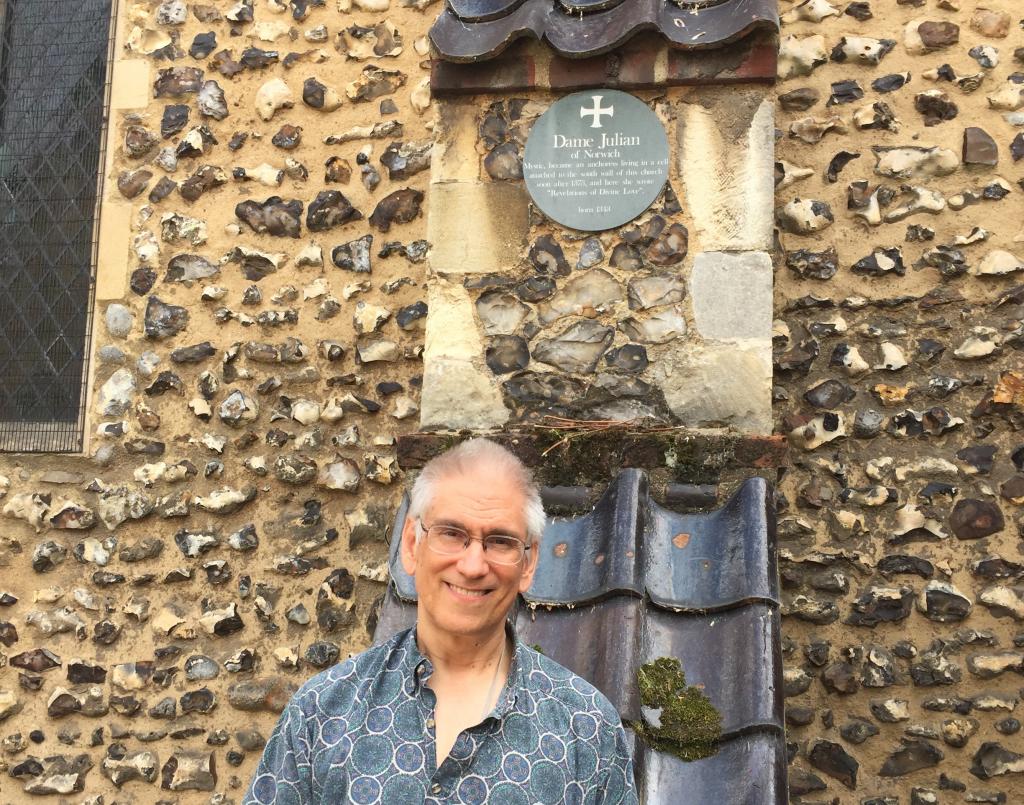
A Kindle search reveals that Julian is mentioned almost forty times in Underhill’s book — not as frequently as St. Teresa of Ávila (over 200 times) or even Meister Eckhart (nearly 90), but often enough for me to notice. Underhill described Julian as “a seer, a lover, and a poet” … “whose unique personality closes and crowns the history of English mediæval mysticism.” Julian’s book, The Revelations of Divine Love, Underhill declared to be “the most beautiful of all English mystical works.”
When Paulist Press published a modern-English edition of Julian’s writings in 1978 (the first volume of their legendary “Classics of Western Spirituality” series), I purchased a copy — only to find that her allusive, deeply poetic style of writing was challenging for me to read. I did not realize this when I was in my early 20s, but Julian, like all the mystics, wrote from a place of visionary union with God, which means that she (like all the mystics) is best approached from a place of prayer, meditation and reflection.
Like the Bible, Julian most readily yields her secrets when a reader brings a spirit of lectio divina to her text: which is to say, a way of reading and reflecting on her mystical words that is grounded in prayer.
In May 1984 I attended a Quiet Day (a one-day retreat) sponsored by the Shalem Institute in Washington DC; the theme was Julian of Norwich. This was my first communal contemplative experience; needless to say, it made a profound impact on me as I discovered I was not alone in my heartfelt yearning for a deeply silent encounter with God.
But at that Quiet Day I also learned that a group of Episcopalians had formed a new religious community called the Order of Julian of Norwich; not sure if I had it in me to become a monk, I nevertheless felt compelled to write to the community’s superior, Fr. John-Julian, and he and I exchanged a couple of letters. In one of them I complained about how my own spiritual journey had led me to a place of confusion and anger, thanks to the spiritual abuse I encountered from a charismatic community I encountered while still in high school. I complained that I could no longer make sense of a religious world-view that was centered on reward and punishment, heaven and hell, judgment and damnation.
Fr. John-Julian replied and said that I needed to read Julian more seriously. I’ve long since lost the letter he wrote to me so I can’t quote him verbatim, but the gist of what he wrote was that if I wanted to get healed from the scars of an abusive theology, Julian’s hope and optimism was the best possible therapy for me.
Enjoy reading this blog?
Click here to become a patron.

In his book How to Change Your Mind, Michael Pollan quotes Rick Doblin as saying “Mysticism is the antidote to fundamentalism.” Doblin is speaking about the mysticism of psychedelic drugs, but thanks to Julian I can attest that the old-fashioned mysticism works just as well. Some thirty-five years have passed since I received that letter from Fr. John-Julian, and I am still learning how to plumb the depths of Julian’s richly nuanced poetry of heaven. But if my unhappy experience with charismatic Christianity introduced me to a god who judges, a god of anger and division who is barely talked out of destroying us all by the Christ who has to die to make his point — then Julian, by contrast, introduced me to the God who loves, the God of compassion and celebration who eagerly and joyfully goes to unending lengths to demonstrate how much delight God finds in each and every human soul, no matter how lost, corrupt or reprobate we might be.
When I first had an unexpected, mind-expanding, embodied encounter with God (a story I most recently told in chapter two of Unteachable Lessons), my overall sense of this God (who I now believe resides in every human heart) is that God is unconditional, lavish, Love-with-a-capital-L. Much of my distress in dealing with the charismatics and other variations of Christian fundamentalists arose from a simple sense of cognitive dissonance: while they paid lip service to “God is love,” their attitudes and perspectives all seemed to point to a god who demands submissive obedience — or else.
If the charismatic/fundamentalist god is a god of love, it is truly a conditional, probationary love: a love that is not easily earned but can all too easily be lost. This is what fundamentalism promised me, and what I could not accept because of what I knew in my bones to be true.
Julian validated what I knew in my bones. She invited me into her intimate relationship with a God who dances with joy, a God of delight and desire, a God who cherishes God’s own creation and seeks any way possible to heal and redeem all those who suffer therein. Julian is best known for optimism (“All shall be well”) and her anticipatory feminism (“As truly as God is our father, so is God our mother”). But her book is not called the “Revelations of Divine Optimism” or the “Revelations of the Divine Feminine.” Love is the heart of her theology, her image of God, and her experience of God. Everything we say or thing or visualize about God must be understood only in the context of lavish, vast, unconditional love. If this sounds “too good to be true” — it is that good, and it is true.
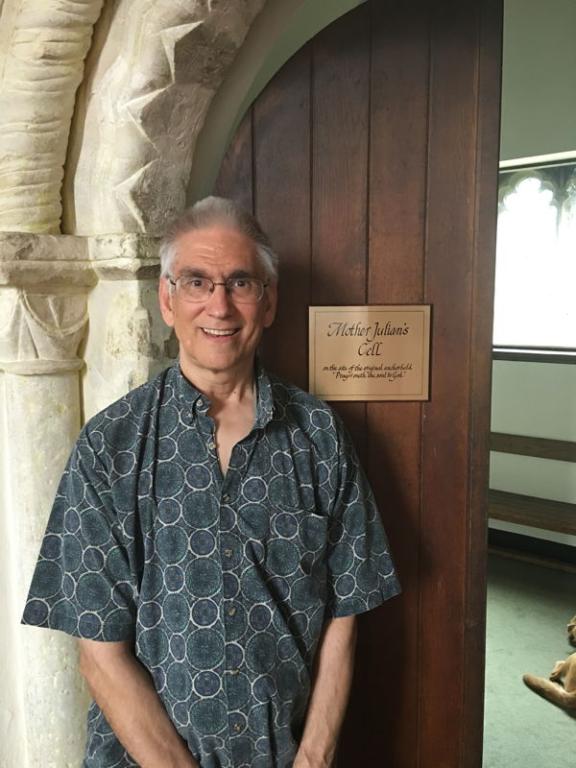
Of course, I’ve learned that the Bible, and the writings of so many of the great saints and mystics throughout Christian history, are gloriously messy and inconsistent: they often serve up images of God-the-Judge and the God-who-is-unconditional-Love in rapid succession. I once heard a talk by Brian McLaren where he proclaimed, in regard to Biblical interpretation, that “the things we focus on determine what we miss.” In other words, we cannot simply read the Bible at face value, we must interpret it, and if not consciously then we will do so unconsciously, catering to our hidden, unspoken assumptions about life and reality.
For far too long, mainstream Christianity — from Augustine to Calvin to John Piper — has focused on God’s judgment and tried to explain away God’s love as a kind of benefit that the elect only have access to. But I don’t think that vision of God squares with what Jesus had to say, and it doesn’t line up with Julian’s theology or my own experience. When we focus on God’s limitless, unconditional love, then we can see all the “judgment talk” in the Bible and elsewhere as efforts to make sense of a world where bad things happen, not as a threat to the ordinary person seeking to find their own way.
Julian offers us a way to find that radical, Love-with-a-capital-L understanding of theology, of grace, of what it means to follow Christ. When we see the Gospel through her eyes, it comes alive as a source of unending joy. That’s certainly been my experience, and I know I am not alone. Thanks to Julian, the heart of my spirituality is joy — which only makes sense, for Julian, after all, said “the fullness of joy is to behold God in all.”
Photos of the author at the Julian Shrine, St. Julian’s Church, Norwich, England by Fran McColman. Used by Permission.
Enjoy reading this blog?
Click here to become a patron.
Previous Post

May 4, 2021
So Many Books, So Little Time!
Next Post
May 18, 2021 "He Confuses a Lot of People" — Jon M. Sweeney on Writing About Thomas Merton
Browse Our Archives
Select a Category Activism Announcements Art Books Catholicism Celtic Christianity Christian mysticism Christianity Contemplation Current events Etc. Family humor interfaith dialogue Interfaith Wisdom Interspirituality Lay Cistercians Living the Faith Meditation movies Mysticism Mystics nature Poetry Reviews Scripture silence Spirituality Uncategorized Writing
Select a Month February 2025 January 2025 November 2024 September 2024 August 2024 July 2024 June 2024 May 2024 March 2024 January 2024 December 2023 November 2023 August 2023 June 2023 April 2023 March 2023 February 2023 January 2023 December 2022 November 2022 October 2022 September 2022 August 2022 July 2022 June 2022 May 2022 April 2022 February 2022 January 2022 December 2021 November 2021 October 2021 September 2021 August 2021 July 2021 June 2021 May 2021 April 2021 March 2021 February 2021 January 2021 December 2020 November 2020 October 2020 September 2020 August 2020 July 2020 June 2020 May 2020 April 2020 March 2020 February 2020 January 2020 December 2019 November 2019 October 2019 September 2019 August 2019 July 2019 June 2019 May 2019 April 2019 March 2019 February 2019 January 2019 December 2018 November 2018 October 2018 September 2018 August 2018 July 2018 June 2018 May 2018 April 2018 March 2018 February 2018 January 2018 December 2017 November 2017 October 2017 September 2017 August 2017 July 2017 June 2017 May 2017 April 2017 March 2017 February 2017 January 2017 December 2016 November 2016 October 2016 September 2016 August 2016 July 2016 June 2016 May 2016 March 2016 February 2016 January 2016 December 2015 November 2015 October 2015 September 2015 August 2015 July 2015 June 2015 May 2015 April 2015 March 2015 February 2015 January 2015 December 2014 November 2014 October 2014 September 2014 August 2014 July 2014 June 2014 May 2014 April 2014 March 2014 February 2014 January 2014 December 2013 October 2013 September 2013 July 2013 May 2013 January 2013 December 2012 November 2012 August 2012 July 2012 June 2012 March 2012 December 2011 September 2011 October 2010 August 2010 March 2010 September 2009 July 2008 January 2008 December 2007 September 2007 February 2007 January 2007 December 2004
Follow Us!
TAKE THE
Religious Wisdom Quiz
Who was the disciple who doubted Jesus' resurrection?
Select your answer to see how you score.
Judas Thomas Peter John
Support this
Column


Related posts from Carl McColman

"This Loving, Uniting Embrace": the Holy Ordinary

You don't have to become a monk to...

Join Me for "24 Meditations for 2024"

LSD, Anxiety, and Contemplation: Can Psychedelic Therapy Support...
TRENDING AT PATHEOS Contemplative

Handy Contemplative Practices for Political Spaces
A Spiritually Grounded Presence In order to bring a spiritually grounded presence...

Halloween: The Holiday of Loving Your Neighbor
All Hallows Eve Is Halloween the least Christian holiday in America, or...

Can Love Be Saved? Some Thoughts on the...
Happy Valentine's Day! I recently published a post on Patreon called Can...

"This Loving, Uniting Embrace": the Holy Ordinary
Today's guest post is by Mark Longhurst, author of The Holy Ordinary:...

How Are We Called to Live?: More About...
How Are We Called to Live? Many of us struggle with discerning...

A Spiritual Practice of Reading: Join Us Online
A Spiritual Practice of Reading A healthy spiritual practice of reading is...
view all Contemplative blogs
Ad-Free & Subscriber Log-In Subscription Support
- About Us
- 2026 Calendar
- Videos
- Podcasts
- Library of World Religions
- Faith In Media Tracker
- Advertise With Us
- Write for Us
- Privacy Policy
- Terms of Service
- Do Not Sell My Data
- Contact Us
- Radiant Digital
- Manage Newsletter Subscriptions
- Unsubscribe From Notifications
- Sitemap
Copyright 2008-2026, Patheos. All rights reserved.
Subscription Support Ad-Free & Subscriber Log-In
Follow Patheos