
BuddhistCatholicContemplativeEvangelicalGeneral ChristianHinduJewishLatter-day SaintMuslimNew VisionsProgressive Christian
Beliefs
- Buddhist
- Catholic
- Contemplative
- Evangelical
- General Christian
- Hindu
- Jewish
- Latter-day Saint
- More Voices
- Muslim
- New Visions
- Pagan
- Progressive Christian
Topics
- Religion News
- Food and Religion
- Sports and Religion
- Religious Art
- Religious Music and Entertainment
- Religious Events
- History and Religion
- Style and Religion
- Politics and Religion
- Women in Religion
- Recreation Outdoors and Religion
- Business Finance and Religion
- Careers Workplace and Religion
- Education and Religion
- Family Parenting and Religion
- Health Fitness and Religion
- Home and Religion
- Relationships and Religion
- Technology and Religion
- Travel and Religion
Columnists
- Buddhist Columnists
- Business Finance and Religion Columnists
- Careers Workplace and Religion Columnists
- Catholic Columnists
- Contemplative Columnists
- Education and Religion Columnists
- Evangelists Columnists
- Family Parenting and Religion Columnists
- General Christian Columnists
- Health Fitness and Religion Columnists
- Hindu Columnists
- History and Religion Columnists
- Home and Religion Columnists
- Jewish Columnists
- More Voices Columnists
- Latter Day Columnists
- Muslim Columnists
- New Visions Columnists
- Nonreligious Columnists
- Pagan Columnists
- Politics and Religion Columnists
- Progressive Columnists
- Recreation Outdoors and Religion Columnists
- Relationships and Religion Columnists
- Religion News Columnists
- Religious Art Columnists
- Religious Events Columnists
- Religious Music and Entertainment Columnists
- Sports and Religion Columnists
- Style and Religion Columnists
- Technology and Religion Columnists
- Travel and Religion Columnists
- Women in Religion Columnists
Resource Library
- 2026 Calendar
- Library of World Religions
- The 100 Most Holy Places on Earth
- Patheos Answers
- Podcasts
- Videos
- Faith Leaders Database
- Anglican Episcopalian
- Bahai
- Baptist
- Buddhism
- Christianity
- Confucianism
- Eastern Orthodoxy
- Hinduism
- Holiness and Pentecostal
- ISKCON
- Islam
- Judaism
- Lutheran
- Methodist
- The Church of Jesus Christ of Latter-day Saints
- New Age
- Paganism
- Presbytarian and Reformed
- Protestantism
- Religion Behind the Scenes
- Roman Catholic
- Scientology
- Shia Islam
- Sikhism
- Sufism
- Sunni Islam
- Taoism
- Zen
- See all religions
Research Tools
 Ad-Free & Subscriber Log-In Subscription Support
Ad-Free & Subscriber Log-In Subscription Support
Follow Patheos 

- Trending:
- Forgiveness
- |
- Marriage
- |
- Consciousness
- |
- Death Penalty
- |
- Election
- |
- Halloween

- Home
- Contemplative
- A Meditation on the Spirituality of Healing (A Patreon Sneak Peek)
A Meditation on the Spirituality of Healing (A Patreon Sneak Peek)
Last updated on: March 9, 2021 at 10:00 am by Carl "Skye" McColman
A Meditation on the Spirituality of Healing (A Patreon Sneak Peek) 2021-03-09T10:00:32-04:00 Carl "Skye" McColman
Patheos Explore the world's faith through different perspectives on religion and spirituality! Patheos has the views of the prevalent religions and spiritualities of the world.
A note from Carl: Friends, I am currently writing a manuscript that I am calling Meditations on the Christian Mysteries*. I’ve identified fifty-two key themes, wisdom teachings, and mystical principles of the Christian tradition — and each month, I take one of those themes and I wrote a meditation based on it. I’m over halfway done — in fact, the meditation I’m sharing with you here is #28.*
I hope you enjoy this meditation — and to learn more about my Meditations on the Christian Mysteries project, please read the note at the end of this post.
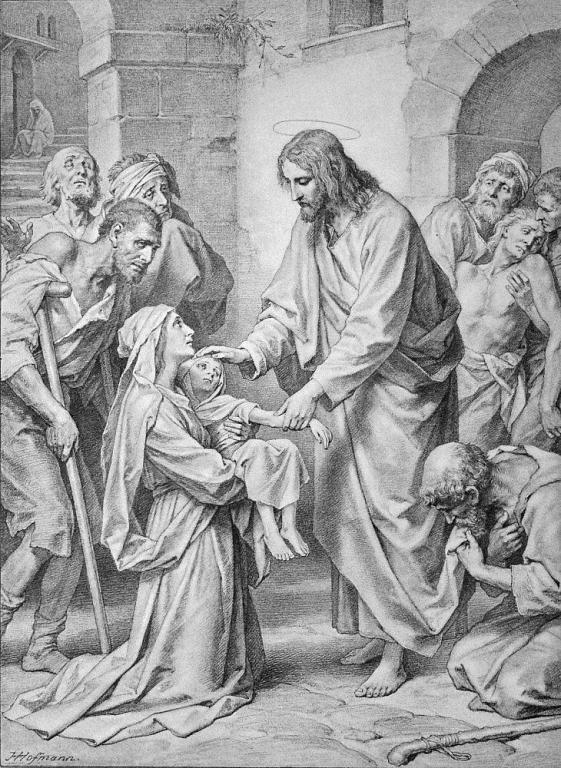
Meditations on the Christian Mysteries, #28: Healing
I have a friend who is a Wiccan priestess; on her car she has a bumpersticker that proclaims simply this: “Witches Heal.” Whatever you make of witches (or Wiccans), I invite you to ponder this question with me: why don’t Christians have a bumpersticker that says, “Christians heal?”
After all, Jesus built his reputation as a healer and wonderworker. Read Matthew, chapters 8 and 9 — fresh off his preaching his foundational Sermon on the Mount, Jesus goes on a veritable healing spree — and not only healing but also casting out demons, raising a girl who had died, and even calming a storm. And remember, Jesus said to his followers that anyone who believes in him will do “even greater things” (John 14:12). And sure enough, the healing and miracle-working carries on in the Acts of the Apostles, with the disciples taking over after Jesus ascended.
If you are a Pentecostal Christian, you probably believe in miraculous healing; for example, a popular charismatic author, Francis MacNutt, built his ministry around celebrating healing as a supernatural gift of the Holy Spirit (writing books such as Healing and The Prayer That Heals). Some other churches, like the Christian Scientists and the Unity School of Christianity, also stress spiritual healing. But it seems like most mainstream Christians regard healing as something that God does mainly through, well, ordinary medicine.
In saying this, I do not mean to belittle the miracle of modern medicine or the many dedicated and often heroic healthcare workers around the world who truly have dedicated their lives to the science of healing. Doctors and nurses and other healthcare professionals are true healers, and for so many people, the ordinary process of getting quality care from physicians and other healthcare providers may be all they need — to get, regain, or maintain their health.
But does the science of healing blind us to the spiritual dimension of healing? Is it really possible, speaking spiritually, for Christians — all Christians — to bring healing into the lives of those they know and love? I’m not suggesting this is magic (like my Wiccan friend might believe in); all healing from a Christian perspective naturally begins with God. But does God only heal through the hands of someone who holds an advanced medical degree?
Unction (Extreme and Otherwise)
Perhaps there is no better sign of how Christianity lost its original mission as a force for healing in the world — and how that healing mission just might be reviving in our time — than the Catholic sacrament of “Anointing of the Sick.”
Before 1972, this sacrament was known as “Extreme Unction” (unction being the Latin form of “anointing”). The word extreme is used here in an archaic sense: meaning “last.” So this anointing was typically understood as a “last anointing” — or, to use a more popularized term, “last rites.”
Technically the last rites involve more than just the anointing of the sick; it includes an opportunity for the dying person to confess sins one final time, and then to receive the Eucharist. But the whole point behind this idea of last rites is that it only happens when death is imminent.
I still remember my catechist (the teacher who helped me prepare to become a Catholic) saying, “the problem with ‘last rites’ is that if the priest showed up and you weren’t near death, it would scare you to death!” How ironic that a ritual act intended to celebrate God’s healing act was often only performed at a time when physical healing was no longer considered likely?
In 1972 the word “Extreme” was retired and “Unction” swapped out for the less forbidding (and foreboding) word “Anointing.” These days, many Catholic Churches offer this sacrament on a regular basis — maybe one Sunday each month, the priest will provide anointing after the Mass, and anyone who has any kind of ailment is welcome to receive it. Any kind of ailment: physical, psychological or spiritual.
I’ve received the anointing for back pain. I know people who have received as part of their journey to heal depression. It’s not just for people who are worried they could die — it’s a celebration of healing in all its many forms.
Once again there’s nothing magical about the oil, or the priest who is doing the anointing. The healing, like all healing, comes ultimately from God. But the sacrament is a powerful reminder that our prayers, intercessions, and love for one another are healing balms in their own right.
Yes, it’s true that not everyone who receives this sacrament will necessarily be cured of whatever affliction they are dealing with. But that’s just like not everyone who goes to the doctor gets the cure they might be hoping for. Healing is sometimes a physical reality, sometimes dramatically so (that’s what we call a miracle) — but healing might just as easily be offered only to our spirits, bringing us the healing God desires to give us — even if it’s not necessarily the healing we think we want.
The Healer Who Needs Healing
Henri J.M. Nouwen wrote many wonderful books, but one of his most loved works is The Wounded Healer. It’s a book about ministry (Nouwen is attempting to answer the question “What does it mean to be a minister in our contemporary society?”), but of course the author connects the dots between ministry, and healing, and the existential reality that we are all, in some way, wounded. Christians speak of Christ as the son of God, the second person of the Holy Trinity, and yet even Christ heals out of the wounds of his crucifixion. If Christ is a wounded healer, then how much more so is that true of the rest of us?
Healing — whether scientific or spiritual, sacramental or charismatic, mundane or miraculous — is always a gift from God, and yet it is a gift that we receive typically from the hands of another — a doctor, a minister, a psychologist, a prayer partner, a family member or friend. All of these people — all of them — are “wounded” healers. We do not heal from a position of strength, but rather we allow God’s healing to flow through us, even through our weakness, our woundedness, our vulnerability.
In the words of Henri Nouwen, “For the minister is called to recognize the sufferings of his time in his own heart and make that recognition the starting point of his service. Whether he tries to enter into a dislocated world, relate to a convulsive generation, or speak to a dying man, his service will not be perceived as authentic unless it comes from a heart wounded by the suffering about which he speaks.”
I think it’s important not to restrict healing to just something the professionals do. Yes, doctors, psychologists, or even priests (as the ministers of sacramental healing), all have a specific and particular role to play as agents of healing. But that does not mean the rest of us have no place to play in the dissemination of God’s healing love in our wounded, suffering world. If you are someone who has suffered from the slings and arrows of life, then you are someone who has the potential to be a wounded healer. We can all be ministers of this particular grace, whether “sacramental” or not.
Healing and Contemplation
How does this tie in to the practice of contemplation? We live in a time when Christians have begun to recover contemplation (and mysticism) as the birthright of all people — not just the super-holy or full-time religious leaders. As the Vatican II council described this, there is a “Universal Call to Holiness.” The parallel, of course, is the aforementioned Pentecostal/Charismatic movement. While its exuberant style of worship and evangelical theology may not be to everyone’s taste, there is no question that Pentecostalism has done much to restore this idea that we are all called to be healers (and prophets, and and so forth — but for now let’s just focus on the ministry of healing). Contemplation reminds us that we are all invited to be still and know God, to be cognizant that God comes to us in a sound of sheer silence, and that our destiny as followers of Christ is to acknowledge and celebrate that we are all created in the Divine Image and Likeness. The spiritual gift of healing simply takes this to the next level.
Christ heals.
In silence you and I discover that we are, literally, one with Christ.
Do the math: you are called to be a healer.
What does that mean? I don’t think it means that everyone is called to be a TV-style evangelist who helps people to get out of wheelchairs or to overcome debilitating syndromes. Healers like that are the equivalent of mystics who can levitate or live for years on nothing but Holy Communion. Is such a thing possible? I don’t know, maybe it is. Is it normal, or usual? Absolutely not. There’s only one Clapton or Segovia in any given generation, but thank heaven, millions of people are called to make beautiful music with the guitar. Healing operates the same way. Don’t compare yourself to a famous wonder worker, or a renowned saint like Mother Teresa. Ask in your heart, what is my calling? And seek to be faithful to the answer that emerges.
Some of us are called to be healers in scientific ways — as doctors, nurses, therapists, and other healthcare providers. Others provide a more spiritual kind of healing, as priests, ministers, pastors, or other spiritual leaders. But healing can also be channeled through the ability to fix someone a good meal, or to offer a sympathetic, listening ear, or to march for social justice. Some of us bring healing through art and creativity, in a variety of ways. Music, dance, poetry, painting… there are so many ways to create beauty, and beauty can be a force for healing. It’s probably wise not to second guess the blessings we are capable to bring others — and to avoid the twin temptations of over-estimating or under-estimating the role we are called to play in the economy of Divine grace and God’s healing energy.
The Buddhist author Charlotte Joko Beck wrote a book about Zen with the title Nothing Special. I love the delicious pun encoded in those words: for not only is it a celebration of humility, but it also reminds us that, in terms of the dharma, there really is something special about “nothing” — about emptiness and impermanence. The Christian corollary to this is kenosis, a rich Greek work that only appears once in the New Testament, meaning emptiness — as in, “Let the same mind be in you that was in Christ Jesus, who, though he was in the form of God, did not regard equality with God as something to be exploited, but emptied himself, taking the form of a slave, being born in human likeness.” (Philippians 2:5-7). Christ’s self-emptying made the incarnation possible; he had to divest himself of his godhood, his divinity, to “fall” into Mary’s womb and embrace the ordinary messy life of being human.
You and I, likewise, are called into a gesture of emptiness, but instead of emptying ourselves of divinity, we might have to empty ourselves of ego-inflation, or self-importance, or self-consciousness, or self-denigration. The particular matter varies from person to person. But it is in this “nothing special” emptying that we create the space for the Holy Spirit to act — sacred elbow room, as it were. And when the Spirit has elbow room in our hearts, miracles can happen. Again, they might be tiny miracles (or not), they might seem perfectly ordinary and commonplace (or not), but what is common to all these miracles is that through them, healing flows, healing happens.
If you practice a sacramental, “catholic” form of Christianity, none of this is meant to belittle or dismiss the spiritual beauty and power of sacramental anointing. My daughter received the sacrament several times, the last time being the day before she died — when it really was part of her last rites. Those were moments of grace, even if they did not deliver a miracle — at least, on the surface of things. But I suspect miracles were delivered hidden safely in our hearts. I know I received grace in those moments, and I am confident Rhiannon did as well.
The celebration of the universal call to healing is not about dismissing the beauty of sacramental healing, but rather expanding its reach, by recognizing what the New Testament calls the priesthood of all believers. We are all called to holiness. We are all called to priesthood. We are all called to be mystics and contemplatives. And we are all called to be healers. Now comes the fun part: discerning just how that call can be uniquely manifested in each of our lives. Let the adventure begin!

The above post is part of an on-going work in progress called Meditations on the Christian Mysteries. As I write these monthly meditations, I first share them with the friends of this blog who make a monthly pledge to support it through Patreon. Patreon is a crowdfunding website specifically designed to support artists of all kinds: visual artists, writers, musicians, video producers, and other creative professionals. People can make a monthly pledge at any amount (the recommended minimum is $3, but it’s okay to pledge even less than that) to support the artist of their choice. Thanks to the miracle of crowdfunding, all those gifts combine to help artists keep on creating the art/writing/music that their supporters love.
Part of the fun of Patreon is that the artists are encouraged to share news, works-in-progress, or other “behind the scenes” updates with their patrons. So I try to post something once a week to Patreon. And usually about once a month I include one of these meditations. Of course, the plan is, once all the meditations are written, to publish them in book form, so everyone will have access to them eventually. But the patrons get a “sneak peek” — which is really important to me as a writer, since they can provide feedback to let me know what is working (and what isn’t) with my work-in-progress.
I have other projects in mind, of course. So once this one is completed (probably by early 2023), I’ll launch another work-in-progress, where patrons will get a first look while the project is being written.
The above meditation was first posted on Patreon, and it received enough positive feedback that I decided it’s ready to share with the public at large.
Please consider making a small monthly pledge to support this blog through Patreon. Not only will you receive the spiritual blessing of knowing that you are helping to keep this blog going (and growing), but you’ll also get access to patron-only content as well. Hope to see you there: click the button below to get started.
Enjoy reading this blog?
Click here to become a patron.

Next Post
March 23, 2021 Hunting Magic Eels: the Quest for a Re-Enchanted Christianity
Browse Our Archives
Select a Category Activism Announcements Art Books Catholicism Celtic Christianity Christian mysticism Christianity Contemplation Current events Etc. Family humor interfaith dialogue Interfaith Wisdom Interspirituality Lay Cistercians Living the Faith Meditation movies Mysticism Mystics nature Poetry Reviews Scripture silence Spirituality Uncategorized Writing
Select a Month February 2025 January 2025 November 2024 September 2024 August 2024 July 2024 June 2024 May 2024 March 2024 January 2024 December 2023 November 2023 August 2023 June 2023 April 2023 March 2023 February 2023 January 2023 December 2022 November 2022 October 2022 September 2022 August 2022 July 2022 June 2022 May 2022 April 2022 February 2022 January 2022 December 2021 November 2021 October 2021 September 2021 August 2021 July 2021 June 2021 May 2021 April 2021 March 2021 February 2021 January 2021 December 2020 November 2020 October 2020 September 2020 August 2020 July 2020 June 2020 May 2020 April 2020 March 2020 February 2020 January 2020 December 2019 November 2019 October 2019 September 2019 August 2019 July 2019 June 2019 May 2019 April 2019 March 2019 February 2019 January 2019 December 2018 November 2018 October 2018 September 2018 August 2018 July 2018 June 2018 May 2018 April 2018 March 2018 February 2018 January 2018 December 2017 November 2017 October 2017 September 2017 August 2017 July 2017 June 2017 May 2017 April 2017 March 2017 February 2017 January 2017 December 2016 November 2016 October 2016 September 2016 August 2016 July 2016 June 2016 May 2016 March 2016 February 2016 January 2016 December 2015 November 2015 October 2015 September 2015 August 2015 July 2015 June 2015 May 2015 April 2015 March 2015 February 2015 January 2015 December 2014 November 2014 October 2014 September 2014 August 2014 July 2014 June 2014 May 2014 April 2014 March 2014 February 2014 January 2014 December 2013 October 2013 September 2013 July 2013 May 2013 January 2013 December 2012 November 2012 August 2012 July 2012 June 2012 March 2012 December 2011 September 2011 October 2010 August 2010 March 2010 September 2009 July 2008 January 2008 December 2007 September 2007 February 2007 January 2007 December 2004
Follow Us!
TAKE THE
Religious Wisdom Quiz
Which Assyrian king threatened Jerusalem and received a prophecy from Isaiah?
Select your answer to see how you score.
Sennacherib Tiglath-Pileser Nebuchadnezzar Shalmaneser
Support this
Column


Related posts from Carl McColman

"This Loving, Uniting Embrace": the Holy Ordinary

Four Dimensions of Mindfulness and Centering Prayer

I Believe Prayer Changes Things. Here's a Few...

You don't have to become a monk to...
TRENDING AT PATHEOS Contemplative

Handy Contemplative Practices for Political Spaces
A Spiritually Grounded Presence In order to bring a spiritually grounded presence...

Halloween: The Holiday of Loving Your Neighbor
All Hallows Eve Is Halloween the least Christian holiday in America, or...

Can Love Be Saved? Some Thoughts on the...
Happy Valentine's Day! I recently published a post on Patreon called Can...

"This Loving, Uniting Embrace": the Holy Ordinary
Today's guest post is by Mark Longhurst, author of The Holy Ordinary:...

How Are We Called to Live?: More About...
How Are We Called to Live? Many of us struggle with discerning...

A Spiritual Practice of Reading: Join Us Online
A Spiritual Practice of Reading A healthy spiritual practice of reading is...
view all Contemplative blogs
Ad-Free & Subscriber Log-In Subscription Support
- About Us
- 2026 Calendar
- Videos
- Podcasts
- Library of World Religions
- Faith In Media Tracker
- Advertise With Us
- Write for Us
- Privacy Policy
- Terms of Service
- Do Not Sell My Data
- Contact Us
- Radiant Digital
- Manage Newsletter Subscriptions
- Unsubscribe From Notifications
- Sitemap
Copyright 2008-2026, Patheos. All rights reserved.
Subscription Support Ad-Free & Subscriber Log-In
Follow Patheos